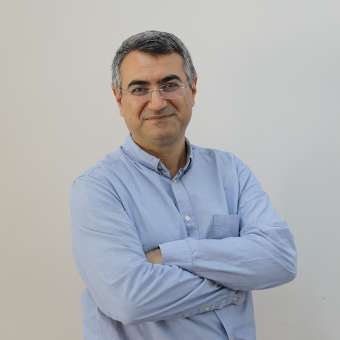
Aykut Erdem is an Associate Professor of Computer Engineering at Koç University, affiliated with the KUIS AI Center. He earned his PhD, MSc, and BSc in Computer Engineering from Middle East Technical University (METU), with visiting researcher experiences at Virginia Tech (2004) and MIT (2007). His research focuses on learning-based approaches for visual data understanding, including image editing, visual saliency estimation, and vision-language integration. Research Interests: Vision and Graphics, Machine Learning, Artificial Intelligence, Computer Vision, Natural Language Processing, Generative Artificial Intelligence. Recent work includes text-guided image/video editing, diffusion models for object removal, and GAN-based frameworks for domain adaptation. Scientific Awards: Young Scientist Award (BAGEP 2021) by Science Academy in Computer Engineering Best Paper Award at 5th Multimodal Learning and Applications Workshop (2022) Collaborations and Funding: Principal investigator for TUBITAK 1001 project on generative AI for visual data (2021-2024), Adobe Research Gift (2023), and co-investigator for multiple TUBITAK grants. Serves as Associate Editor for IEEE Transactions on Image Processing (2022-present).
Prof. Ayşegül Aksoy is a faculty member in the Department of Environmental Engineering at Middle East Technical University (METU) since 2002. She holds a Ph.D. in Civil Engineering from the University of Virginia (2000) and has held visiting roles at Stanford University (2015-2016) and the University of California Davis (2001). Her academic leadership includes Vice Chair roles in METU's Environmental Engineering Department (2012-2015 and 2006-2009), and she co-developed UN courses on Black Sea environmental management. Her research focuses on environmental systems engineering, integrated waste management, water quality modeling, and remote sensing applications. Notable projects include developing autonomous systems for lake turnover monitoring, optimizing landfill leachate management, and evaluating solar sludge drying alternatives. She has directed over 20 graduate theses and contributed to research funded by TÜBİTAK, Newton Fund, and EU programs. Key awards include the AQUA 360 Best Paper Award (2021) and TÜBİTAK Fellowships. Her work spans 120+ peer-reviewed publications, with recent focus areas including anaerobic digestion optimization, GIS-based waste routing, and pollutant fate modeling in heterogeneous aquifers. She advises on national environmental policies and manages projects like the 'Turnover Response System Development' (2020-2023) and 'Chlorophyll-a Modeling in Lake Eymir' (2009-2010).
Dr. İsmail Arı is an Assistant Professor in the Computer Science department at Özyeğin University . He holds a PhD from the University of California, Santa Cruz (2004), MS from University of Maryland (2000), and BS in Electrical & Electronics Engineering from Boğaziçi University (1998).
Kerem Yavuz Arslanlı is an Associate Professor at Istanbul Technical University's Faculty of Architecture, Department of Urban and Regional Planning. He has held various academic roles since 2002, including Deputy Head of Department (2020-2022) and Education Coordinator. His international collaborations include positions at the University of Alicante, Cass Business School, and institutions in Switzerland, Germany, and Romania. Education: PhD in Urban and Regional Planning from Istanbul Technical University (2004), MA in Real Estate Development (2001) Research interests span Urban Economics , Disaster Risk Management , Real Estate Finance , and Post-Disaster Reconstruction . His work focuses on seismic risk scenarios , impact chain analysis , and low-carbon real estate investments , often leveraging spatial statistics and social big data . Recent publication trends highlight applications of impact chains for systemic risk assessment, tokenization in real estate, and sustainability factors in consumer behavior. His 2025 Journal of Risk Research paper addresses Istanbul's seismic risk modeling, while 2024 works explore post-earthquake housing affordability and low-carbon investments . Scientific awards include: 1st Prize, Meles Stream National Urban Design Competition (2020) AREUEA Doctoral Session Prize (2009) Advising encompasses 18 theses on topics like real estate tokenization , smart contracts , and post-disaster urban planning . He has led projects including Energy Demand Modeling for Post-Disaster Settlements and Impact Chain Analysis of Kahramanmaraş Earthquakes .
Assoc. Prof. Dr. Umut Asan is an active faculty member in the Department of Industrial Engineering at Istanbul Technical University (ITU), Faculty of Management. He holds the academic rank of Associate Professor and has been affiliated with ITU since 1999, progressing from Research Assistant to his current role. He earned his PhD from Technische Universität Berlin and holds a Master’s and Bachelor’s from ITU in Engineering Management and Industrial Engineering, respectively. PhD: Technische Universität Berlin (2003–2009) MSc: Istanbul Technical University, Engineering Management (1999–2001) BSc: Istanbul Technical University, Industrial Engineering (1995–1999) Dr. Asan's research lies at the intersection of decision science and industrial systems, with a strong emphasis on Multi-Criteria Decision Making (MCDM) , Fuzzy Cognitive Mapping , Scenario Planning , and Digital Twins . His work applies advanced modeling techniques such as Bayesian networks and fuzzy logic to solve complex problems in supply chain resilience, urban mobility, technology adoption, and organizational behavior. His recent publications (2023–2025) reveal a consistent trend toward integrating artificial intelligence and data-driven methods into decision support systems. Topics include electric vehicle adoption in urban logistics, digital twin frameworks for manufacturing, risk analysis in forestry and rail systems, and consumer behavior in digital platforms. These works demonstrate interdisciplinary applications across engineering, business, and social sciences, often using fuzzy and probabilistic models to handle uncertainty. Dr. Asan is actively involved in research leadership, having served as Vice Dean (2018–2023) and currently supervising numerous graduate theses. He is the principal investigator of funded projects, including BAP grants on qualitative cross-impact analysis and consumer cognitive models. Principal Investigator, "A New Approach to Qualitative Cross-Impact Analysis" (BAP Project, 2016–2020) Principal Investigator, "A New Approach to Consumer Causal Chain Models" (BAP Project, 2022–2024) He is a member of several international academic societies, including the International Society on MCDM, ENBIS, and EURO, reflecting his active engagement in the global operations research community. His research has been published in journals such as IEEE Access, European Journal of Forest Engineering, and Decision Science Letters, with a growing citation impact (Scopus h-index: 13). Dr. Asan advises a large cohort of graduate students, both at the Master’s and PhD levels, in areas ranging from risk modeling to digital transformation. His lab or research group focuses on decision support systems and cognitive modeling, supervising theses on FMEA, Bayesian networks, and digital twins. Future work appears to be directed toward enhancing predictive capabilities in industrial and societal systems through hybrid AI models.
Prof. Cevdet Aykanat is a Professor of Computer Engineering at Bilkent University, Ankara, Turkey. He earned his BS/MS in Electrical Engineering from METU and PhD from Ohio State University as a Fulbright scholar. His research focuses on parallel computing, sparse matrix algorithms, graph partitioning, and high-performance computing for big data. He has been affiliated with Bilkent since 1989 and has held roles like Associate Provost. Education: BSc/MSc (METU Electrical Engineering), PhD (Ohio State University Electrical & Computer Engineering). Research interests include parallel scientific computing, combinatorial optimization, distributed systems, and large-scale data analysis. His work spans over 100 publications in top journals like IEEE Transactions and SIAM, with 5,500 citations and an H-index of 40. Awards: 1996 TUBITAK Investigator Award, 2007 METU Parlar Science Award. He led 6 TUBITAK projects and participated in EU-funded projects like PRACE-1IP to PRACE-6IP. Publications emphasize efficient parallel algorithms for sparse computations, graph partitioning, and distributed systems. His work addresses latency reduction, load balancing, and scalable data processing in HPC environments. Grants: Funded by TUBITAK, Intel SSD, and EU programs. Academic service includes editorial roles at IEEE Transactions on Parallel and Distributed Systems.
Ayşenur Akyüz Birtürk serves as a Lecturer in the Department of Computer Engineering at Middle East Technical University (METU), Ankara, where she has taught since February 1994. Her academic career spans foundational programming courses to advanced graduate seminars in AI and Computational Linguistics, reflecting 30+ years of institutional commitment. She earned all her degrees from METU, culminating in a 1998 Ph.D. focused on Turkish language computational analysis. Her educational journey includes: B.S. in Computer Engineering (1985) M.S. in Computer Engineering (1988) with thesis on “A Model for Representing Concepts: Conceptual Dependency Theory” Ph.D. in Computer Engineering (1998) with thesis on “A Computational Analysis of Turkish using the Government-Binding Approach” Dr. Birtürk’s research centers on Artificial Intelligence and Natural Language Processing , with pioneering work in Turkish language parsing evolving into modern Recommender Systems . She integrates semantic relations and multi-domain data to build hybrid engines for movies, books, and music, emphasizing user modeling through knowledge representation and data mining techniques. Analysis of her 2010-2015 publications reveals two dominant threads: adaptive recommender systems (80% of output) using semantic similarity and dynamic clustering, and renewable energy analytics (20%) applying machine learning to wind/hydrological data. This pivot from NLP to energy forecasting demonstrates methodological versatility while maintaining core AI expertise. Her scientific recognition includes: TUBITAK scholarships throughout education (1977-1988) Multiple national contest awards in high school (1979-1980) Leadership in TUBITAK-funded energy and healthcare projects Dr. Birtürk has supervised 17 Master’s theses in NLP and recommender systems while securing competitive grants including METU-ISTEC #17435 (2006-2008; 504,000 YTL) and HASAT (2010-2013; 601,637 YTL). Her industry consultancy spans medical form design (FormAnalitik), question-answering systems, and retail intelligence platforms, translating academic research into real-world tools.
Sanem Sarıel Uzer is a Professor at Istanbul Technical University (ITU) in the Department of Artificial Intelligence and Data Engineering, part of the College of Computer and Informatics. She has been a faculty member at ITU since 2007, progressing from Instructor to Associate Professor in 2016 and achieving full Professor status in 2024. She is the founder and coordinator of the ITU Artificial Intelligence and Robotics Laboratory and leads multiple research initiatives in cognitive robotics, planning, and machine learning. Ph.D. in Computer Engineering, Istanbul Technical University (2002–2007) M.Sc. in Computer Engineering, Istanbul Technical University (1999–2002) B.Sc. in Control and Computer Engineering, Istanbul Technical University (1995–1999) Her research focuses on artificial intelligence, robotics, and machine learning, particularly in enabling cognitive systems and robots to reason, plan, and learn in complex environments. She investigates lifelong learning methods, multi-robot team strategies, and safe robot manipulation using deep reinforcement learning. Her recent work emphasizes failure anticipation, multimodal detection, and knowledge distillation to improve robot safety and autonomy. The trend in her recent publications (2023–2024) shows a strong focus on enhancing the safety and reliability of robotic manipulation through AI techniques such as deep reinforcement learning, adversarial learning, and multimodal perception. Her work spans both theoretical algorithm development and practical applications in service and industrial robotics. Scientific Awards: Siemens Turkey Excellence Award (2004) TÜBİTAK 13th Technology Award – Best Product (2018) TÜBİTAK 13th Technology Award – University-Industry Collaboration Mention (2018) Best Visual Presentation Award, IEEE SIU (2016) ITU Project Performance Award (2020) TÜBİTAK Ufuk 2020 (2019) Necdet Eraslan Project Competition Mention (2007) She has supervised numerous students in RoboCup competitions and led multiple funded research projects, including two TÜBİTAK projects on lifelong learning for cognitive robots and the development of the open-source Violet system for robot vision. She has also served as a consultant on AI projects with companies like Triodor, Artı Teknoloji, and Analitik Bilişim. Her grants include funding from TÜBİTAK, ITU Scientific Research Projects, and the Ministry of Science, Industry and Technology. She leads the ITU Artificial Intelligence and Robotics Laboratory and is actively involved in national and international collaborations, including with Georgia Tech, University of Pennsylvania, and University of South Florida. She also contributes to professional communities such as IEEE, AAAI, RoboCup, and EUCog.
Professor Abuzer Çelekli is affiliated with Gaziantep University , where he serves in the Faculty of Arts and Sciences , Department of Biology . His research focuses on Ecology , Limnology , and Hydrobiology , particularly algae-based solutions for environmental and food science challenges. Doctorate in Biology (2006), Abant İzzet Baysal University Master’s in Biology (2002), Ankara University Licence in Biology (1998), Ankara University Çelekli’s work spans algal biotechnology , water quality assessment using diatoms, and eco-friendly processes for dye removal. His recent studies include Arthrospira platensis applications in functional foods and terraforming concepts for Mars. Key trends in his 108+ articles involve diatom metrics , phytoplankton ecology , and adsorption technologies for heavy metals and dyes. Despite extensive publication activity, no specific awards are documented in the provided texts.
Selin Aslan serves as an Assistant Professor in the Department of Mathematics at Koç University, Istanbul, Turkey, where she conducts research at the intersection of computational mathematics and imaging science. Her academic appointments and research activities are centered within the university's mathematics department, contributing to both undergraduate and graduate education in mathematical sciences. Her educational qualifications include: PhD in Mathematics from Virginia Polytechnic Institute and State University (2018) Master's in Mathematics from Rochester Institute of Technology (2013) B.A. in Mathematics from Ege University (2010) Dr. Aslan's research program focuses on developing advanced computational methods for solving inverse problems in imaging, with particular expertise in phase retrieval, tomographic reconstruction, and ptychography. Her work bridges theoretical mathematics with practical applications in medical imaging, microscopy, and materials science, emphasizing algorithmic innovation and computational efficiency. She integrates techniques from deep learning, optimization theory, and high-performance computing to address challenges in image reconstruction under physical constraints. Analysis of her publication record reveals a consistent trajectory toward solving complex imaging problems through hybrid approaches that combine physics-based models with data-driven techniques. Her recent work demonstrates increasing emphasis on scalability for large datasets, robustness in photon-limited scenarios, and real-time processing capabilities, with applications spanning biomedical imaging to advanced microscopy. No scientific awards were documented in the available sources. Information regarding student advising and research grant activities was not specified in the provided materials, though her publication record suggests active research collaboration. Her computational focus implies engagement with high-performance computing resources for large-scale image reconstruction tasks. While specific laboratory infrastructure details were unavailable, her research on multi-GPU implementations and distributed computing indicates utilization of advanced computational facilities for handling large-scale imaging datasets.
Ramazan Küçükkara is a Lecturer at the Eflani Vocational School of Karabük Üniversitesi since 2019, focusing on Medical Services and Techniques . He holds a PhD in Fisheries Catching and Processing Technology (Ege University, 1999), a Master’s in Aquatic Products (Ege University, 1991), and a Bachelor’s in Fisheries Pr. (Ege University, 1989). His academic career spans roles such as Myo/Yüksekokul Müdürü (Vocational School Manager) since 2024 and Arş. Uyg. Merkezi Müdür Yardımcısı (Research Application Center Deputy Manager, 2023). PhD: Ege University, Institute of Science, Fisheries Catching and Processing Technology (1994–1999) MSc: Ege University, Institute of Science, Aquatic Products (1988–1991) BSc: Ege University, School of Fisheries (1985–1989) His research interests center on Fishing Technologies , Water Quality and Water Pollution , and Aquaculture . He has published extensively on medicinal leech reproduction, crayfish growth, and lake ecosystem health, often collaborating with researchers like Mustafa Ceylan and Ufuk Akçimen . His work addresses both theoretical and applied aspects, including GIS-based water temperature modeling and sustainable fisheries management. Key trends in publications include: Studies on medicinal leech reproduction (Hirudo spp.) and crustacean growth (Astacus leptodactylus) Analysis of lake ecosystems (Yeniçağa, Manyas, Uluabat) and their commercial fish fauna Investigations into water quality impacts from aquaculture and trout farming Applications of GIS and ANN for environmental monitoring He has collaborated with institutions such as the Turkish Ministry of Agriculture and Forestry , Trakya Üniversitesi , and İsparta Uygulamalı Bilimler Üniversitesi , with a focus on regional lakes and streams in Turkey. His projects often involve assessing stock populations , pollution sources , and probiotic applications in aquatic environments.
Vedat Akgiray is a Professor at Bogazici University, holding a Ph.D. from Syracuse University. His teaching and research areas focus on Derivatives , Portfolio Management , Probability , and Financial Markets , with a particular emphasis on Mathematical Finance . He has published extensively on topics such as FinTech, corporate governance, pension systems, and risk management. Education : Ph.D., Syracuse University Email: akgirayv@bogazici.edu.tr
Prof. Dr. Tolga Ovatman is a faculty member at the Department of Computer Engineering, Istanbul Technical University , where he has been serving as Head of Department since 2024. His academic career spans roles from Research Assistant (2004-2012) to Associate Professor (2019-2023) and full Professor (2023-present). He previously held administrative roles such as Vice Dean (2018-2022) and Deputy Head of Department (2016-2018). PhD in Computer Engineering (2005-2011) MS in Computer Engineering (2003-2005) BSc from Hacettepe University (1999-2003) His research focuses on model checking , replicated state machines , cloud computing , and object-oriented software . Recent work addresses computation offloading in 6G networks , collaborative text editing data structures , and energy-efficient environmental monitoring systems . Key projects led include Design of a Multiplexed State Machine Storage System for Edge Computing (2022-2024) and Microservice Compatible Symphony Infrastructure Research (2020). He has supervised numerous theses on topics ranging from collaborative text editing to AI applications in watershed management . Publications span IEEE Transactions , Springer , and conferences like CSCE and CLOSER .
Gökberk Cinbiş is an Associate Professor at the Department of Computer Engineering, Middle East Technical University (METU), leading research in data-efficient machine learning with minimal supervision. His work spans zero-shot, few-shot, weakly-supervised, and self-supervised learning, with applications in vision-language integration and large-scale image/video understanding. PhD from Université de Grenoble (2014) M.A. from Boston University (2010) His research focuses on generative models, meta-learning, and robust computer vision systems. Recent work explores sparsity in parameter-efficient fine-tuning, token embeddings for vocabulary extension, and domain-aware LoRA components for personalization. Notable trends in his publications include: Advancements in zero-shot and few-shot learning Applications in remote sensing (SAR2ET for evapotranspiration) Meta-learning and hybrid augmentation techniques Sign language recognition and industrial vision benchmarks Scientific honors include: Science Academy - Young Scientist Award (BAGEP 2024) Google Faculty Research Award (2019-2020) Best PhD Thesis Prize by AFRIF (2015) Alper Atalay Best Student Paper Award (2016) He has supervised MSc students Gencer Sumbul and Berkan Demirel, secured TUBITAK grants on meta-learning and any-shot learning, and organized workshops on industrial inspection at CVPR and ECCV. Cinbiş leads METU ImageLab, focusing on computer vision and machine learning.
Prof. Dr. Tülay ÖZER is a Professor at the Vocational School of Health Services, Medical Services and Techniques Department, Ahievran University, Turkey. She holds a PhD in Biology Education (1998) and has dedicated her career to hydrobiology and limnology, focusing on freshwater algae, their ecological roles, and biotechnological applications. BA (1987), Master's (1993), PhD (1998) from Gazi University Over 25 years of experience in algal ecology, biosorption, and FTIR spectroscopy Research Interests include: Lake and stream algal assemblages Heavy metal bioremediation via microalgae Molecular characterization using FTIR Cryopreservation of algal strains Development of algal culture collections Publication Trends show consistent work on freshwater algae, with emphasis on ecological monitoring, biosorption mechanisms (Cr(VI), Cu), FTIR applications, and seasonal dynamics. Her projects often integrate biodiversity assessments with environmental variables. Advising includes supervision of 4 Master's theses and collaboration with 81 researchers. She co-developed a comprehensive Türkiye Bitkileri Listesi Suyosunları (2019) and contributed to 17 funded projects.