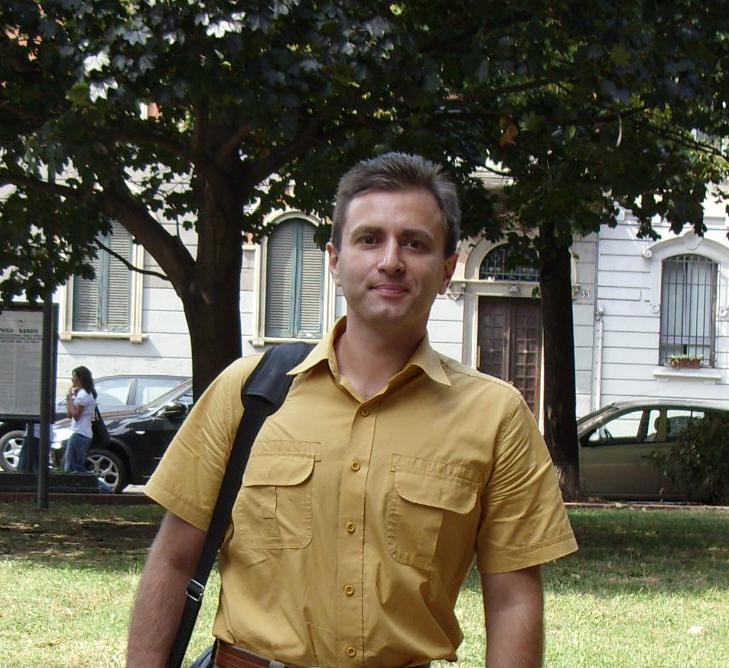
Sergiu Nisioi is an Associate Professor at the Faculty of Mathematics and Computer Science, University of Bucharest, with expertise in computational linguistics, machine translation, and text simplification. He bridges cognitive science with NLP through eye-tracking and EEG research, while also exploring sound art and digital autonomy via initiatives like HYPHA.ro. Current projects include PN-IV-P2-2.1-TE-2023-2007 (text complexity/readability), Legal Document Processing , and Europarl Dialectal Corpora Research spans computational psycholinguistics , LSTM-based translation models , and algorithmic composition for sound art His work integrates interdisciplinary methodologies, combining EEG signal processing for architecture data with the University of Architecture, and DSP for ecological projects at chlorophylla.live.
Andang Sunarto is an Associate Professor affiliated with the State Islamic Institute (IAIN) Bengkulu, Indonesia and the Lepage Research Institute, Slovakia . His work bridges Numerical Analysis , Computational Mathematics , and Algorithm Design with applications in Robotics , Image Processing , and Sharia-Compliant Systems . Research Focus: Fractional Calculus, Nonlinear PDEs, GPU-Accelerated Algorithms Collaborations: International institutions including Union of Czech Mathematicians and Physicists and University of Prešov His recent publications (2021–2025) emphasize Iterative Methods for solving Time-Fractional Diffusion Equations and Porous Medium Models . He also explores Digital Islamic Education and Halal Tourism Development . Despite no listed awards, his work spans diverse domains like Mobile Banking Evaluation , Environmental Pollution Analysis , and Ethnobotanical Applications . Andang actively designs EdTech tools (e.g., Wordwall-based modules) and contributes to computational methods in Climate Modeling and Nonlinear Diffusion .
Vlad Pojoga is Deputy Dean of the Faculty of Letters and Arts at Lucian Blaga University of Sibiu, holding a Lecturer position in the Department of Romance Studies. His research focuses on Romanian literature, digital humanities, and literary analysis, with particular emphasis on quantitative methods and spatial narratives. He leads projects like the Digital Museum of the Romanian Novel, exploring 19th-20th century literary trends through digital curation and geocritical approaches. His academic background includes advanced studies in literary theory and digital methodologies. Research interests span translation studies, postmodernism, and the intersection of narrative forms with cultural geography. Recent work analyzes character networks in classical novels and metaphor systems in contemporary poetry. Pojoga frequently collaborates on international literary projects, contributing to FORTHEM Alliance initiatives and organizing events like the International Week at ULBS. His publications bridge traditional literary criticism with computational methods, offering innovative frameworks for understanding Romanian literary history.
Stavros Vologiannidis serves as an Assistant Professor in the Department of Informatics, Computer and Telecommunications Engineering at the International University of Greece. His academic career spans both teaching and research in control theory, robotics, and machine learning applications. Previously, he was associated with the Mathematics Department at Aristotle University of Thessaloniki where he completed his education and conducted postdoctoral research. Education: B.Sc. in Mathematics from Aristotle University of Thessaloniki (1997) Ph.D. in Control Theory from Aristotle University of Thessaloniki (2005) with dissertation titled 'ALGEBRAIC-POLYONYMICAL COMPUTING METHODS IN CONTROL THEORY' Dr. Vologiannidis' research focuses on Classical and Intelligent Control Theory, Robotics, and Machine Learning, with particular expertise in polynomial matrices and automatic control systems. His work bridges theoretical mathematics with practical engineering applications, especially in educational robotics and industrial control systems. He has developed several educational platforms including EUROPA, a ROS-based educational robot for teaching sensor integration and data acquisition. His publication record shows a clear evolution from theoretical control systems research toward applied machine learning and educational technology. Recent work demonstrates increasing focus on practical applications of AI in education, urban feature recognition, industrial monitoring, and robotics education across multiple educational levels from middle school through university. His research combines mathematical rigor with real-world implementation. Scientific Recognition: Excellence Scholarship in the 'Excellence Scholarships 2010' program of the Research Committee Total citations exceeding 250 with Scopus H-index of 9 Dr. Vologiannidis has secured numerous research grants and led multiple projects including 'Rapid Earthquake Damage Assessment Consortium – REDACt', 'Predictive Maintenance 4.0', and 'Development of computational methods for optimization of eigenvalue assignment problems'. He has collaborated extensively with institutions across Europe including UTIA Foundation in Prague and has participated in EU-funded projects like GALENOS and GN4-1 GÉANT Research and Education Networking. His laboratory work centers around the EUROPA educational robotics platform and the StreetScouting urban feature detection system, both of which integrate hardware, software, and educational applications. These projects demonstrate his commitment to translating theoretical research into practical educational and industrial tools.
Prof. Adrian Filipescu is a full professor and PhD supervisor at the Department of Automation and Electrical Engineering, Dunărea de Jos University of Galati. He holds a PhD in Control Systems (1993) and has over 40 years of academic and research experience. His expertise spans numerical calculus, adaptive control, robotics, and Industry 4.0/5.0 applications. He has authored 12 books and over 110 indexed articles with an h-index of 11 (SCOPUS), and his work earned two UEFISCDI awards (2014, 2019). Education: Engineer diploma in Automatic Control (Polytechnic University of Bucharest, 1981) and PhD in Control Systems (Dunărea de Jos University, 1993). His research focuses on mechatronics systems integration, robotic control, digital twins, and industrial automation. Notable contributions include developing a mechatronics line with integrated autonomous robots, wheelchair systems for disabled users, and multidirectional autonomous vehicles. Research Themes: Digital twin frameworks, IoT-cloud robotics control, Industry 4.0/5.0 systems, inverse kinematics modeling, and autonomous robotic navigation. His recent work emphasizes cloud-based remote control, HIL simulation, and SCADA integration. Awards: Recipient of the 2014 and 2019 UEFISCDI 'Award for Research Results' for highly commended papers. He has led 10+ research projects, endowing labs with advanced robotic infrastructure and PLC-controlled systems. Advising & Grants: Supervised 7 completed PhD theses (including 1 international co-supervision). Projects focused on robotic-assisted manufacturing, autonomous systems, and mechatronics line optimization. Current lab facilities include mobile robots, industrial manipulators, and PLC-based control systems. Labs/Teams: Director of a research lab developing Industry 5.0-ready systems, including robotic assistants for elderly/disabled users and flexible assembly/disassembly technologies. Collaborations include NATO internships at Politecnico di Torino (Italy), INPG Grenoble (France), and ISR Coimbra (Portugal).
Ciprian Bogdan Chirila is a Senior Lecturer at the University Politehnica of Timisoara (Faculty of Automation and Computer Science, Computing and Information Technology Department) and also teaches at Ioan Slavici University . His career spans over two decades, with roles in teaching, research, and software development. Education : PhD in Computer Science (2010, University Politehnica Timisoara & University Nice-Sophia Antipolis) Master's in Computer Science & Software Engineering (2002) Engineer Diploma in Automation & Computer Science (2001) Analyst-Programmer Diploma (1996) Research Interests : His work focuses on reverse inheritance for software reusability, generative learning objects for education, and software quality assessment using code metrics. He explores interdisciplinary applications in healthcare, mathematics education, and industrial IT services. Article Trends : Recent publications emphasize adaptive e-learning frameworks , gamification in education , and model-driven development . Key themes include automated assessment , dynamic content generation , and integration of standards like SCORM and xAPI . Scientific Awards : Microsoft Award, Student Scientific Communications Session (2001) Award, Student Scientific Communications Session (2002) Third Place, Mechanics and Robotics Contest (1998) Fourth Place, Traian Lalescu Mathematics Contest (1998) Teaching & Development : He has led laboratory sessions and lectures in Data Structures , Compiler Design , Operating Systems , and Heuristic Methods . He organizes programming contests and develops centralized materials management software as a volunteer engineer.
Professor Andriy Volodymyrovych Karpenko is a Doctor of Economic Sciences and Professor at the Department of Economics and Customs within the Faculty of Business Technologies and Economics at National University 'Zaporizhzhia Polytechnic'. With over 14 years of academic experience since 2010, he has established himself as a prominent scholar in innovation economics, human capital development, and customs policy. Faculty of Business Technologies and Economics, National University 'Zaporizhzhia Polytechnic' Department of Economics and Customs Director of the Public Organization 'Zaporizhzhia Cluster Engineering - Automation - Mechanical Engineering' since 2020 Deputy Editor-in-Chief of the electronic periodical 'Management and Business' Member of multiple editorial boards of economic journals Professor Karpenko's research interests span innovations and innovation ecosystems, national and regional economy, economics and enterprise management, human capital and human development, and customs affairs. His work demonstrates a consistent focus on Ukraine's economic development through innovation, human capital investment, and cluster-based economic strategies, with particular emphasis on the impact of digital transformation and global challenges on Ukraine's economic landscape. His extensive publication record includes 354 scientific works, with 30 published internationally (7 in Scopus and Web of Science-indexed journals), 94 in Ukrainian professional periodicals, 27 in monographs (including one sole-authored monograph), and 203 conference theses. Recent publications (2020-2024) reveal a strong focus on Ukraine's economic resilience during wartime, cluster development strategies, human capital measurement, and innovation ecosystem management. Letter of thanks from Zaporizhzhia Regional State Administration (2012) Honorary certificates from Zaporizhzhia National Technical University (2013, 2015, 2018) Letter of thanks from Ministry of Education and Science of Ukraine (2020) Letters of thanks and Certificate of Honor from Zaporizhzhia Regional authorities and Ministry of Education (2023) Professor Karpenko actively participates in advising and grant activities, having led multiple research projects since 2014. He currently serves as the responsible executor of research topics at the Department of Economics and Customs at National University 'Zaporizhzhia Polytechnic', focusing on sustainable development of business ecosystems. His work with the Zaporizhzhia Cluster 'IAM' demonstrates strong engagement with practical applications of his research in regional economic development. His academic leadership extends to various councils and government structures, including the Coordination Council for SME Development of Zaporizhzhia City Council and the Council of Entrepreneurs of Zaporizhzhia Region, where he contributes expertise on economic policy and business development strategies.
Prof. Victor Grigoras is a faculty member at the Technical University of Iași, holding the rank of Professor. He specializes in electrical engineering and computer science, focusing on signal processing, parallel architectures, and nonlinear dynamics in power systems. His research interests include smart grid technologies, renewable energy integration, and data-driven methodologies for grid optimization. He teaches courses such as 'Semnale, Circuite și Sisteme' and 'Algoritmi și Structuri Paralele de Calcul.' His research spans over 15 recent articles (2021–2025), emphasizing advancements in smart grid automation, machine learning applications in voltage quality analysis, and optimal power flow solutions for renewable integration. Notable trends include SCADA system improvements, energy storage strategies for prosumer grids, and IoT-based energy management. His work addresses challenges in grid reliability, power quality, and future urban grid resilience under high EV adoption scenarios. Prof. Grigoras has contributed to frameworks for electric vehicle charging station placement, hydropower plant optimization via data mining, and demand response mechanisms using smart metering. His methodologies often combine clustering techniques with fuzzy logic or metaheuristic algorithms to solve complex grid problems.
Dr. Paula Bulieris is a Recognized Researcher (R2) at the National Institute for Research and Development in Isotopic and Molecular Technologies (INCDTIM) in Cluj-Napoca, Romania. She works in the Department of Isotopic and Molecular Technologies, focusing on the Molecular and Biomolecular Technologies research team. Education: MSc in Cellular and Molecular Biology (1998) from Babeș-Bolyai University, Romania PhD in Biology (2007) from Konstanz University, Germany Her research spans protein biochemistry, structural biology, and biophysics, with expertise in protein folding, bacterial flagellum structure, and biochemical/biophysical characterization of biomolecules. Recent work includes biomedical applications of dendrimers and nanopores, antimicrobial peptide functionalization, and phycobiliprotein-based photosensitive materials. Notable Projects: TehnoBioMed (2018–2021): Developing micro/nanostructured biomedical technologies POC 18/2016 (2016–2021): Enhancing bioeconomics knowledge transfer capacity Key Expertise: Protein folding and membrane insertion mechanisms Antimicrobial surface functionalization Dendrimer-based drug delivery systems Coherent optics diagnostics Phycobiliprotein applications She has contributed to technologies like nano-ELISA, high-resolution OCT imaging, and antimicrobial biofilm prevention systems. Her lab work involves crystallization, spectroscopy, and fluorescence quenching techniques.
Dr. Onet-Marian Zsuzsanna is a Lecturer in the Department of Computer Science at Babes-Bolyai University in Cluj-Napoca, Romania. Her research focuses on applying machine learning techniques to software engineering challenges, particularly software defect prediction and restructuring. Academic Rank: Lecturer Affiliation: Babes-Bolyai University Department: Computer Science Email: zsuzsanna.onet@ubbcluj.ro Research Interests : Dr. Marian specializes in developing machine learning models (clustering, association rules, reinforcement learning) for software defect detection, package-level restructuring, and test order optimization. She also explores applications of Formal Concept Analysis in text summarization and music pattern discovery. Recent Publications highlight her work in source-code embeddings, unsupervised learning for software analysis, and comparative studies of online/traditional learning environments. Her methods often integrate domain-specific metrics and AI-driven optimization. Contact : zsuzsanna.onet@ubbcluj.ro | Office: Teodor Mihaly street, Room 440
Lavinia Stănică Justina is a university lecturer at the Faculty of Managerial Informatics, Romanian-American University (URA), with 18 years of teaching experience in software programming and e-learning domains. Holding a PhD in Cybernetics and Economic Statistics since 2011, she teaches courses in Romanian and English at both bachelor's and master's degree programs. Her research focuses on ICT's role in innovation, educational technologies, and data analysis for energy consumption, with over 30 publications and multiple coordinated research projects. Faculty: Managerial Informatics University: Romanian-American University Academic Rank: Lecturer Teaching Experience: 18 years PhD: Cybernetics and Economic Statistics (2011) Her research interests include: e-Learning systems and technology integration Artificial Intelligence applications in education ICT's impact on innovation performance Mathematical content modeling Energy consumption data analysis Internet of Things implementations Fractal techniques in imaging Recent publications highlight trends in: Comparative innovation-ICT readiness analysis AI education accessibility Smart energy systems Competitive programming metrics Neural network energy forecasting IoT cloud solutions Modular educational software As Erasmus coordinator since 2013 and Institutional Erasmus Coordinator since 2020, she actively promotes internationalization efforts and academic collaboration with partner universities across Europe.
Professor Hakim Al-Samoui is a distinguished faculty member in the Department of Civil Engineering at the Faculty of Engineering, University of Tripoli. He has served at the university since 2003, obtaining the rank of Professor in 2005 and receiving a promotion to job grade 16 in 2022 (effective from January 1, 2017). His academic career spans over three decades with significant contributions to concrete technology research and education. Bachelor's degree from University of Tripoli (1988) Master's degree from University of Gdansk, Poland (1990) PhD from University of Gdansk, Poland (1996) Worked at University of Gdansk (1996-2002) Professor Al-Samoui specializes in concrete technology with particular expertise in two-stage concrete pouring, concrete durability, fabric formwork, concrete recycling, pozzolanic materials, and concrete mix design. His research bridges theoretical advancements with practical applications in construction engineering. He has published over eighty research papers in distinguished journals and presented at numerous international conferences worldwide, establishing himself as a leading expert in specialized concrete technologies. His recent publications demonstrate a clear trajectory toward sustainable construction materials, advanced concrete technologies, and computational approaches to material science. The research spans traditional concrete innovations while increasingly focusing on eco-friendly alternatives, waste material utilization, and cutting-edge technologies like 3D printing and machine learning applications in construction materials. Scientific Recognition: Fellowship from American Concrete Institute (2020) - first Libyan to receive this honor Active member of American Concrete Institute committees since approximately 1999 External evaluator for leading journals including Construction and Building Materials, American Concrete Institute publications, and American Society of Civil Engineering journals Professor Al-Samoui has supervised six Master's theses at University of Tripoli and served as advisor for graduate students from Gdansk Technical University (Poland), Tehran University (Iran), and Dublin Institute of Technology (Ireland). He has also acted as an external examiner for numerous Master's and PhD theses across multiple universities in Libya, Lebanon, Iraq, and India. His extensive international collaborations include research visits to Columbia University, University of South Carolina, Munich University, and Gdansk University of Technology. Through his active participation in international conferences across more than 20 countries and his role on scientific committees, Professor Al-Samoui maintains a robust research network that spans the global concrete technology community. His recent activities in 2023-2024 demonstrate continued research productivity and academic engagement.
Călin-Adrian POPA is a Full Professor at the Department of Computer and Software Engineering, Politehnica University of Timişoara. He holds a Ph.D. in Computer Science and Information Technology (2015) from Politehnica University Timişoara, and additional degrees in Mathematics from West University of Timişoara (B.Sc. 2013, M.Sc. 2015). His research focuses on artificial intelligence, machine learning, and neural networks, with specializations in complex-valued systems (octonion, quaternion, Clifford algebra), stability analysis, and synchronization of neural networks. He has been awarded the 'Profesor Bologna' Distinction (2017). Research interests include: Advanced neural network architectures Deep learning for computer vision Fractional-order systems Nonlinear dynamics and control Applications in robotics and astrophysics His publications span 2014–2025, emphasizing theoretical contributions to neural networks and practical applications in computer vision and robotics. He supervises a large cohort of PhD students in AI-related fields.
Toșa Nicoleta Ioana is a senior researcher at the National Institute for Research and Development of Isotopic and Molecular Technologies (INCDTIM) in Cluj-Napoca, Romania, where she is affiliated with the Department of Isotopic and Molecular Technologies and the Laser Induced Processes research team. She obtained her PhD in Chemistry from Babeș-Bolyai University in 2009 and has been actively contributing to advanced materials and laser-based technologies research since 2006. Education: MSc in Heterocyclic Chemistry, Babeș-Bolyai University, Cluj-Napoca (1995) PhD in Chemistry, Babeș-Bolyai University, Cluj-Napoca (2009) Her research focuses on laser nanofabrication, plasmonics, spectroscopy, and functional materials , with applications spanning biosensing, environmental monitoring, and biomedical technologies. She specializes in photochemical synthesis of noble metal nanoparticles, direct laser writing, surface-enhanced Raman spectroscopy (SERS), and structural characterization in solid and solution phases. Her work bridges chemistry, physics, and engineering to develop innovative sensing platforms and nanomaterials. The recent articles highlight a strong trend in advanced optical sensing and nanofabrication , particularly in dual-mode biosensors (SERS/electrochemical), ultrafast photonics, high-density data storage, and supramolecular systems. Her projects often integrate simulation, nanofabrication, and spectroscopic validation to address challenges in healthcare and environmental science. Scientific Awards: No specific awards listed in the provided text. Dr. Toșa has played a key role in numerous national and international research projects, serving as a key expert in areas such as plasmonic biosensing, EUV photonics, and environmental pollutant detection, and as a partner team leader in projects on optical nanofabrication and petabyte-scale optical storage. She has secured significant research funding and collaborated with institutions across Romania and Europe. Her laboratory and research team focus on laser-induced processes and nanostructured materials , utilizing advanced facilities for optical characterization and nanofabrication within INCDTIM.
Mirel Cosulschi is an Associate Professor in the Department of Computer Science at the University of Craiova, Romania, where he has been a faculty member since 1997. He is affiliated with the Faculty of Automation, Computers and Electronics and teaches courses in Graph Algorithms, Software Engineering, Web Data Management, and Fundamentals of Programming at both undergraduate and master's levels. PhD in Computer Science, University of Craiova, 2006 MSc in Artificial Intelligence, University of Craiova, 1998 BSc in Computer Science, University of Craiova, 1997 His research interests include algorithms and complexity, software engineering, web data management, semantic web, distributed programming, and cloud computing. He has supervised numerous BSc and Master’s theses focusing on web applications, mobile development, data processing, and software modeling. His teaching emphasizes algorithmic thinking, structured programming, and modern software development practices. While no formal scientific publications are listed, his academic contributions include authored textbooks such as Algoritmica grafurilor si aplicatii (2014) and Practica programarii in C (2014), indicating active engagement in curriculum development and educational materials. He is involved with the MSDN Academic Alliance and utilizes tools like Windows Installer MSI and Advanced Web Ranking. Mirel Cosulschi has advised over 100 students in thesis projects related to software development, data management, and web technologies. Although no external grants or awards are mentioned, his long-standing academic career and consistent supervision reflect sustained scholarly activity. He maintains a professional web presence at http://inf.ucv.ro/~mirel and can be contacted via email at mirelc@central.ucv.ro . He is currently active in teaching and academic supervision, with no indication of retirement or part-time status.