Justine Sherry is the A. Nico Habermann Associate Professor of Computer Science at Carnegie Mellon University, affiliated with the College of Engineering. She holds a PhD (2016) and MS (2012) from UC Berkeley and a BS/BA (2010) from the University of Washington. Her research focuses on networked systems, including middleboxes, cloud computing, congestion control, and hardware acceleration (e.g., SmartNICs/FPGAs). Notable projects include Pigasus (open-source 100Gbps IDS), APLOMB (cloud-based middlebox scaling), and BlindBox (encrypted traffic scanning). Her academic roles include serving on the SIGCOMM CARES Committee, DARPA ISAT Study Group, and ACM CoNEXT Steering Committee. Awards include the Alfred P. Sloan Fellowship, VMware Systems Award, and IETF Applied Networking Prize. She advises over 15 students and collaborates with industry partners like Intel and VMware. Research highlights include radical shifts in datacenter architectures (SmartNIC compute control), fairness in congestion algorithms (BBR analysis), and database-proxy innovations (Tigger with eBPF). Her teaching emphasizes systems as science labs, integrating experimental design and hypothesis testing into projects. Education: PhD UC Berkeley (2016), MS UC Berkeley (2012), BS/BA University of Washington (2010) Labs/Teams: CyLab, SNAP Research Group, CMU Portugal Collaboration Grants: NSF, Intel, Google Faculty Awards
Bruce MacDowell Maggs is a Professor in the Department of Computer Science at Duke University and serves as Vice President of Research at Akamai Technologies. His career bridges academic research and industrial innovation in computer science, particularly in distributed systems and networking. Research Interests: His work spans computer networks , distributed systems , parallel algorithms , content delivery , and fault-tolerant computing . He has made significant contributions to network routing, load balancing, scalability of web applications, and energy efficiency in large-scale systems. His research often combines theoretical rigor with practical system design. The recent publications highlight a consistent focus on scalability , network performance , and security in internet-scale applications. Key themes include query caching , traffic modeling , resilient routing , and energy optimization , reflecting his deep involvement in the infrastructure of modern web services. No scientific awards are mentioned in the provided text. Advising and Teaching: He has advised numerous Ph.D. students, many of whom are now faculty or researchers at top institutions. His former students include Ramesh Sitaraman, Anja Feldmann, and Andrea Richa. He currently advises Anat Talmy at Duke. He has taught a wide range of courses at Duke, Carnegie Mellon, and MIT, including Computer Networks, Operating Systems, Algorithms, and Discrete Mathematics. Labs and Teams: While not explicitly named, his research is closely tied to systems and networking groups at Duke and his industrial work at Akamai, a leader in content delivery networks. His collaborations with Tom Leighton and others at Akamai suggest leadership in research teams developing foundational internet technologies.
Garth Gibson is a Professor in the Computer Science Department and Department of Electrical and Computer Engineering at Carnegie Mellon University's School of Computer Science. He serves as Co-Director of the Master of Computational Data Science program and as Associate Dean for Master's Programs. Gibson has been a faculty member at CMU since 1991, after receiving his Ph.D. and M.Sc. in Computer Science from the University of California at Berkeley and a Bachelor of Mathematics in Computer Science and Applied Mathematics from the University of Waterloo. Gibson's research focuses on large-scale parallelism in computer systems, secondary memory system technologies and optimization, scalable file and key-value storage systems, scalable machine learning, and systematic testing for large scale systems. His work bridges theoretical concepts with practical implementations, with a strong emphasis on shepherding technological advances from academic research to commercial reality. He has made significant contributions to RAID technology, network-attached secure disks (NASD), and parallel file systems that have shaped industry standards and products. Gibson's recent publications reveal a strong trend toward data-intensive scalable computing, with increasing focus on machine learning systems, distributed storage solutions, and high-performance computing infrastructure. His research has evolved from foundational storage technologies to address the challenges of petascale and exascale computing environments, with particular attention to the intersection of storage systems and machine learning workloads. The papers demonstrate a consistent theme of addressing system scalability challenges through innovative architectural approaches. Scientific Awards: 2014 Fellow of the IEEE for contributions to the performance and reliability of transformative storage systems 2012 Fellow of the ACM for contributions to the performance and reliability of storage systems 2012 Jean-Claude Laprie Award in Dependable Computing Industrial/Commercial Product Impact Category 2011 SIGOPS Hall of Fame for the SIGMOD88 RAID paper 1999 Reynold B. Johnson Information Storage Award 1999 Allan Newell Award for Research Excellence 1998 Test of Time Award 1991 A.C.M. Doctoral Dissertation Award (tied for second) Gibson has advised numerous graduate students who have gone on to influential positions in both academia and industry, including Swapnil Patil who won first place in the 2010 ACM Graduate Student Research Competition. He has secured significant research funding through initiatives like the DOE Petascale Data Storage Institute and the Intel Science and Technology Center for Cloud Computing. His research has been supported by collaborations with national laboratories including Los Alamos, Sandia, Oak Ridge, Pacific Northwest, and Lawrence Berkeley. Gibson founded CMU's Parallel Data Laboratory (PDL) in 1993, which has grown into a vibrant research community comprising 6-9 faculty members, 2-3 dozen students, and 4-10 staff. The PDL operates with guidance from the Parallel Data Consortium, which includes 15-25 companies interested in parallel data systems. He also founded Panasas Inc. in 1999, a scalable storage cluster company that has deployed technology in national laboratories, energy sectors, and other high-performance computing environments. More recently, Gibson established the Big Learning research group and created the Systems Major curriculum within CMU's Master of Computational Data Science program.
Jignesh Patel is a Professor in the Computer Science Department at Carnegie Mellon University, specializing in database systems and data-intensive computing. His research focuses on hardware-software synergy for high-performance databases and democratizing data analytics through no-code interfaces. He co-founded DataChat, a startup focused on intuitive data analytics platforms. He holds fellowships from AAAS, ACM, and IEEE, along with teaching awards. His work emphasizes building systems that leverage novel hardware and user-friendly interfaces. Research interests include scalable data platforms, LLM-based query interfaces, and optimizing database performance through hardware collaboration. Notable projects include the Quickstep data platform and the Ava conversational interface. Awards: Fellow of AAAS, ACM, IEEE; Multiple Teaching Awards Labs/Teams: CRISP (Intelligent Storage and Processing), DataChat startup
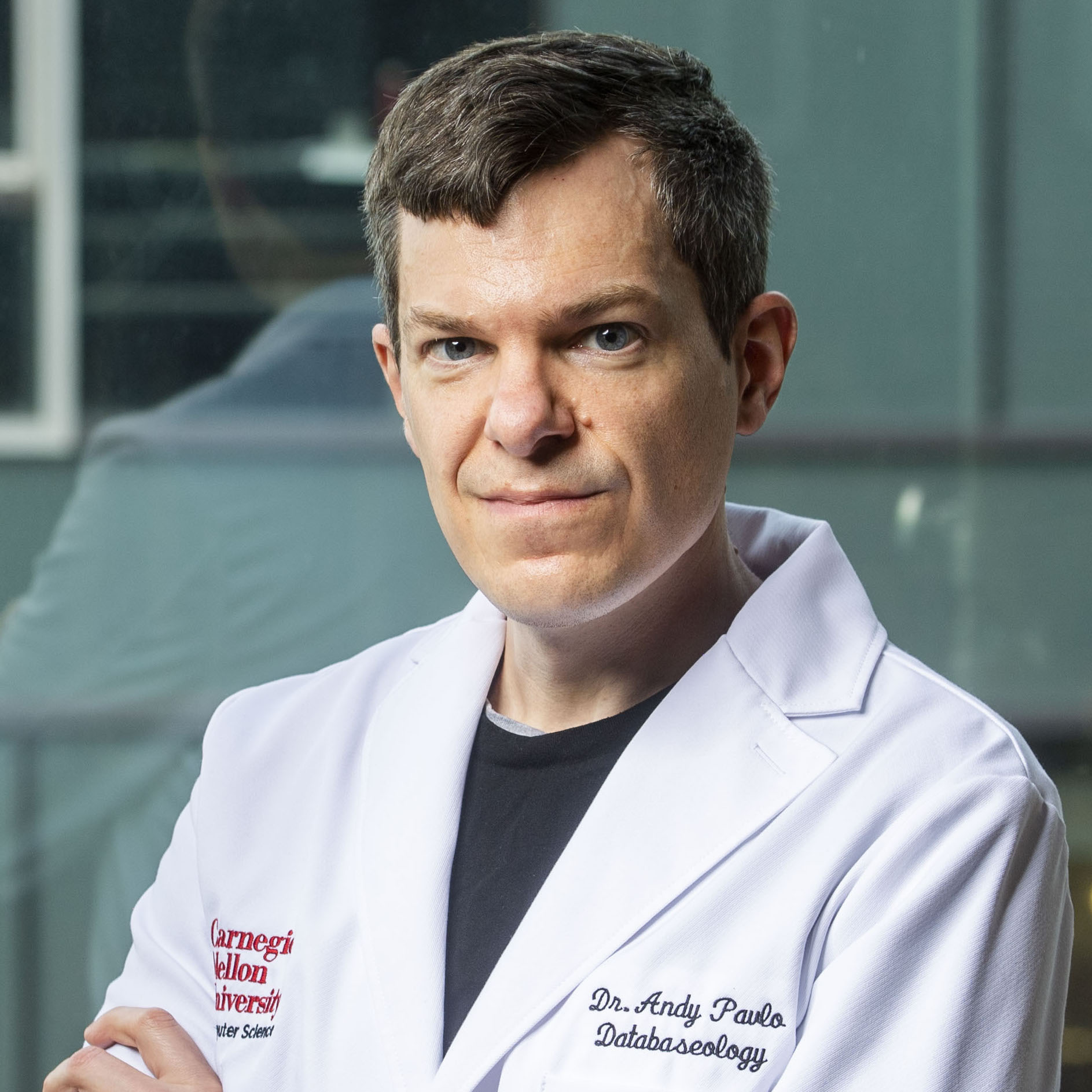
Andrew Pavlo is an Associate Professor of Databaseology in the Computer Science Department at Carnegie Mellon University , part of the School of Computer Science . His research focuses on database systems, particularly self-driving architectures, transaction processing, and large-scale analytics. He is a member of the CMU Database Group and Parallel Data Laboratory. His awards include the NSF CAREER (2019), Sloan Fellowship (2018), and ACM SIGMOD Jim Gray Dissertation Award (2014). He co-founded OtterTune, a database tuning startup, though it later ceased operations. Current research interests emphasize autonomous database systems, query optimization, and distributed computing. Recent publications (2024) highlight work on self-driving DBMS, null representation in columnar formats, and UDF optimization techniques. Awards: NSF CAREER Award (2019) Sloan Fellowship (2018) ACM SIGMOD Jim Gray Dissertation Award (2014) Advising: Mentors students in database systems, including Sam Arch, Wan Shen Lim, and William Zhang. Labs/Teams: Leads the Database Group and collaborates with the Parallel Data Laboratory.
David Andersen is a Professor in the Computer Science Department at Carnegie Mellon University, with research spanning systems, databases, distributed systems, networking, and security. He holds a Ph.D. and M.S. from MIT, and B.S. degrees in Computer Science and Biology from the University of Utah. Education: Ph.D./M.S., MIT (Computer Science); B.S., University of Utah (Computer Science, Biology). His research focuses on networked systems , emphasizing robustness , energy efficiency , and scalable architectures . Key projects include FAWN (low-power clusters), XIA (secure internet architecture), and MemC3 (memory-optimized hashing). Recent publications highlight trends in machine learning integration , storage innovations , and datacenter networking . Professional activities include leadership roles in conferences like OSDI, SOSP, and NSDI, and advisory positions in DARPA’s ISAT group. He is also founder and CTO of BrdgAI and previously co-founded a deep-learning startup and an ISP. Personal interests include running, triathlons, and rock climbing, with notable contributions like the Pi Searcher and running route guides for Pittsburgh and Boston.
Gregory Ganger is the Stephen J. Jatras Professor at Carnegie Mellon University's College of Engineering, holding joint affiliations with the Computer Science Department and CyLab. He has served as Director of the Parallel Data Lab (PDL) since 2000 and teaches Storage Systems (Fall) and Advanced Cloud Computing (Spring) courses. Education: Ph.D. in Computer Science & Engineering (1995, University of Michigan) M.S. in Computer Science & Engineering (1993, University of Michigan) B.S. in Computer Science (1991, University of Michigan) Dr. Ganger's research spans computer systems, focusing on: cloud computing, distributed systems, storage architectures, and machine learning infrastructure. His work addresses challenges in resource scheduling, non-volatile memory optimization, and scalable infrastructure design through projects like BigLearning, CILES, HeART, and Zoned Storage systems. Recent publications demonstrate expertise in: DNN training optimization (GraphPipe, Nonuniform-Tensor-Parallelism), sustainable storage (Storage Emissions, FairyWREN), and cloud efficiency (MACARON Cache). These works intersect machine learning, storage systems, and hardware-software co-design. Scientific Awards: 2021 OSDI Best Paper 2021 SOSP Best Paper 2021 SoCC Test of Time Award 2021 R&D 100 Award As advisor to 8 graduate students, he contributes to training the next generation of systems researchers. His lab (PDL) collaborates with industry partners on cutting-edge storage and cloud infrastructure problems.