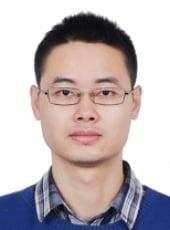
Prof. Qi Wang is a Full Professor in Next-Generation Smart Networks & Services at the University of the West of Scotland (UWS), Scotland, UK. He is Co-Founder and Co-Director of Beyond 5G Hub and a Voting Member of Europe’s 6G-IA. His expertise spans 5G/6G/IoT networking, AI applications, and vertical use cases. He has supervised 16 PhD students and led multi-million GBP projects like SELFNET and SliceNet. Awards include UK THE Awards 2020 and Scotland CeeD Innovation Award 2020. Research Interests : 5G/6G mobile networks and IoT AI-driven network optimization Automated driving systems Virtual reality facial recognition Sustainable CO2 emission prediction Key Projects : EU Horizon 2020 projects (SELFNET, SliceNet, 6G BRAINS) UK National Edge AI Hub (£12M) UKRI SIPF Digital Dairy Value-Chain (21M GBP) Awards : UK THE Awards 2020 - Knowledge Exchange Initiative Scotland CeeD Innovation Award 2020 Multiple Best Paper Awards (IEEE ICCE, SOFTNETWORKING) Advisory Roles : Board Member of EU 5G-PPP Technology Board (2015-2020) Member of Scotland’s AI Strategy Working Group Academic Member of ITU and ETSI Labs/Teams : Beyond 5G Hub (founded 2015) Leading R&D in 6G-PATH project (€16.8M)
Dr. Miljan Vučetić holds the title of Principal Research Fellow in Information Technologies at the School of Electrical Engineering, University of Belgrade. He earned his PhD in Computer Science from the University of Belgrade (2013) and has extensive industry experience in roles such as Data Scientist at Drey Corporation, Software Engineer at Vlatacom Institute (2014–), and team leader of its AI group since 2019. His research focuses on artificial intelligence, machine learning, data mining, and fuzzy systems, with over 70 publications and 14 technical solutions. He is a Senior Member of IEEE (2024) and has contributed to FP7, H2020, and COST projects. Education: PhD in Computer Science, University of Belgrade (2009–2013) M.Sc. in Telecommunication, Faculty of Transport and Traffic Engineering, University of Belgrade (2003–2008) High School Diploma, High School Sokolac (1999–2003) Research emphasizes computational intelligence, with notable work on distributed algorithms, fuzzy query engines, and AI applications in telecommunications and smart cities. His articles span topics like consensus protocols, reinforcement learning, and sensor network optimization. He serves as a journal reviewer and conference committee member. Scientific achievements include the IEEE Senior Member status (2024), Best Student Award (2008), and leadership in projects like FP7 and H2020. His technical solutions address spectrum management, vehicle actuation, and disaster preparedness systems. He advises multiple collaborative research groups and leads the Vlatacom AI team.
Fang Liu is an Adjunct Associate Professor in the School of Computational Science and Engineering (CSE) at Georgia Institute of Technology. She holds a Ph.D. in Computer Science from Indiana University (2009) and serves as a Research Scientist at the Partnership for Advanced Computing Environment (PACE) center. Her primary roles include diagnosing complex technical issues in HPC systems, developing HPC software stacks, teaching courses on Linux and Python, and conducting research on big data analytics. She has also served in leadership roles for HPC conferences since 2014, including program chair for HPC2012 and HPC2013. Education: Ph.D. in Computer Science, Indiana University Bloomington (2009) Dissertation: "Building Sparse Linear Solver Component for Large Scale Scientific Simulation and Multi-physics Coupling" Advisor: Professor Randall Bramley Research Interests: Her work focuses on High Performance Computing (HPC) , parallel/distributed scientific computing , multi-physics coupling , big data infrastructure , and data management systems . She actively explores Hadoop/Spark-based solutions for graph databases and streaming data security, collaborating with Prof. Polo Chau's group. Recent projects include optimizing HPC cluster operations through big data analytics and developing provenance-capturing frameworks. Technical Contributions: She has pioneered tools like ProvBench for performance tracking and Phoenix for cost model modernization at Georgia Tech. Her work on automated storage cleanup and hybrid software deployment workflows has improved research computing efficiency across heterogeneous systems. Professional Activities: Served as program committee member for HPC, ICCS, and ICCSA conferences. Currently chairs the HPC conference steering committee since 2014. Labs & Teams: Works within the PACE center and collaborates closely with CSE faculties on computational science projects. Leads instructional initiatives via the ICE federated cluster environment.
Michael Godfrey is a Professor at the University of Waterloo's David R. Cheriton School of Computer Science, affiliated with the Department of Electrical and Computer Engineering. His work focuses on software engineering, empirical studies of software systems, code review practices, and open-source software ecosystems. He holds a Ph.D., M.Sc., and B.Sc. from the University of Toronto (1997, 1988, 1986). Research interests include software evolution, mining software repositories, provenance tracking, code duplication analysis, and program comprehension. He actively explores how developers interact with code reviews, documentation systems, and modern CI/CD pipelines. Recent work investigates app store software ecosystems, Bash scripting vulnerabilities, and deep learning API testing. Publications span empirical studies of developer communities (e.g., Stack Overflow analysis), architectural teaching methods, and automated testing techniques like documentation-guided fuzzing. His work bridges theory and practice, addressing challenges in large-scale systems maintenance and developer productivity. Leverages tools like Elasticsearch for repository mining and explores anomaly detection in software development. Engaged in curriculum development for software architecture education and has contributed to conferences like MSR and ICSE.
Dr. Long Cheng was a former Researcher at the International Center for Computational Logic (ICCL) within the Faculty of Computer Science at TU Dresden. His research focused on cloud computing, big data analytics, and distributed systems, particularly in optimizing large-scale data processing, outer join operations, and semantic web technologies. He contributed to projects involving parallel programming models like X10, MapReduce frameworks, and efficient data compression techniques for RDF datasets. Cheng collaborated with the Knowledge-Based Systems research group, addressing challenges in scalable systems, high-throughput indexing, and parallel reasoning under non-monotonic logics. His work emphasized performance optimization in distributed environments, including skew handling, data redistribution strategies, and algorithm scalability for large datasets. Publications span topics such as outer join evaluation in cloud environments, efficient compression of semantic web data, and high-performance query execution over distributed systems. His research bridges theoretical computational logic with practical applications in big data and cloud infrastructure.
Cesare Alippi is a Full Professor at the Faculty of Informatics, Università della Svizzera italiana (USI), and also holds a professorship at Politecnico di Milano, Italy. He serves as a visiting Professor at Guangdong University of Technology (China) and Consultant Professor at Northwestern Polytechnic of Xi'an (China). His academic leadership extends to multiple international institutions where he has served as a visiting researcher including UCL (UK), MIT (USA), ESPCI (France), CASIA (China), A*STAR (Singapore), and University of Kobe (Japan). Professor Alippi's research interests center around graph-based learning, adaptation and learning in non-stationary environments, and intelligence for embedded, cyber-physical systems and IoT. His work bridges theoretical foundations with practical applications in sensor networks, environmental monitoring, and industrial processes. He has established significant research infrastructure including the Wireless Embedded Systems (WEmSy) Lab and the Internet of Things Lab, with notable deployments for marine environment monitoring in Queensland, Australia and the Fiji Islands, as well as rockfall and landslide monitoring systems across Italy and Switzerland. His research output shows a clear evolution toward graph-based deep learning approaches for time series analysis, anomaly detection, and spatiotemporal forecasting, reflecting the growing importance of graph neural networks in handling complex relational data in non-stationary environments. Major Awards: IEEE CIS Enrique Ruspini Meritorious Service Award (2024) IEEE CIS Outstanding Computational Intelligence Magazine Paper Award (2018) Gabor Award from International Neural Network Society (2016) IBM Faculty Award (2013) IEEE Instrumentation and Measurement Society Young Engineer Award (2004) Professor Alippi has held significant leadership roles including Past Board of Governors member of the International Neural Network Society, Past member of the Administrative Committee of the IEEE Computational Intelligence Society, and Past Vice-President for Education of the IEEE Computational Intelligence Society. He has served as Associate Editor for Proceedings of IEEE and several other prestigious journals. His research has been supported through numerous grants including an IBM Faculty Award in 2013 specifically for research on Intelligent Embedded Systems working in non-stationary environments. His research infrastructure includes the Wireless Embedded Systems (WEmSy) Lab and the Internet of Things Lab, with notable deployments including a sophisticated automatic, adaptive, sustainable and reliable wireless monitoring system for marine environments deployed in Queensland, Australia (2007) and under deployment at the Fiji Islands (2014-2015). He has also led several top-world deployments for rockfall and landslide monitoring across Italy and Switzerland since 2010, demonstrating the practical impact of his research in real-world harsh environments.
Xinyu Lei is an Assistant Professor in the Department of Computer Science at Michigan Technological University (MTU) , where he joined in Fall 2021. He earned his PhD in Computer Science and Engineering from Michigan State University (MSU) , advised by Prof. Guan-Hua Tu. Prior to MTU, he worked as a Research Assistant at Texas A&M University at Qatar (2013) and a Research Intern at Ford Motor Company (2017). University: Michigan Technological University Department: Computer Science Academic Rank: Assistant Professor PhD Institution: Michigan State University His research focuses on distributed computing , mobile systems , data science , and trustworthy machine learning , with particular emphasis on privacy-preserving protocols for IoT and blockchain technologies. His publications span top venues like ACM MobiCom , IEEE TDSC , and IEEE TIFS , addressing vulnerabilities in cellular IoT, secure blockchain protocols, and federated learning systems. Recent work includes privacy-preserving federated learning in 2023 (TIFS), secure redactable blockchain (TDSC), and IoT data heterogeneity handling (IoT-J). Earlier contributions in 2020-2021 explored Wi-Fi security for smart homes (MobiSys), encrypted geodata queries (ICDE), and Bitcoin payment protocols (CODASPY). Research Grants: NSF CRII: CNS-2153393 ($175K, Sole-PI) Professional Activities: Program Committee: CVPR'24, INFOCOM'24 TPC: BigDataService'20, Workshop Mobicom'19 Dr. Lei teaches graduate and undergraduate courses in applied cryptography (CS 5090), network security (CS/EE 4723), and computer security (CS 4471/5471) at MTU. He also contributes to academic community service through program committee roles at conferences like CVPR, INFOCOM, and WSDM.
Assistant Professor Ante Panjkota holds a Ph.D. and is affiliated with the Department of Information Sciences and Technologies at the University of Zagreb. His office is located in Office 45, and he can be reached at apanjkot@unizd.hr. Regular consultations are held every Friday from 9:30 to 11:30 AM via prior email notification. His academic background includes teaching courses such as Basics of Information Technology, Programming Basics, Introduction to Network Systems, Advanced Programming, Data Mining, and Information Search and Retrieval. His research interests span programming, algorithms, machine learning theory, data mining, signal processing, and business intelligence with notable contributions to e-government frameworks and motion analysis systems. Key research activities include the TRIPLE project focusing on interdisciplinary research practices. His publications reflect expertise in data-driven methodologies, including neural networks for financial forecasting, e-government maturity models, and innovative motion-tracking systems. He has also explored applications of inductive logic programming in robotic vision and developed frameworks for analyzing human motion in sports contexts. While no scientific awards are explicitly listed, his work demonstrates sustained engagement with cross-disciplinary challenges in information sciences and technology. His teaching and research activities are further detailed in his CV available in Croatian and English formats.
Paul Wong is a Senior Lecturer at the School of Cybernetics of the Australian National University (ANU). He holds a PhD in Non-classical Logics from ANU (2004) and a Master's in Philosophy from Simon Fraser University (1996). His academic career includes roles as a lecturer in software engineering, policy analyst, and defense analyst. His research focuses on cybernetics, complex systems science, network science, and data-driven decision-making. He has contributed to national research infrastructure development and strategic data management practices. Research Interests: Cybernetics and sociotechnical systems design Complex systems modeling and analysis Network science applications in research evaluation Data quality and integration methodologies Policy analysis using predictive analytics Recent work emphasizes leveraging data networks to forecast research impacts and optimize national innovation strategies. His 2022 publications address cybernetic frameworks for complex world design and non-academic research impacts. He has co-authored over 13 peer-reviewed works across data science, logic, and interdisciplinary systems analysis. Professional Contributions: Principal Investigator on AI Library Services and Research Performance Evaluation projects Member of ACM and IEEE since 2024 Labs/Teams: Active in ANU's School of Cybernetics research community focusing on interdisciplinarity and systems thinking.
Dr.-Ing. Rita Streblow is a leading researcher at RWTH Aachen University's Institute for Energy Efficient Buildings and Indoor Climate, where she heads the Digital Energy Neighbourhoods team (since 2021). Formerly, she served as Chief Engineer at the same institute (2007-2023) and held a professorship in Digitale Vernetzung von Gebäuden, Energieversorgungsanlagen und Nutzenden at Technische Universität Berlin (2019-2024). Since 2025, she has been an Associate Member of the Einstein Center Digital Future. She earned her doctorate from RWTH Aachen in 2011 with a thesis on thermal comfort modeling. Her research spans energy-efficient building systems , smart grid integration , and HVAC optimization , with focal areas including: Digitalization of energy neighborhoods and local market mechanisms Thermal comfort modeling for inhomogeneous environments Semantic interoperability in building automation Retrofit strategies for residential and office buildings Analysis of her recent publications reveals strong emphasis on smart building technologies , district-scale energy management , and data-driven fault detection , with recurring themes of IoT integration, open-source tool development, and policy-relevant energy planning. She has received notable scientific awards including: Borchers-Plakette, RWTH Aachen (2012) Award for Young Researchers, German Society of Refrigeration and Air Conditioning (2011) She leads experimental research at the Urban Energy Lab 4.0 and collaborates on national projects like PLUG-N-HARVEST (adaptive façade retrofits) and AGENT (multi-agent energy systems).
Chaitanya Shivade is a prominent researcher specializing in medical natural language processing with significant contributions to clinical text analysis, radiology informatics, and behavioral health documentation. His work bridges computational linguistics and healthcare applications, focusing on practical solutions for clinical documentation challenges. Shivade's research spans multiple critical areas: developing evaluation frameworks for behavioral therapy notes (TN-Eval), creating shared tasks for medical summarization (MEDIQA), advancing visual dialog systems for radiology, and pioneering synthetic clinical note generation. He has made substantial contributions to textual inference in clinical domains through the MedNLI dataset and has explored fundamental linguistic challenges like negation detection and gradable term analysis in medical text. As a workshop organizer for the NLP for Medical Conversations series, he has helped shape community standards and foster collaboration. His publication record demonstrates consistent leadership in applying NLP to real-world healthcare problems, with particular emphasis on evaluation methodologies, dataset creation, and practical clinical applications. Shivade has collaborated extensively with medical professionals and researchers across institutions to ensure clinical relevance of his technical work. Organized MEDIQA shared tasks (2019, 2021) Co-organized NLP for Medical Conversations workshops (2019, 2020) Developed TN-Eval framework for therapy note quality assessment Created MedNLI dataset for clinical textual inference Pioneered synthetic clinical note generation approaches His work consistently addresses the tension between clinical utility and technical innovation, with growing emphasis on evaluating LLM performance in healthcare contexts. The progression from foundational clinical NLP techniques to complex evaluation frameworks demonstrates his evolving research trajectory toward ensuring reliable AI deployment in medical settings.
Александар С. Станимировић serves as an Associate Professor in the Department of Computer Science at the Faculty of Electronic Engineering, University of Niš, appointed in 2024 within the field of Computer Science and Informatics. His academic foundation stems entirely from this institution, where he has maintained continuous affiliation since undergraduate studies. His educational journey includes: Bachelor's degree (Diplomirao) in Electrical Engineering and Computing (2000) Master's degree (Magistrirao) in Electrical Engineering and Computing (2006) Doctorate (Doktorirao) in Electrical Engineering and Computing (year unspecified) Research focuses intensely on Geographic Information Systems with specializations in semantic interoperability, ontology mapping, and component-based spatial frameworks. His work bridges theoretical computer science with practical applications in utility network management and emergency response systems, emphasizing data integration challenges in heterogeneous environments. Early-career publications demonstrate consistent innovation in making geospatial systems interoperable through semantic technologies. Analysis of his 2004-2007 publications reveals a cohesive trajectory: initial work established component-based GIS architectures (2004), evolving toward semantic integration solutions (2005-2006), and culminating in domain-specific implementations for power networks and disaster management (2007). This progression shows increasing sophistication in handling real-world spatial data interoperability problems while maintaining theoretical rigor in ontology engineering. He currently participates in three active research initiatives comprising two national projects and one international collaboration, indicating sustained research momentum beyond his early publication period. While project specifics aren't detailed, their existence confirms ongoing scholarly activity aligned with his GIS expertise. No formal advising relationships or laboratory leadership roles are documented in the available materials.
Dr. Kathryn Napier is a Lead Data Scientist at the Curtin Institute for Data Science (CIDS) within Curtin University's Faculty of Science and Engineering. She leads the Curtin Open Knowledge Initiative (COKI), a team developing tools to track open access research performance and improve scholarly communication. Her work bridges data science, healthcare informatics, and bioinformatics, with a focus on transdisciplinary research integration. Education: PhD BSc (Honours) BSc CHIA (Certified Health Informatics Analyst) Research Focus: Kathryn’s research spans data science applications in healthcare, bioinformatics, and open access metrics. She designs web-based registries for rare diseases (e.g., familial hypercholesterolemia, Angelman syndrome) and develops machine learning models for clinical and ecological studies. Her work emphasizes privacy-preserving data linkage and global research evaluation tools. Key Projects: COKI Dashboard: Tracks global open access performance using 12 trillion data elements Chronic Kidney Disease Modeling: Uses linked health data to improve outcomes Ballet Biomechanics: Machine learning for dancer posture analysis Labs/Teams: Leads the COKI team, collaborating with CWTS (Leiden University) and international partners to advance open science and university performance analytics.
András Gasparetz is an Associate Professor at the Faculty of Business and Economics , University of Pannonia, with expertise spanning IT consulting, outsourcing, project management, and information security. He combines academic rigor with extensive industry experience across IT, healthcare, and manufacturing sectors. Education: University of Veszprém, Department of Organizational Engineering (1986) BKME MBA (2004) Research Focus: His work centers on information security and outsourcing risk management , emphasizing practical frameworks for corporate and public sectors. Key contributions include BS 7799/ISO 17799 standardization and ICT legal compliance. Professional Impact: Gasparetz has published on secure desk practices, outsourced data theft, and IT law compliance. His research bridges technical standards with organizational behavior. Scientific Awards: Tódor Kármán Award (2006) Honorary Associate Professor (2004) Industry Leadership: Founder of VAR Kft. (ranked #99 in Hungary’s Top 200 IT companies) and MagiCom Ltd., he has led projects for GE, the World Bank, and the National Ambulance Service, focusing on digital transformation and security protocols.
Amos H. C. Ng is a Professor at the School of Engineering Science, University of Skövde, specializing in simulation-based optimization and Industry 4.0 technologies. His research bridges production engineering with human-robot collaboration, ergonomics evaluation, and cloud-based cyber-physical systems for manufacturing efficiency. Key Affiliations: University of Skövde (School of Engineering Science), Uppsala University (Industrial Engineering and Management) Research Themes: Multi-objective optimization, Digital Twin frameworks, Human-centric production systems, Reconfigurable manufacturing, Throughput bottleneck analysis Projects: ACCURATE 4.0 (Knowledge Foundation), VF-KDO (Virtual Factories with Knowledge-Driven Optimization), EWASS (Wire Harness Assembly Optimization) His recent publications demonstrate expertise in applying evolutionary algorithms, machine learning models, and digital human modeling tools to solve complex manufacturing problems ranging from crankshaft machining to wood supply chain robustness. Current work integrates motion capture technology with DHM tools for objective ergonomic assessments in assembly stations. Amos collaborates extensively with industrial partners like Volvo Penta and academic institutions, utilizing simulation-based approaches to enhance decision-making in production systems. His methodological focus includes non-dominated sorting genetic algorithms, surrogate modeling, and parallel computing architectures for optimization tasks.