Dominic Thibault is an Assistant Professor at the Faculty of Music, Université de Montréal . His research-creation explores human-machine interaction in musical contexts, focusing on embodied cognition through electroacoustic compositions, audiovisual performances, and musical software development. Co-director, Laboratoire Formes·Ondes Active member, CIRMMT (Centre for Interdisciplinary Research in Music Media and Technology) Research axis leader, Expanded Musical Practice (CIRMMT) Member, Québecor Millénium entrepreneurship committee Scientific committee member, ACFAS
Dr. Changyou Chen is an Associate Professor in the Department of Computer Science and Engineering at the University at Buffalo, State University of New York. His research focuses on Multi-Modal Learning Foundation Models Deep Generative Models Large-scale Bayesian Sampling with applications in document understanding, music-AI integration, and molecular representation learning. Research Trends revealed through his recent publications include Optimizing Multimodal Large Language Models Developing Novel Retrieval-Augmented Generation Frameworks Creating Benchmark Datasets for Visual Text Understanding Advancing Diffusion Models with Domain-Specific Constraints across domains from music sheets to biomedical documents. Scientific Contributions : UB Young Investigator Award (2020) Architect of LoCAL Framework for Long Document Understanding Co-developer of MusiXQA Benchmark Pioneering Work in Probability Contrastive Learning Academic Leadership includes mentoring 10+ graduate students and serving as Area Chair for major AI conferences (ICML, NeurIPS, AAAI, IJCAI). His Labs develop scalable solutions for multimodal reasoning, with recent work demonstrating practical GPU memory optimization through LoRA adapter sharing.
Prof. Dr. Nadine Lehnen is a Research Group Leader at the Department of Psychosomatic Medicine , Faculty of Medicine, Technical University of Munich (TUM). Her work bridges computational neuroscience and psychosomatic disorders, focusing on the central nervous system (CNS) mechanisms underlying functional symptoms that lack organic explanations. Research Focus : Functional somatic disorders, sensorimotor processing, vestibular system dysfunction, and computational modeling of symptom pathogenesis. Key Collaborations : EURONET-SOMA Group, interdisciplinary teams in neuroscience and clinical psychology. Her recent studies explore sensorimotor dysregulation in irritable bowel syndrome, post-COVID symptoms, and functional dizziness, emphasizing transdiagnostic mechanisms. Publications highlight translational approaches combining computational and experimental methods to redefine understanding of persistent physical symptoms. She mentors students such as Dr. Lena Schröder and Dr. Dina von Werder, contributing to training in psychosomatic research. While no specific awards are listed, her work has been supported by institutional affiliations and collaborative grants.
Veysel Murat İstemihan Genç is a Professor in the Department of Electrical Engineering at Istanbul Technical University (ITU), College of Engineering. His research is centered on modern power systems, with a focus on transient stability, cybersecurity, and integration of renewable energy sources. He actively leads multiple research projects and supervises graduate students in advanced power system technologies. Research Interests: His work spans key areas including transient stability assessment, machine learning applications in power systems, cyber-attack detection in AGC systems, and dynamic security evaluation under high renewable penetration. He employs cutting-edge techniques such as ensemble learning, deep neural networks, and hybrid optimization algorithms. Publication Trends: Recent publications (2023–2025) highlight a strong trend toward integrating AI and machine learning for real-time transient stability prediction, cybersecurity in distributed energy systems, and performance optimization of solar and wind-integrated grids. His work frequently addresses challenges in low-inertia systems and false data injection attacks. Scientific Projects: Strengthened Machine Learning-Based Dynamic Security Evaluation for Transient Stability under False Data Injection Attacks (BAP, 2025) Analysis and Control Methods for Stability of Large-Scale Low-Inertia Power Systems (BAP, 2023–2024) Dynamics Security Evaluation of Renewable-Rich and Cyber-Attacked Power Systems (BAP, 2022–2024) Risk-Based Stability Assessment and Corrective Control Methods in Power Systems (BAP, 2019–2022) Wide-Area Monitoring Protection and Control System Design Using Advanced Signal Processing and Machine Learning (TÜBİTAK, 2018–2020) Advising and Grants: He is the principal investigator (PI) on multiple funded research projects from BAP and TÜBİTAK, indicating strong grant acquisition and leadership. His supervision of 27 ongoing theses reflects an active role in mentoring graduate students in electrical engineering and power systems. Labs and Teams: While specific lab names are not mentioned, his projects suggest leadership in a research group focused on smart grid technologies, AI-enabled power system security, and renewable integration at Istanbul Technical University.
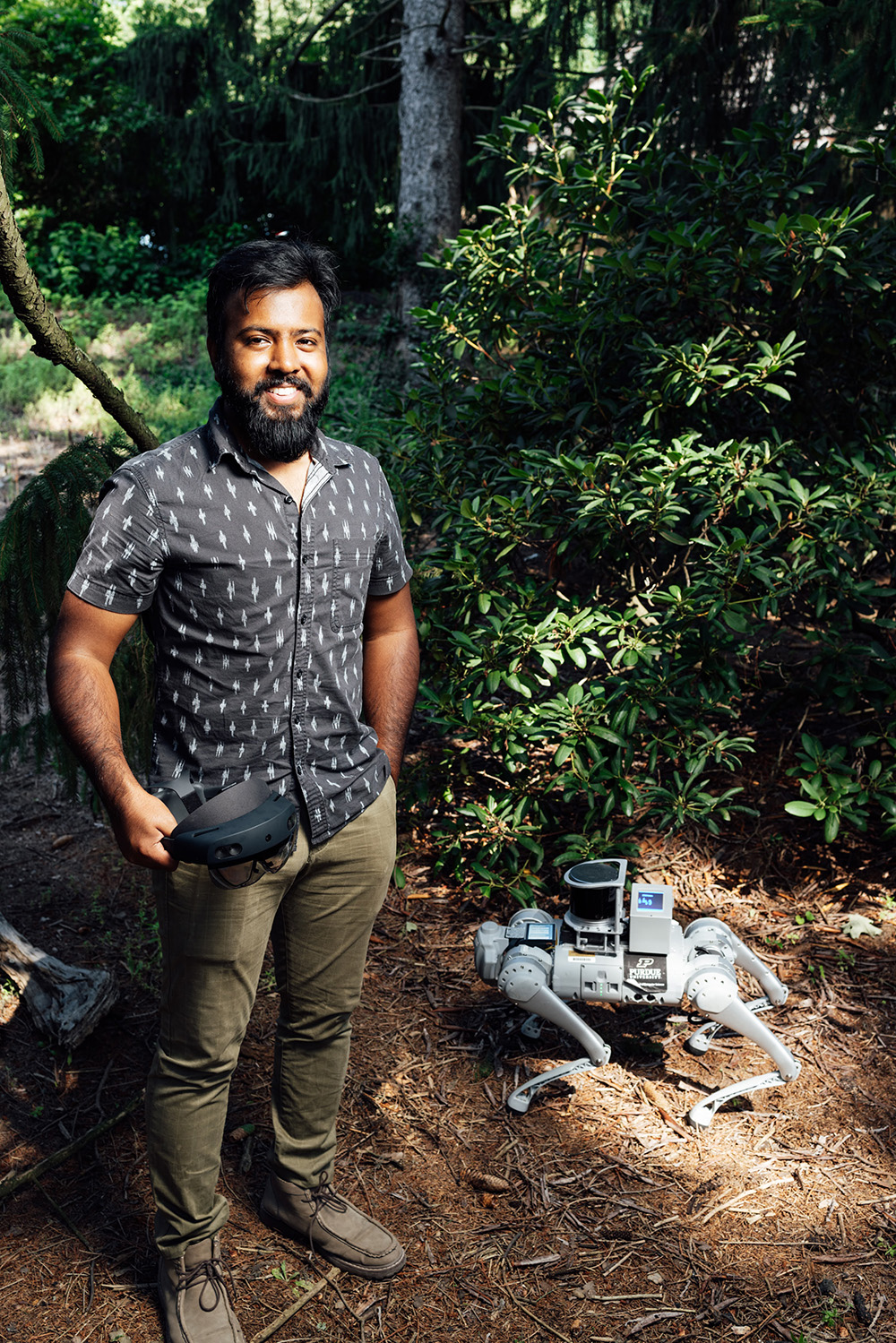
Dr. Aniket Bera is an Associate Professor in Computer Science at Purdue University and holds an Adjunct Associate Professor role at the University of Maryland at College Park (UMIACS). He directs the IDEAS Lab at Purdue and previously served as a Research Assistant Professor at UNC Chapel Hill. His research focuses on Affective Computing, Computer Graphics (AR/VR), AI & Robotics, Social Robotics, and medical AI applications for mental health diagnostics. Affiliations: Purdue University (Primary), University of Maryland (Adjunct), UMIACS Career: Joined Purdue in 2017, extensive industry collaborations with Disney Research, Intel, and C-DAC Research Interests: Affective Computing: Emotion perception via gait analysis, speech, and facial/body expressions AR/VR: Redirected walking, virtual environments, and human motion modeling Medical AI: AI-driven mental health detection systems (e.g., VidSole dataset) in collaboration with medical schools Key Contributions: Developed Project Dost (mental health initiative) Received 2020 Brain & Behavior Seed Grant ($X) for emotion-gait research Authored 65+ papers (1,800+ citations) with awards at IEEE VR 2021 Funding & Leadership: Serves as Senior Editor for IEEE RA-L (Planning/Simulation) Conference Chair for ACM SIGGRAPH MIG 2022 Labs/Teams: IDEAS Lab (Purdue), UMD GAMMA Group
Dr. Jules Rawlinson is a Senior Lecturer in Digital Design at the Reid School of Music , University of Edinburgh. He serves as Programme Director for the MSc Sound Design and contributes to MSc Design and Digital Media, ESALA undergraduate courses, and the Reid School's MSc Digital Composition and Performance. PhD in Composition (University of Edinburgh, 2011) MSc Sound Design (University of Edinburgh, 2006) BA Combined Arts (Sunderland University) Jules investigates audiovisual composition , live electronics , and interactive performance systems , blending machine learning , virtual environments , and corpus-based sound synthesis . His work explores non-linear narrative structures , graphical scores , and political sound-art through collaborations like Raw Green Rust and projects such as Lie Still My Sleepy Fortunes and w[i]nd . His 15 most recent outputs span audiovisual installations , generative sound systems , and collaborative performances , focusing on virtual reality , spectral transformation , and digital improvisation . Jules co-founded the LLEAPP network and has secured grants from EPSRC and New Media Scotland's Alt-w Fund . He supervises PhD students Tim Bentley, Hal Xu, Benjamin Cantil, and Liam Peacock, with works showcased at festivals including Sonorities , Edinburgh International Film Festival , and Edinburgh Festival Fringe . His Requiem for Edward Snowden was featured in BBC Radio 3's Hear and Now and selected for Creative Scotland's Made In Scotland Showcase.
Dr. Abdallah Chehade is an Associate Professor in the Department of Industrial and Manufacturing Systems Engineering at the University of Michigan-Dearborn , where he leads the Informatics, Reliability, and Data Analytics (IRDA) lab . He holds a Ph.D. in Industrial Engineering from the University of Wisconsin-Madison (2017), with minors in Computer Sciences and Statistics, alongside an M.S. in Mechanical Engineering and a B.E. in Mechanical Engineering from the American University of Beirut. Research Interests span safe and robust deep learning solutions , explainable AI , data fusion for degradation modeling , and Bayesian statistical modeling . His work integrates AI/ML with prognostics and Internet of Things (IoT) to address challenges in reliability analytics and industrial data science . Publications highlight advancements in deep autoencoders , LSTM networks , and hybrid models for warranty forecasting , with applications in battery cells , sheet metal stamping , and rail transportation . His grants from Ford, Honda, and the U.S. Army focus on smart manufacturing , AI for sensor modeling , and digital twins . Lab Members include Ph.D. students working on topics like physics-based AI , computer vision , and deep learning for prognosis . He serves on the INFORMS Quality, Statistics, and Reliability (QSR) Council and maintains affiliations with IEEE , INFORMS , and IISE .
Nelly V. Litvak is a Full Professor in Algorithms for Complex Networks at Eindhoven University of Technology (Mathematics and Computer Science). She works on mathematical methods and algorithms for complex networks (social networks, WWW) using random graph models. She joined TU/e as a part-time professor in 2017 after being an Associate Professor at the University of Twente since 2012. Affiliations: 4TU Applied Mathematics Institute, Data Science Center Eindhoven, CTIT Industry Partners: ABN-AMRO Bank, Philips Lighting, Thales Editorial Role: Managing Editor of Internet Mathematics Her research focuses on extracting value from network data across three areas: (1) Information extraction and prediction, (2) Mathematical analysis of network characteristics, and (3) Efficient algorithms for incomplete network data. Key topics include PageRank, HITS algorithm, random graphs, homophilic networks, and network epidemiology. Recent work (2022-2025) spans network growth mechanisms, fairness in ranking algorithms, educational pedagogy, and pandemic forecasting dashboards. She contributes to SDGs through data-driven approaches to societal challenges. Teaching activities include course development at TU/e and earlier institutions, with innovative methods for computer engineering students' statistical understanding.
Dr. Leah Perlmutter is a tenure-track Assistant Professor in the Computer Science Department at Grinnell College, focusing on inclusive pedagogy and student belonging in post-secondary CS education. She earned her Ph.D. (2023) and M.S. (2020) in Computer Science and Engineering from the University of Washington, and her B.A. (2012) in Computer Science and Engineering from Colby College. Her research examines how course policies and teaching assistant interactions impact student inclusion in computer science, with a particular emphasis on resubmission opportunities and justice-centered approaches to teaching. Her work also includes human-robot interaction projects like GestureCalc (an eyes-free calculator for touchscreens) and EMAR (a social robot for emotional clarity support). Recent publications explore themes such as algorithmic ethics in education, student belonging in CS, and accessible interface design. She received the NSF Graduate Research Fellowship (2017) and the Outstanding Female Engineer Award (2018). At Grinnell, she teaches courses like Functional Problem Solving, Software Design, and Algorithms, Ethics, and Society.
James A. Evans is the Max Palevsky Professor of Sociology and Data Science at the University of Chicago, where he is a faculty member in the Department of Sociology within the Division of the Social Sciences. He is the director of Knowledge Lab and the Faculty Director of the Masters Program in Computational Social Science . He holds additional affiliations as an External Professor at the Santa Fe Institute , External Faculty at the Complexity Science Hub, Vienna , and Visiting Faculty Researcher at Google . Education: B.A. in Anthropology, Brigham Young University (1994) M.A. in Sociology, Stanford University (1999) Ph.D. in Sociology, Stanford University (2004) His research centers on the collective system of thinking and knowing , exploring how ideas emerge, spread, and evolve through social and technical systems. He investigates innovation, collective intelligence, and the science of science , using large-scale data modeling, machine learning, generative AI, and network analysis to study knowledge creation. His work spans domains including science, technology, law, and religion, with a focus on how AI is reshaping discovery processes. The most recent publications highlight trends in AI and scientific discovery , with a strong emphasis on innovation, knowledge systems, and human-machine intelligence . His research increasingly explores AI as a transformative agent in science , including the concept of 'alien intelligence' and the development of complementary AI to augment human capacity. Projects like the $20M NSF-funded APTO initiative aim to build language models that predict technological outcomes by analyzing historical data. Scientific Recognition and Funding: Research supported by the National Science Foundation (NSF) , National Institutes of Health (NIH) , Air Force Office of Scientific Research (AFOSR) , and philanthropic sources Work published in Nature, Science, PNAS , and leading social science journals Featured in The New York Times, The Economist, The Atlantic, Wired, NPR, BBC, Le Monde , and others James Evans advises on science policy and funding strategies, emphasizing the importance of diversity, interdisciplinary collaboration, and demographic balance in fostering innovation. He critiques current academic incentives and proposes alternative discovery regimes. He leads Knowledge Lab , a collaborative research environment that conducts seminars, grants, and employment opportunities in computational social science and AI.
Francesca Rodino is a Doctoral Assistant and Research Fellow at École Polytechnique Fédérale de Lausanne (EPFL), affiliated with the School of Engineering and the Electrical and Microengineering Institute (IEM). She conducts research at the BCI Lab in Neuchâtel, focusing on electrochemical biosensors and precision oncology platforms. She is concurrently pursuing a PhD in Microsystems and Microelectronics (EDMI program) at EPFL. Education: B.Sc. in Biomedical Engineering, Politecnico di Torino (2019) M.Sc. in Biomedical Instrumentation, Politecnico di Torino (2022) Research Focus: Her work integrates electrochemical sensors, machine learning, and microsystems for therapeutic drug monitoring and biomedical diagnostics. Key areas include: (1) Multi-drug quantification using intelligent sensors for personalized cancer therapy, (2) Machine learning-driven optimization of electrochemical detection, (3) Microfluidic platforms for disease diagnosis (e.g., malaria), and (4) Wearable systems for neural prosthetics. Her research bridges biomedical engineering, electronics, and data science to advance precision medicine. Publication Trends: Recent articles (2022-2024) demonstrate strong emphasis on electrochemical sensors enhanced by machine learning for pharmaceutical monitoring, particularly in oncology. Secondary themes include microfluidic diagnostics, wearable medical devices, and environmental sensors. Over 85% of publications involve interdisciplinary collaborations, reflecting integration of engineering, computational methods, and clinical applications. Teaching & Leadership: Teaching Assistant for Bio-nano-chip design (EE-517) and MEMS practicals II (MICRO-503) EPFL team coach for international SensUs biotechnology competition
Prof. Dr. Janick Edinger is a Professor of Distributed Operating Systems at the Department of Informatics, Faculty of Mathematics, Informatics and Natural Sciences, University of Hamburg, Germany. He leads a research group focused on distributed, context-aware, and adaptive computing systems, with a strong emphasis on edge computing, computation offloading, and assistive technologies. Education: PhD in Computer Science, University of Mannheim Studies at National Taiwan University Studies at University of Alberta, Canada Research stays at University of British Columbia, Hong Kong Polytechnic University, and Georgia State University, USA His research explores how edge computing and computation offloading can enable efficient, privacy-preserving processing of sensor and video data close to their sources, particularly in dynamic environments. He investigates the integration of autonomous and heterogeneous systems—such as drone fleets and mobile devices—into scalable middleware platforms for real-time monitoring and decision-making in logistics and industrial operations. His work also emphasizes societal impact, contributing to accessible routing, adaptive interfaces, and crowd-sourced mapping. The recent publications reflect a strong trend in edge computing, federated learning, privacy-preserving analytics, and assistive technologies. Topics include WebAssembly-based offloading, emotion prediction via eye tracking, real-time traffic detection, and predictive maintenance in Industry 4.0, showcasing a blend of foundational systems research and applied human-centered computing. Scientific Awards: PerCom 2021 Mark Weiser Best Paper Award Best Paper Award at IEEE PerCom 2021 for 'Voltaire: Precise Energy-Aware Code Offloading Decisions with Machine Learning' Prof. Edinger actively advises students and leads research projects involving grants and collaborations. His team includes PhD candidates and researchers working on middleware, edge systems, and context-aware applications. He has served on conference program committees, such as shadow PC member for EuroSys 2021, and publishes in top venues including IPDPS, PerCom, CHIIR, and COMPSAC. Labs and Teams: He leads the Distributed Operating Systems research group at the University of Hamburg, where he mentors students and collaborates on projects involving edge computing, IoT, and adaptive systems.
Seth Blumsack is a Professor at the Pennsylvania State University in the Department of Energy and Mineral Engineering and serves as Director of the Center for Energy Law and Policy . He holds an Adjunct Research Professor position at the Carnegie Mellon Electricity Industry Center and is affiliated with the Santa Fe Institute as an External Faculty member. His research spans energy economics , power grid reliability , and complex infrastructure networks . Key projects include: Interdependent natural gas and electricity systems analysis Governance of regional transmission organizations Smart grid consumer behavior studies Power grid reliability tools development He has secured funding from the U.S. National Science Foundation , Department of Energy , Environmental Protection Agency , and private industry. His Best paper award at Hawai’i International Conference on System Sciences (2011) and John T. Ryan, Jr. Fellowship (2011-17) highlight his scientific recognition. Publications emphasize electricity market deregulation , energy infrastructure resilience , and consumer response to smart grid technologies . His work has been cited in major media outlets like The New York Times and The Los Angeles Times , and he has consulted for National Renewable Energy Laboratory , U.S. Department of Energy , and other industry stakeholders.
Ana Inés Torres is an Associate Professor in the Department of Chemical Engineering at Carnegie Mellon University's College of Engineering. She leads an active research group focused on sustainable process systems engineering, with affiliations at the Center for Advanced Process Decision-Making and the Wilton E. Scott Institute for Energy Innovation. Her work bridges chemical engineering with sustainability challenges, particularly in decarbonization and circular economy applications. Dr. Torres earned her educational credentials from Universidad de la República Oriental del Uruguay and the University of Minnesota: Ph.D. in Chemical Engineering, University of Minnesota (2013) Diploma in Chemical Engineering, Universidad de la República Oriental del Uruguay (2005) B.S. in Chemistry, Universidad de la República Oriental del Uruguay (2003) Her research interests span process systems engineering with a sustainability focus, particularly in chemical industry decarbonization through electrification and biomass utilization, circular economy network analysis, and environmentally-friendly rare earth element recovery processes. She integrates modeling, analysis, and optimization to design clean and sustainable chemical processes, with growing emphasis on machine learning applications in process optimization. Analyzing her recent publications reveals a strong focus on decarbonization strategies for existing industrial infrastructure, particularly oil refineries, and circular economy network design. Her work demonstrates increasing integration of machine learning with traditional process systems engineering approaches to tackle complex sustainability challenges across multiple scales, from molecular recovery processes to entire supply chain networks. Dr. Torres has received several prestigious recognitions: NSF CAREER award (2024) Dean's Early Career Fellowships award (2025) Consultant for United Nations Industrial Development Organization (UNIDO) (2024) Associate editor of Clean Technologies and Environmental Policy She actively mentors a diverse group of graduate students working on cutting-edge sustainability challenges, with recent projects focusing on circular economy networks, rare earth element recovery, and bio-refinery design. Her research has attracted significant funding, including the NSF CAREER award, and she participates in multiple collaborative initiatives through CMU's energy research centers. Dr. Torres also serves as an invited speaker at major conferences including FOCAPD and FOCAPO/CPC. Dr. Torres leads the Torres Research Group at CMU, which maintains strong connections with industry partners and international organizations including UNIDO. The group operates within CMU's robust energy research ecosystem, collaborating with the Wilton E. Scott Institute for Energy Innovation and the Center for Advanced Process Decision-Making to address complex sustainability challenges through interdisciplinary approaches.
Xiaofan Yu is an Assistant Professor in the Department of Electrical Engineering at the University of California, Merced. He holds a Ph.D. (2025), M.S. (2020), and B.S. (2018) from the University of California, San Diego and Peking University, respectively. His research focuses on embedded systems , edge AI , and neuromorphic computing , with applications in IoT, federated learning, and hyperdimensional computing. ML&Systems Rising Star (2024) CPS Rising Star (2023) EECS Rising Star (2022) His work addresses on-device AI for real-world IoT deployments, reliability-driven sensor networks , and next-generation edge intelligence . Recent publications highlight advancements in federated learning (TIOT 2025), multimodal sensor interaction (IMWUT 2025), and noise-resilient sensor systems (Sensors 2024). Key subfields include hyperdimensional computing , asynchronous distributed training , and resource-efficient edge models . Dr. Yu actively mentors students across institutions and programs, including the Early Research Scholarship Program (UCSD) and ENLACE Summer Research Program. He has advised projects on smart elderly monitoring , LLM-based sensor reasoning , and hyperdimensional algorithm optimization . Collaborations span UCSD, TUM, and Stanford, with industry partnerships in IoT design automation (RelIoT simulator) and biomedical applications (bladder fullness restoration system).