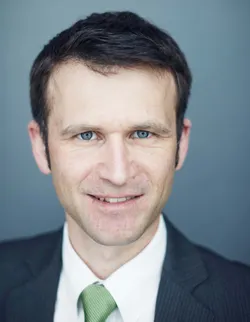
Thijs Defraeye is a Senior Scientist at Empa (Swiss Federal Laboratories for Materials Science and Technology) and Adjunct Professor at Dalhousie University. He holds a PhD in Building Physics from KU Leuven (2011) and a Master's in Civil Engineering (2006). His work focuses on optimizing food supply chains through multiphysics simulations and digital twins, addressing challenges in refrigerated transport, postharvest quality preservation, and energy-efficient food processing. He leads the SimBioSys group, developing solutions for perishable goods logistics and electrohydrodynamic technologies. Research interests include: Biophysics of food systems Digital twin applications in agriculture Electrohydrodynamic drying Thermal management in cold chains Sustainable food technologies Recent work emphasizes reducing food loss through physics-based modeling of refrigerated containers, ventilated packaging optimization, and scalable evaporative cooling systems. His studies bridge engineering principles with biological processes, aiming to enhance global food security and environmental sustainability.
Professor Jennifer Whyte is a Professor and Director of the John Grill Institute for Project Leadership at the University of Sydney's School of Project Management (Faculty of Engineering). Her research focuses on project leadership, systems integration, digital transformation in construction, and future-making practices. She previously led the School of Project Management (2021-23) and holds a retained Professorship at Imperial College London's Department of Civil and Environmental Engineering. She is a Policy Fellow of the Institution of Civil Engineers, contributing to industry policy and advisory boards such as the UK Construction Leadership Council. Education: Holds a PhD and is a Fellow (FICE) of the Institution of Civil Engineers. Her work bridges academia and industry, emphasizing practical impact through tools like digital twins and visualization technologies. Current projects include the Alan Turing Institute's Data-Centric Engineering Programme (Grand Challenge III) and the EPSRC-funded VENTURA Project's Virtual Decision Room initiative. Research interests span infrastructure projects, innovation ecosystems, and leadership in complex environments. She actively supervises doctoral students exploring areas like risk management in construction and digital transformation in public institutions. Awards include recognition for policy contributions and leadership in project-based organizations. Grants include funding for Big Data-driven stakeholder engagement in mega-projects and collaborations on new energy technologies. Her global links include Imperial College London and ongoing partnerships with institutions in the UK and Australia.
Dr. Andrzej Ożadowicz is a University Professor at the Department of Power Electronics and Automation of Energy Conversion Systems within the Faculty of Electrical Engineering, Automatics, Computer Science and Biomedical Engineering at AGH University of Science and Technology in Kraków, Poland. His office is located in room 510, building C-1, with contact details including phone +48 12 617 50 11 and email ozadow@agh.edu.pl. He holds PhD, DSc, and Engineering degrees, reflecting his dual expertise in academic research and practical engineering applications. His research spans Power Electronics, Building Automation, Smart Grids, and IoT-driven energy systems. Key interests include energy efficiency optimization through digital twins and BIM, distributed energy resource integration , and AI-enhanced demand management . Notably, he pioneers applications of deep reinforcement learning in home energy systems and develops frameworks for Smart Readiness Indicator implementation. His work bridges theoretical innovation with practical case studies in building thermal modeling and dynamic façade systems. Recent publications (2021-2025) reveal three dominant trends: (1) Convergence of digital twin technology with building automation for real-time energy management; (2) Critical analysis of IoT security and interoperability in smart infrastructure; (3) Pedagogical innovations in engineering education through blended learning methodologies post-COVID-19. His scholarly output demonstrates consistent focus on energy transition challenges and smart grid evolution. Professor Ożadowicz actively contributes to the Discipline Council for Automation, Electronics, Electrical Engineering and Space Technologies at AGH. He is instrumental in the AutBudNet initiative —a network of certified laboratories for energy efficiency assessment that implements "learning by doing" principles in building automation education. His work with this consortium emphasizes practical validation of smart grid technologies and demand response systems.
Manolis Chatzis is an Associate Professor in the Department of Engineering Science at the University of Oxford and a Tutorial Fellow at Hertford College. His research focuses on dynamic systems and earthquake engineering, particularly modeling risks for unanchored structural and non-structural components subjected to ground motions. University of Oxford - Department of Engineering Science Hertford College - Tutorial Fellow His work on system identification and observability of nonlinear systems aims to optimize sensor setups for infrastructure reliability. Recent publications address discontinuous Kalman filters for non-smooth dynamics, energy loss in rocking bodies, and experimental validation of seismic response models. Applications span seismically isolated buildings, museum artifacts, hospital equipment, and supercomputers. Key research trends include: Nonlinear dynamics of rocking/sliding systems Bayesian identification methods Energy dissipation mechanisms 3D motion tracking algorithms Sensor fusion and data-driven modeling His publications since 2010 demonstrate interdisciplinary collaboration across civil, mechanical, and computational engineering domains.
Eleni Stai is an Assistant Professor at the School of Electrical and Computer Engineering, National Technical University of Athens (NTUA), affiliated with the Division of Communication, Electronic and Information Engineering. She holds advanced degrees in Electrical Engineering, Mathematics, and Applied Mathematical Sciences from NTUA and the National and Kapodistrian University of Athens. Her academic credentials include: Diploma in Electrical and Computer Engineering, NTUA (2009) B.Sc. in Mathematics, National and Kapodistrian University of Athens (2013) M.Sc. in Applied Mathematical Sciences, NTUA (2014) Ph.D. in Electrical Engineering, NTUA (2015) Dr. Stai's research integrates advanced optimization techniques with communications networks and energy systems. She develops stochastic and deterministic optimization frameworks for network resource allocation, data analytics on complex topologies, and smart-grid control applications. Her work bridges theoretical foundations with practical implementations in energy-harvesting networks, network slicing, and reinforcement learning for distributed systems. Analysis of her recent publications reveals dominant research thrusts in AI-driven network management (particularly O-RAN and network slicing), energy-integrated communications, and optimization of energy communities. A significant portion of her work addresses the convergence of 5G/6G networking with power systems, emphasizing real-time control and sustainability. Her scientific contributions have been recognized through prestigious awards: Chorafas Foundation Best Ph.D. Thesis award Thomaidis Foundation Best M.Sc. Thesis award Best Paper Award at ICT 2016 Best Presenter Award at IEEE ENERGYCON 2022 Dr. Stai serves on technical program committees for major international conferences and has co-authored the book "Evolutionary Dynamics of Complex Communications Networks". She teaches undergraduate courses in Queuing Systems, Computer Networks, and Social Network Analysis, reflecting her expertise in network theory and applications. Her research trajectory demonstrates continuous evolution from fundamental network optimization to AI-enhanced solutions for next-generation communication-energy systems. Her work builds upon her postdoctoral experience at EPFL (2016-2020) and ETH Zurich (2020-2023), where she developed advanced frameworks for communications networks and energy systems.
Giuseppe Cavallaro is an Associate Professor at the Department of Physics and Chemistry , University of Palermo. His research focuses on nanotechnology , biopolymer composites , and cultural heritage conservation . Key research themes include: Halloysite clay nanotubes for drug delivery and pollutant removal Hybrid materials integrating chitosan , cellulose , and metal oxides Applications in sustainable agriculture , art conservation , and environmental decontamination Recent publications highlight his work on thermoresponsive nanocarriers , antimicrobial composites , and green building materials . Contact: giuseppe.cavallaro@unipa.it
Yue Li is the Leonard Case Jr. Professor in the Department of Civil and Environmental Engineering at Case Western Reserve University. He specializes in resilient and sustainable infrastructure systems, focusing on structural reliability, probabilistic design, and climate change adaptation. His research addresses risk assessment for infrastructure under extreme events, including earthquakes, hurricanes, and climate impacts. Education: PhD in Civil Engineering, Georgia Institute of Technology, 2005 Research Interests: Dr. Li’s work integrates advanced statistical methods and data-driven approaches to enhance infrastructure resilience. Key areas include: Probabilistic modeling of structural systems Risk-informed decision-making for multi-hazard mitigation Climate change impacts on material durability and performance Asset management and lifecycle cost analysis Notable Contributions: His recent publications emphasize data-driven resilience metrics for water systems and seismic risk assessment for bridges. He has pioneered frameworks for evaluating infrastructure vulnerability under climate change, including corrosion effects and extreme weather adaptation. Awards: ABSE Outstanding Paper Award (2023) Case School of Engineering Teaching Award (2020) Nomination for John S. Diekhoff Award (2019) Leadership Roles: Dr. Li serves as Section Editor for the ASCE Journal of Structural Engineering and chairs multiple technical committees on safety and reliability. He leads initiatives to standardize multi-hazard design practices and resilience evaluation methodologies.
Sebastien Nicolas Gros is a Professor at the Department of Engineering Cybernetics, Norwegian University of Science and Technology (NTNU). His research focuses on safe reinforcement learning (RL) and data-driven model predictive control (MPC), with applications in energy systems, biomedical engineering, and autonomous vehicles. Institution: Norwegian University of Science and Technology Department: Engineering Cybernetics His work emphasizes AI-driven optimization for domestic energy storage, battery integration, and smart building management. Collaborations include Equinor, DNV, Kongsberg, Volvo, and CorPower Ocean. Key themes in his publications include: Control theory for renewable energy systems (wave energy converters, buildings) Biomedical applications (artificial pancreas, glucose monitoring) Transportation systems (electric vehicles, autonomous ships) Machine learning integration with physical models He supervises 6 PhD students and co-supervises projects on multi-rotor wind turbines and industrial PhD collaborations. The articles demonstrate a convergence of RL, MPC, and uncertainty quantification across energy, biomedical, and transportation domains.
Dr. Christoph Trinkl serves as Head of the Institute of new Energy Systems (InES) at Technische Hochschule Ingolstadt, a position he has held since 2008. His work focuses on renewable energy technologies and sustainable energy systems development, with particular expertise in solar thermal applications and system integration. His research interests include: Green Technologies Renewable Energy Technologies Solar Energy Engineering Solar Heating and Cooling Renewable Energy Systems for Industrial, Domestic and Mobility Applications Technology Transfer and Network Management Dr. Trinkl's educational background includes a PhD in Engineering from De Montfort University Leicester's Institute of Energy and Sustainable Development (UK) in 2007, following his work as a researcher at Technische Hochschule Ingolstadt from 2001-2007. His degree course in Mechanical Engineering and Business (1997-2001) provided the foundation for his interdisciplinary approach to energy systems. His recent publications demonstrate a strong focus on practical applications of renewable energy technologies, particularly in solar thermal systems, heat pump integration, and district heating networks. His research spans from fundamental engineering analysis of collector technologies to large-scale system integration and optimization, with increasing emphasis on real-world implementation challenges and optimization techniques including AI-driven approaches. Dr. Trinkl's extensive publication record spanning over two decades shows an evolution from fundamental collector technology research to broader energy system integration, addressing both technical and practical implementation considerations across diverse contexts from industrial applications to rural energy access solutions.
Univ.-Prof. Martin Pinzger is a Professor at the Department of Informatics Systems, Alpen-Adria-Universität Klagenfurt. He serves as Head of Department and Member of the Senate, actively contributing to academic governance. Research Focus: Automating Software Engineering Tasks, Mining Software Repositories, Program Analysis, Software Evolution and Visualization Recent Work: Developing tools for API evolution analysis, cybersecurity AI (CAI), robotics benchmarking (RobotPerf), and dependency validation His research combines empirical studies with tool development for software maintenance and security. Current projects address challenges in REST API breaking changes, cloud security certifications, and robotic system performance evaluation. Publications since 2023 demonstrate continued engagement with topics spanning AI-driven code segmentation, microservice API evolution, and cybersecurity tool development. Key trends include cross-disciplinary applications of NLP to software engineering and security-focused tool creation. Contact: martin.pinzger@aau.at
Valentijn Visch is a researcher and academic at Delft University of Technology's Faculty of Industrial Design Engineering, specializing in Human-Centered Design and Society, Culture, and Critique. His work focuses on eHealth interventions, gamification in healthcare, and reducing health-related stigmas through innovative design solutions. He teaches courses such as 'eHealth Design for a Healthy Society' and 'Understanding Humans,' emphasizing interdisciplinary approaches to healthcare challenges. His research projects include developing embodied coaches for stroke rehabilitation, AI-driven healthcare decision-making frameworks, and inclusive eHealth tools for low socioeconomic populations. He has been recognized with awards like the Rehabilitation Year Award 2024 for his work on cardiac rehabilitation interventions and a CHI 2024 Best Paper Honourable Mention for studies on patient preferences in AI autonomy. Visch collaborates on initiatives like the 'Emotion Aware Car Seat' project, exploring human-technology interaction. His work bridges academic research with real-world applications, addressing gaps in healthcare accessibility and patient empowerment through technology.
Dr. Luca Castiglione is a Research Associate in Resilience and Safety to Cyber Attacks at the Department of Computing, part of the Faculty of Engineering at Imperial College London. His work focuses on interdisciplinary cybersecurity challenges in cyber-physical systems (CPS), emphasizing the intersection of safety and security. Research interests include threat modeling for CPS, hazard analysis in smart grids and aviation systems, and secure file storage in cloud environments. His methodologies often combine systems theory with practical frameworks like assurance case generation and cooperative communication protocols over 5G. Recent publications explore automated detection of safety-critical attacks, impact analysis of cyber threats on flight management systems, and security-aware hazard analysis for infrastructure systems. While no awards or grants are explicitly mentioned, his research demonstrates expertise in cross-disciplinary approaches to system resilience. His location is listed as the Huxley Building on the South Kensington Campus, though no email or educational background details are provided in the available text.
Marcel Gebhardt (born 1987) is a Professor in the Department of General Business Administration at the Faculty of Industrial Engineering, Mannheim University of Applied Sciences since April 2022. His expertise spans B2B Marketing, Technical Sales, and Data-driven Marketing & Sales, with a focus on Digital Sales and Business Performance Methods. University: Mannheim University of Applied Sciences School: Faculty of Industrial Engineering Rank: Professor Research Interests: Digital Marketing & Sales Marketing & Sales Analytics Data-driven Marketing & Sales Cost Management in Industrial Engineering Publications Trends: His research focuses on data-driven approaches in B2B marketing, lead scoring models, cost analysis for engineering changes, and optimization of production systems. His work bridges academic theory with industrial applications, particularly in machine building and laser technologies. Scientific Awards: Dissertationspreis der Péter Horváth-Stiftung (2018) Other Contributions: Gebhardt has served as a researcher and consultant in public and industry-funded projects, including roles at the International Performance Research Institute (IPRI).
Professor Timothy Walsh serves as Chair of Critical Care at the University of Edinburgh's Usher Institute within the College of Medicine and Veterinary Medicine. He concurrently holds the position of Director of Innovation for NHS Lothian and Health Innovation South East Scotland, bridging academic research with clinical implementation. His dual roles position him at the forefront of critical care research and healthcare innovation in the UK. Walsh's research spans critical and perioperative care, with a programmatic approach building complex multi-center trials. His work integrates epidemiology, systematic reviews, cohort studies, and stakeholder engagement to develop pragmatic trials. Recent focus includes AI algorithm validation, sedation protocols, transfusion medicine, and sepsis management. His fingerprint reveals deep expertise in Intensive Care Medicine (100%), Intensive Care Unit operations (74%), and Critical Illness (70%), with notable contributions to sedation research (35%) and sepsis (26%). His 221 research outputs include high-impact publications in NEJM, JAMA, and The Lancet. Current projects like the SHORTER antibiotic trial and aerosolized virus quantification study demonstrate ongoing leadership in trial methodology. As Director of Innovation for NHS Lothian (2018-2024), he established data-driven innovation frameworks connecting academic and industry partners to address NHS challenges. Walsh has secured £9 million as Chief Investigator and £34 million as co-applicant from NIHR, MRC, Wellcome, and industry sources. His leadership extends to founding the NIHR critical care specialty group (2007-15) and UK critical care research group (2007-16), which remain foundational to UK critical care research infrastructure. Trustee at Chest Heart & Stroke Scotland (2021-present) Director of Research & Development for NHS Lothian (2017-2021) Chair of 19 trial steering/data safety monitoring committees Leadership in 13 ECTU trials, 9 UK trials, and multiple international studies
Amrita Basak serves as an Associate Professor in the Department of Mechanical Engineering within the College of Engineering at Pennsylvania State University. Her research focuses on advancing metal additive manufacturing technologies, particularly for gas turbine applications. She maintains her laboratory in 233 Reber Building at University Park, PA. Her primary research interests center on laser-based additive manufacturing processes including Laser Powder Bed Fusion (L-PBF) and Laser Directed Energy Deposition (LDED). Specific expertise spans nickel-based superalloys, melt pool dynamics, microstructure-property relationships, fatigue behavior of additively manufactured components, and AI-driven process optimization. Her work addresses critical challenges in thermal distortion control, surface roughness effects, and high-temperature performance of turbine components. Analysis of her recent publications reveals strong emphasis on integrating machine learning with experimental methods to optimize additive manufacturing processes. Key trends include Gaussian process regression for melt pool modeling, Bayesian optimization for thermal management, reinforcement learning for parameter control, and multi-fidelity modeling approaches. Her research bridges fundamental materials science with practical engineering applications in aerospace and energy sectors. Scientific Awards: NSF CAREER Award (2024) for gas turbine research DARPA Young Faculty Award (2022) for multi-laser additive manufacturing Materials Research Institute Roy Award (2023) Professor Basak actively mentors graduate students including R. Pal, N. Menon, and A. Kushwaha who appear as first authors on multiple publications. Her research is supported by significant grants including NSF CAREER funding, Office of Naval Research grants (2024), and DARPA funding. Current projects include 'On-Demand 3D Printing of Food-Grade Biopolymer-Encapsulated Ferrate(VI) for Individualized and Equitable Access to Drinking Water' and metal additive manufacturing research for gas turbine hot section components.