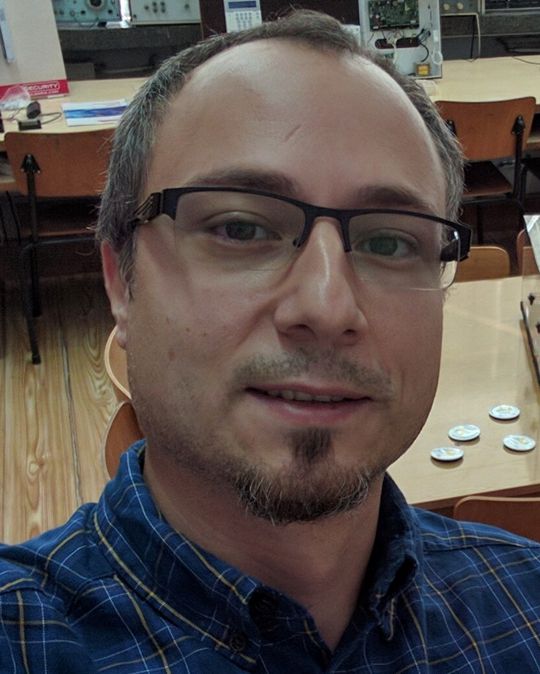
Krassen Kirov Angelov is a full professor at the Department of Communication Equipment and Technologies within the Faculty of Electrical Engineering and Electronics at Technical University - Gabrovo . He has led and participated in 15 research projects, focusing on wireless communication platforms, IoT systems, and optical network optimization. Head, Department of Communication Equipment and Technologies Project Manager for 5G/IoT research (2022) Co-author of 3 textbooks on communication circuits Research Interests include: 5G network design and optimization IoT communication protocols Optical network modeling Secure data transmission Satellite broadcasting systems Smart infrastructure development His recent publications (2021-2025) demonstrate expertise in: Chaotic encryption techniques Neural network applications LoRaWAN coverage planning DVB-S2 signal transmission Passive optical network modeling Radio frequency optimization PhD Students : Plamen Tashev (Radio Channel Monitoring) Mikhail Angelakis (Wireless Resource Management) Victor Krustev (Security Identification) Ivan Zlatev (Network Resource Allocation) Evelina Vaseva (Beekeeping Monitoring)
Assoc. Prof. Petya Asenova, PhD, is a permanent faculty member at New Bulgarian University's Bachelor's Faculty since 2001, holding the rank of Associate Professor in the Department of Informatics. She has served as Director of bachelor's programs in Informatics and Network Technologies, Director of the Master's program in IT Project Management, Head of the Department of Informatics, and Dean of the Bachelor's Faculty. Her academic credentials include: Bachelor's degree in Computational Mathematics from Plovdiv University "P. Hilendarski" Master's degree in Mathematics Education from Plovdiv University "P. Hilendarski" Master's degree in Informatics from Sofia University "St. Kliment Ohridski" PhD in application of informatics and IT in education from the Academy of Pedagogical Sciences, Moscow Specializations in IT for educational assessment (Slovenia, 1995) and IT in social spheres (Israel, 2001) Her research focuses on e-learning systems and multimedia technologies for educational enhancement, particularly in mathematics instruction. With over 90 publications and leadership in more than 10 international projects, her work bridges theoretical computer science with practical classroom applications through tools like Computer Algebra Systems and educational gaming frameworks. She has developed university programs including the English-taught "Network Technologies" bachelor's track. Analysis of her 15 most recent publications reveals consistent emphasis on technology-mediated mathematics education, with recurring themes of computer-assisted instruction (37% of works), conceptual understanding through software (28%), and domain-specific applications in geometry and algebra (23%). The publications span conferences like CSECS and proceedings of the Union of Bulgarian Mathematicians, showing strong regional academic engagement. No scientific awards or fellowships were documented in the source material. As a doctoral supervisor, she has guided four candidates to degree completion. Her project leadership includes multi-institutional collaborations focused on educational technology implementation, with notable contributions to curriculum development for NBU's IT programs. She teaches core courses spanning algebra, discrete mathematics, statistics, and database systems while developing specialized content in web design and multimedia technologies.
Світлана Львівна Воропаєва serves as an Assistant Professor at the Department of Computer Systems and Networks within the Faculty of Physics at Yuriy Fedkovych Chernivtsi National University. Holding a Candidate of Technical Sciences degree (2012) with her dissertation on 'Computerized system of UV sources monitoring', she teaches Engineering Graphics, Computer Graphics, and Technology of Designing Computer Systems while maintaining active research in applied computer engineering. Education: Chernivtsi National University named after Yuriy Fedkovych, Faculty of Physics, Department of Electronic Computing Machines (2000) Her research centers on data compression and protection in telemetry reconfigurable information systems, with significant contributions across computer vision (handwritten text recognition, video parameter optimization), image processing (scanned document enhancement), UV radiation monitoring (Tensor-31M radiometer-dosimeter), and semiconductor photodetector systems. She specializes in hardware-software integration for real-time control applications, particularly in UV source management and smart home technologies, while developing advanced signal processing algorithms for spectral coordination and parameter stabilization. Analysis of her 15 most recent publications (2005-2018) reveals consistent focus on applied solutions bridging computer science and physical instrumentation. Her work demonstrates strong interdisciplinary collaboration, particularly with Vorobets and Dobrovolskyi teams, evolving from semiconductor interface modeling (2005-2007) toward practical implementations in computer vision (2018) and smart systems. Key thematic progression shows increasing emphasis on neural networks, parallel computing, and IoT-integrated hardware solutions while maintaining core expertise in radiation physics and optoelectronics. Professional development is evidenced by 15+ certificates (2019-2023) in digital competencies including Adobe Photoshop, project planning, active learning methods, and international conference participation (Austria, Czech Republic, Romania). Her technical leadership spans hardware-software co-design for UV monitoring systems, photodetector optimization, and embedded control modules, with consistent publication output in Ukrainian and international engineering venues.
Gorditsa Valentina Emanuilivna serves as a Lecturer at the Department of Computer Systems and Networks within the Faculty of Physics at Chernivtsi National University. Her teaching portfolio spans critical disciplines including Information Theory and Coding, Data Transmission Systems, Computer Architecture, Internet of Things for Cyber-Physical Systems, and VHDL Design Technologies, reflecting deep integration of theoretical and applied computing. She earned her Diploma in 2001 from Chernivtsi National University's Faculty of Physics, Department of Computer Systems and Networks, establishing her foundational expertise in hardware and communication systems. Her research centers on data compression and protection within telemetric reconfigurable information processing systems, emphasizing adaptive noise immunity and multilevel coding. This work bridges cryptographic security with hardware reconfiguration to enhance reliability in dynamic transmission environments, particularly for cyber-physical applications requiring real-time data integrity. Analysis of her 2005-2016 publications reveals consistent innovation in telemetric data transmission, with recurring themes of self-adaptive codec reconfiguration, multifrequency code optimization, and reconfigurable environments for security. Her contributions demonstrate a methodical progression from signal generator instrumentation to advanced noise-immunity frameworks, highlighting practical implementations in semiconductor systems and communication protocols. Professional certifications including dComFra workshops, Cisco IoT training, and AllDigitalWeek participation underscore her engagement with emerging technologies, though no formal scientific awards or grants are documented. No information is available regarding academic advising, laboratory leadership, or research teams.
Ivan Buchvarov is an Associate Professor at the Faculty of Physics, Sofia University 'St. Kliment Ohridski', where he leads the Laboratory of Laser Physics and Applications. His work focuses on ultrafast laser systems, nonlinear optics, and photonic applications in biomedical engineering and material science. He has established research infrastructures through competitive projects funded by the Scientific Research Fund and international collaborations. Key research areas: Ultrafast molecular phenomena, optical parametric oscillators, laser surface texturing International partnerships: Max-Born Institute, ELETTRA Synchrotron, Romanian and American institutions His group develops compact laser systems for medical applications and material processing, emphasizing technology transfer and education. He has mentored students in experimental physics and laser technology, integrating research with academic training. Recent publications highlight innovations in metasurface optics, biocompatible scaffolds, and ultrafast spectroscopy. Scientific Awards: Award for Best Project Activity (2011) from Sofia University's Faculty of Physics
Prof. PhD Miroslav Nikolov Galabov is a Professor at the Faculty of Mathematics and Informatics, St. Cyril and St. Methodius University of Veliko Turnovo in Bulgaria. His academic career spans several decades with significant contributions to computer science, particularly in the areas of 3D visualization, virtual and augmented reality, and image processing. He maintains active research collaborations and participates in multiple funded projects at the university. Professor Galabov's research interests focus on cutting-edge technologies including: Image processing and computer vision 3D visualization and modeling Virtual and Augmented Reality systems Microprocessor systems and embedded computing System programming and software architecture Multimedia systems and publishing technologies E-business applications and social network technologies His scholarly output demonstrates a clear evolution from foundational work in digital signal processing and image compression toward contemporary research in cloud infrastructure, semantic web technologies, and digital twin applications. Recent publications show a strong emphasis on practical implementations of AWS infrastructure, microservices architecture, and blockchain solutions for IoT systems. His work consistently bridges theoretical computer science with real-world applications across multiple domains including education, business, and cultural heritage preservation. Professor Galabov actively participates in significant research projects including: "Изследване и анализ на приложението на технологични инструменти и инфраструктура като креативна среда за трансфер на знания" (2025-2025) "Изследване, анализ и популяризиране на мобилни технологии и софтуерни приложения в полза на студенти със специални потребности" (2025-2025) "Изследване възможностите на технологиите за виртуална и добавена реалност за атрактивно представяне и популяризиране на българското фолклорно наследство" (2023-2023) Multiple projects related to 3D visualization, e-learning, and digital infrastructure development