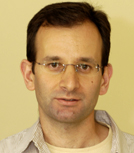
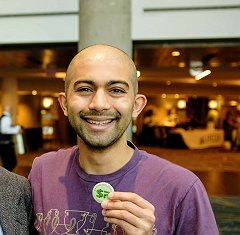
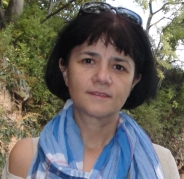
Amalia Foka is an Assistant Professor in Computer Science Applications for the Arts at the Department of Fine Arts & Art Sciences , School of Fine Arts , University of Ioannina , Greece. She has held academic positions at the University of Patras (2005-2013), University of Ioannina (2005-2008), and Computer Technology Institute & Press "Diophantus" (2014-2015). Her research bridges Artificial Intelligence with Digital Art , focusing on Generative AI , Social Media Mining , and Human-Computer Interaction within artistic contexts. Education: BEng in Computer Systems Engineering (1998) from the University of Manchester Institute of Science & Technology (UMIST) , UK MSc in Advanced Control (1999) from UMIST PhD in Robotics (2005) from the Department of Computer Science , University of Crete Her artistic research includes projects like Bushwalking (StyleGAN2 landscape generation), Breaking the Silence (NLP analysis of taboo topics), and The Invisible Structures of the Artworld (social media-driven network visualization). She leads the Multimedia Lab at the University of Ioannina, focusing on AI in Creative Processes and Digital Interaction methodologies.
Ion Androutsopoulos is a Professor of Artificial Intelligence in the Department of Informatics at Athens University of Economics and Business (AUEB), where he also serves as Head of Department. He is founder and co-director of AUEB's Natural Language Processing Group and an Adjunct Researcher at the Digital Curation Unit and "Archimedes" Research Unit of the Research Centre "Athena". His research spans multiple dimensions of Artificial Intelligence with a focus on Natural Language Processing. Key interests include: Machine learning in NLP, particularly deep learning and large language models Question answering and retrieval augmented generation for document collections Dialog systems for new languages and knowledge domains Sentiment analysis and emotion recognition from text and speech Detecting toxic posts and disinformation online Image-to-text generation for medical diagnostics NLP applications in biomedical, legal, and financial domains His recent publications demonstrate strong activity across medical AI (particularly ImageCLEFmed Caption competitions where his group consistently ranks 1st-2nd), legal NLP (LexGLUE benchmark), financial NLP (EDGAR-CRAWLER), and multilingual challenges. His work shows increasing emphasis on large language models, explainability, and practical applications. Notable awards include: Top 2% scientist worldwide (Stanford University database, 2023) Multiple AUEB Excellent Teaching Awards (2017-18, 2021-22, 2023-24) Three consecutive BioASQ awards (2018-2020) Multiple 1st/2nd place rankings in ImageCLEFmed Caption competitions (2021-2025) He actively organizes major events including the Athens Natural Language Processing Summer School (AthNLP) and SemEval tasks. His group maintains strong industry and research collaborations, particularly in medical AI applications where they've developed systems that generate diagnostic captions from medical images with state-of-the-art performance.
Badogiannis Efstratios is a Professor at the Department of Structural Engineering , National Technical University of Athens. He serves as Deputy Dean and works in the Reinforced Concrete Laboratory, Zografou Campus, Athens, Greece. Email: badstrat@central.ntua.gr Phone: +30 210 772 1266 Research Interests: Focus on sustainable concrete technology, pozzolanic materials (metakaolin, palygorskite clay), durability of lightweight and self-compacting concrete, seismic isolation systems for bridges, application of artificial neural networks in civil engineering, and mechanical/thermal activation of clays. Publication Trends: Recent work emphasizes AI-driven rheological modeling, seismic resilience of precast bridge systems, durability of concretes incorporating industrial by-products (e.g., by-pass filter dust, rice husk ash), and nano-materials for structural health monitoring. Laboratory Affiliation: Actively contributes to research at the Reinforced Concrete Laboratory, focusing on sustainability, corrosion resistance, and innovative construction techniques.
Laxman Dhulipala serves as an Assistant Professor in the Department of Computer Science at the University of Maryland, College Park, while also working as a research scientist at Google Research with the Graph Mining team. Dr. Dhulipala earned his Ph.D. from Carnegie Mellon University under Guy Blelloch's supervision and completed a postdoctoral fellowship at MIT with Julian Shun. His research centers on efficient parallel algorithms, particularly for parallel clustering and graph processing, along with developing computational models for emerging hardware technologies. His scholarly output demonstrates significant expertise across parallel computing domains, with particular emphasis on scalable graph algorithms, dynamic data structures, and computational geometry. Dr. Dhulipala's work bridges theoretical computer science with practical systems implementation, producing algorithms that achieve both theoretical optimality and real-world performance. His research group has made substantial contributions to benchmarking frameworks including the Graph Based Benchmark Suite (GBBS) and ParClusterers Benchmark Suite, establishing standardized evaluation methods for graph processing systems. The collective work shows progression from theoretical foundations to practical implementations that handle massive-scale datasets. Best Paper Award at SPAA 2022 Best Paper Runner Up at VLDB 2022 Distinguished Paper Award at PLDI 2019 Memorable Paper Award Finalist at NVMW'20 CMU's SCS Dissertation Award Honorable Mention As an educator, Dr. Dhulipala mentors numerous graduate students while teaching advanced courses in algorithm design and parallel computing. His research collaborations span multiple institutions including Carnegie Mellon University, MIT, and Google Research, reflecting his position at the intersection of academia and industry research.
Ioannis Iglezakis is an Associate Professor at the School of Law, Aristotle University of Thessaloniki (AUTH), specializing in the intersection of law and technology. His academic career spans over three decades with continuous contributions to informatics law, cyber law, data protection, and privacy law. At AUTH, he teaches courses including Law of Informatics, Computers and Law I (Cyberlaw I), Computers and Law II (Privacy and Security in the Information Society), Legal Aspects of Cybercrime, Internet-Law, and Law and Information Technology. Dr. Iglezakis earned his undergraduate degree in Law from AUTH in 1987, followed by a Magister Legum Europae from Hannover University in 1993. He completed his postgraduate studies in History, Philosophy and Sociology of Law at AUTH in 1990 and earned his PhD in Law from AUTH in 1999. His educational background combines Greek legal training with European legal perspectives. His research interests focus on the legal challenges posed by digital technologies, with particular emphasis on data protection, privacy law, cybercrime regulation, digital rights, and the application of GDPR in various contexts. He has published extensively on topics including the right to be forgotten, digital identity management, workplace surveillance in the digital age, hate speech online, and the legal implications of emerging technologies like blockchain and artificial intelligence. His work bridges theoretical legal analysis with practical applications in the rapidly evolving digital landscape. The trends in his publications reveal a consistent focus on the evolving relationship between law and technology, with increasing attention to GDPR implementation, health data protection, and the challenges of algorithmic decision-making. His work spans multiple disciplines including legal theory, privacy studies, cyber security, and digital governance, reflecting the interdisciplinary nature of modern informatics law. Dr. Iglezakis has supervised over 50 master's theses at AUTH, mentoring the next generation of legal scholars in areas including cloud computing contracts, personal data protection, social media law, intellectual property in digital environments, and cybercrime. His administrative roles have included membership on the European Educational Programs Committee (2011-2012) and the Legal Committee of AUTH (2013-2014). His research projects include the 2018-2019 study on 'Legal Issues of Mobile Applications Development, Distribution and Use,' the 2014 '6th International Conference on Informatics Law,' and the 2013-2015 Center of Excellence for Cybercrime for Education, Research and Training in Greece. These projects highlight his commitment to addressing practical legal challenges in the digital domain while contributing to academic discourse.
Sotiris Christodoulou is an Associate Professor at the Department of Electrical and Computer Engineering within the College of Engineering at the University of Peloponnese. He also serves as a research associate at the 'Diofantos' Institute of Computer Technology and Publishing. His academic career spans multiple institutions where he has taught graduate and undergraduate courses across seven different universities since 2004. Dr. Christodoulou earned his B.A. in Computer Engineering and Informatics from the University of Patras in 1994 and completed his PhD in Web Engineering from the same institution in 2004. His educational background established the foundation for his extensive research career focused on web technologies and applications. His primary research interests include Web Engineering, Web Application Performance Optimization, Web Code Quality, Semantic Web technologies, Hypermedia Systems, and emerging Web 2.0 and Web 3.0 technologies. His work extends to Virtual Interactive Environments, 3D and Augmented Reality applications, and Spatial Hypertext systems. Christodoulou's research bridges theoretical web engineering principles with practical applications in cultural heritage, education, and urban infrastructure systems. His research output comprises over 45 publications in international journals, book chapters, and conferences, accumulating more than 450 citations. He has participated in over 23 European and National Research and Development Projects focused on web software technology, hypermedia applications, and 3D educational and cultural applications. Professional member of ACM Professional member of IEEE Member of organizing committees for over 15 international scientific conferences Reviewer for recognized international journals (ACM, IEEE, etc.) Christodoulou has extensive teaching experience across seven universities, specializing in programming languages, web software engineering, software quality, and data management. His research projects typically combine applied research with cutting-edge technology implementation for real-world problems in large organizational information systems. He maintains regular office hours at Building K, Office K2.02 at the University of Peloponnese, with appointments available on Mondays and Thursdays.
Panagiotis Kyriakoulakos is an Assistant Professor in Computer Animation at the Department of Product and Systems Design Engineering, University of the Aegean. He previously served as Lecturer at the same department (2010-2018) and Adjunct Lecturer at Paris 1 University (1987-1992). His academic career spans over 35 years with expertise in digital arts, animation, and new media. Education: Electrical Engineering (Aristotle University of Thessaloniki), DEA in Cinema/Television (Paris I), PhD in Art Sciences (Paris X). Professional Experience: Managing Director at Post Reality (1994-2006), New Media Director at PLD Production (2006-2010), awarded SCAM (1991) and Chevalier des Palmes Academiques (2014). Research Focus: Creative processes in animation, digital aesthetics, interactive systems, and cultural heritage projects like ARCHEOGUIDE and HIST3D. His research explores intersections between technology and artistic expression, emphasizing entrepreneurship in creative industries. Key contributions include the first Greek 30-minute computer-animated TV special Alexandra Meets the Space Toons (2003) and the Homeweb VOD platform pilot (2010). Dr. Kyriakoulakos coordinates the XARTS International Conference/School since 2013 and leads the Interactive Systems Design Lab. His work bridges academic research with practical applications through projects like the HIST3D framework and Paris-based research grants (2013). Awards: SCAM Video Magazine Editor Award (1991), Paris Research Grant (2013), French Academic Palms (2014). Labs/Teams: Interactive Systems Design Lab (since 2000), XARTS Conference Leadership. Publications: Over 30 articles, 3 books including 70 Years of Greek Animation (2016) and foundational texts on animation techniques.
Nikolaos Papaspyrou is a Professor at the School of Electrical and Computer Engineering of the National Technical University of Athens (NTUA) and a member of the Software Engineering Laboratory . His research focuses on the theory and implementation of programming languages, including semantics, type systems, compilers, static analysis, and formal verification. Since October 2021, he has been on leave from NTUA, working as a Software Engineer for Google in the memory management team for the V8 JavaScript and WebAssembly engine. He previously served as Director of the Division of Computer Science (2017-2019) and was on sabbatical with Google's compiler group in Munich (2015-2016). His work includes the RELEASE project (EU FP7 STREP) for reliable large-scale server software and uncertainty handling in distributed databases (European Social Fund). Ph.D. and Diploma in Electrical and Computer Engineering from NTUA M.Sc. in Computer Science from Cornell University His research interests span programming languages , software engineering , and formal verification , with recent publications on coinductive proofs in Liquid Haskell, concurrency semantics, and quantum compilation. He has supervised over 50 diploma projects and mentored numerous students now at institutions like MIT, Princeton, and UC Berkeley. Awards include conference organizing and program committee roles, though no formal scientific prizes are listed.
Nikas Thomas is an External Instructor at the Department of Informatics (DI) of the National and Kapodistrian University of Athens (NKUA). His work spans multiple interdisciplinary areas including quantum cryptography, fiber optic sensing technologies, and seismic monitoring. Key roles include advancing secure communication protocols through quantum key distribution (QKD) and developing novel Li-Fi transceivers using perovskite photodiodes. He also pioneers applications of Distributed Acoustic Sensing (DAS) for urban earthquake monitoring in Athens, leveraging existing fiber-optic infrastructure for environmental and geophysical studies. His research bridges theoretical frameworks (e.g., phase transmission analysis) with practical implementations in optical communication systems and seismic detection. Research interests focus on: Secure optical communication systems leveraging quantum principles Fiber optic-based seismic and acoustic sensing Emerging Li-Fi technologies for high-speed wireless networks Phase-sensitive fiber optic analysis for geophysical applications Publications from 2022-2024 highlight trends in: Quantum security protocols for optical and radio-over-fiber systems Urban DAS applications for earthquake monitoring Microwave frequency interferometry for low-cost seismic sensors No scientific awards are explicitly listed in the provided materials. His work often involves collaborative projects with industry and academic partners, though specific grants are not detailed here. Current projects include optimizing DAS for real-time urban seismic networks and exploring novel modulation formats for secure optical transmission.
Evaggelia Pitoura is a Professor in the Department of Computer Engineering and Informatics at the University of Ioannina, Greece, and a Lead Researcher at the Archimedes Research Unit, ATHENA Research Center. Her work spans data management, distributed systems, and mobile computing, with a strong focus on database personalization and diversity. Her research interests include data diversity, contextual preferences, XML data management, peer-to-peer systems, and mobile computing . She has pioneered work in result diversification, preference-aware querying, and distributed data indexing, publishing extensively in top venues such as PVLDB, ICDE, SIGMOD, and IEEE TPDS. The recent publications highlight a consistent trend in personalized, context-aware database systems , with emphasis on improving user experience through intelligent query processing, recommendation, and efficient data organization in distributed environments. Best Paper Award, SIGMOD 1999 Best Paper Award, PVLDB 2013 She has advised several PhD students, including Georgia Koloniari, Kostas Stefanidis, Marina Drosou, and Konstantinos Semertzidis, who now hold positions in academia and industry. She teaches courses in Databases and Information Retrieval and actively contributes to the academic community through program committee roles in major conferences like ICDE, VLDB, SIGMOD, and WWW. She leads the Distributed Management of Data Group , fostering innovation in scalable and intelligent data systems.
Christos Diou is an Associate Professor of Artificial Intelligence and Machine Learning at the Department of Informatics and Telematics, Harokopio University of Athens, Greece. His academic career spans over 15 years of participation in national and international research projects, with a focus on machine learning algorithms, domain generalization, causal inference, and bias mitigation. He earned a BSc and Ph.D. in Electrical and Computer Engineering from Aristotle University of Thessaloniki. His research emphasizes the application of machine learning to healthcare, addressing challenges such as visual bias mitigation, causal effect estimation from observational data, and fairness-aware representation learning. Notable projects include REBECCA and RELEVIUM , both EU-funded, and MELIORA , targeting lifestyle interventions for breast cancer risk reduction. He has published extensively in top-tier venues like IEEE TPAMI, CVPR, and ICCV. Christos is a leading voice in AI ethics and healthcare innovation, with over 150 publications and best paper awards at IEEE Big Data Service 2023 and AIAI 2022. His work includes developing platforms like Effector for feature effects and Beam for behavior studies. He collaborates with institutions such as Karolinska Institutet and CERTH/ITI, and his students include PhD candidates Ioannis Sarridis and Aristotelis Ballas.
Michael D. Bond is a Professor in the Department of Computer Science & Engineering at Ohio State University's College of Engineering. He leads the Programming Languages and Software Systems (PLaSS) Research Group, which focuses on designing program analyses and software and hardware systems that enhance computing reliability, scalability, and security. His academic service includes general chair for PLDI 2027, program committee membership for multiple top conferences, and committee roles in SIGPLAN Research Highlights (2024-2027). Professor Bond's research spans programming languages, systems, and security, with particular expertise in memory management, concurrency, hardware transactional memory, information flow control, and predictive race detection. His work bridges theoretical foundations with practical implementations, as evidenced by numerous open-source projects accompanying his publications. The PLaSS group has made significant contributions to understanding and improving memory models, developing efficient garbage collection techniques for modern architectures, and creating novel approaches to secure programming in languages like Rust. Analysis of his recent publications reveals a clear trajectory toward addressing security and reliability challenges in modern computing systems, particularly through language-based approaches. His work increasingly focuses on Rust programming language security mechanisms, memory disaggregation for datacenters, and advanced techniques for detecting and preventing concurrency bugs. The research demonstrates strong continuity in exploring memory models and concurrency while adapting to emerging hardware trends and security challenges. Outstanding Teaching Award, Department of Computer Science and Engineering, Ohio State University (2018) Lumley Research Award, College of Engineering, Ohio State University (2016) OOPSLA 2015 Distinguished Paper and Artifact Awards NSF CAREER Award ACM SIGPLAN Outstanding Doctoral Dissertation Award Intel PhD Fellowship Professor Bond actively mentors several PhD students including Chujun Geng, Vincent Beardsley, Chris Xiong, Victor Chen, and Noah Charlton, with external co-advisee Zixian Cai at Australian National University. His research is currently supported by multiple NSF grants including SaTC-2348754 (2024-2027), CyberCorps-2336531 (2024-2029), and CSR-2106117 (2021-2025), reflecting sustained funding for his work in information flow control, security, and systems research. The PLaSS Research Group maintains a strong presence in both academic and industrial communities, with graduated PhD students securing positions at major technology companies like Google, Amazon Web Services, and Huawei, as well as academic positions at institutions like UIUC and IIT Kanpur. The group's work combines theoretical rigor with practical implementation, consistently producing open-source artifacts that enable reproducibility and further research in the systems and programming languages community.
Andreas Papasalouros is an Associate Professor at the Department of Mathematics, University of the Aegean. He holds a Ph.D. in Engineering from NTUA (2004), a Diploma in Electrical and Computer Engineering (2000), and a BSc in Physics (1992). His research focuses on Educational Technology , Adaptive Hypermedia , and Ontology Engineering . Education Ph.D. in Mechanics, School of Electrical and Computer Engineering, NTUA (2004) Diploma in Electrical and Computer Engineering, NTUA (2000) BSc in Physics, National and Kapodistrian University of Athens (1992) Research Interests Papasalouros's work centers on leveraging UML and Ontologies for designing Educational Software . He explores Automated Assessment systems, Accessibility solutions (e.g., TeX-to-Braille), and Mobile Learning applications. His studies often intersect with Collaborative Learning and Semantic Web technologies. Key Contributions His publications span Adaptive Hypermedia , Ontology-Driven Learning , and Accessibility Tools . Notable works include Ob-AHEM (2002), Grid4All Ontology (2008), and TeX-to-Braille Transcribing (2017). Recent trends emphasize Game-Based Learning and Query Log Analysis for ontology creation. Courses Taught New Technologies in Education (3rd semester) Introduction to Computer Science (2nd semester) Advanced Programming Languages (6th semester) Postgraduate Course in New Technologies in Education
Christos Tryfonopoulos is an Associate Professor and Head of the Department of Informatics & Telecommunications at the University of the Peloponnese, where he leads the Software and Database Systems (SoDa) Lab. His academic career spans prestigious institutions including the Max-Planck Institute for Informatics in Germany, where he led the P2P and Information Management research area from 2006-2009, and the Technical University of Crete, where he completed his PhD and MSc degrees. His research interests focus on information management, distributed systems, digital libraries, and data/user anonymity. His work bridges theoretical foundations with practical applications across diverse domains including environmental monitoring, cybersecurity, cultural heritage, and medical informatics. He has developed innovative frameworks for pollution prediction, cyber-threat intelligence, and academic expertise mapping that demonstrate the interdisciplinary nature of his research. Professor Tryfonopoulos has published over 80 papers in top-tier journals and conferences including TOIS, TKDE, SIGIR, and SIGMOD. His recent work shows a strong trend toward applying machine learning techniques to information management problems, with publications spanning environmental science, cybersecurity, and bibliometrics. His research group has developed several significant tools including VeTo+ for expert set expansion, inTIME for cyber-threat intelligence, and Hydria for cultural heritage analytics. Candidate for best research paper in ESWC 2016 conference Honorable mention for best poster (3rd place) in ESWC 2012 conference Award as Distinguished Scientist Excelling in Research Abroad (2008) Best student paper award in ECDL 2005 conference Heraclitus PhD fellowship from Greek Ministry of Education (2002-2005) National Scholarship Foundation of Greece (IKY) scholarship (1998) Professor Tryfonopoulos has supervised 5 PhD students (3 in progress), 19 MSc students, and 31 BSc students. He has led or participated in 13 competitive EU and national research projects including ENIRISST+ for shipping and transport infrastructure, WeCare for student support structures, and FORESIGHT for cybersecurity simulation. His current research focuses on intelligent infrastructure for transportation logistics, cyber-threat intelligence systems, and educational technologies for data science.
Maria Hatzigianni is an Assistant Professor at the University of West Attica with an honorary position at the University of Melbourne. Boasting over 13 years of early childhood teaching experience across Greece and Australia plus 7+ years in academia, she specializes in digital technology integration for children birth to 8 years. Her academic foundation includes: PhD from the University of Melbourne (full scholarship), researching technology's impact on children's self-esteem Masters in ICT in Education from National and Kapodistrian University of Athens (National Scholarship) Bachelor's in Early Childhood Education from National and Kapodistrian University of Athens Hatzigianni's research critically examines technology's intersection with creativity, play, and social-emotional development using mixed methodologies. She actively collaborates with children, teachers, and parents across cultural contexts, with current projects addressing touchscreen usage by infants, STEAM integration, makerspaces, and virtual reality applications. Her work emphasizes teacher professional development in digital competencies, grounded in critical/postmodern ecological frameworks. Publication analysis reveals consistent cross-cultural investigations (Greece, Australia, China) into technology-enhanced learning environments, quality improvement systems in ECEC, and innovative pedagogies like 3D printing. She consistently addresses how digital tools can enhance early learning while navigating implementation challenges across diverse educational settings. Though no specific scientific awards beyond her educational scholarships are documented, Hatzigianni actively contributes to early childhood organizations. Her research collaborations include quality improvement studies with Professor Linda Harrison and makerspace/STEAM projects with Professor Matt Bower. Current research initiatives demonstrate her global impact: Touchscreen beliefs study (birth to three) Australian quality improvement systems STEAM curriculum embedding Makerspace pedagogies with 3D printing VR applications in teacher education Google Suite implementation for preservice teachers These projects highlight her commitment to evidence-based technology integration in early childhood education worldwide.