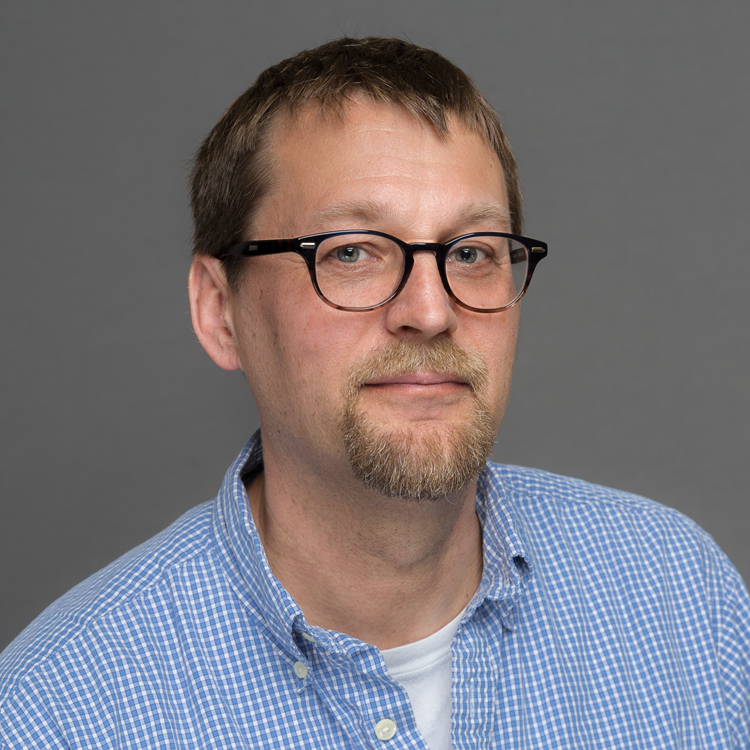
Helmut H. Strey is an Associate Professor in the Department of Biomedical Engineering at Stony Brook University. His research focuses on micro- and nanotechnologies for quantitative biology , including single-cell analysis, cancer metabolism modeling, and functional MRI data analysis. He holds academic appointments since 2008 and has pioneered technologies like tumor-on-a-chip and optical decoders for translation stages. Education: PhD in Biophysics (Technical University München, 1993), postdoctoral training at NIH (1994-1998). Awards include the NSF CAREER Award (2000-2005), Dillon Medal (2003), and Weston Visiting Professorship (2020). Research interests span cell-to-cell variability , Warburg effect in cancer , and Bayesian analysis of time-series data . His lab develops tools for 3D tumor microenvironments, MRI-compatible drug delivery systems, and biomimetic neural circuit models. Teaching includes advanced numerical methods in biomedical engineering, quantitative biology, and biomolecular analysis. Active in open hardware projects, including microfluidics controllers and IoT devices for health monitoring.
Patrick Skeba is a Teaching Assistant Professor at the University of Pittsburgh's Department of Computer Science within the School of Computing and Information. He holds a PhD in Computer Science from Lehigh University (2022) and bachelor's degrees in Cognitive Science and Computer Science from Johns Hopkins University (2017). His research focuses on internet privacy, AI ethics, and the responsible use of data. He teaches courses in machine learning and programming. Research Interests: Skeba's work bridges technology and societal impact, emphasizing privacy risks in data systems, algorithmic fairness, and user-centric privacy frameworks. His recent studies explore informational friction in data collection, community-based privacy strategies, and lay-expert disparities in understanding privacy-enhancing technologies (PETs). Publications: His articles analyze privacy dynamics in digital spaces, from pandemic-era discourse on r/privacy to methodological approaches for categorizing technology non-use. His earlier work includes breakthroughs in sleep disorder diagnostics, particularly periodic leg movement (PLM) analysis and telemedicine applications for neurological conditions. Awards: No scientific awards listed. Grants and advising details are currently unspecified. Labs/Teams: No specific lab affiliations mentioned in provided materials. His teaching and research emphasize collaboration across computational and social domains.
Dr. Bhavna Sharma is an Associate Professor and Director of the Chase L. Leavitt Master of Building Science Program at the USC School of Architecture. Her work focuses on decarbonization, bio-based materials innovation, and sustainable healthcare infrastructure. She leads the Keck USC Sustainable Healthcare Initiative (KUSHI) to advance environmentally conscious healthcare systems. Dr. Sharma holds a Ph.D. in Civil and Environmental Engineering from the University of Pittsburgh, with additional degrees in Art History and Architecture. Her research spans structural systems optimization from material harvesting to building-scale applications, emphasizing bio-composites like bamboo and timber. She co-chairs USC's Presidential Working Group on Sustainability, contributing to Assignment: Earth climate goals. Courses taught include seismic design, structural systems, and building science integration. Key research areas include lifecycle assessment in healthcare, seismic-resistant designs, and interdisciplinary standards for non-conventional materials. Her work bridges material science, architectural practice, and policy to address global sustainability challenges.
Eleonora Vacca is a PhD student and Research Fellow in the Department of Automatic Control and Computer Science (DAUIN) at the Polytechnic University of Turin. She holds a B.S. in Electronic Engineering from the University of Palermo (2018) and an M.S. in Electronic Engineering-Embedded Systems from Politecnico di Torino (2021). Her research focuses on digital hardware design, reliability engineering, reconfigurable devices, and AI applications in aerospace and safety-critical systems. She is a member of the Aerospace and Safety Computing Lab and the CAD - Electronic CAD & Reliability Group (DAUIN). Her work addresses challenges such as radiation effects mitigation in space missions, fault-tolerant AI accelerators, and real-time anomaly detection in satellite telemetry. She has contributed to projects like the RAMSES CubeSat-1 Development (2025-2026), funded by commercial contracts. In 2024, she won the Best Student Paper Award at the NEWCAS Conference for her research on radiation effects in space missions. Vacca collaborates on teaching, including assisting in the course 'Electronic Calculators' for Computer Engineering students. Her recent publications explore AI resilience in RISC-V ecosystems, radiation environment analysis for space missions, and gesture recognition systems for smart cities. She actively contributes to conferences such as the ACM International Conference on Computing Frontiers and the IEEE International Smart Cities Conference.
Stefano Leonardi is a Full Professor in the Department of Computer, Control and Management Engineering Antonio Ruberti at Sapienza Università di Roma. His research focuses on Algorithm Theory, Algorithms and Data Science, and Economics and Computation. He leads the ERC Advanced Grant project AMDROMA, exploring algorithmic mechanisms for online markets. He has held roles as Conference Chair for STOC 2021, WWW 2015, and FUN 2018, and coordinates the Sapienza School of Advanced Studies (2016-2018). His work spans approximation algorithms, online algorithms, and mechanism design. Awards include the ERC Advanced Grant and EATCS Fellowship. His research interests emphasize foundational algorithmic problems in web-based markets, leveraging rigorous design and large-scale data analysis. Recent projects include ALGADIMAR (PRIN 2019-2022) for digital market algorithms. He chairs the Highlights of Algorithms conference series and serves on program committees for top venues like EC, ICALP, and SODA. His lab focuses on web algorithmics and data mining, addressing challenges in online labor markets and fair division. Leonardi's academic contributions include over 100 publications, with recent work on fair algorithms, prophet inequalities, and mechanism design in auctions. He has pioneered methods for submodular optimization, online learning, and multi-agent systems. Grants and awards reflect his leadership in bridging theory with real-world applications, particularly in digital economies. Grants: ERC Advanced Grant (2018-2023), PRIN ALGADIMAR (2019-2022) Leadership: Chair of ACM STOC 2021, WWW 2015, and 9th FUN Conference Labs/Teams: Laboratory on Web Algorithmics and Data Mining Key Projects: AMDROMA (algorithmic mechanisms), ALGADIMAR (digital markets)
Majid Ghaderi is a Professor in the Department of Computer Science at the University of Calgary, Faculty of Science. His expertise spans network algorithms, secure communication, and machine learning applications in network control. He holds a Ph.D. in Computer Science from the University of Waterloo (2006), and M.Sc. and B.Sc. degrees in Software Engineering from Sharif University of Technology (2001 and 1999). Education: Ph.D. Computer Science, University of Waterloo, 2006 M.Sc. Software Engineering, Sharif University of Technology, 2001 B.Sc. Software Engineering, Sharif University of Technology, 1999 Research Interests: Dr. Ghaderi focuses on optimizing network algorithms, securing communication in distributed systems, and leveraging machine learning for network control. His work addresses challenges such as secure wireless protocols, SDN-based network management, and efficient resource allocation in data centers. He explores proactive traffic scheduling and anomaly detection in critical infrastructures like industrial control systems and vehicular networks. Publications Trends: His recent work emphasizes covert communication in heterogeneous networks, adaptive federated learning in edge environments, and low-overhead diagnostic systems for cloud networks. He also investigates cybersecurity defenses against hardware vulnerabilities and dynamic threat landscapes. Awards: Best in-session Presentation Award, IEEE INFOCOM 2018 Municipal Excellence Award, Government of Alberta 2018 Faculty of Science Excellence in Teaching Award 2012 Advising & Grants: While no specific advisees are listed, his research has been supported by grants focusing on network security, edge computing, and IoT applications. He teaches CPSC 441 (Computer Networks) and maintains an active lab focused on network systems and cybersecurity. Labs & Teams: His research group collaborates on projects involving software-defined networks, vehicular communication, and industrial IoT security. The team develops open-source tools for network monitoring and anomaly detection.
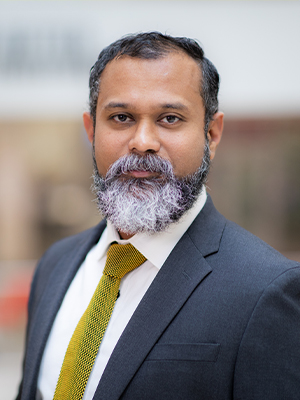
Isuru Godage is an Assistant Professor in the Department of Engineering Technology & Industrial Distribution at Texas A&M University's College of Engineering. He holds affiliated faculty positions in Mechanical Engineering and Multidisciplinary Engineering. His work focuses on advanced robotics systems, particularly soft robots, continuum arms, and their applications in surgery and blockchain-based collaboration. He earned a B.Sc. (Hons) in Electronic and Telecommunication Engineering from the University of Moratuwa, Sri Lanka (2007), and a Ph.D. in Robotics, Cognition, and Interaction Technologies from the University of Genova – Italian Institute of Technology, Italy (2013). Research Interests: Soft robots and continuum robots Modular robotic systems MRI-compatible surgical robotics for intracerebral hemorrhage evacuation Motion planning and control of underactuated systems Blockchain-enabled trustless collaboration between humans and robots His publications emphasize dynamic control of soft robotic arms, kinematic modeling of continuum systems, and bio-inspired designs for medical and industrial applications. Recent work explores locomotion strategies for soft quadrupeds and snake-like robots, alongside innovations in decentralized robotic data frameworks. Dr. Godage has secured grants such as the NSF CAREER Award (2021) focused on transformable soft robots and collaborative projects with the National Robotics Initiative (NRI). His research bridges robotics mechanics, control theory, and emerging technologies like blockchain for swarm robotics.
Professor Ingrid Bouwer Utne is a faculty member at the Department of Marine Engineering, Norwegian University of Science and Technology (NTNU). Her primary research focuses on risk analyses of ships, marine systems, and autonomy, with emphasis on operational safety, maintenance management, and risk control in autonomous maritime technologies. Key Projects: Leader of the Risk Group at NTNU, involved in the SFI Autoship initiative and ERC AdG BREACH project addressing risk-based rationality in autonomous systems. Research Interests: Autonomous systems design, probabilistic risk assessment, safety engineering, and risk-informed decision-making for marine operations. Grants & Funding: Secured funding from the Research Council of Norway, MAROFF, and industry partners for projects like ORCAS (Online Risk Management for Autonomous Ships) and UNLOCK (Supervisory Risk Control). She supervises numerous PhD students and postdocs, focusing on topics such as autonomous vessel navigation, risk modeling for underwater robotics, and decarbonization of maritime systems. Her work bridges theoretical risk analysis with practical applications in marine autonomy and safety systems.
Stavros G. Vougioukas is a Professor and Vice Chair in the Department of Biological and Agricultural Engineering at the University of California, Davis. His research focuses on agricultural robotics, mechanization, and automation for specialty crops, with particular emphasis on robotic harvesting systems and precision agriculture technologies. He leads initiatives in developing actuator systems, perception, and control mechanisms to optimize crop management. Key areas of expertise include robotic fruit harvesting, autonomous vehicle navigation in orchards, and site-specific pest management strategies. His work integrates mechanical engineering principles with advanced automation to address labor shortages and improve agricultural efficiency. Recent projects emphasize data-driven solutions for yield estimation, worker activity analysis, and economic viability of robotic systems. Academic contributions span over 50 peer-reviewed publications (2023-2025), with a focus on robotic orchard platforms, crop transport systems, and sensor-based automation. Notable innovations include vacuum suction end-effectors for fruit harvesting and GNSS-free navigation systems for autonomous vehicles. He also explores sustainable agricultural machinery through techno-economic analyses of electric/hybrid tractors. Current research bridges robotics and agricultural economics, addressing labor cost optimization and precision irrigation. His lab collaborates with industry partners to translate prototypes into field-ready solutions, emphasizing practical applications for specialty crop production systems.
Dr. Rishita Nandagiri is a feminist researcher and academic currently serving as a Lecturer (Assistant Professor) in the Department of Global Health & Social Medicine at King's College London. She previously held research and teaching positions at the London School of Economics (LSE), including an ESRC Postdoctoral Fellowship and an LSE Fellow in Health and International Development. Her work is deeply rooted in reproductive justice, gender, and global health, with a focus on the Global South. PhD in Social Policy, London School of Economics (2019) ESRC Postdoctoral Fellow, LSE Department of Methodology (2020-2021) LSE Fellow in Health and International Development (2019-2020) Research Assistant, LSE Department of Media and Communications (2018-2019) Dr. Nandagiri’s research centers on reproductive (in)justices, interrogating how power and politics shape abortion access, self-managed abortion, care trajectories, and reproductive governance. Her work is interdisciplinary, drawing on feminist theory, qualitative and participatory methods, policy analysis, and co-production with communities and organizations. She has extended her research to examine the impact of the COVID-19 pandemic on abortion and the role of lay health providers in care delivery. Her methodological interests include multi-method designs that integrate interviews, archival research, and community engagement. The 15 most recent articles reflect a strong trajectory in reproductive justice, with increasing engagement with feminist economics, carceral systems, and global policy. Themes include structural violence, legal pluralism, care ethics, and transnational advocacy. Her publications span high-impact journals in public health, social policy, gender studies, and media, indicating a broad interdisciplinary reach. Scientific awards and recognitions include: ESRC Postdoctoral Fellowship (2020-2021) LSE Class Teacher Award (2020) LSE Research Investment and Infrastructure Funds (2020) Best PhD Poster Prize, British Society for Population Studies (2018) LSE PhD Studentship (2015-2019) Dr. Nandagiri has advised on and contributed to numerous research grants, particularly those related to reproductive health, digital privacy, and pandemic response. She has collaborated with major institutions such as UNFPA, the Women’s Global Network for Reproductive Rights, and FRIDA. She co-founded the Abortion Book Club and serves on editorial and advisory boards, including BMJ Sexual & Reproductive Health and the International Union for the Scientific Study of Population’s Abortion Research panel. She also co-convenes the Development Studies Association’s Women and Development Study Group, demonstrating strong leadership in academic and advocacy networks. She is actively involved in public engagement, contributing to LSE blogs, media outlets like Women's Health Magazine UK, and platforms such as the Oxford Human Rights Hub and Harvard’s Bill of Health. Her lab and team affiliations are not explicitly named, but her collaborative projects suggest strong ties to interdisciplinary research groups focused on global health, reproductive justice, and digital rights.
Prof. Dr.-Ing. Weihan Li is a Junior Professor at RWTH Aachen University, specializing in Artificial Intelligence and Digitalization for Batteries. He is affiliated with the Institute for Power Electronics and Electrical Drives (ISEA) and the Center for Ageing, Reliability, and Lifetime Prediction of Electrochemical and Power Electronic Systems (CARL). His research bridges informatics, electrochemistry, and power electronics to advance battery technology through AI. B.Sc. in Automotive Engineering (Tongji University, 2014) M.Sc. in Automotive Engineering and Transport (RWTH Aachen, 2017) Ph.D. in Electrical Engineering and Information Technology (RWTH Aachen, 2021, summa cum laude) Prof. Li’s research focuses on AI-driven battery modeling, diagnostics, and optimization. Key areas include digital twin technology, electrochemical parameterization, and lifetime prediction using field data. He explores multi-scale kinetic processes, thermal management, and mechanical-electrochemical coupling effects in battery systems. The articles listed reflect his leadership in AI-powered battery analytics, spanning degradation prediction, fast charging, failure mode analysis, and grid-scale storage. His work emphasizes both theoretical innovation (e.g., diffusion models, physics-informed neural networks) and practical applications (e.g., second-life battery screening, automotive integration). Clarivate Highly Cited Researcher 2024 BMBF BattFutur Research Group (€2M+) German Thesis Award (Körber Foundation) Reichart Prize vgbe Innovation Prize Battery Young Research Award Umbrella Award RWTH Innovation Award Prof. Li leads an interdisciplinary research group with over €6 million in grants from BMBF, BMWK, BMDV, European Commission, and industry partners. His teams focus on battery informatics, AI-driven diagnostics, and digitalization of testing processes at CARL and ISEA.
Prof. Maryline Laurent is a Professor at Telecom SudParis, affiliated with the SAMOVAR research laboratory. Her work focuses on cybersecurity, privacy-preserving technologies, blockchain applications, and IoT security. She has contributed to numerous high-impact publications and conferences, addressing challenges in secure healthcare systems, decentralized identity management, and privacy in distributed systems. Her research spans cryptographic protocols, access control mechanisms, and compliance with EU data protection regulations. Key areas of expertise include secure communication protocols for IoT, blockchain-based solutions for healthcare, and privacy-enhancing technologies. She has collaborated on projects such as self-sovereign identity frameworks, anonymized data aggregation, and privacy-preserving smart grid systems. Her work emphasizes practical methodologies for assessing re-identification risks in anonymized datasets and designing secure systems compliant with evolving regulations. Prof. Laurent’s contributions extend to book chapters and edited volumes on digital identity management and wireless network security. She actively participates in international conferences and initiatives, advocating for privacy-by-design principles in intelligent infrastructures.
Dr. Yelda Turkan is an Associate Professor in the School of Civil and Construction Engineering at Oregon State University, where she leads research in automation, computer vision, and machine learning for sustainable infrastructure. She holds a PhD from the University of Waterloo and dual BS degrees in Civil Engineering and Geomatics Engineering from Istanbul Technical University. Her work focuses on leveraging lidar, digital twins, and BIM to improve construction operations and decision-making in the built environment. She has secured over $4M in grants from NSF, FHWA, and other agencies, and currently leads the NSF Convergence Accelerator-funded 'Deep Reality' project for AI-driven infrastructure management. Education: Ph.D., Civil Engineering, University of Waterloo, 2012 M.S., Engineering Informatics & Remote Sensing, Istanbul Technical University, 2006 B.S., Civil Engineering (double major in Geomatics Engineering), Istanbul Technical University, 2005/2003 Professional Roles: Vice President, International Association for Automation and Robotics in Construction (IAARC) Chair, ASCE Computing Division Education Committee Associate Editor, ASCE OPEN Journal Her research emphasizes automation in construction quality control, infrastructure inspection via drones and lidar, and immersive education tools using VR/AR. Recent projects include automated curb ramp compliance analysis, wildfire impact modeling, and digital twin development for timber structures. She has published over 80 peer-reviewed articles and actively promotes computing integration in civil engineering education and professional practice.
Daniel Webster is Bloomberg Professor of American Health in the Department of Health Policy and Management at the Johns Hopkins Bloomberg School of Public Health. He is also affiliated with the Urban Health Institute, the Johns Hopkins Center for Gun Violence Solutions, the Johns Hopkins Center for Injury Research and Policy, and the Center for Mental Health and Addiction Policy Research. Dr. Webster is one of the nation’s leading experts on firearm policy and the prevention of gun violence. His research interests include violence and violence prevention, firearm injuries, gun policy, policy evaluation, domestic violence, youth violence, and opioid abuse. He has led extensive research on the effects of firearm and alcohol policies, policing strategies, street outreach, conflict mediation, and school-based curricula. His recent publications focus on public health approaches to gun violence, the impact of purchaser licensing and background check laws, firearm injury hospitalizations, police shootings, and the deregulation of civilian gun carrying. These works reveal a strong trend in evaluating state-level firearm policies using longitudinal data and mixed-methods designs to inform public health and criminal justice policy. Inaugural Bloomberg Professor of American Health, 2018 Johns Hopkins University Distinguished Alumni Award, 2017 Baltimore City Health Equity Leadership Award, 2016 David Rall Award for Science-Based Advocacy, American Public Health Association, 2015 Finalist, Marylander of the Year, The Baltimore Sun, 2013 Delta Omega Honorary Society in Public Health – Alpha Chapter, Faculty induction, 2005 Educator of the Year, Maryland Network Against Domestic Violence, 2004 Dr. Webster has led numerous federally and foundation-funded research projects, including evaluations of city-level gun violence prevention initiatives, the Lethality Assessment Program, California’s domestic violence firearm intervention, and Baltimore policing strategies. He has advised on national and state-level policy and is a sought-after expert in public health advocacy. He teaches Understanding and Preventing Violence and Crafting Effective Solutions to Gun Violence: A Problem-Solving Seminar. He is a Distinguished Scholar at the Johns Hopkins Center for Gun Violence Solutions, where he continues to lead research and policy engagement efforts. His work is supported by interdisciplinary teams and collaborations across public health, criminology, law, and social work.
Frank Russo is a Professor in the Department of Psychology at Toronto Metropolitan University, where he holds the NSERC-Sonova Senior Research Chair in Auditory Cognitive Neuroscience. He leads the Science of Music Auditory Research and Technology (SMART) Lab and holds affiliate and adjunct positions at the University Health Network and the University of Toronto, respectively. Research Interests: Dr. Russo's work lies at the intersection of auditory cognitive neuroscience, music psychology, and rehabilitation. His research explores how humans perceive music and speech, particularly under challenging conditions such as hearing loss or non-native accents. He investigates the cognitive and neural mechanisms of listening effort, emotional speech processing, and the social and therapeutic benefits of music, especially through community choirs and digital interventions. Publication Trends: His recent publications emphasize objective measurement of listening effort using functional near-infrared spectroscopy (fNIRS), music-based interventions for Parkinson’s disease and dementia, vocal and emotional responses to singing, and multisensory integration in beat perception. The work is highly translational, bridging basic cognitive neuroscience with clinical and community applications. Scientific Awards and Honors: NSERC-Sonova Senior Research Chair in Auditory Cognitive Neuroscience Fellow of the Canadian Psychological Association Fellow of Massey College Fellow of the Canadian Society for Brain, Behavior and Cognitive Science Past President of the Canadian Acoustical Association Advising and Grants: Dr. Russo actively mentors students and researchers, as evidenced by his co-authorship with numerous junior colleagues. He has secured major funding through NSERC and industry partnerships, enabling the development of impactful technologies such as hearing aid algorithms, sensory substitution systems, and digital therapeutics. His SingWell project fosters collaboration across academic, clinical, and community sectors. Labs and Teams: He directs the SMART Lab at Toronto Metropolitan University, a hub for interdisciplinary research on music, hearing, and cognition. The lab collaborates extensively with KITE Research Institute, Rehabilitation Sciences at the University of Toronto, and various community organizations focused on aging, hearing loss, and neurodegenerative conditions.