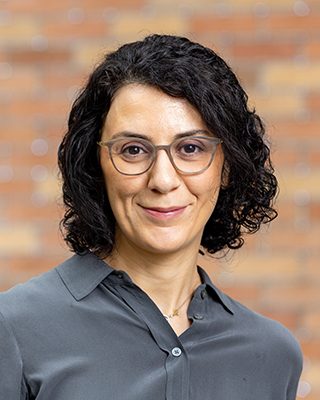
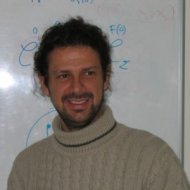
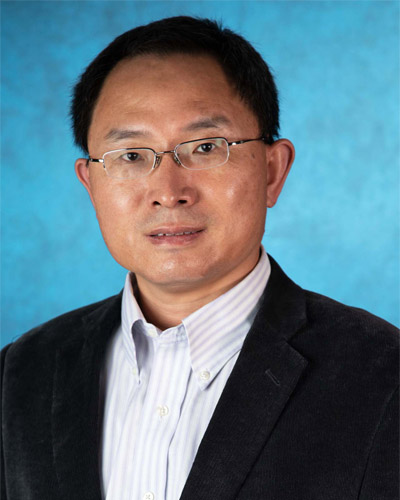
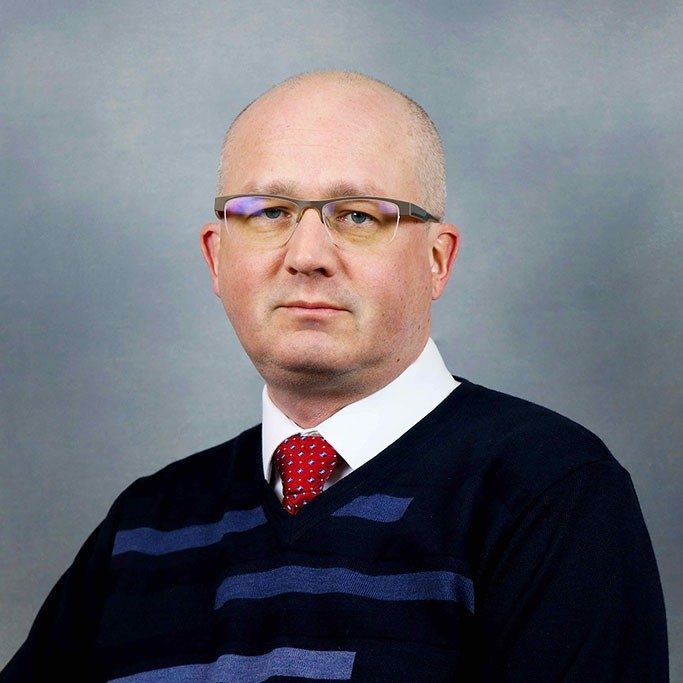
M.Sc. Fabian Lehmann is a scientific collaborator at the Humboldt University of Berlin , affiliated with the Faculty of Mathematics and Natural Sciences and the Institute of Computer Science . His research focuses on knowledge management in bioinformatics and scientific workflows, particularly in areas like resource management, workflow scheduling, and energy-efficient computing. His recent work includes: Carbon-aware execution strategies for scientific workflows (2025) Runtime prediction techniques for heterogeneous infrastructures (2024-2022) Performance prediction and resource recommendation systems (2025-2022) Community-driven workflow standardization initiatives (2024-2022) Applications in environmental data analysis and earth observation (2023-2021) Contact: fabian.lehmann@informatik.hu-berlin.de Phone: 030 2093-41285 Address: Unter den Linden 6, 10099 Berlin
Hannaneh Hajishirzi is an Associate Professor at the Paul G. Allen School of Computer Science & Engineering at the University of Washington, with adjunct appointments in the Departments of Electrical & Computer Engineering and Linguistics. She leads the H2Lab and serves as Senior Research Director at the Allen Institute for AI (AI2). Her research focuses on advancing large language models through projects like OLMo, retrieval-based language modeling, and post-training optimization. Ph.D. in Computer Science from University of Illinois at Urbana-Champaign (2011) Postdoctoral associate at Disney Research and Carnegie Mellon University (2011-2012) Her work spans NLP, AI, and machine learning, with over 140 publications in top-tier venues (ACL, EMNLP, NeurIPS, ICLR). Key contributions include BiDAF, SciREX, and MedICaT datasets. Recent publications emphasize language modeling , in-context learning , and efficient architectures . Papers explore knowledge representation , multimodal reasoning , and scientific claim verification . 2020 Alfred Sloan Fellowship 2021 NSF CAREER award 2019 Intel Rising Star Faculty Award 2018 Allen Distinguished Investigator Award 2023 Academic Achievement UIUC Alumni Award 2024 Innovator of the Year finalist (GeekWire) She has mentored numerous students and received industry research awards from Amazon, Google, and other tech companies. Her lab's work appears in major media outlets (New York Times, Forbes, MIT Technology Review).
Martin Törngren is a Professor of Embedded Control Systems at the Department of Mechatronics and Department of Mechanical Engineering at KTH Royal Institute of Technology. He is actively engaged in research and teaching within Embedded Systems , Mechatronics , and Cyber-Physical Systems , focusing on architecture, model-based development, and system integration. His work bridges control systems and embedded systems, emphasizing reliability and safety in industrial applications. Research Leadership: Technical coordinator of the Artemis project iFEST, focusing on functional safety for automated systems. Education: Teaches courses like Cyber-physical Systems (MF2140) , Mechatronics Higher Course , and doctoral-level courses in embedded systems. Research Interests: Törngren's work spans model-based systems engineering , distributed control systems , co-design of control and computer systems , and system safety . He emphasizes industry-university collaboration , particularly with the automotive and automation sectors. His publications highlight trends in automated driving safety , edge computing , and toolchain integration . Collaborative Initiatives: He co-founded the Innovative Centre for Embedded Systems (ICES) and participates in networks like Artist2 and ArtistDesign. His research projects often involve partnerships with global companies and academic institutions.
Sanne Willems serves as an Assistant Professor in the Methodology & Statistics department within Leiden University's Institute of Psychology. Her academic journey began with Mathematics studies at Utrecht University followed by Statistics at Leiden University, culminating in a PhD in Applied Statistics from Leiden's Mathematical Institute in 2020. In 2021, she transitioned to her current position in the Psychology faculty, where she bridges statistical methodology with psychological research on communication. Dr. Willems' research focuses on the critical intersection of statistical communication and public understanding. She investigates how statistical uncertainties and risk information are interpreted by diverse audiences, with particular attention to the cognitive and emotional impacts of different communication formats. Her work addresses fundamental challenges in statistics communication, including the problematic interpretation of probability phrases (like 'likely' or 'rarely') which her research demonstrated vary dramatically between individuals, creating significant risks for miscommunication in medical, policy, and everyday contexts. Analysis of her recent publications reveals a consistent trajectory toward practical applications of statistics communication research. Her articles increasingly focus on debunking misleading visualizations through the 'Grafiekpolitie' (Graph Police) initiative, examining how common graphical distortions in media and official communications affect public understanding. This work spans consumer statistics (examining misleading 'value pack' marketing), medical communication (interpreting survival probabilities), and public policy (referendum design flaws). Kiem grant, Leiden University (2024) Project Grant, Leiden University Fund / Gratama-Stichting/LUF (2023) YAL Outreach Grant (2022) LUF Lustrum Subsidy (2020) IOPS Best Poster Award (2019 and 2015) Through her outreach activities, Willems has significantly expanded the societal impact of statistics communication research. As co-founder of the Statistics Communication section of the VVSOR (Netherlands Society for Statistics and Operations Research), she established both the society's statistics blog and a regular reading group on statistics communication and (in)numeracy. Her 'Grafiekpolitie' collaboration with Nieuwscheckers.nl provides regular public debunking of misleading graphs in Dutch media. She has developed teaching packages on misleading statistics and engages in national radio discussions to improve statistical literacy. Willems also coordinates the Communication Advisory Board for Statistics Netherlands and organizes events to increase diversity in mathematics, particularly targeting minority groups considering PhD studies.
Paolo Baldan is a Professor of Computer Science at the Department of Mathematics of the University of Padova, where he maintains office 6DA6. Previously, he served as an assistant professor at the University of Venice's Computer Science Department and as a PostDoc Researcher at the University of Pisa's Department of Computer Science. His research focuses on Formal Methods for Software Reliability and Programming Languages , with particular expertise in Concurrency Theory, Petri Nets, and Graph Transformation Systems. Professor Baldan has led multiple research projects including the current MUR Project RAP (2023-2025) and previous initiatives like ASPRA (2019-2022) and ANCORE (2015-2016). His publication record spans journal articles, conference papers, and technical reports in theoretical computer science. His recent work examines resource awareness in programming, program analysis techniques, and verification of concurrent systems. The publications demonstrate consistent contributions to formal methods with applications to software reliability. Professor Baldan actively participates in the academic community through conference organization and committee work, including involvement with CALCO, Petri nets conferences, and ICGT. His upcoming commitments include CSL 2026. He teaches courses including Computability , Languages for Concurrency and Distribution , and Algorithms and Data Structures at the University of Padova. Office hours are held Wednesdays 11:00-13:00, requiring advance contact for meetings.
Dakai Zhu is a Professor, Assistant Department Chair, and Graduate Advisor of Record for PhD programs in the Department of Computer Science at the University of Texas at San Antonio (UTSA). He holds the Kay and Steve Robbins Faculty Teaching Fellowship Award in Computer Science, reflecting his commitment to education and research excellence. His research focuses on dependable and low-power computing, IoT innovations, real-time embedded systems, and cloud computing performance management. Education: Ph.D. in Computer Science, University of Pittsburgh M.E. in Computer Science and Technology, Tsinghua University B.E. in Computer Science and Technology, Xi'an Jiaotong University Dr. Zhu's work emphasizes sustainable computing frameworks for AI-driven healthcare applications, energy-efficient fault-tolerant systems, and privacy-preserving IoT solutions. His recent research includes real-time health monitoring using wearable sensors (e.g., PPG-based heart rate analysis), cybersecurity for cyber-physical systems, and optimization of embedded systems for assistive technologies like power wheelchair control. He also investigates scheduling algorithms for multiprocessor systems and cloud resource management to enhance reliability and energy efficiency. His publications span topics from AI-enabled health frameworks to fault-tolerant scheduling strategies, showcasing a blend of theoretical rigor and practical applications. Awards highlight his contributions to teaching and interdisciplinary research bridging computer science with healthcare and embedded systems.
Yanghao Zhang is a Researcher at Imperial College London's Department of Computing, part of the Faculty of Engineering, working under Prof. Alessio Lomuscio at the Safe AI Lab (SAIL). He also holds a Research Scientist position at Safe Intelligence. He completed his PhD at the University of Liverpool (2020–2024), supervised by Prof. Wenjie Ruan and Prof. Xiaowei Huang, with earlier PhD studies at the University of Exeter. His research focuses on adversarial machine learning, safety verification, robust deep learning applications, and graph neural networks. Education: MSc Artificial Intelligence (Distinction, University of Southampton); BEng Software Engineering (Huizhou University). His work emphasizes adversarial attacks/defenses, semantic robustness in perception systems, and safety of large language models. Key contributions include frameworks for evaluating robustness in autonomous systems and risk-aware learning algorithms. Recent achievements include AAAI and CVPR publications, invitations as a reviewer for top conferences (e.g., AISTATS, ICML, NeurIPS), and PhD defense in 2024. He collaborates with industry (Safe Intelligence) and academia to advance trustworthy AI systems. Labs/Teams: Primary affiliation with Safe AI Lab (SAIL) at Imperial, and research at Safe Intelligence. Active in reviewing for journals like TKDE and conferences like ICLR, CVPR, and NeurIPS.
Shriram Krishnamurthi is a Professor in the Computer Science Department at Brown University, Providence, RI. With a prolific research career spanning over three decades (from 1994 to present), he has made significant contributions across programming languages, formal methods, and computer science education. His work bridges theoretical foundations with practical educational applications, particularly in making complex concepts accessible to students. Dr. Krishnamurthi's research interests encompass programming languages, formal methods, type systems, and computer science education. His work often focuses on the intersection of these areas, particularly how to make formal methods and advanced programming concepts accessible to students through innovative language design and educational tools. He has developed several educational frameworks that have been adopted in both university and K-12 settings, demonstrating his commitment to improving computer science education at all levels. His recent publications reveal a strong focus on making formal methods more approachable through grounded language design, addressing student misconceptions in programming through innovative assessment techniques, and developing practical tools like Forge for teaching formal methods. His work on Rust's type system, privacy-aware static analysis, and document calculus demonstrates the breadth of his research interests while maintaining a consistent thread of improving programming language understanding and usability. As a dedicated educator and researcher, Krishnamurthi has mentored numerous PhD students who have become prominent researchers in their own right, including Ben Greenman, Tim Nelson, Kuang-Chen Lu, and Will Crichton. His collaborative approach is evident in his extensive publication record featuring collaborations with both established researchers and emerging scholars.
Godmar Back is an Associate Professor in the Department of Computer Science at Virginia Tech's College of Engineering. He holds a Ph.D. in Computer Science from the University of Utah (2002) and specializes in systems research, programming languages, and performance analysis. His work focuses on foundational aspects of operating systems, distributed systems, and cloud computing, with notable contributions to memory management, concurrency, and cybersecurity education. His research explores how hardware and software interact to optimize system performance, including studies on SPEC benchmarking, garbage collection, and undefined behavior in programming languages. He has developed frameworks like CloudBrowser 2.0 for cloud-based applications and the VT-ASOS system for many-core platforms. Back is also active in pedagogy, integrating DevOps practices into undergraduate research and incorporating cybersecurity modules into core curricula through spiral theory-based methods. Key projects include the Pintos instructional operating system kernel, the VirtuOS virtualized OS, and ReplayCache for predictive computations. His work frequently bridges theoretical systems research with practical applications, emphasizing reproducibility and real-world impact. His educational initiatives aim to broaden participation in systems research through high-impact practices and collaborative development environments.
Hua Li is a Research Associate Professor at the University of Illinois Urbana-Champaign, affiliated with the Department of Biomedical and Translational Sciences, Beckman Institute for Advanced Science and Technology, and the Department of Bioengineering. Their research focuses on medical imaging, machine learning, and radiation therapy, with a particular emphasis on advancing image reconstruction techniques, task-based image quality assessment, and applications of deep learning in diagnostic imaging. Research interests include developing AI-driven solutions for medical imaging challenges such as denoising, segmentation, and classification. Notable contributions include learning-based ideal observers for performance evaluation and diffusion models for cell segmentation in quantitative phase imaging. Collaborations span interdisciplinary projects in bioengineering, radiation oncology, and computational biology. Recent work emphasizes integrating task-aware methodologies into imaging systems to enhance diagnostic accuracy and clinical utility. Hua Li’s publications reflect a strong focus on translational research, bridging theoretical advancements with practical applications in healthcare.
Prof. Hans-Peter Hutter is a Professor of Computer Science at the ZHAW School of Engineering, specializing in Deep Learning-based Automatic Speech Recognition, Conversational User Interfaces, and Human-Centered Computing. He leads the Human-Centered Computing research group at InIT/ZHAW and has held this position since 2005. His work focuses on accessibility technologies, mobile usability, and inclusive design for visually impaired users. Education: Dr. sc. techn. ETH in Computer Engineering (ETH Zurich, 1996) Dipl. El.-Ing. ETH in Electrical Engineering (ETH Zurich, 1986) Research Interests: Advancing accessibility in digital systems (e.g., accessible PDFs, navigation aids for visually impaired users) Speech recognition and dialogue systems Mobile application design principles Service engineering and platform development His recent work emphasizes multimodal interaction, accessible document remediation, and SLAM systems for navigation assistance. Projects: Leading the InCrowd-VI dataset project for indoor navigation Developing MathNet for mathematical expression recognition Creating accessible tourism services in Lake Constance region Grants & Labs: Active in EU-funded and industry collaborations, leading the InIT Institute founded in 2002. Collaborates with organizations like SwissICT and ACM.
Michele Coscia is an Associate Professor in the Department of Data Science at the IT University of Copenhagen. He also serves as the Head of Programme for the BSc in Data Science. His research focuses on network analysis, social networks, data mining, and their applications in understanding human mobility, complex systems, economic development, and memetics. He has contributed to projects such as the Pioneer Centre for Artificial Intelligence and leads initiatives like ROMNET (Past social network reconstruction from material culture data) and Work2Vec (exploring deep learning in healthcare and work hours analysis). His research interests encompass interdisciplinary network science, including misinformation dynamics, ideological polarization, and the impact of social media systems. He has developed methodologies like the generalized Euclidean measure for multilayer networks and explored cultural data analytics through case studies like Italian music history. His work also addresses real-world challenges, such as quantifying the effects of violence on migration patterns and optimizing network sampling strategies for cost efficiency. Michele Coscia has received the Årets Forskningsmiljø 2022 award, recognizing his contributions to fostering outstanding research environments. He actively engages with media, discussing topics like misinformation and data visualization. As a principal investigator, he oversees projects funded by institutions such as the Villum Foundation and Danish National Research Foundation. His research spans academic collaborations across countries, reflecting his global network and commitment to advancing network theory and its applications.
Tovi Grossman is an Associate Professor in the Department of Computer Science at the University of Toronto. He holds the NSERC/Autodesk Industrial Research Chair in Human-Computer Interaction (HCI) and has received prestigious awards like the Alfred P. Sloan Research Fellowship (2021) and the NSERC E.W.R. Steacie Memorial Fellowship (2020). His research focuses on intelligent user interfaces, mixed reality, and AI-driven interaction techniques. Education: Ph.D. in Human-Computer Interaction from the University of Toronto. Previously, he was a Distinguished Research Scientist at Autodesk Research. Research Interests: Grossman explores how emerging technologies like AI and mixed reality can enhance user experiences. His work spans intelligent UIs, human-robot interaction, and education technologies. Notable projects include Autodesk Sketchbook Motion (Apple iPad App of the Year 2016) and Geppetto (CHI 2019 Best Paper Award). Articles Trends: Recent work emphasizes AI-assisted creativity (e.g., generative design tools), mixed reality applications in education, and human-AI collaboration in programming and robotics. Over 180 peer-reviewed articles and 100+ patents highlight his contributions. Awards: 18+ best paper awards, Sloan Fellowship, NSERC Chairs. Grants: NSERC/Autodesk Chair (2019–2024), multiple industry collaborations. Team: Supervises a dynamic team of Ph.D./M.Sc. students and undergraduate researchers, focusing on HCI innovation. Collaborates with Toronto-area industry labs like Autodesk.
Reynold Bailey is a Professor in the Department of Computer Science at Rochester Institute of Technology (RIT), serving as the Associate Undergraduate Program Coordinator. He holds a BS in Mathematics and Computer Science from Midwestern State University and MS/PhD in Computer Science from Washington University in St. Louis. His research focuses on applied visual perception in computer graphics, multimodal human sensing, and AI-driven eye-tracking technologies. He leads the Computer Graphics and Applied Perception Lab and oversees NSF-funded initiatives including the AWARE-AI Research Traineeship and AI-PROWIL International Research Programs. Education: BS: Midwestern State University MS/PhD: Washington University in St. Louis Research Interests: Subtle gaze direction manipulation Eye-tracking in virtual environments Multimodal collaboration analysis Accessible visualization systems His recent work emphasizes AI applications in eye-tracking robustness (2024), international PhD mobility (2025), and multimodal dialogue analysis (2024). Over 100+ peer-reviewed publications span ACM/IEEE journals and conferences. Awards: NSF CAREER Award Best Interactive Paper Award (2011) Grants: AWARE-AI NSF Traineeship AI-PROWIL International Research He advises RIT's NSF REU programs and co-developed the Gaze3D framework for 3D gaze analysis. Active in curriculum design, he teaches foundational graphics courses (CSCI-610/716) and mentors MS thesis projects.
Daniel Neider is a Professor at TU Dortmund University, Germany. He holds former affiliations with Carl von Ossietzky University Oldenburg and the Max Planck Institute for Software Systems (Kaiserslautern). His research focuses on formal methods, automata theory, temporal logic, and their applications in verification, AI, and machine learning. Neider earned his PhD in 2014 from RWTH Aachen University and a second PhD in 2022 from Kaiserslautern University. His work bridges theoretical foundations with practical tools, such as developing algorithms for automata learning, robust temporal logics (rLTL), and neuro-symbolic verification frameworks for deep neural networks. Key research areas include: (1) learning-based formal methods for system verification, (2) robust temporal logics for handling noisy environments, (3) reinforcement learning with temporal logic constraints, and (4) automated specification mining from data. He has contributed to tools like libALF (Automata Learning Framework) and Sorcar for property-driven invariant synthesis. His recent work explores: (a) scalable LTL learning from noisy data using MaxSAT, (b) neuro-symbolic verification techniques, and (c) applying large language models to automate reinforcement learning with reward machines. He has published over 135 papers in top venues like AAAI, TACAS, and FMCAD, focusing on formal methods intersections with AI and systems verification. Current projects involve: (i) robustness-aware synthesis for reactive systems, (ii) temporal logic inference from positive examples, and (iii) developing interpretable verification tools for complex operational domains. His lab collaborates on applying formal methods to real-world systems like smart contracts and neural networks.