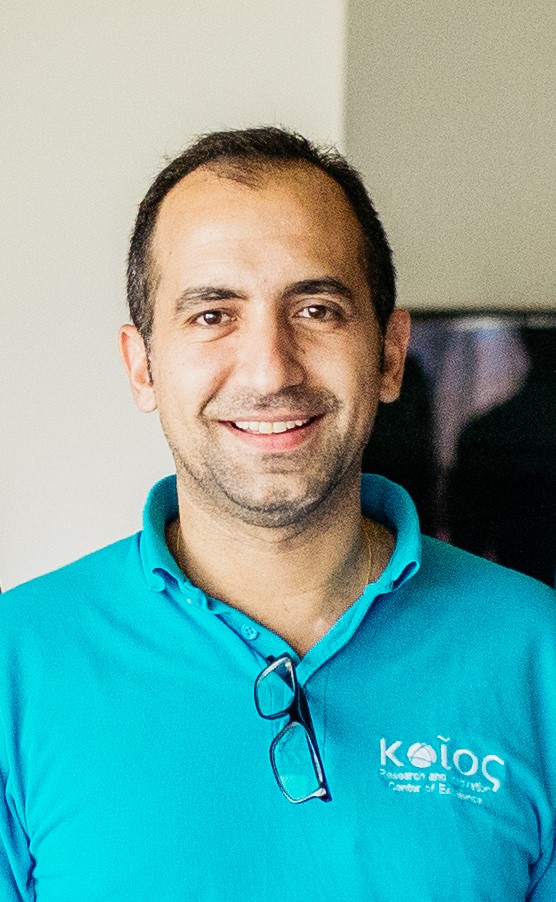
Stelios Timotheou is an Associate Professor at the Department of Electrical and Computer Engineering and faculty member at the KIOS Research and Innovation Center of Excellence, University of Cyprus. He holds a Dipl-Ing from National Technical University of Athens, and MSc/PhD from Imperial College London. His research focuses on developing real-time distributed methodologies using mathematical optimization, machine learning, and computational intelligence to enhance efficiency in critical infrastructure systems. Research interests center on data-driven decision making for urban mobility management, traffic control systems, and energy optimization. Key areas include: Intelligent UAV-based sensing for traffic monitoring Cooperative control algorithms for multi-agent systems Optimization of renewable energy integration Robust infrastructure protection strategies Recent publications demonstrate strong focus on traffic state estimation (76%), energy system optimization (16%), and UAV applications (8%). Awarded the Cyprus Research Award (2017) and ERC Consolidator Grant for URANUS project. Secured multiple research grants focusing on real-time control systems.
Marios Polycarpou is a Professor of Electrical and Computer Engineering and Director of the KIOS Research and Innovation Center of Excellence at the University of Cyprus. He holds honorary positions at Imperial College London and is a member of Academia Europaea. His expertise spans intelligent systems, adaptive control, machine learning, and critical infrastructure. Education: B.A. Computer Science (Rice University, 1987) B.Sc. Electrical Engineering (Rice University, 1987) M.S. Electrical Engineering (University of Southern California, 1989) Ph.D. Electrical Engineering (University of Southern California, 1992) Research Focus: Polycarpou’s work emphasizes fault diagnosis in cyber-physical systems, water distribution networks, and adaptive control. He pioneers digital twin technologies for infrastructure resilience and develops algorithms for real-time anomaly detection and system optimization. Article Trends: His recent publications address adaptive control strategies, cybersecurity in networked systems, and AI-driven solutions for water management. Key themes include distributed control, event-triggered mechanisms, and transformer-based anomaly localization. Awards: 2023 IEEE Frank Rosenblatt Technical Field Award 2016 IEEE Neural Networks Pioneer Award Fellow of IEEE and IFAC Grants & Leadership: He secured prestigious grants including ERC Advanced and Synergy Grants. He led KIOS CoE’s Horizon 2020 projects and served as IEEE Computational Intelligence Society President (2012–2013). Labs & Teams: Directs the KIOS CoE, a hub for AI in critical infrastructure. Collaborates on projects like ERC Water-Futures, focusing on long-term water system transitions and contamination mitigation.
Panayiotis Kolios is an Assistant Professor at the Department of Computer Science, University of Cyprus (UCY). Previously, he served as a Research Assistant Professor at the KIOS Research and Innovation Centre of Excellence (2013–2024) and a Visiting Lecturer at UCY. He holds a BEng and PhD in Telecommunications Engineering from King’s College London (2008 and 2012, respectively). His research focuses on networked intelligent systems, emergency management using AI and UAV technologies, and cyber-physical systems. Education: BEng in Telecommunications Engineering, King’s College London, 2008 PhD in Telecommunications Engineering, King’s College London, 2012 Research Interests: His work centers on autonomous systems, intelligent transportation, and emergency management. Key areas include AI-driven disaster response, UAV-based surveillance, and algorithmic optimization for critical infrastructure. He develops solutions for real-time situational awareness and decision-support in emergencies. Recent work trends show a focus on multi-UAV coordination, disaster management platforms (like AIDERS), and AI applications in emergency response. His team’s 2023 win in the Cooperative Aerial Robots Inspection Challenge highlights advancements in UAV inspection algorithms. Scientific Awards: First Prize in Cooperative Aerial Robots Inspection Challenge (CDC 2023) Grants and Advising: He has secured over €40 million in EU and industrial grants, leading projects like PREDICATE, SWIFTERS, and AIDERS. His team advises on emergency response strategies and has trained first responders through EU-funded programs such as the Exchange of Experts training. Labs and Teams: He leads the Security and Emergency Response Group at KIOS CoE and established the Cyprus Civil Defence Aerial Observation Unit. His team collaborates with institutions like the Cyprus Police and Fire Service to operationalize UAV technologies in disaster scenarios.
Professor Ioannis Katakis is a Faculty Member at the University of Nicosia, where he is affiliated with the School of Sciences and Engineering and the Department of Computer Science. He has held various academic positions across multiple institutions including Aristotle University of Thessaloniki, University of Cyprus, Cyprus University of Technology, Open University of Cyprus, Hellenic Open University, Athens University of Economics and Business, and National and Kapodistrian University of Athens. His educational background includes a PhD in Machine Learning for Automated Text Classification (2005-2009), a Master's in Information Systems (2005-2007), and a Bachelor's in Computer Science (2000-2004), all from Aristotle University of Thessaloniki. Professor Katakis specializes in several cutting-edge areas of computer science and data analysis. His primary research interests include Mining Social, Web and Urban Data , Sentiment Analysis and Opinion Mining , Data Streams , and Multi-label Learning . His work bridges theoretical machine learning approaches with practical applications in social media analysis, healthcare informatics, privacy protection, and smart city technologies. He has published extensively in top venues including CIKM, ECML/PKDD, IEEE TKDE, and ECAI. His recent publications demonstrate a clear trend toward applying machine learning techniques to real-world problems with societal impact. He has focused on areas such as GDPR compliance in smart devices, sentiment analysis in crowd-sourced content, healthcare applications including drug reaction classification and brain disease monitoring, and privacy protection in wearable technologies. His work often involves multi-modal data analysis and addresses challenges in data streams and multi-label classification. Professor Katakis has made significant contributions to his field, with his research cited over 4,200 times. He serves as an Editor for the journal Information Systems and has edited four special issues in journals such as DAMI and InfSys. He regularly contributes to the academic community by serving on program committees for major conferences including ECML/PKDD, WSDM, DEBS, and IJCAI, and by reviewing for prestigious journals like TPAMI, DMKD, TKDE, TKDD, JMLR, TWEB, and ML. He has been actively involved in European research projects, notably serving as Quality Assurance Coordinator and Senior Researcher for projects such as VAVEL (www.vavel-project.eu) and INSIGHT (www.insight-ict.eu). His grant activities demonstrate a strong focus on collaborative, interdisciplinary research with practical applications in urban data management, social media analysis, and healthcare informatics. He has organized three workshops at major conferences (ICML, ECML/PKDD, EDBT/ICDT) and has extensive experience translating research into practical applications through his involvement in European projects.
Dr. Vagia Polyzoidou is an Associate Professor in the Department of Law at the University of Cyprus, serving as Associate Head of Department and Programme Coordinator. She is a Member of the Senate and holds an academic rank of Associate Professor. Her expertise spans Criminal Law, Cybercrime Legislation, and Gender-Based Violence. She earned her Bachelor's, Master's, and PhD in Law from Aristotle University of Thessaloniki, with a specialization in Criminal Law and Criminology. Education: Bachelor of Law, Aristotle University of Thessaloniki Master of Law (Criminal Law and Criminology), Aristotle University of Thessaloniki PhD in Law (Criminal Law), Aristotle University of Thessaloniki Her research focuses on cybercrime, digital violence against women, EU legal frameworks for electronic evidence, and legal responses to social issues like fat shaming. She has an h-index of 8 and 101 citations, with active research since 2011. Notable contributions include work on the Budapest Convention, psychosocial interventions in legal contexts, and violence against women. Her recent publications (2023–2024) address EU e-evidence regulations, legal approaches to sexual harassment in Greece, and protections for minor victims through exceptional criminal provisions. She has collaborated internationally on criminal justice policies and cybercrime legislation. Dr. Polyzoidou’s work aligns with UN Sustainable Development Goals, particularly those addressing gender equality and quality education. She maintains an active Scopus profile and contributes to academic discourse through peer-reviewed journals and conference presentations.
Prof. Dr. Zeki Bayram is a full Professor and current Chairman of the Computer Engineering Department at Eastern Mediterranean University (EMU). He has served as the founding chairman of the Internet Technologies Research Center (2006) and chaired the departmental ABET committee from 2010 to 2023. His academic contributions span semantic web services, mobile payment systems, and XML-based technologies. Founded Cybersoft Bilişim Teknolojileri Limited, a dormant software company in North Cyprus Active in academic service, including thesis supervision and editorial roles Teaches courses on programming languages, automata theory, and software tools Research focuses on semantic web service composition, secure payment schemes, and declarative programming paradigms. His work integrates logic programming, constraint solving, and ontology engineering. Prof. Bayram has published extensively in journals and conferences since the 1990s, with notable contributions to formal methods in service-oriented architectures.
Michael Sirivianos is an Associate Professor at the Cyprus University of Technology (CUT), where he serves as Dean of the School of Engineering and Technology. He holds a PhD in Computer Science from Duke University (2010) and leads research in cybersecurity, disinformation detection, and social media analysis. He coordinates multiple EU-funded projects including ReCRED (Horizon 2020) and ENCASE (Marie Curie RISE), securing over €3M in research funding. Research Focus His work spans: Cybersafety : Detection of cyberbullying, hate speech, and inappropriate content targeting children Trust Systems : Device-centric authentication and blockchain applications Disinformation Analysis : Graph-based detection of fake news and state-sponsored manipulation Scalable Systems : Distributed databases and network infrastructure Achievements & Recognition Best Paper Award (2019) for work on state-sponsored disinformation Distinguished Paper (2018) for fringe web community analysis Spotlight Session recognition (2020) for child protection research Featured in NYT, Washington Post, and Wired for YouTube content analysis Leadership Co-directs the Network Systems Research Lab, serves on the Board of CYENS Centre of Excellence, and coordinates the Fact-check Cyprus Centre against Disinformation.
Prof. Dr. Fadi AL-TURJMAN serves as the founding Dean of the Faculty of AI and Informatics at Near East University (NEU), Cyprus. He holds multiple leadership roles including Head of the Software Engineering Department and Director of the AI and Robotics Institute and the International Research Center for AI and IoT. With a PhD in Computer Science from Queen’s University (2011), he specializes in AIoT systems, wireless networks, and blockchain integration. Affiliation: Near East University Leadership: Founding Dean for AI and Informatics, Director of AI & Robotics Institute Research Focus: His work bridges Artificial Intelligence of Things (AIoT) , Blockchain Applications , and Smart Networking . He explores cybersecurity frameworks for smart cities, quantum state optimization techniques, and novel AI-driven solutions for healthcare, agriculture, and energy systems. Key Article Trends: Recent publications emphasize Transformer models for environmental monitoring, blockchain-enabled security protocols , and evolutionary algorithms for resource optimization. His research spans interdisciplinary domains including medical diagnostics, vehicular networks, and sustainable infrastructure. Scientific Awards: Lifetime Golden Award of Dr. Suat Gunsel (2022) Multiple Best Research Awards at International Venues Labs & Teams: Directs the International Research Center for AI and IoT at NEU, leading multidisciplinary teams in developing advanced networking technologies and AI-driven solutions for global value chain applications.
Klitos Christodoulou is an Assistant Professor in the Department of Digital Innovation at the University of Nicosia (UNIC), affiliated with the School of Business. He holds a PhD in Computer Science from the University of Manchester (2014), along with a BSc and MSc in Computer Science from the same institution. His research focuses on Distributed Ledger Technologies, Blockchain, Machine Learning, and Data Integration. He is a research faculty member at UNIC's Institute For the Future (IFF) since 2018 and actively contributes to ISO/TC 307 standards for Blockchain. Christodoulou has led projects like the Ripple grant and participated in EU initiatives such as EUNOMIA and DLT4ALL. He teaches blockchain courses in UNIC's MSc in Digital Currency program and serves on editorial boards, including Frontiers in Blockchain. His work explores blockchain governance, consensus algorithms, and ethical applications in supply chains. Education: BSc in Computer Science, University of Manchester (2006–2009) MSc in Advanced Computer Science, University of Manchester (2009–2010) PhD in Computer Science, University of Manchester (2010–2014) Research Interests: Blockchain and DLT architectures Machine Learning applications in finance and security Decentralized governance models Blockchain adoption frameworks Awards/Grants: Principal Investigator of the Ripple grant; EU-funded projects (EUNOMIA, DLT4ALL); contributor to Cyprus National Blockchain Strategy. Labs/Teams: Institute For the Future (IFF), University of Nicosia
Dr. Andria Procopiou is a Lecturer in Artificial Intelligence and Cybersecurity at the University of Central Lancashire Cyprus, serving as Course Leader for the MSc Computing program and Deputy Course Leader for the MSc Cybersecurity. She holds a PhD in Computer Science (City, University of London, 2022), an MSc in Human-Computer Interaction (University College London, 2014), and a BSc in Computer Science (University of Surrey, 2013). Her research spans AI applications in sports analytics, cybersecurity for smart cities/IoT, hate speech detection, and metaverse safety. She has led modules in User Experience Design, Penetration Testing, and Cybersecurity. Research interests include AI-driven solutions for sports injury prediction, real-time DDoS detection in IoT networks, and ethical challenges in the metaverse. Her work emphasizes explainable AI (XAI) for transparency in decision-making systems. She has published extensively in journals like Wireless Communications and Mobile Computing and conferences such as IEEE CYBER and the International Conference on Human-Computer Interaction. Education: PhD Computer Science (City University London), MSc HCI (UCL), BSc Computer Science (University of Surrey) Key Roles: Course Leader (MSc Computing), Deputy Course Leader (MSc Cybersecurity) Administrative Contributions: Module leadership in AI, Cybersecurity, and Digital Forensics Her recent publications address critical issues like privacy concerns in smart campuses, gender-based hate speech in virtual spaces, and injury patterns in professional football using data analytics. She collaborates with industry on IoT security solutions and metaverse governance frameworks.
Harald Gjermundrod is a Professor of Computer Science in the Department of Computer Science at the University of Nicosia's School of Sciences and Engineering, where he has served since September 2008. Previously, he was a Post-Doctorate Associate (2006-2008) at the High-Performance Computing Systems Laboratory, University of Cyprus. Education: PhD in Computer Science, Washington State University (2006) MS in Computer Science, Washington State University (2001) BS in Computer Science, Washington State University (1999) Dipl.-Ing, Oslo Metropolitan University (1998) His research spans Distributed Computing Systems , Computer Security , Blockchain Technology , and Data Protection , with emphasis on practical implementations like GridStat middleware for power grids and privacyTracker for GDPR compliance. As co-director of the Informatics Security Laboratory, he leads research on active defense mechanisms and data protection frameworks. His 87+ publications since 2001 show evolving focus from grid computing (2006-2010) to blockchain applications (2016-present), with recent work emphasizing privacy engineering, secure e-voting, and AI-driven security analytics. Key trends include transitioning from infrastructure-focused research (GridStat, ICGrid) to policy-compliant systems (privacyTracker, HoneyCY). Scientific Recognition: Senior Member of ACM Eclipse Committer Status (Alumni) Chair of ACM Cyprus Chapter (2015-2018) He has secured funding from EU programs, US National Science Foundation, and National Institute of Technology, developing software products including GridStat (critical infrastructure middleware), ICGrid (medical data sharing), and ReProTool (Bologna Process compliance). His supervision has produced student-developed prototypes like NoteLocker and HoneyCY. Current projects include privacyTracker (GDPR compliance) and SmartTeV (blockchain voting). As co-director of the Informatics Security Laboratory, he oversees research on active defense systems, honeypot frameworks (HoneyCY), and verifiable data traceability, with applications in e-government and healthcare security.
Professor Andreas Milidonis of the University of Cyprus holds a prominent position in the Department of Accounting & Finance within the Faculty of Economics and Management. With a PhD in Risk Management and Insurance from Georgia State University (2007) and a BSc in Actuarial Science (Minor in Mathematics) from Pennsylvania State University (2001), his career spans academic appointments at Nanyang Business School (NTU, Singapore), Manchester Business School (UK), and consulting roles with the European Central Bank. Education PhD (Risk Management & Insurance) - Georgia State University, USA (2007) BSc (Actuarial Science, Honors) - Pennsylvania State University, USA (2001) His research bridges actuarial science, finance, and insurance economics, focusing on risk regimes, corporate governance, and financial markets. Key contributions include regime-switching models for mortality and credit risk, executive compensation dynamics in insurance, and cultural influences on banking risk. His work has been recognized with awards such as the EGRIE 2012 Best Paper and Lloyd’s Science of Risk Prize shortlisting (2011). Recent publications explore financial education spillovers (2025), trade secrets valuation (2024), and desert storm insurance solutions (2024). Earlier studies on cyberattack reputational impacts (2021), CEO debt incentives (2017), and longevity risk sharing (2017) remain influential. Articles consistently integrate finance and actuarial science methodologies across 20+ years of research. Scientific Awards Best paper award at the 2012 EGRIE meeting Nominated for the 2011 Lloyd’s Science of Risk Prize Professor Milidonis has supervised numerous PhD students and contributed to editorial boards, including the Journal of Risk and Insurance since 2022. His consulting work with the European Central Bank and Towers Perrin underscores practical relevance of his research in financial risk and regulatory frameworks.
MSc. Sinem Alturjman is a Lecturer in the Department of Artificial Intelligence Engineering at Near East University's College of Engineering. Her academic work focuses on the intersection of artificial intelligence, blockchain technology, and internet of things (IoT) systems. Research areas include: Development of AI-powered learning facilitators and educational tools Integration of blockchain for secure IoT architectures Optimization of mobile cloud computing services Application of machine learning in cybersecurity frameworks 6G communication systems with intelligent routing protocols Recent publications demonstrate expertise in: AI-enhanced scheduling mechanisms Decentralized cloud-IoT architectures Reinforcement learning applications Smart healthcare systems with blockchain Energy-aware routing protocols for sensor networks
Pericles Leng Cheng is a Lecturer in the Department of Computer Science and Engineering at the European University Cyprus (School of Sciences). He holds a Doctor of Information Technology (Walden University, 2017) and dual M.Sc. and B.Sc. in Computer Science from the University of Texas at Austin (2003 and 2001). His research focuses on robotics applications in education, therapeutic systems, and aspect-oriented software development for embedded systems. He leads Cyprus' participation in international robotics competitions like Robotex and has contributed to EU-funded projects addressing energy efficiency and ubiquitous computing. Education: PhD: Information Technology, Walden University (2017) M.Sc.: Computer Science, University of Texas at Austin (2003) B.Sc.: Computer Science, University of Texas at Austin (2001) Key Contributions: Developed robotic systems for Constraint Induced Movement Therapy (CIMT) in children Advanced remote robotic experimentation platforms for STEM education Authored foundational studies on aspect-oriented programming for real-time embedded systems Professional Roles: Head of Technical Committee for Robotex Cyprus (Cyprus Computer Society) EU Project Researcher (FP6, Horizon 2020, Erasmus+) Academic Consultant for educational robotics competitions His research spans robotics applications across healthcare, education, and industry, with a focus on integrating emerging technologies into practical solutions. Recent work emphasizes autonomous systems in gaming environments and robotics competitions' pedagogical impact. Over 15 years of academic experience includes teaching, curriculum development, and fostering international collaboration in tech education.
Paul Timmers is an Adjunct Professor of Cybersecurity at the School of Sciences, European University Cyprus, and holds positions at the University of Oxford and University of Rijeka. His part-time status reflects his extensive advisory roles in digital policy. With qualifications including a PhD in Theoretical Physics (University of Nijmegen) and MBA from Warwick Business School, Timmers researches digital sovereignty, cybersecurity governance, and electronic markets. He leads projects on digital health infrastructure and EU strategic autonomy. His publications demonstrate consistent focus on technology policy evolution: Cybersecurity regulation frameworks (2020-2024) Digital sovereignty in telecommunications (2019-2025) EU-US technology policy alignment (2022) Award highlights: Diamond Award for Assistive Technology Advancement (2017) EU Fellowship (2008) Most cited paper in International Journal of Electronic Markets (1998) Timmers serves on advisory boards including the EU Cyber Direct strategy group and EIT Health, influencing European digital policy development.