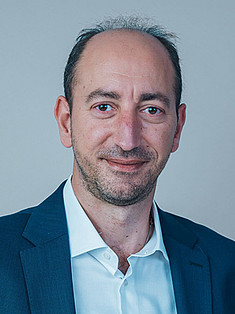
Kuan-Hsun Chen is an Assistant Professor specializing in Computer Architecture Design for Embedded Systems Real-Time Systems Non-Volatile Memory (NVM) Optimization Machine Learning and Edge AI His research focuses on bridging hardware-software gaps in real-time embedded applications through innovative architectural solutions. Research highlights include: Decision Tree Optimization for Real-Time Inference Wear-Leveling Techniques in NVM Probabilistic Timing Guarantees GPU-Accelerated Graph Algorithms Security-Enhanced NVM Designs He explores theoretical foundations while emphasizing practical implementations in autonomous systems and cyber-physical platforms. Scientific achievements: Best Paper Award (2023) Outstanding Paper Award (2023) Outstanding Reviewer Award (2024) His work spans algorithm design, hardware-software co-optimization, and rigorous system validation through fault injection and simulation frameworks.
Rob A. Rutenbar is the Senior Vice Chancellor for Research at the University of Pittsburgh and holds Distinguished Professorships in Computer Science (School of Computing and Information) and Electrical and Computer Engineering (Swanson School of Engineering). He also serves as Adjunct Professor at UIUC and CMU. With nearly 40 years in academia and industry, his research focuses on integrated circuit tools, nanoscale chip design statistics, and AI hardware accelerators. He led the University of Illinois' CS department (ranked #5 nationally) and spent 25 years at CMU, where he pioneered analog CAD tools and founded Neolinear (acquired by Cadence) and Voci Technologies (acquired by Medallia). Education: PhD (Computer Engineering, University of Michigan, 1984), MS (Computer Engineering, University of Michigan, 1979), BS (Electrical Engineering, Wayne State University, 1978). Research interests include analog circuit synthesis, statistical methods for nanoscale ICs, and hardware architectures for AI. Notable contributions include the first MOOC on chip design tools (60k+ learners) and the Phil Kaufman Award for lifetime contributions to EDA. His work spans over 200 publications and 14 patents, with funding from DARPA, NSF, and industry partners like Google and IBM. Awards include ACM SIGDA Pioneering Achievement Award (2021), AAAS Fellowship (2019), and NAI Fellow (2019). He has advised over 50 PhD students, many of whom lead industry and academia (e.g., Amith Singhee at IBM, Saurabh Tiwary at Google). Rutenbar's leadership initiatives at Pitt include the Momentum Funds for team science, LifeX Labs for life sciences commercialization, and the Office of Industry Partnerships to align research with industry needs.
Shahzad Ahmad is a Researcher at the Institute of Networks and Security within Johannes Kepler University Linz (JKU), actively affiliated with the LIT Secure and Correct Systems Lab. His work bridges theoretical cryptography and practical security implementations with geometric data applications. Master of Science (MSc) degree holder His research concentrates on cryptographic security mechanisms, including control flow integrity verification and deniable encryption systems, while also advancing geometric algorithms for point cloud manipulation. This dual focus demonstrates significant interdisciplinary contributions to both computer security and spatial data processing domains. Publication analysis reveals consistent innovation in cryptographic protocol design, particularly in malware-resistant instruction chaining and plausibly deniable storage systems. His geometric research shows methodological evolution from Euclidean foundations toward customized metric spaces for complex point cloud relationships. No scientific awards were documented in the source materials. Available records indicate no formal student advising responsibilities or grant funding disclosures. As a core contributor to JKU's LIT Secure and Correct Systems Lab, Ahmad participates in developing formally verified security architectures and cryptographic implementations resistant to side-channel attacks.
Zhengping Jay Luo serves as Assistant Professor II in Rider University's Department of Computer Science and Physics, specializing in cybersecurity and computer science with research spanning machine learning security, network defenses, and quantum computing applications. Education: Ph.D. Systems and Security, University of South Florida, Tampa, Florida, United States M.S. Computer Application Technology, Jinan University, Guangzhou, China B.S. Computer Science and Technology, Hebei University of Science and Technology, Shijiazhuang, China His research centers on three interconnected pillars: securing machine learning systems within IoT and communication infrastructures, developing advanced network security protocols, and exploring quantum computing's security implications—particularly in quantum machine learning frameworks. This work addresses critical vulnerabilities in AI-driven systems while pioneering defense mechanisms against next-generation threats. Analysis of his 15 most recent publications (2025-2017) reveals a consistent trajectory toward securing emerging technologies, with 2025-2023 works dominating publications on AI security (SpeechGPT jailbreaks), quantum machine learning, and UAV network defenses. His research bridges theoretical innovation with practical implementations across wireless communications, cryptography, and adversarial machine learning. Scientific Awards: None documented in provided materials. Professor Luo actively mentors Rider students through CYB/CSC 490 Independent Research projects and advises both the ACM Club and Asian American Students Association. His professional service includes NSF Panelist roles (2024-2025), CCSC Eastern conference committee membership, Mercer County Science Fair judging, and NJCCIC affiliation, though specific research grants remain unlisted. He maintains active engagement with the cybersecurity community through invited talks at international conferences and summer tournaments, focusing on quantum computing mathematics and RSA algorithm fundamentals for diverse audiences.
Stefan Schubert is an Associate Lecturer at the Department of Computer Science and Security at St. Pölten University of Applied Sciences, where he contributes to both the IT Security (BA) and Cyber Security and Resilience (MA) study programs. His work is closely associated with the Institute for IT Security Research, where he actively participates in cutting-edge security research initiatives. Dr. Schubert's research focuses primarily on cryptographic systems in the face of emerging technologies, with particular emphasis on post-quantum cryptography . His work addresses how quantum computing advancements threaten current encryption standards and explores viable migration paths to quantum-resistant cryptographic systems. He has conducted significant research on NIST's post-quantum cryptography standardization process, blockchain technologies, and cryptographic applications for wireless communication security. Analysis of Dr. Schubert's publications reveals a consistent focus on the intersection of quantum computing and cryptographic security. His work spans both theoretical explorations of quantum threats to established encryption methods and practical implementations of post-quantum cryptographic solutions. The research demonstrates growing urgency around preparing IT infrastructure for the quantum computing era, with particular attention to standardization efforts led by organizations like NIST. Dr. Schubert actively contributes to major research initiatives including the Josef Ressel Center for Blockchain Technologies & Security Management and the KIF project on Cryptography for Wireless Communication. His work bridges academic research with practical security applications, supporting both educational programs and industry partnerships through the Institute for IT Security Research.
Joseph Lallemand is a CNRS Researcher (Chargé de recherche) at IRISA (Institut de Recherche en Informatique et Systèmes Aléatoires) in Rennes, France. He works full-time in the SPICY team (formerly EMSEC) where he focuses on the formal analysis of cryptographic protocols, particularly electronic voting protocols and automated verification of privacy properties. His work combines theoretical computer science with practical security applications. Lallemand's research interests include formal methods for security, cryptographic protocols, privacy properties, electronic voting protocols, and automated verification. His work often involves developing rigorous mathematical frameworks to analyze security protocols and verify their properties. He has made significant contributions to the analysis of voting protocols, where privacy and verifiability are critical requirements. His research spans both theoretical foundations and practical implementations, with an emphasis on provable security guarantees. Lallemand's publications demonstrate a consistent focus on formal verification techniques applied to security protocols, particularly in the domain of electronic voting. His work shows progression from foundational type systems for privacy properties to increasingly sophisticated analyses of real-world voting systems. The research often bridges theoretical computer science with practical security concerns, demonstrating how formal methods can be applied to ensure the security of critical systems. Price Distinguished Paper Award, IEEE CSF 2020, for the article Fifty Shades of Ballot Privacy: Privacy against a Malicious Board Accessit of the 2020 thesis prize from the GdR Computer Security Lallemand has been actively involved in the development of Squirrel, a proof assistant specifically designed for cryptographic protocols. His work connects theoretical advances in formal methods with practical security verification. He collaborates with researchers across institutions, including ETH Zürich where he completed a post-doc in David Basin's group, and maintains connections with his PhD advisors at the Pesto team where he completed his doctoral work under Véronique Cortier. Based at IRISA, a leading French research institute in computer science, Lallemand contributes to a vibrant research environment focused on security and formal methods. His work has practical implications for the design and verification of secure systems, particularly in the sensitive domain of electronic voting where privacy and verifiability must be carefully balanced.
Petros Wallden is a Reader (Associate Professor) at the University of Edinburgh's School of Informatics, where he has been faculty since 2018, achieving the rank of Associate Professor in 2023. He is a member of the Laboratory for Foundations of Computer Science (LFCS) and participates in multiple research groups including the Quantum Informatics Group, Security & Privacy Group, Quantum Computing Application Cluster (QCA), and Quantum Information Scotland (QUISCO). PhD in Theoretical Physics from Imperial College, UK (2003-2006) Master of Advanced Study in Mathematics from University of Cambridge, UK (2002-2003) BSc in Physics with Theoretical Physics from Imperial College, UK (1999-2002) Dr. Wallden's research focuses on the intersection of quantum computing and cryptography, with particular expertise in quantum digital signatures, verifiable quantum computing, quantum algorithms, and post-quantum cryptography. His work bridges theoretical foundations with practical applications, especially in the context of cybersecurity in the quantum era. He has made significant contributions to developing quantum protocols that maintain security even when quantum computers become widely available. His recent publications show a clear trend toward practical quantum algorithms and quantum cybersecurity solutions, with an increasing focus on variational quantum methods and applications to real-world problems like cryptographic security in the post-quantum era. His work spans both theoretical foundations of quantum information and practical implementations of quantum protocols. Principal Investigator for STFC's Quantum Software for a Digital Universe (QuSoDU) Co-Investigator for EPSRC's Quantum Computing and Simulation Hub (QCS Hub), leading the Quantum Software Work Package since 2023 Co-Investigator for EPSRC's Collaborative Computational Project Quantum Computing (CCP-QC), serving as Deputy co-chair Co-Investigator for EPSRC's Quantum Advantage Pathfinder (QAP), co-founding the Quantum Software Lab He currently supervises PhD students Milos Prokop, Stuart Ferguson, and Sean Thrasher, and has previously supervised Sean Adamson. Dr. Wallden has served as General Chair for the International Conference on Practice and Theory of Public-Key Cryptography (PKC) in 2020 and 2021, demonstrating leadership in the cryptographic research community. Dr. Wallden is a key member of Edinburgh's quantum computing ecosystem, contributing to multiple collaborative projects including the Quantum Computing & Simulation Hub (QCS Hub), Collaborative Computational Project Quantum Computing (CCP-QC), Quantum Software for a Digital Universe (QuSoDU), and Quantum Advantage Pathfinder (QAP). His work sits at the critical intersection of quantum information science and cybersecurity, addressing one of the most pressing challenges of the quantum computing era.
Professor Shoichi Saito is a distinguished academic at Nagoya Institute of Technology, where he serves in the Department of Information Engineering within the College of Engineering. His research focuses on information security, computer systems, and software engineering, with particular expertise in IoT security, distributed systems, and network security. Professor Saito earned his Doctor of Engineering from Ritsumeikan University in March 2000. Prior to his current position, he served as Assistant Professor, Lecturer, and Associate Professor at Wakayama University's Faculty of Systems Engineering from 1998 to 2006. His research interests span multiple critical areas of modern computing: Information security with focus on IoT device protection Distributed systems and blockchain technologies Mobile application security, particularly for Android platforms Confidential information protection using virtual machine technologies Network security and anonymous communication systems Professor Saito's research outputs demonstrate a consistent focus on practical security solutions for emerging technologies. His recent work has centered on IoT security, data usage control in distributed environments, and advanced taint tracking mechanisms for mobile applications. His research bridges theoretical security concepts with practical implementation challenges. Among his notable recognitions are multiple awards from the Information Processing Society of Japan's Computer Security Research Group, including CSS2024 Student Paper Awards and Encouragement Awards. Professor Saito actively contributes to the academic community through committee memberships, including the Nagoya City Personal Information Protection Council and various program committees for the Information Processing Society of Japan. He has secured significant research funding, most recently for projects on IoT device emulation and virtual execution platform remote authentication.
Dimitrios Simos serves as Senior Lecturer and Joint Professor of Cybersecurity in the Department of Information Technologies and Digitalisation at Salzburg University of Applied Sciences (FH Salzburg), with an additional appointment as University Professor for Cybersecurity at the University of Salzburg where he teaches Introduction to Cryptography and IT Security. His research expertise includes: Resilient Security Testing and Web Technologies Security via Interaction Testing Protocol Security Testing for Internet and Industrial Systems Hardware Security with focus on Trojan Detection in Chips Quantum Software Security Implementations Combinatorial Mathematics for Secure Systems Engineering Dynamics Modeling of Natural and Cyber-Disasters Prof. Simos supervises Bachelor and Master students in cybersecurity and software/systems testing, cyberattacks, and mathematical security modeling. His teaching portfolio encompasses Cryptology, IT Security Engineering, Advanced Networking/Security/Privacy topics, and Attack-Defense Simulation labs across multiple degree programs.
Attila Yavuz serves as an Assistant Professor at the University of South Florida with leadership roles in cybersecurity research initiatives. He functions as Site Lead for CREDC (Center for Risk-based Energy Defense Cybersecurity), focusing on cryptographic solutions for critical infrastructure systems. His research expertise spans: Lightweight cryptographic protocols for resource-constrained environments Delay-aware security mechanisms for time-sensitive networks Scalable post-quantum key distribution systems Real-time digital signature implementations Aggregate signature frameworks for authentication efficiency Dr. Yavuz's work addresses fundamental challenges in smart-grid security through projects like FAAS (Fast Authentication with Aggregate Signatures) and lightweight cryptographic services designed for operational technology environments. His research bridges theoretical cryptography with practical deployment requirements in energy infrastructure protection. Current investigations prioritize low-cost implementations that maintain security guarantees under strict timing constraints inherent in industrial control systems. Contact: attilaayavuz@usf.edu
Prof. Viveck Cadambe is an Associate Professor in the School of Electrical and Computer Engineering at Georgia Institute of Technology. He holds a Ph.D. from the University of California, Irvine (2006), and was a postdoctoral researcher at Boston University and MIT's Research Laboratory of Electronics (2011–2014). His research focuses on theoretical and applied aspects of information theory, with applications to secure machine learning, distributed systems, wireless networks, and cloud storage. He leads the LITES Lab, which develops foundational algorithms and systems for information processing. Key research areas include privacy-preserving computation, coded distributed storage, and interference alignment in wireless networks. His work bridges theoretical analysis (e.g., information-theoretic limits) and practical implementations (e.g., prototyping distributed systems). Prof. Cadambe has received multiple awards, including the 2009 IEEE Information Theory Society Best Paper Award, 2016 NSF Career Award, and a 2019 Google Faculty Award. He serves as an Associate Editor for IEEE Transactions on Communications. His lab actively explores topics such as Secure multiparty computation with differential privacy Geo-distributed storage systems (e.g., LEGOStore) Coded computing for fault-tolerant distributed algorithms Recent research highlights include Optimal recovery thresholds for coded matrix multiplication Latency-optimized storage schemes for distributed systems Adversarial-resistant decentralized machine learning frameworks His contributions span theoretical insights, algorithm design, and system prototyping, emphasizing practical scalability and robustness.
Anamaria Costache is an Associate Professor at the Norwegian University of Science and Technology (NTNU) in the Department of Information Security and Communication Technology. Previously, she held roles including a postdoc at Royal Holloway, University of London (RHUL), a Research Scientist at Intel AI Research, and a part-time position at Intel. She earned her PhD from the University of Bristol and undergraduate/master's degrees from the University of Warwick, focusing on number theory and algebraic structures like Brauer Groups. Her research interests center on fully homomorphic encryption (FHE), privacy-preserving machine learning, lattice-based cryptography, and post-quantum security protocols. Her work is supported by Intel, addressing challenges in secure computation on encrypted data. She has authored numerous publications in top venues like CRYPTO, PKC, and IEEE conferences, focusing on FHE optimizations, biometric systems, and cryptographic security analyses. Teaching includes courses on applied cryptography, network security, and quantum-safe encryption at NTNU. She co-chairs NIKT 2019 and the WAHC workshops (2022–2024), and serves on editorial boards for journals like IACR Communications in Cryptology. She actively participates in program committees for conferences such as MathCrypt and FHE.org. Professional service includes the Lattigo Advisory Committee and contributions to the Bristol Crypto Blog. Her current projects emphasize verifiable computation over encrypted data and resilient authentication mechanisms in biometric systems.
Elena Dubrova is a Professor at the Division of Electronics and Embedded Systems, KTH Royal Institute of Technology. She specializes in hardware security, cryptography, and embedded systems security. Her roles include examiner and course responsible for advanced degree projects in Computer Engineering, Communication Systems, Embedded Systems, and Machine Learning. She also teaches courses such as Design of Fault-Tolerant Systems, Hardware Security, and Internet Security and Privacy. Her research focuses on side-channel attacks, cryptographic algorithm vulnerabilities, and FPGA security. Notable work includes analyzing hardware security flaws in cryptographic implementations (e.g., CRYSTALS-Kyber, AES), RF signal leakage in chips, and mitigating threats in FPGA-based systems. Her contributions span both theoretical advancements and practical countermeasure development. Dr. Dubrova’s articles highlight trends in post-quantum cryptography vulnerabilities, machine learning-assisted security analysis, and the integration of physical unclonable functions (PUFs) for secure authentication. She emphasizes hardware-software co-design for robust security solutions. No scientific awards are explicitly listed in the provided information. Her work involves collaborative projects on cryptographic protocol design and secure embedded system architecture, though specific grants or lab affiliations are not detailed here.
Dr. Ryan Robucci is an Associate Professor in the Department of Computer Science and Electrical Engineering at the University of Maryland Baltimore County (UMBC). He holds a Ph.D. from Georgia Institute of Technology (2009) and a B.S. from UMBC (2002). His research focuses on analog/mixed-signal VLSI, hardware security, embedded systems, and biologically-inspired systems. Key areas include side-channel attack mitigation, low-power wearable devices, and FPGA-driven embedded systems. Education: Ph.D. in Electrical and Computer Engineering, Georgia Tech, 2009 M.S.E.E., Georgia Tech, 2004 B.S. in Computer Engineering, UMBC, 2002 Research Interests: Hardware Security: Side-channel resistance, PUFs, and IC fraud detection Analog/Digital Hybrid Systems: Low-power sensors and reconfigurable circuits Embedded Systems: Wearable health monitoring and FPGA design His publications span hardware security, sensor networks, and embedded systems. He leads the Covail Lab, exploring ultra-low-power analog-digital systems and assistive technologies. Teaching includes courses on digital signal processing, FPGA design, and embedded systems.
M. Sadegh Riazi is an Assistant Professor in the Department of Computer Science and Engineering at the University of California, San Diego's Jacobs School of Engineering. He completed his PhD at UCSD in 2020 with a dissertation titled 'Towards A Private New World: Algorithm, Protocol, and Hardware Co-Design for Large-Scale Secure Computation.' Dr. Riazi's research focuses on the critical intersection of cryptography, machine learning, and hardware security, with particular emphasis on making secure computation practical for real-world applications. His work spans secure multi-party computation, homomorphic encryption, privacy-preserving machine learning, and hardware acceleration for cryptographic protocols. He has made significant contributions to optimizing secure computation frameworks for deep learning applications, developing techniques that balance security guarantees with computational efficiency. His publication record shows a clear progression from foundational secure computation techniques to increasingly sophisticated applications in privacy-preserving AI. Notably, his work on HEAX (Homomorphic Encryption Acceleration) and XONN (XNOR-based Oblivious Neural Network) demonstrates practical approaches to making encrypted deep learning feasible. The research trends in his publications indicate a consistent focus on bridging theoretical cryptographic security with practical system implementations. Dr. Riazi has established a strong collaborative network, most prominently with Professor Farinaz Koushanfar's research group at UCSD, with whom he has co-authored numerous papers across multiple domains including biometric security, secure hardware design, and privacy-preserving machine learning. His research has been published in top-tier venues including IEEE Security & Privacy, USENIX Security, ASPLOS, and CCS, reflecting the high impact and quality of his work in both the security and systems communities.