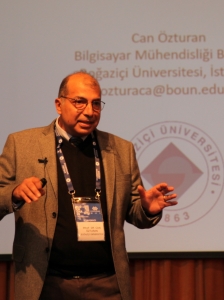
Can Özturan is a Professor in the Department of Computer Engineering at Bogazici University in Istanbul, Turkey. He joined the department as a faculty member in 1996 after completing his Ph.D. in Computer Science from Rensselaer Polytechnic Institute in 1995 and working as a Postdoctoral Staff Scientist at the ICASE (Institute for Computer Applications in Science), NASA Langley Research Center. His research interests span Blockchain Technologies, Parallel Processing, High Performance Computing, Graph Algorithms, Scientific Computing, Resource Management, and Grid/Cloud Computing. Over his career, his research focus has evolved from parallel processing and graph algorithms toward blockchain technologies, particularly focusing on privacy-preserving techniques, fraud detection, and performance optimization in Ethereum systems. An analysis of his recent publications (2021-2025) reveals a strong concentration on blockchain applications, with particular emphasis on privacy-preserving protocols using zero-knowledge proofs, fraud detection in transaction graphs, and performance optimization for blockchain systems. His work bridges theoretical computer science with practical blockchain implementations, often applying parallel processing techniques to blockchain challenges. Professor Özturan teaches courses in Blockchain Programming (CMPE483), Parallel Processing (CMPE478), Systems Programming (CMPE230), Graph Algorithms (CMPE528), and Compiler Design (CMPE425), demonstrating his expertise across both foundational and emerging areas of computer engineering.
Wenting Zheng is an Assistant Professor in the Computer Science Department at Carnegie Mellon University (CMU), with a courtesy appointment in the Electrical and Computer Engineering Department. She co-founded Opaque Systems and serves as a core faculty member at CyLab Security and Privacy Institute. Ph.D. in Electrical Engineering and Computer Science (EECS) from UC Berkeley M.Eng. and Bachelor’s degrees from MIT under Barbara Liskov Her research focuses on system security and applied cryptography , particularly systems enabling “sharing without showing.” Key areas include secure cloud computation, collaborative privacy-preserving analytics, and practical cryptographic frameworks for machine learning. Recent work emphasizes encrypted AI (e.g., Cinnamon), secure multi-party computation (e.g., Silph), and private information retrieval (e.g., PIANO). Notable scientific honors include the Berkeley Fellowship (2014-2016) , IBM Research Fellowship (2017-2018) , and the USENIX Security 2021 Distinguished Paper Award . She has advised numerous Ph.D. and Master’s students, including collaborators at CMU and UC Berkeley. Teaching: Distributed Systems, Secure Computer Systems, Cryptosystems: Theory and Practice Research grants from NSF, AWS, Cisco, Google, Samsung, and CMU CyLab Co-founder of DARE, a diversity-focused research mentorship program
Aggelos Kiayias is the Chair in Cyber Security and Privacy at the University of Edinburgh, where he directs the Blockchain Technology Laboratory. He also serves as Chief Scientist at Input Output, a blockchain technology company. His research focuses on computer security, privacy, applied cryptography, blockchain technologies, distributed systems, e-voting, secure multiparty protocols, and identity management. Ph.D., City University of New York B.Sc., Mathematics, University of Athens With over 200 publications, his work examines blockchain protocol design, consensus mechanisms, privacy-preserving systems, and cryptocurrency economics. Recent research explores transaction fairness, stake-based consensus, and regulatory-compliant financial systems. His studies bridge theoretical cryptography with real-world implementations, including quantum-resistant blockchain frameworks and incentive-aligned protocol designs. Scientific recognitions include the BCS Lovelace Medal (2024), ERC Starting Grant, Marie Curie Fellowship, NSF Career Award, and Royal Society of Edinburgh Fellowship. Supervised 22 Ph.D. students with impactful careers in academia and industry, including researchers at Stanford, Imperial College, and blockchain protocol architects. Current projects investigate tiered transaction fee models, privacy-preserving tokens, and decentralized reliability estimation systems. His work receives funding from European Research Council, Horizon 2020, EPSRC, NSF, and NIST.
Professor Tolga Ayav is affiliated with the Department of Computer Engineering at Izmir Institute of Technology , where he has served as faculty since 2006. He received his BSc in Electrical and Electronics Engineering (1995) from Dokuz Eylül University, MSc in Computer Engineering (1999) from Izmir Institute of Technology, and PhD in Computer Engineering (2004) from Ege University. He was a researcher at INRIA Rhone-Alpes in 2005. Education BSc: Electrical and Electronics Engineering, Dokuz Eylül University (1995) MSc: Computer Engineering, Izmir Institute of Technology (1999) PhD: Computer Engineering, Ege University (2004) Research Interests include formal methods for software testing, hardware component and on-chip system tests, real-time and fault-tolerant embedded systems, blockchain applications, and machine learning. His work focuses on: Formal verification techniques Real-time system optimization Hardware-software co-design Blockchain-based security solutions Mathematical modeling in testing Recent Publications span topics like: Deep learning for livestock monitoring Blockchain in IoT security Fourier expansion in fault analysis Optimized data replication strategies Finite state machine testing Scientific Awards include: Best Paper Award at IEEE CBDCom 2016 for cloud data replication research Teaching includes courses such as: CENG 312: Computer Networks CENG 523: Advanced Topics in Real-Time Systems CENG 215: Circuits and Electronics Projects he has led include: TÜBİTAK TEYDEB: Spectrally Efficient Small Cell Base Station Design BAP: Dedicated Server for Physical Network Applications Lab Leadership : He leads the DCS Research Group at Izmir Institute of Technology, focusing on distributed computing and real-time systems.
Massimiliano Albanese is a Professor and Associate Chair for Research in the Department of Information Sciences and Technology at George Mason University. He serves as the Executive Director of the Institute for Digital Innovation (IDIA) and Director of the Center for Infrastructure Security in the Era of AI (ISEAI). Previously, he was the Associate Director of the Center for Secure Information Systems (CSIS). Dr. Albanese earned his PhD and MS in Computer Science and Engineering from the University of Naples Federico II. After completing a postdoctoral position at the University of Maryland, College Park, he joined George Mason University in 2011. His primary research focuses on Information and Network Security, with particular emphasis on Modeling and Detection of Cyber Attacks, Cyber Situational Awareness, Network Hardening, Moving Target Defense, Configuration Security, and Vulnerability Metrics. His recent work has expanded into election security, AI-enhanced cybersecurity, and vulnerability scoring frameworks. He has developed innovative approaches to cyber defense that integrate machine learning, game theory, and formal modeling techniques. Dr. Albanese's publication record shows a clear evolution from foundational work in moving target defense and attack modeling toward more applied research in vulnerability metrics, election security, and AI-assisted cyber defense. His recent publications demonstrate growing interest in practical security implementations, election infrastructure protection, and the intersection of AI with cybersecurity. 2014 Mason Emerging Researcher/Scholar/Creator Award Best Paper Award at IEEE CNS 2020 for SCIBORG Best Paper Award at SECRYPT 2018 Best Paper Runner-up Award at IEEE CNS 2015 Dr. Albanese has participated in 33 sponsored projects totaling $13.1M, with a personal share of $3.5M. His research has been funded by prestigious organizations including the National Science Foundation, Department of Defense, National Security Agency, and Virginia Innovation Partnership Authority. He has served as Principal Investigator on 18 projects, demonstrating strong leadership in securing research funding. His current projects focus on election security, cybersecurity scholarships, and AI-enhanced threat detection. Dr. Albanese leads multiple research centers and initiatives, including the Center for Infrastructure Security in the Era of AI. His work bridges academic research with practical applications, particularly in securing election systems and developing frameworks for vulnerability assessment. He actively collaborates with government agencies and industry partners to translate research into real-world security solutions.
Dr. Nicolas Sklavos is a tenured Associate Professor in the Department of Computer Engineering and Informatics at the Polytechnic School of the University of Patras, Greece. He serves as Director of the SCYTALE Group and holds editorial positions including Associate Editor for ACM Digital Threats: Research and Practice, IEEE VLSI Circuits and Systems Letters, and IET Networks. As an IEEE Senior Member, ACM Distinguished Speaker, and member of the ACM/IEEE-CS/AAAI Computer Science Curricula Task Force, he actively shapes cybersecurity research and education standards globally. His research centers on hardware-level security for critical infrastructure, with emphasis on cryptographic implementations in embedded systems and IoT healthcare applications. He investigates vulnerabilities in 5G/6G communication protocols and develops countermeasures for hardware Trojans and side-channel attacks. His work bridges theoretical cryptography with practical system design, focusing on real-world deployment challenges in next-generation networks and medical devices. Dr. Sklavos has received multiple scientific awards recognizing his contributions to hardware security, though specific honors aren't detailed in available sources. His professional distinctions include IEEE Senior Member status and ACM Distinguished Speaker designation, reflecting industry-wide recognition of his expertise. He has led numerous European Commission and national research projects spanning cryptographic engineering and secure system design. As an evaluator for international funding bodies and organizer of major conferences (serving as General Chair, Program Chair, and Publication Chair for IEEE/ACM events), he drives collaboration across academia and industry. His grant portfolio emphasizes translating theoretical security concepts into deployable solutions for emerging technologies. The SCYTALE Group under his direction pursues cutting-edge research in post-quantum cryptography implementations, side-channel resistant hardware, and security validation frameworks for IoT ecosystems. Current initiatives focus on securing medical IoT devices against physical attacks and developing lightweight cryptographic accelerators for 6G infrastructure.
Davor Runje is a lecturer at Algebra University with extensive industry experience as a software engineer, computer scientist, and serial entrepreneur. He has co-founded multiple technology ventures including AIRT (an AI startup), DRAP (a digital agency acquired by Imago Ogilvy in 2018), and PlayMedia Systems (1997), which became a global leader in AMP MP3 playback technology. His research interests span artificial intelligence, theoretical computer science, parallel and distributed computing, and cryptography. Runje has made significant contributions to programming for multiprocessor/multicore systems, with work that later became the Task Parallel Library in the .NET framework during his time at Microsoft Research. His publication portfolio shows a clear evolution from theoretical computer science and concurrency research (2003-2009) toward machine learning and AI (2019-2025), with particular focus on neural networks, model interpretability, and security aspects of large language models. His recent work demonstrates expertise in constrained monotonic neural networks, attention mechanisms for tabular time-series, and vulnerabilities in large language models. His notable achievements include: Microsoft Research SSCLI and Phoenix 2005 awards Two US patents 20 publications in theoretical computer science and artificial intelligence Chairing the Croatian Independent Software Exporters board (2020-2024) As an active industry leader, Runje has participated in numerous legal and tax reform initiatives aimed at increasing the competitiveness of the Croatian IT sector in global markets, representing approximately one-third of the Croatian IT industry through his leadership role.
Dave Levin is an Associate Professor at the University of Maryland with a joint appointment in the Department of Computer Science and the Institute for Advanced Computer Studies (UMIACS) . His research focuses on network security , Internet censorship avoidance , and PKI analysis , combining empirical measurement with cryptographic and economic approaches to system design. Recent research trends include certificate revocation systems (e.g., CRLite), geographic traffic evasion (Alibi Routing), and large-scale network measurement of DNS root servers. His work often involves undergraduate research groups through the Breakerspace lab, which he founded to scale cybersecurity education. Scientific awards include Best Paper Honorable Mention at ACM CCS 2022 and the Internet Defense Prize (2021). Teaching includes graduate security courses (CMSC 614) and undergraduate honors seminars (CMSC 396H). Service involves chairing conferences like ACM IMC 2021 and reviewing for IEEE S&P 2023.
Ling Ren is an Assistant Professor at the Siebel School of Computing and Data Science, University of Illinois at Urbana-Champaign. He earned his Ph.D. in Computer Science from MIT in 2018 and held a postdoctoral position at VMware Research Group before joining UIUC. His research bridges theoretical and practical aspects of applied cryptography and secure distributed algorithms. University: University of Illinois at Urbana-Champaign School: Siebel School of Computing and Data Science Department: Department of Computer Science Academic Rank: Assistant Professor Research Interests: Ling Ren focuses on designing algorithms that combine practical efficiency with provable security. His work spans threshold/distributed cryptography, fault-tolerant consensus (blockchain), and privacy-preserving protocols like Private Information Retrieval (PIR). Recent projects include Granular Synchrony for unified network timing models and Practical Asynchronous Distributed Key Generation for blockchain infrastructure. Selected Publications (2025-2023): Recent works cover verifiable secret sharing, BLS threshold signatures, batch PIR protocols, and asynchronous consensus algorithms. These publications address foundational challenges in cryptographic security and distributed systems, with applications to blockchain scalability and privacy. 2025: Verifiable Secret Sharing Simplified, Single-Server Client Preprocessing PIR 2024: S3PIR Protocol, Adaptively Secure BLS Threshold Signatures 2023: Threshold Signatures from Inner Product Argument Scientific Awards: NSF CAREER (2022) Google Research Scholar Award (2023) Chaincode Lab Bitcoin Research Prize (2023) Best Paper Runner-up at CCS (2021) Top Picks in Hardware and Embedded Security (2018) Teaching & Advising: Ling Ren teaches graduate courses such as CS 539 (Distributed Algorithms) and CS 461 (Computer Security I). He advises current students like Sourav Das and Ananya Appan, while past advisees include Zhuolun Xiang (PhD 2022) and Muhammad Haris Mughees (PhD 2024).
Jessica Sorrell is an Assistant Professor in the Department of Computer Science at Johns Hopkins University and a member of the Data Science and AI Institute. Her research focuses on the theoretical foundations of machine learning, emphasizing replicability, privacy, fairness, and robustness. She has contributed to lattice-based cryptography and secure computation. Johns Hopkins University (Assistant Professor, Department of Computer Science) University of Pennsylvania (Postdoctoral Researcher) University of California, San Diego (PhD in Computer Science) Rochester Institute of Technology (Undergraduate in Applied Mathematics) Research Areas: Theoretical machine learning Replicability and reproducibility of statistical algorithms Differential privacy and adaptive generalization Lattice-based cryptography Secure computation protocols Publications highlight her work on replicable reinforcement learning, algorithmic stability, and cryptographic techniques. She previously studied at UCSD under Daniele Micciancio and Russell Impagliazzo. Teaching: Spring 2025: Theory of Replicable Machine Learning (EN.601.774).
Giuseppe Durisi is a Professor at Chalmers University of Technology in Gothenburg, Sweden, specializing in information theory and communication systems. His research bridges mathematically rigorous solutions with practical engineering applications in wireless and optical communication. Primary affiliation: Communication Systems Group , Chalmers University. Research focus: Optimal information transmission, 6G network design, and theoretical foundations of deep learning. Research Interests: Durisi investigates the interplay between latency, reliability, and throughput in digital communication, particularly in millimeter-wave and optical fiber channels . He develops finite-blocklength theory for efficient coding and explores how information theory can explain deep learning performance. Recent Article Trends: His 2025–2024 work emphasizes 6G distributed MIMO networks , energy-harvesting protocols , and machine learning integration into communication theory. Key themes include random access protocols , privacy in wireless aggregation , and hardware-constrained massive MIMO . Scientific Recognition: An IEEE Senior Member, Durisi has published extensively in top journals like IEEE Transactions on Communications and IEEE Transactions on Wireless Communications . Notable Collaborations: Work with teams on radio-over-fiber fronthaul , unsourced multiple access , and time-synchronized URLLC links .
Anatoly V. Anisimov is a Professor and current Dean of the Faculty of Computer Science and Cybernetics at Taras Shevchenko National University of Kyiv, with a career spanning over five decades. He previously served as Dean of the Faculty of Cybernetics (2004-2016) and has held academic roles ranging from Assistant Professor to Head of Department of Mathematical Informatics. Candidate of Physical and Mathematical Sciences (1972) Doctor of Science (Dr. Sc.) in Physics and Mathematics (1994) Internship at Stanford University (1976-1977) under Donald Knuth His research interests focus on information theory, cryptography, data compression, natural language processing, and algorithm design , with recent work exploring multidelimiter prefix codes, two-base numeration systems, and lightweight authentication protocols for IoT. Over 150 publications and book chapters reflect his contributions to computational linguistics and theoretical computer science. Key article trends reveal a consistent emphasis on encoding techniques, mathematical modeling, and parallel computing , including applications in error correction, semantic analysis, and tensor factorization . His work bridges classical algorithmic theory with modern cybersecurity and AI challenges. Scientific honors include: Glushkov Prize (1994) Soros Professor Grant (1994-1995) State Prize of Ukraine (1998) Honored Worker of Science and Technique (2005) Distinguished Professor Title (2008) Lebedev Prize (2008) Corresponding Member, National Academy of Sciences (2009) Order of Merit (2018) Advising and grants show collaborations with researchers like I.O. Zavadskyi and O.O. Marchenko. He secured international grants (e.g., Soros) and led projects in computational linguistics, information security, and matrix factorization .
Haodong Wang is an Associate Professor in the Department of Electrical Engineering and Computer Science at Cleveland State University, where he maintains his office in FH 219. He previously served as an Assistant Professor in the Department of Math and Computer Science at Virginia State University before joining Cleveland State. Wang received his educational foundation through a Bachelor of Engineering in Electronic Engineering from Tsinghua University in Beijing, China, followed by a Master of Science in Electrical Engineering from Penn State University, culminating in a Ph.D. in Computer Science from the College of William and Mary in August 2009. His research primarily focuses on wireless and mobile computing security, with particular expertise in cryptographic implementations for resource-constrained sensor networks. Wang's WM-ECC project represents one of the most efficient publicly available ECC implementations for wireless sensor motes, adopted by numerous institutions including USC, UCLA, and Siemens Research Corporation. His work bridges theoretical security concepts with practical implementations for pervasive computing environments. Analysis of his 15 most recent publications reveals a progression from foundational wireless sensor network security work toward broader applications in cloud computing, virtualization, and web security, while maintaining his core expertise in wireless communications. His research consistently demonstrates a practical engineering approach to solving real-world security and performance challenges. Wang has served on technical program committees for major conferences including GLOBECOM 2014 and ICCCN 2014, reflecting his standing in the networking research community. He teaches a comprehensive range of courses at Cleveland State University from foundational programming and data structures to advanced topics in information security, blockchain, and artificial intelligence, demonstrating both breadth and depth in computer science education.
Farshid Agharebparast serves as an Associate Professor Teaching in the Department of Electrical and Computer Engineering at the University of British Columbia's Faculty of Applied Science. His academic career is anchored in data communications networks and mobile computing, with active contributions to the Communication Systems Research Group specializing in Data Communications. Education: BSc, University of British Columbia MASc, University of British Columbia PhD, University of British Columbia Dr. Agharebparast's research explores stochastic network calculus applications for wireless performance evaluation, cross-layer design in fading channels, and QoS provisioning. His work bridges theoretical frameworks like min-plus algebra with practical challenges in 4G handover privacy, bandwidth allocation in WiMAX, and traffic shaping for unreliable channels. These investigations address critical needs in next-generation mobile infrastructure where latency guarantees and resource efficiency are paramount. His teaching encompasses core engineering subjects including Circuit Analysis (ELEC 201), Operating Systems (CPEN 331), Computer Networking (ELEC 331, CPEN 400N), and multiple design studio courses (ELEC 291, CPEN 291). This portfolio demonstrates deep engagement with both foundational theory and hands-on implementation across electrical and computer engineering curricula. Scientific Awards: No awards documented in source materials Through design studio courses and undergraduate teaching assistantships, Dr. Agharebparast mentors emerging engineers in practical system development. His publication trajectory from 2001-2022 indicates sustained research activity in network performance modeling, though specific grant funding details remain unreported. His work consistently targets real-world wireless challenges including video streaming optimization and privacy-preserving mobility management. Affiliated with UBC's Communication Systems Research Group, he contributes to a collaborative ecosystem focused on data communications innovation. Current investigations appear centered on stochastic performance bounds for modern wireless architectures, extending his two decades of scholarship in network calculus applications.
Michael Reiter is the James B. Duke Distinguished Professor in the Departments of Computer Science and Electrical & Computer Engineering at Duke University's Pratt School of Engineering. With a career spanning over three decades, he has established himself as a leading authority in computer security, distributed systems, and cryptography. His academic journey includes significant positions at Carnegie Mellon University, where he served as founding Technical Director of CyLab, and the University of North Carolina at Chapel Hill. Ph.D. from Cornell University, 1993 James B. Duke Distinguished Professor, Duke University Former Professor at Carnegie Mellon University Former Distinguished Professor at UNC Chapel Hill Former Director of Secure Systems Research at Bell Labs Professor Reiter's research spans the critical intersection of security, cryptography, and distributed computing. His work addresses fundamental challenges in computer and network security, with particular focus on Byzantine fault-tolerant systems, privacy-preserving protocols, and applied cryptography. His recent research has expanded into machine learning security, blockchain technologies, and the security implications of emerging network infrastructures like 5G. Reiter's approach combines theoretical rigor with practical implementation, resulting in systems that have influenced both academic research and industry practice. Analysis of Reiter's recent publications reveals a strong trend toward addressing security challenges in modern computing environments. His work bridges traditional security domains with emerging technologies, particularly focusing on the security implications of machine learning systems, blockchain applications, and next-generation network architectures. The breadth of his research demonstrates how foundational security principles can be adapted to address novel threats in increasingly complex computing ecosystems. Test of Time Award, ACM Conference on Data and Application Security and Privacy (2024) Lasting Research Award, ACM Conference on Data and Application Security and Privacy (2024) Test of Time Award, ACM Conference on Computer and Communications Security (2022, 2019) Outstanding Contributions Award, ACM SIGSAC (2016) Fellow, IEEE (2014) Fellow, ACM (2008) Throughout his career, Reiter has mentored numerous students and collaborated extensively with researchers across academia and industry. His work has been supported by significant research grants from NSF, DARPA, and other funding agencies, focusing on foundational security mechanisms and their application to real-world systems. He has taught courses ranging from introductory security to advanced cryptography and distributed systems. Reiter maintains an active research group at Duke that explores cutting-edge security challenges. His team works at the intersection of theory and practice, developing both novel security mechanisms and practical implementations that address real-world vulnerabilities. Current projects focus on securing machine learning systems, enhancing blockchain security through trusted execution environments, and developing privacy-preserving protocols for distributed applications.