Juan Garay is a Professor in the Department of Computer Science & Engineering at Texas A&M University, affiliated with the College of Engineering. His research focuses on cryptography, information security, and distributed systems, with notable contributions to cryptographic protocols, blockchain technologies, and consensus mechanisms. He holds a leadership role in advancing theoretical and applied aspects of secure computation and network security. Research Interests: Cryptography and Information Security Secure Multiparty Computation Cryptocurrencies and Blockchain Protocols Consensus Algorithms Distributed Computing Game Theory in Cryptography Publications highlight his work on the Bitcoin Backbone Protocol, secure multiparty computation, and post-quantum cryptographic systems. He actively contributes to conferences and workshops in cryptography and distributed systems. He advises graduate students in computer science and engineering, though specific advisee names are not listed. His work is supported by grants from the National Science Foundation (NSF) and other institutions, focusing on secure protocols and distributed systems. Office: Peterson Building (PETR 429) Contact: garay@cse.tamu.edu
Qiang Tang is currently an Associate Professor (Level D) at the School of Computer Science of The University of Sydney. Previously, he was a Senior Lecturer (2021.1-2024.12) at USYD and an Assistant Professor at the Computer Science Department of New Jersey Institute of Technology (2016.8-2021.1), where he co-directed the JACOBI Blockchain Lab with Prof. Jian Pei and Prof. Zhenfeng Zhang. He completed his PhD at the University of Connecticut under Prof. Aggelos Kiayias and Prof. Alexander Russell, following postdoctoral research at Cornell University with Prof. Elaine Shi. His research spans applied and theoretical cryptography, blockchain technology, privacy, and computer security. His work is supported by ARC, Google, Ethereum Foundation, Stellar Foundation, Protocol Labs, Algorand Foundation, Oracle, and USYD. Previous funding includes NSF, JD.com, AFRL, DoE, and Particl Foundation. His research has led to significant contributions in consensus protocols, distributed randomness generation, secure multi-party computation, and privacy-preserving technologies. Tang's publications reveal a strong focus on practical cryptographic solutions for blockchain and distributed systems. His recent work demonstrates expertise in asynchronous consensus, optimal protocol design, and secure implementations for real-world applications. His research shows consistent innovation in improving efficiency, security, and scalability of distributed systems. Scientific Awards: 2025 DSN Best Paper Award 2024 ICDCS Distinguished Paper Award 2023 SOAR Prize, USYD 2023 Oracle for Research Award 2022 Stellar Foundation Research Awards 2022 Ethereum Academic Award 2019 MIT Technical Review, 35 Chinese Innovators Under 35 Tang actively mentors PhD and Master's students, with several alumni now holding faculty positions or research roles at institutions like City University Hong Kong, Chinese Academy of Sciences, and A*STAR Singapore. He has received significant research funding including a multi-year Google project on End-to-End Secure Cloud and an ARC DP grant on Order Fairness in Decentralized Systems. He leads the research in his lab focusing on blockchain protocols and cryptographic applications, with strong industry connections through collaborations with Google, Ethereum Foundation, Stellar Foundation, and Protocol Labs. His team regularly publishes in top security and cryptography venues including CRYPTO, CCS, USENIX Security, and S&P.
Professor Dr. Michael Woywode is a full professor and holds the Chair of SME Research and Entrepreneurship at the University of Mannheim , within the Business School . His research and teaching are embedded in the Institute for SME Research and Entrepreneurship (ifm Mannheim) , a central research institute of the university, and the Mannheim Center for Entrepreneurship and Innovation (MCEI) , which offers entrepreneurship courses university-wide. Research Interests: Family Firms: Succession planning, leadership transitions, and post-succession innovation. Entrepreneurship: Founder behavior, startup ecosystems, and entrepreneurial decision-making. Digitalization in SMEs: Competitiveness, digital transformation, and innovation in small and medium-sized enterprises. Self-Employment & Labor Markets: New forms of self-employment and their societal implications. Teaching: Prof. Woywode teaches across Bachelor’s, Master’s, and Doctoral levels, offering courses such as Strategic and International Management , Introduction to Entrepreneurship , and Managing the Family Business . Research Output: His recent publications span high-impact journals including Organization Science , Family Business Review , and Journal of Small Business Management , with a clear focus on entrepreneurship, family business, and institutional theory. Team & Collaboration: He leads a multidisciplinary team including postdocs, PhD candidates, and research associates, working closely with the MCEI and ifm Mannheim to foster entrepreneurship research and education.
Hanna Halaburda is an Associate Professor of Technology, Operations, and Statistics at the Leonard N. Stern School of Business, New York University, where she joined in 2019. Her research lies at the intersection of economics, technology, and digital platforms, with a strong focus on blockchain, cryptocurrencies, and platform competition. She has published extensively in top academic journals and co-authored the seminal book Beyond Bitcoin: The Economics of Digital Currencies . PhD in Economics, Northwestern University MA in Economics, Warsaw School of Economics MA in Philosophy, Warsaw University Her research interests center on the economic implications of digital transformation. She investigates how blockchain technology reshapes trust, governance, and competition in digital markets. Her work explores token design, consensus mechanisms, smart contracts, and the strategic use of decentralization in platforms. She also studies platform competition under network effects, consumer choice, and omnichannel marketing. A recurring theme is how digital technologies alter traditional economic forces and business models. The most recent articles show a strong trend toward analyzing the governance, security, and economic design of blockchain systems. Her work combines rigorous theoretical modeling with empirical insights, often applying game theory and industrial organization frameworks. Topics include permissioned vs. permissionless blockchains, the role of cryptographic tokens in coordination, and the macroeconomic implications of digital currencies. She also contributes to debates on Web3, AI, and the future of digital platforms. Scientific awards and recognitions include: ISR Best Paper Published in 2022 Runner-Up Lead article in RAND Journal of Economics Best Paper Award at Tokenomics 2023 Best Paper Award at WISE 2023 Best Paper Finalist at WISE 2022 and WISE 2021 Hanna Halaburda has advised and collaborated with numerous researchers and institutions. Her co-authors include leading scholars from Harvard, NYU, and international universities. She has received research recognition through best paper awards and invitations to contribute to high-impact journals and policy discussions. Her work has been supported by academic and policy institutions, including the Bank of Canada, where she previously served as a senior economist. She frequently publishes in both academic and practitioner outlets, including Harvard Business Review and Nature Human Behavior , indicating strong translational impact. She is actively involved in research teams focused on digital assets, blockchain governance, and platform economics. While no formal lab is mentioned, her extensive list of working papers and collaborations suggests leadership in a dynamic research group at NYU Stern. Her recent work on DAOs, public crypto mining firms, and CBDCs indicates ongoing, forward-looking research programs with real-world policy and business implications.
Kambiz Ghazinour is a Professor and Chair of the Department of Cybersecurity at SUNY Canton, where he directs the Advanced Information Security and Privacy (AISP) Lab. He holds a PhD in Computer Science from the University of Calgary (2012) and a Postdoctoral Fellowship from the University of Ottawa and Children's Hospital of Eastern Ontario (2014). Previously, he served as an Assistant Professor at Kent State University (2015-2019) and earned a Master's in High Performance Scientific Computing from the University of New Brunswick (2007). Research Focus: Data Security and Privacy, Privacy Enhancing Technologies, Usable Security, Healthcare Systems, and Social Media. Key Projects: DigitalPASS—patented simulation-based privacy education tool for social media safety. His recent publications span Cybersecurity , Deep Learning , and Health Informatics , including works on cryptocurrency price prediction, Alzheimer's detection via eye tracking, and privacy-preserving surveillance. He has received multiple teaching awards such as the Best Teaching Award at the University of Calgary (2008). Faculty Recognition Award, Kent State University (2015, 2016) University Teaching Certificate (2009) Dr. Ghazinour's teaching portfolio includes graduate courses in Data Mining, Digital Forensics, Cryptography, and undergraduate instruction in cybersecurity fundamentals and programming.
Professor Jun Zhang is a leading academic in cybersecurity at Swinburne University, Australia, where he directs the Cybersecurity Lab. He has been honored as Australia's top cybersecurity researcher and instrumental in establishing Swinburne as a globally recognized cybersecurity research institution. His work includes high-impact papers and multi-million-dollar R&D projects, culminating in awards like the 2021 'Top Cybersecurity Research Institution' accolade. As course director of the Bachelor of Cyber Security, he pioneered an industry-driven teaching model with Deloitte and CSIRO, significantly boosting course enrollment. His collaborations extend to Adobe's Curriculum Innovation Program and the Australian P-TECH initiative, promoting STEM education and cybersecurity awareness. He supervises doctoral candidates and leads grants focused on AI-driven cybersecurity, smart home security, and blockchain-based edge computing. His research spans vulnerability detection, GAN forensics, IoT security, and privacy preservation in OSNs. Research interests include cybersecurity fundamentals, data science applications, and distributed systems. Notable achievements include the PTFix framework for Java vulnerabilities, the IoTFuzz smart home testing system, and CTI mining methodologies. Awards reflect his mid-career research excellence and industry partnerships. His grants with CSIRO and defense organizations emphasize real-world impact, addressing challenges from malware detection to adversarial machine learning. The Cybersecurity Lab and collaborative projects like Artchain demonstrate his commitment to bridging academia and industry. Professional activities include supervising over 20 HDR students and securing grants totaling millions. His work on blockchain-based edge storage (CSEdge) and SDCCP congestion control highlights innovation in networking. Future directions include advancing AI for design collaboration with CSIRO and enhancing privacy in smart energy technologies. His contributions span technical, educational, and community outreach domains, positioning him as a pivotal figure in cybersecurity's evolution.
Jim Thatcher is an Assistant Professor at the College of Earth, Ocean, and Atmospheric Sciences (CEOAS) at Oregon State University. He serves as editor of Cartographic Perspectives , a leading journal in cartography. His research focuses on the intersection of technology, society, and environment, particularly examining how data and spatial technologies operate within capitalist systems. Key areas include Critical GIS, Critical Cartography, and Digital Political Ecology. Thatcher's current projects explore equitable coastal flood risk modeling using topological data analysis, mapping infrastructural legacies of slavery in the Pacific Northwest, and creating accessible disaster response maps for non-English speakers in Oregon. He also investigates spectral governance for rural internet access, cartography's societal role, climate education through board games, and geographic influences on electoral districting. His research emphasizes critical approaches to spatial data, questioning representational practices and power dynamics embedded in geospatial technologies. Recent work includes analyzing Bitcoin mining's environmental impacts on hydropower systems and examining the World Bank's renewable energy mapping through Critical Data Studies. Thatcher actively mentors graduate students and encourages interdisciplinary inquiries blending critical social theory with computational methods. Thatcher has authored numerous articles and co-authored Data Power (Pluto Press, 2022), an open-access exploration of data's role in societal control and resistance. His scholarship bridges critical geography with emerging technologies, advocating for ethical and equitable spatial practices in an increasingly data-driven world.
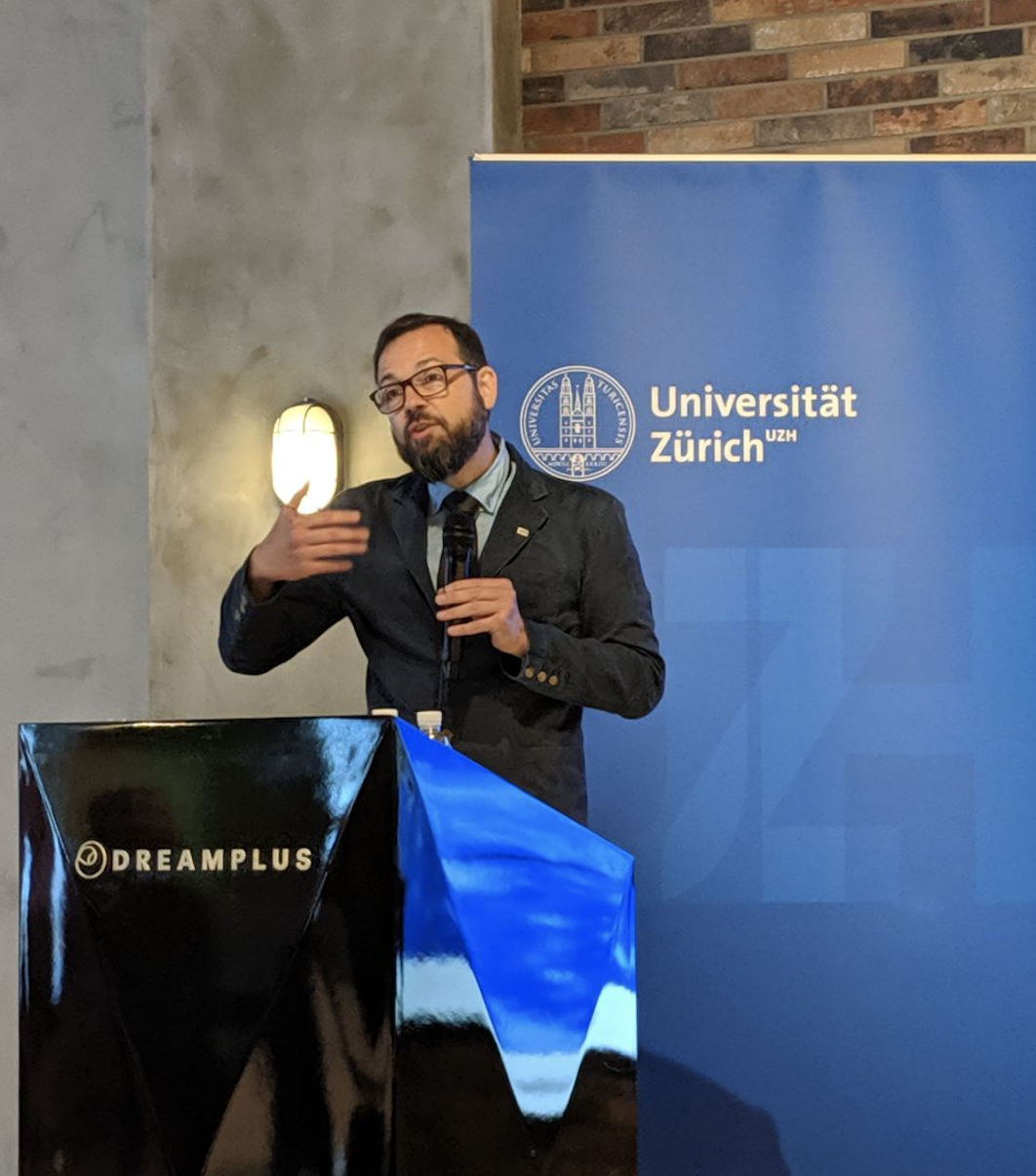
Prof. Claudio J. Tessone is a Professor of Blockchain and Distributed Ledger Technologies at the Department of Informatics, University of Zurich. He serves as Head of the Blockchain and Distributed Ledger Technologies group, Chairman of the UZH Blockchain Center, and is incharge of the NetSci Society. His academic background includes a PhD in Physics (Complex Systems) and an Habilitation in Complex Socio-Economic Systems from ETH Zurich. Education: PhD in Physics (2006): Thesis on synchronization in stochastic systems, Universitat de les Illes Balears, Spain Habilitation (2015): Thesis on agent-based modeling of socio-economic systems, ETH Zurich Master in Physics (1999): Thesis on stochastic resonance, Instituto Balseiro, Argentina Research Interests: Prof. Tessone specializes in modeling complex socio-economic and socio-technical systems, with a focus on blockchain-based systems. His work explores crypto-economics, blockchain scalability, decentralized finance (DeFi), and the interplay between micro-level agent behavior and macro-level emergent properties. Notable areas include transaction network analysis in Bitcoin/Ethereum, consensus mechanisms (Proof-of-Stake/Work), and blockchain governance models. Publications Trends: Recent articles emphasize empirical blockchain analysis (e.g., Ethereum microvelocity, Bitcoin mesoscopic structure), DeFi arbitrage strategies, and privacy-preserving blockchain applications in healthcare. His work bridges theoretical agent-based models with real-world blockchain datasets, addressing both technical and socio-economic dimensions of distributed ledger technologies. Grants & Labs: Director of the UZH Summer School on Blockchain and Certificate of Advanced Studies program. Active in interdisciplinary collaborations through the URPP Social Networks (2015–2021) and ETH Zurich’s Systems Design group (2007–2014). Labs/Initiatives: Leads the UZH Blockchain Center, a hub for academic-industry research on blockchain applications in finance, governance, and digital transformation.
Abhinav Goyal is a Professor of Finance and Director of Global Engagement at Birmingham Business School, University of Birmingham. He is affiliated with the Department of Finance and plays a leadership role in shaping the school's international strategy. His research is widely published in premier finance journals, and he serves on editorial boards including as Associate Editor for British Accounting Review . Education: PhD in Banking and Finance, University College Dublin, Ireland (2013) MA in Financial Risk Management, Simon Fraser University, Canada (2007) BE (Hons) in Computer Science, India (2006) His research focuses on corporate finance , particularly IPOs, corporate governance, privatization, and dividend policy, with a strong emphasis on institutional and emerging market contexts. His work explores how legal, political, cultural, and media factors influence corporate financial decisions, especially in initial public offerings and payout policies. Using empirical methods, he investigates global patterns in financial markets, often drawing on cross-country datasets to assess the impact of governance reforms, ownership structures, and socio-political events. The recent articles reflect a consistent focus on IPO pricing dynamics, influenced by democracy, media, terrorism, board reforms, and legal frameworks. His research integrates insights from political economy, behavioral finance, and institutional theory, demonstrating a multidisciplinary approach to understanding financial markets. A recurring theme is the role of transparency, governance, and external shocks in shaping corporate financial behavior. Scientific Awards and Editorial Roles: Associate Editor, British Accounting Review Area Editor (Frontier Markets), Research in International Business and Finance Dr. Goyal has advised doctoral and postdoctoral researchers in finance, though specific names are not listed. He has secured research funding through collaborative projects reflected in his co-authored publications with international scholars. His past academic appointments include positions at University College Cork and the University of Liverpool, along with visiting roles at Monash University, Xi’an Jiaotong-Liverpool University, and Manipal University, indicating a strong global academic network. He teaches advanced courses such as Contemporary Topics in Banking and Finance (MBA) and Private Equity and Venture Finance (MSc), contributing significantly to graduate education. He leads no named research lab or center in the provided text, but his editorial roles and global engagement position suggest active participation in research communities and international academic collaborations.
Ashley Cordes (Coquille/KōKwel) serves as an Assistant Professor of Indigenous Media in Environmental Studies and Data Science at the University of Oregon's College of Arts and Sciences. She is also a recent American Council of Learned Societies Fellow whose research bridges Indigenous science and technology studies, digital media, and environmental/place-based studies. Her educational background includes a PhD in Media Studies with an outside area in Native American Studies from the University of Oregon (2019), an MA in Communication from Hawaii Pacific University (2012), and a BA in Communication with a Journalism Certificate from Loyola Marymount University (2010). Cordes' research centers on how Indigenous culture and technology producers leverage digital media, emerging technologies, and discourse to advance Tribal sovereignty, cultural revitalization, and the resurgence of Indigenous knowledge systems. Her work specifically examines AI, blockchain, and cryptocurrency through Indigenous epistemologies, challenging dominant narratives about technological progress and financial systems. She has published in journals such as Cultural Studies >Critical Methodologies , Journal of International and Intercultural Communication , and Feminist Media Studies , and is the author of Indigenous Currencies: Leaving Some for the Rest in the Digital Age (MIT Press). Her recent publications reveal a consistent focus on decolonial approaches to technology, with particular attention to Indigenous data sovereignty, environmental justice, and alternative economic systems. The trajectory of her work shows increasing engagement with AI ethics from Indigenous perspectives, culminating in her contributions to the Indigenous Protocol and Artificial Intelligence position paper. American Council of Learned Societies Fellow Contributor to Indigenous Protocols and Artificial Intelligence Working Group Cordes actively mentors doctoral students in Indigenous digital media and participates in multiple research collectives including Abundant Intelligences, CHoRUS Network (focusing on ethical data gathering in Indigenous contexts), Indigenous Protocols and Artificial Intelligence, and the Climate Resilience Taskforce. Her community-engaged work includes the Storying on the Coquille River project, which addresses climate change impacts on salmon populations through digital humanities approaches. She maintains strong connections to her Coquille Nation community, serving on the Climate Resilience Taskforce and as Chair of the Culture and Education Committee, ensuring her academic work remains grounded in community needs and Indigenous knowledge systems.
Arthur Gervais is a Professor of Information Security at University College London's Department of Computer Science. His work focuses on blockchain systems, smart contract security, and decentralized finance (DeFi) risk analysis. He has published extensively on topics ranging from privacy technologies to systemic vulnerabilities in financial cryptography. Research Interests: Gervais investigates security challenges in blockchain ecosystems, including censorship mechanisms, zero-knowledge proofs, and DeFi liquidation risks. His interdisciplinary approach bridges computer science, cryptography, and financial systems. Publications Trends: Recent articles emphasize empirical studies of DeFi attacks, hybrid fuzzing for smart contract verification, and privacy trade-offs in blockchain mixers. His work spans conferences like ACM SIGMETRICS, IEEE Security & Privacy, and World Wide Web Conference.
Christian FISCH is an Associate Professor in Business Economics and Entrepreneurship at the University of Luxembourg's Interdisciplinary Centre for Security, Reliability and Trust (SnT). His research focuses on the intersection of entrepreneurship with digital technologies, venture finance, and socio-cultural influences. Key areas include blockchain-based financing mechanisms (e.g., ICOs), the psychological and digital identity aspects of entrepreneurs, and the impact of environmental/climate factors on entrepreneurial activity. He has published extensively in top journals, addressing topics such as B Corp certification signaling effects, venture capital decision-making, and the paradox of technology adoption among SMEs. His work spans both theoretical contributions (e.g., extending Schumpeterian frameworks) and applied analyses (e.g., post-pandemic entrepreneurial resilience). FISCH collaborates with global institutions, leveraging mixed-methods approaches including digital trace analysis from platforms like Twitter to study investor behavior and entrepreneurial traits. He has no listed awards but maintains active research agendas in decentralized finance, climate entrepreneurship, and cross-cultural entrepreneurial motivations. Professional activities include editorial roles in entrepreneurship journals and advising on innovation policy. His research often addresses emerging trends such as NFTs in creative industries, DAO governance structures, and the role of trademarks/patents in regional innovation ecosystems.
Juliet M. Moringiello is Professor of Law and Associate Dean for Academic Affairs at Widener University - Commonwealth Law School, where she has established herself as a leading scholar in property law, electronic contracting, and blockchain technology. Her work bridges traditional legal doctrines with emerging digital economies, particularly in the areas of NFTs, crypto assets, and secured transactions. Position: Professor of Law, Associate Dean for Academic Affairs Institution: Widener University - Commonwealth Law School, Harrisburg, PA Her research interests focus on the evolving landscape of digital property, including the legal treatment of tokens, virtual assets, and blockchain-based real estate. She critically examines the Uniform Commercial Code (UCC), particularly Articles 9 and 12, in the context of technological innovation. Moringiello also explores municipal bankruptcy, consumer contracts, and the implications of automated enforcement mechanisms like smart contracts. The trends in her recent publications reflect a growing scholarly engagement with decentralized technologies. Her work analyzes how traditional legal frameworks—such as property rights, title registration, and contract formation—apply (or fail) in digital environments. She frequently collaborates with legal scholars like Christopher K. Odinet and William L. Reynolds, contributing to foundational debates on electronic assent, consumer protection, and financial regulation. Moringiello’s scholarship has been widely disseminated through major law reviews and research platforms. Her publications appear in journals such as Florida Law Review , William & Mary Law Review , Rutgers Law Review , and Yale Journal on Regulation . She has also contributed to book chapters with Cambridge University Press. She has been involved in public policy discussions, notably co-authoring commentaries on the Federal Trade Commission’s proposed ban on non-compete clauses. Her academic leadership is evident in her editorial and collaborative roles across legal academia. Moringiello has advised on issues related to data security, domain name enforcement, and the legal infrastructure of subprime mortgages. Her work on municipal receiverships and bankruptcy highlights the intersection of public trust, governance, and financial distress. Although no formal advising or grant information is listed, her extensive collaborative research suggests active engagement in scholarly networks and policy initiatives.
Pratyush Mishra is an Assistant Professor in the Department of Computer and Information Science at the University of Pennsylvania's School of Engineering and Applied Science, where he is a member of the Security and Privacy Laboratory. His academic career bridges theoretical cryptography with practical implementations in secure computation systems. University of Pennsylvania (Current) UC Berkeley (Alma Mater) Dr. Mishra's research focuses on cryptography and computer security, particularly zkSNARKs, secure computation, and cryptographic proof systems. His work enables efficient privacy-preserving systems through innovations in zero-knowledge proofs and verifiable computation. He is a co-author and co-maintainer of the arkworks ecosystem, which provides foundational libraries for zkSNARK implementations used across industry and academia. His recent publications demonstrate significant contributions to proof accumulation, delegation-friendly zkSNARKs, and scalable zero-knowledge systems. These works appear consistently in top-tier security and cryptography venues including CRYPTO, IEEE S&P, and USENIX Security. ACM SIGSAC Doctoral Dissertation Award Runner-Up (2022) Dr. Mishra serves on prestigious program committees including IEEE S&P (2023-2026), CRYPTO (2023, 2025), and FC (2025). He currently advises five PhD students and teaches advanced cryptography courses covering both theoretical foundations and practical implementations of cryptographic systems. His research has practical impact through his role as founding scientist at Aleo, a startup based on his Zexe research project.
Christopher Kruegel is a Professor in the Department of Computer Science at the University of California, Santa Barbara (UCSB), where he conducts research in systems security. He is affiliated with the International Secure Systems Lab (iSecLab) and was a co-founder of Lastline, Inc., which was acquired by VMware in 2020. His work focuses on creating practical security solutions that address real-world problems through system building and experimental validation. Professor Kruegel's research spans multiple areas of computer security including malware analysis, web security, network security, and vulnerability analysis. His work often involves developing systems that analyze programs for malicious behavior, scanning web applications for vulnerabilities, and improving privacy on social networks. He has made significant contributions to firmware security, smart contract analysis, and mobile security through his extensive publication record. His 15 most recent publications (2022-2023) demonstrate a strong focus on practical security solutions across diverse domains including firmware security (Shimware, Fuzzware), blockchain and smart contract security (Confusum Contractum, NFT security), mobile security (TEEzz, Columbus), and vulnerability detection techniques (Actor, Toss a Fault to Your Witcher). His research shows consistent innovation in security tools and methodologies with several papers receiving distinguished awards. Fellow of the Institute of Electrical and Electronics Engineers Outstanding Graduate Mentor Award, UCSB Academic Senate Distinguished Artifact Award for Fuzzware paper Distinguished Paper Award for Ramblr paper Best Student Paper Award for Detecting Spammers On Social Networks Professor Kruegel has advised numerous graduate students and collaborated extensively with researchers at UCSB and beyond. His work has been funded by various research grants supporting his security research initiatives. He is actively involved in the International Secure Systems Lab, which focuses on practical security solutions for real-world problems.