Gilbert Fridgen is Full Professor in Digital Financial Services and holder of the PayPal-FNR PEARL Chair at the University of Luxembourg's Interdisciplinary Centre for Security, Reliability and Trust (SnT). He leads the FINATRAX research group focusing on blockchain, digital identity, and sustainable digital solutions. His research explores decentralized technologies in finance, energy systems, and public administration. Current projects investigate blockchain applications in industrial demand response, NFT markets, EU digital identity wallets, and DeFi institutional adoption. Prof. Fridgen examines the intersection of technology with regulatory frameworks and user behavior in energy and financial systems. He collaborates extensively with industry partners including PayPal and Spuerkeess. Prof. Fridgen actively contributes to EU digital policy discussions, particularly regarding the European Digital Identity Wallet framework and decentralized finance governance.
Aggelos Kiayias FRSE is Chair in Cyber Security and Privacy and Director of the Blockchain Technology Laboratory at the University of Edinburgh. He is also Chief Scientist at blockchain technology company Input Output. His academic work spans over two decades with more than 200 publications in cryptography, blockchain, and security. Dr. Kiayias received his Ph.D. from the City University of New York and was an undergraduate at the University of Athens Mathematics department. His research focuses on computer security, privacy, applied cryptography, and foundations of cryptography with particular emphasis on blockchain technologies, distributed systems, e-voting, secure multiparty protocols, and identity management. His recent work demonstrates continued innovation across multiple dimensions of blockchain technology, with publications spanning theoretical foundations, practical implementations, economic modeling, and privacy-preserving techniques. The research output shows strong emphasis on security analysis, consensus protocols, transaction processing, and economic incentives within decentralized systems. His work bridges theoretical cryptography with real-world blockchain applications. Among his notable recognitions are an ERC Starting Grant, Marie Curie fellowship, NSF Career Award, Fulbright Fellowship, election as Fellow of the Royal Society of Edinburgh in 2021, and the BCS Lovelace Medal in 2024. He has served as program chair for major conferences including the Cryptographers' Track of RSA (2011), Financial Cryptography (2017), Real World Crypto Symposium (2020), and Public-Key Cryptography Conference (2020), and as general chair of Eurocrypt 2013. Professor Kiayias has supervised over 20 PhD students, many of whom have gone on to academic positions at institutions including Imperial College, Stanford University, Royal Holloway University London, University of Glasgow, University of Sydney, and Virginia Commonwealth University. His current advisees include Yu Shen, Amirreza Sarencheh, and Christina Ovezik with expected graduations between 2025-2026. He leads the Blockchain Technology Laboratory at the University of Edinburgh and is involved in several major blockchain research projects including Panoramix and Fentec. His research has received significant funding from the European Union (Horizon 2020, ERC), UK research councils (EPSRC), US agencies (NSF, DHS, NIST), and Greek research bodies.
Hanna Halaburda is an Associate Professor of Technology, Operations, and Statistics at the Leonard N. Stern School of Business, New York University, where she joined in 2019. Her research lies at the intersection of economics, technology, and digital platforms, with a strong focus on blockchain, cryptocurrencies, and platform competition. She has published extensively in top academic journals and co-authored the seminal book Beyond Bitcoin: The Economics of Digital Currencies . PhD in Economics, Northwestern University MA in Economics, Warsaw School of Economics MA in Philosophy, Warsaw University Her research interests center on the economic implications of digital transformation. She investigates how blockchain technology reshapes trust, governance, and competition in digital markets. Her work explores token design, consensus mechanisms, smart contracts, and the strategic use of decentralization in platforms. She also studies platform competition under network effects, consumer choice, and omnichannel marketing. A recurring theme is how digital technologies alter traditional economic forces and business models. The most recent articles show a strong trend toward analyzing the governance, security, and economic design of blockchain systems. Her work combines rigorous theoretical modeling with empirical insights, often applying game theory and industrial organization frameworks. Topics include permissioned vs. permissionless blockchains, the role of cryptographic tokens in coordination, and the macroeconomic implications of digital currencies. She also contributes to debates on Web3, AI, and the future of digital platforms. Scientific awards and recognitions include: ISR Best Paper Published in 2022 Runner-Up Lead article in RAND Journal of Economics Best Paper Award at Tokenomics 2023 Best Paper Award at WISE 2023 Best Paper Finalist at WISE 2022 and WISE 2021 Hanna Halaburda has advised and collaborated with numerous researchers and institutions. Her co-authors include leading scholars from Harvard, NYU, and international universities. She has received research recognition through best paper awards and invitations to contribute to high-impact journals and policy discussions. Her work has been supported by academic and policy institutions, including the Bank of Canada, where she previously served as a senior economist. She frequently publishes in both academic and practitioner outlets, including Harvard Business Review and Nature Human Behavior , indicating strong translational impact. She is actively involved in research teams focused on digital assets, blockchain governance, and platform economics. While no formal lab is mentioned, her extensive list of working papers and collaborations suggests leadership in a dynamic research group at NYU Stern. Her recent work on DAOs, public crypto mining firms, and CBDCs indicates ongoing, forward-looking research programs with real-world policy and business implications.
Catherine Tucker is the Sloan Distinguished Professor of Management and Professor of Marketing at the MIT Sloan School of Management. She serves as the faculty director of the EMBA program and has chaired the MIT Sloan PhD Program. Her research focuses on the intersection of technology, marketing, and public policy, with expertise in digital privacy, online advertising, and blockchain applications. She co-founded the MIT Cryptoeconomics Lab and has testified before Congress on digital privacy issues. Tucker holds a PhD in Economics from Stanford University and a BA from the University of Oxford. Education: PhD in Economics, Stanford University Bachelor of Arts, University of Oxford Research Interests: Algorithmic bias and fairness Privacy regulation and consumer data Blockchain technology applications Healthcare technology and digital health Marketing strategy in digital ecosystems Awards: NSF CAREER Award (2010s) William F. O’Dell Award (Long-term Impact in Marketing) Garfield Economic Impact Award (2020) Editorial Roles: Senior editor at Marketing Science , former co-editor at Quantitative Marketing and Economics , and associate editor roles at Management Science and Journal of Marketing Research . Labs & Initiatives: Co-director of the NBER Digital Economics and AI program, and co-founder of the MIT Cryptoeconomics Lab studying blockchain applications.
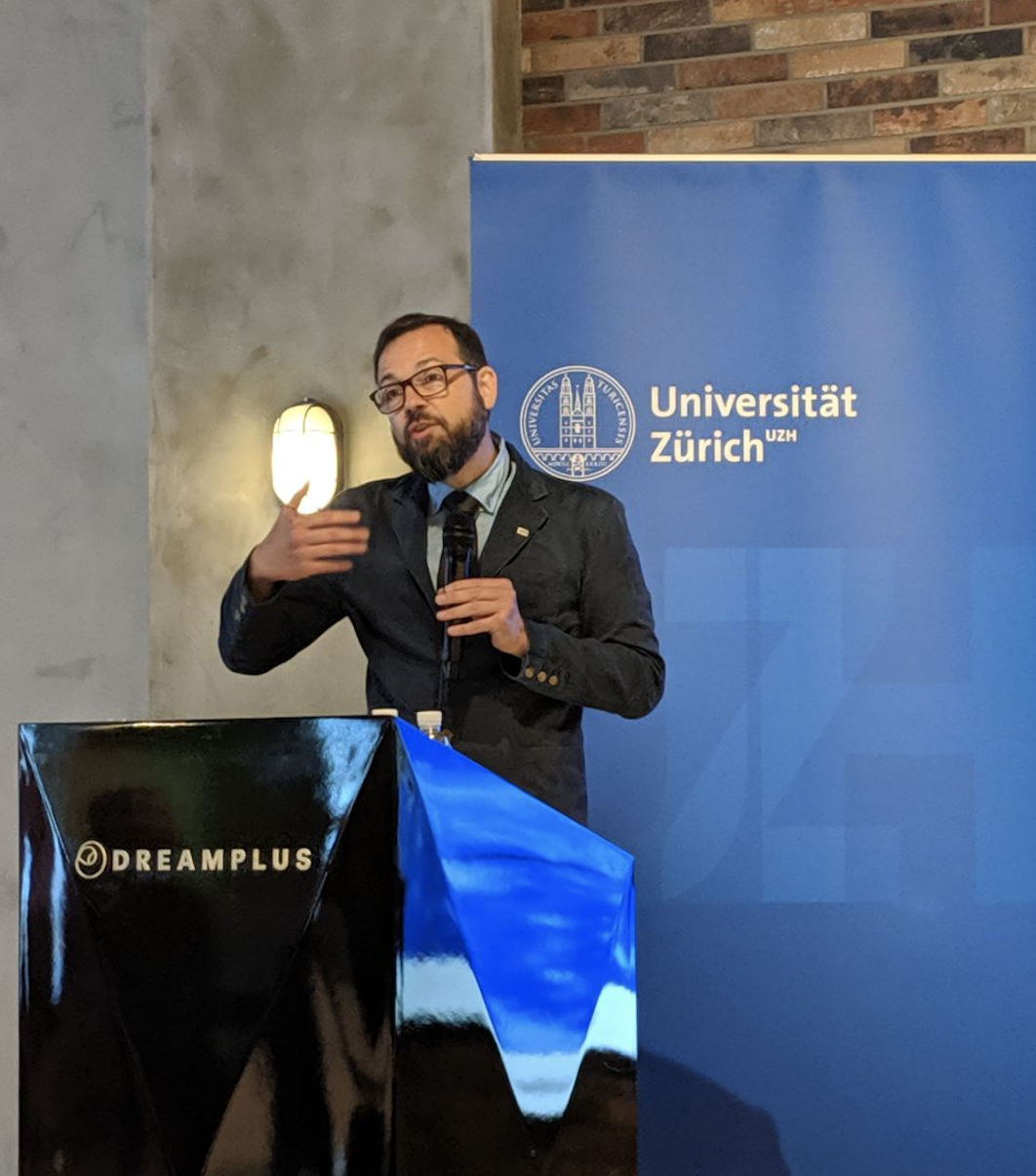
Prof. Claudio J. Tessone is a Professor of Blockchain and Distributed Ledger Technologies at the Department of Informatics, University of Zurich. He serves as Head of the Blockchain and Distributed Ledger Technologies group, Chairman of the UZH Blockchain Center, and is incharge of the NetSci Society. His academic background includes a PhD in Physics (Complex Systems) and an Habilitation in Complex Socio-Economic Systems from ETH Zurich. Education: PhD in Physics (2006): Thesis on synchronization in stochastic systems, Universitat de les Illes Balears, Spain Habilitation (2015): Thesis on agent-based modeling of socio-economic systems, ETH Zurich Master in Physics (1999): Thesis on stochastic resonance, Instituto Balseiro, Argentina Research Interests: Prof. Tessone specializes in modeling complex socio-economic and socio-technical systems, with a focus on blockchain-based systems. His work explores crypto-economics, blockchain scalability, decentralized finance (DeFi), and the interplay between micro-level agent behavior and macro-level emergent properties. Notable areas include transaction network analysis in Bitcoin/Ethereum, consensus mechanisms (Proof-of-Stake/Work), and blockchain governance models. Publications Trends: Recent articles emphasize empirical blockchain analysis (e.g., Ethereum microvelocity, Bitcoin mesoscopic structure), DeFi arbitrage strategies, and privacy-preserving blockchain applications in healthcare. His work bridges theoretical agent-based models with real-world blockchain datasets, addressing both technical and socio-economic dimensions of distributed ledger technologies. Grants & Labs: Director of the UZH Summer School on Blockchain and Certificate of Advanced Studies program. Active in interdisciplinary collaborations through the URPP Social Networks (2015–2021) and ETH Zurich’s Systems Design group (2007–2014). Labs/Initiatives: Leads the UZH Blockchain Center, a hub for academic-industry research on blockchain applications in finance, governance, and digital transformation.
Jacob D. Leshno is an Associate Professor of Economics and Robert H. Topel Faculty Scholar at the University of Chicago Booth School of Business. His research employs game theory, applied mathematics, and microeconomic theory to study allocation mechanisms and marketplace design, with applications spanning school choice systems, patient assignments to nursing homes, and decentralized cryptocurrency protocols. Professor Leshno's academic background includes: PhD in Economics from Harvard University, completed under Nobel laureate Alvin Roth M.Sc. in Pure Mathematics from Tel Aviv University B.Sc. in Pure Mathematics from Tel Aviv University His research program centers on market design theory with two primary strands. The first focuses on matching markets, where he developed tractable cutoff characterizations that clarify market structures for college admissions and medical residency matching (NRMP). His work demonstrates how price discovery mechanisms can streamline inefficient processes like college applications and subsidized housing allocation. The second strand examines cryptocurrencies and blockchain technology, investigating how open-source computer code functions as market rules in decentralized systems. This research explores both the economic security of permissionless consensus and fundamental limitations of proof-of-work protocols. Professor Leshno's publications reveal a cohesive research trajectory applying economic theory to increasingly complex market structures. His work consistently bridges theoretical rigor with practical implementation, evolving from traditional matching markets to the frontier of decentralized digital systems. Publications in top journals like American Economic Review and Journal of Political Economy demonstrate both analytical depth and real-world relevance across education, healthcare, and financial technology sectors. Professor Leshno has received significant recognition for his contributions: ACM SIGecom Test of Time Award for foundational work in matching markets INFORMS Frederick W. Lanchester Prize for outstanding contributions to operations research Prior to Chicago Booth, Professor Leshno served as Assistant Professor at Columbia Business School and completed a postdoctoral fellowship at Microsoft Research New England, following industry experience at Yahoo! and IBM. He teaches MBA courses in Competitive Strategy and Market Design, and developed a PhD seminar bridging computer science theory with economic principles for distributed systems. His research continues to influence both academic theory and practical implementations of market mechanisms across multiple sectors. Professor Leshno maintains active collaborations with leading researchers including Itai Ashlagi, Irene Lo, and Gur Huberman, advancing the theoretical foundations of market design while addressing contemporary challenges in digital marketplaces and allocation systems.
Fan Zhang is an Assistant Professor in the Department of Computer Science at Yale University. He holds a Ph.D. from Cornell University, advised by Ari Juels, and a B.S. from Tsinghua University. His research focuses on computer security, applied cryptography, decentralized systems, blockchains, and trusted execution environments (TEEs). He leads the Decentralized Systems Group at Yale and is affiliated with the IC3, CDCC, and CADMY centers. He teaches courses on blockchain and real-world cryptography. Key research interests include blockchain decentralization, privacy-preserving protocols, and secure distributed systems. Notable contributions include the Town Crier oracle system (acquired by Chainlink), the DECO TLS protocol, and foundational work on transaction order fairness and MEV mitigation. Awards include the Ethereum Foundation Academic Grant (2022) and the IBM PhD Fellowship (2018-2020). His work has been published in top venues like CCS, S&P, CRYPTO, and USENIX Security.
Elaine Shi is a Professor with a joint appointment in the Computer Science Department (CSD) and Electrical and Computer Engineering (ECE) at Carnegie Mellon University. She is also an Adjunct Professor of Computer Science at the University of Maryland. Her research focuses on cryptography, security, mechanism design, algorithms, blockchains, and programming languages. She co-founded Oblivious Labs, Inc., and her work on Oblivious RAM and differential privacy has been adopted by Signal, Meta, and Google. Education: Not explicitly listed, but her academic roles imply advanced degrees in computer science. Research Interests: Shi's work spans foundational areas such as secure computation, privacy-preserving algorithms, and blockchain protocols. She emphasizes practical implementations, such as Oblivious RAM and cryptographic compilers like Viaduct. Her research also explores game-theoretic mechanisms for decentralized systems and explores the intersection of theory and practice in secure distributed systems. Publications: Over 150+ articles in top venues like Eurocrypt, S&P, and CCS, covering topics like oblivious algorithms, blockchain security, and differential privacy. Recent work includes optimizing obfuscation, secure aggregation, and transaction fee mechanisms. Packard Fellow, Sloan Fellow, ACM Fellow, IACR Fellow Co-founder of CMU's Crypto Group and Crypto Seminar Series Advising & Grants: Supervises a large group of students and postdocs, with notable alumni holding academic and industry roles. Active in securing grants for research in secure computation and blockchain technologies. Labs & Teams: Leads research in Oblivious Labs and collaborates on projects like the Viaduct compiler and secure enclaves for privacy-preserving computation.
Cristina Nita-Rotaru is a tenured Professor of Computer Science at Northeastern University's Khoury College of Computer Sciences , where she leads the Network and Distributed Systems Security Laboratory (NDS2) and is a founding member of the Cybersecurity and Privacy Institute . Previously, she was a faculty member at Purdue University from 2003 to 2015. Education: Ph.D. in Computer Science from Johns Hopkins University M.S. in Computer Science from Politehnica University of Bucharest , Romania Research Focus: Her research lies at the intersection of cybersecurity , distributed systems , and computer networks . She designs and builds resilient distributed systems and network protocols that maintain security, availability, and performance despite faults, misconfigurations, and attacks. Her work integrates formal methods , adversarial testing , blockchain security , and trustworthy AI . Funding & Impact: Her research has been supported by NSF , DARPA , ONR , Google , Ethereum Foundation , and others. She has received numerous awards, including the NSF CAREER Award (2006) and multiple best paper awards at top venues like NDSS , ACM CCS , and IEEE S&P . Scientific Awards: NSF CAREER Award (2006) NETYS 2023 Best Paper Award ACM SACMAT 2022 Best Paper & Test-of-Time Awards IEEE SafeThings 2019 Best Paper Award NDSS 2018 Best Paper Award ISSRE 2017 Best Paper Award DSN 2015 Best Paper Award IETF/IRTF Applied Networking Research Prize (2016, 2018, 2025) Purdue College of Science Research Award (2013) Purdue Excellence in Research Award (2012) Purdue College of Science Leadership Award (2012) Purdue College of Science Undergraduate Advising Award (2008) Purdue Teaching for Tomorrow Award (2007) Advising & Students: She has advised over 30 PhD and MS students at Northeastern and Purdue. Notable former students include Reza Curtmola (NJIT Professor) , Endadul Hoque (Syracuse University Assistant Professor) , and Max von Hippel (Bencify founding partner) . Labs & Teams: She directs the NDS2 Lab , focusing on network and distributed systems security, with projects spanning blockchain protocols , SDN security , IoT and connected cars , and formal verification of protocols .
Alfred Taudes is a Full Professor at the Department of Information Systems and Operations, Institute for Production Management, Vienna University of Economics and Business (WU Vienna). He holds a doctoral degree and a Habilitation from WU Vienna in Business Administration and Management Information Systems, and a Magister degree from Vienna University. He has held assistant professorships at WU and visiting professorships at Augsburg, Münster, Essen, and Tsukuba University, Japan. He joined WU permanently in 1993 and served as head of the Department of Information Systems and Operations from 2010 to 2016. His research spans Operations and Supply Chain Management , Marketing Engineering , Knowledge Management , and the impact of Big Data and Blockchain on production systems. Using Complexity Science and Cryptoeconomics , he investigates digital production, integrated value chains, and market designs. He teaches undergraduate and graduate courses including Operations Strategy, Data Science, and IT seminars in WU’s International Supply Chain Master program, and has also taught at Japanese universities. His recent publications focus on blockchain privacy (e.g., CoinJoin analysis), CBDCs, MiCAR regulation, decentralized federated learning, and digital custody, reflecting a strong trend toward cryptoeconomics and blockchain-based systems in operations and finance. These works appear in top journals and conferences in information systems, security, and operations research. Cooperation Officer of the Year 2013/14 Distinguished Paper Award WI 2009 VHB Best Paper Award Nomination VHB Best Paper Award Dr. Wolfgang Houska - Recognition Award Alfred Taudes has coordinated major research projects such as the WWTF-project “Integrated Demand and Supply Chain Management” and the Special Research Area Adaptive Models in Economics and Management Science. He currently leads the research group on Cryptoeconomics at WU and chairs the scientific board of the Austrian Internet Offensive . His leadership extends to project management in initiatives like the Austrian Blockchain Center and research on decentralized finance and digital assets. He is actively involved in academic service, including organizing conferences like DEXA 2022, serving on editorial boards, and advising on research policy. His lab and research group focus on blockchain applications, digital transformation in operations, and the societal implications of big data.
Kevin Leyton-Brown is a Professor of Computer Science at the University of British Columbia (UBC), holding a Canada CIFAR AI Chair at the Alberta Machine Intelligence Institute (Amii). He is also an Associate Member of the Vancouver School of Economics and a Fellow of the Royal Society of Canada, ACM, and AAAI. His research focuses on AI, machine learning, computational economics, and game theory, with notable contributions to algorithmic market design, heuristic algorithms, and large language models. He co-authored influential textbooks on multiagent systems and game theory, and his work has been recognized with prestigious awards including the INFORMS Franz Edelman Award and the Killam Teaching Prize. Education: PhD (Computer Science), Stanford University; MSc (Computer Science), Stanford University; BSc (Computer Science), McMaster University. Research Interests: Artificial Intelligence, Machine Learning, Game Theory, Computational Economics, Algorithmic Game Theory, Market Design, and Large Language Models. He has developed impactful tools like SATzilla, AutoWEKA, and Mechanical TA, and contributed to high-stakes projects such as spectrum auction design and Ugandan agricultural market platforms. Awards & Recognition: Royal Society of Canada Fellow (2023), ACM SIG-KDD Research Track Test of Time Award (2023), INFORMS Franz Edelman Award (2018), ACM Fellow (2020), AAAI Fellow (2018), Killam Teaching Prize (UBC), and numerous paper awards from top conferences like AAAI, ICML, and ACM-EC. Leadership & Affiliations: Director of UBC’s CAIDA and AIM-SI research clusters, former Chair of ACM SIG-Ecom, and advisor to companies like AI21 Labs and Auctionomics. He has held visiting roles at institutions including MIT, Harvard, and the Simons Institute.
Naranker Dulay is a Professor in the Department of Computing at Imperial College London, part of the Faculty of Engineering. He holds affiliations with the Centre for Cryptocurrency Research and Engineering, Centre for Smart Connected Futures, and the Distributed Software Engineering group. His research focuses on Distributed Computing, Applied Economics, Policy and Administration Law, Computer Software, and Information Systems. His work explores blockchain technologies, smart contracts, consensus algorithms, and distributed systems. Recent research includes optimizing post-trade processing using distributed ledgers and developing adaptive protocols for dispute resolution in smart contracts. He is also involved in cybersecurity and privacy-preserving technologies for data management. Key contributions include frameworks like Chainlog for logic-based smart contracts and FADE for self-destructing data. His articles span over a decade, emphasizing blockchain scalability, energy-efficient neural networks, and decentralized macro-programming in wireless sensor networks. Dr. Dulay collaborates across interdisciplinary domains, blending technical innovation with socio-technical challenges. His affiliations reflect a commitment to advancing smart connected futures through cutting-edge research.
Agostino Capponi is a Professor of Industrial Engineering and Operations Research at Columbia University, affiliated with Columbia Engineering and the Data Science Institute (DSI). He holds academic fellowships at the Luohan Academy (Alibaba Group) and the Fintech@Cornell Center. His research focuses on systemic risk, financial technology, blockchain economics, and machine learning applications in finance. He has authored a best-selling book on machine learning in financial markets and received prestigious awards including the NSF CAREER Award and the JP Morgan AI Faculty Research Award. Education: Master's and PhD in Computer Science and Applied & Computational Mathematics from Caltech (2006-2009). Professional roles include Editor of Management Science , co-editor of Mathematics and Financial Economics , and leadership positions in the Bachelier Finance Society and INFORMS Finance Section. His research has been funded by NSF, DARPA, J.P. Morgan, Ethereum Foundation, and others. Research interests span blockchain governance, decentralized finance protocols, and systemic risk mitigation in financial networks. Notable contributions include work on liquidity risk, crypto-economic systems, and causal inference in financial modeling. Media coverage includes American Banker, Vox, and Chicago Booth Review. He holds a patent in military network tracking and served as a visiting scholar at the Federal Reserve Bank of New York.
Xiaotie Deng is a distinguished academic and Chair Professor at Peking University (since 2018), with prior roles at Shanghai Jiao Tong University (2013–2017), the University of Liverpool (2010–2013), and City University of Hong Kong (1997–2013). His research focuses on algorithmic game theory, internet economics, and parallel computing. He holds prestigious fellowships including ACM Fellow (2008) and IEEE Fellow (2019). Deng has led significant grants, including a RMB 5M project on algorithmic game theory at Peking University (2018–2020) and NNSFC-funded research on market competitiveness and fairness (2018–2020). Education: PhD in Computer Science from Stanford University (1989), MSc from Chinese Academy of Sciences (1984), BSc from Tsinghua University (1982). Research interests span computational game theory, equilibrium analysis, and blockchain applications. Notable contributions include foundational work on Nash equilibrium complexity and mechanism design for resource allocation. He has advised numerous PhD students and serves on editorial boards of top journals like SIAM Journal on Computing and IEEE Transactions on Cloud Computing. Key awards: ACM and IEEE Fellowships, JSPS Invitation Fellowships (2005, 1996), and NSERC International Fellowship (1991). Active in conference organizing, including PC chairs for WINE 2020 and SAGT 2018. Consultancy includes work with Cryptape, Ant Financial, and Microsoft Research Asia, reflecting his industry engagement in algorithmic solutions and blockchain technologies.
Jonathan Beller is a Professor in the Humanities and Media Studies department at the School of Liberal Arts & Sciences , Pratt Institute. His work sits at the intersection of visual culture, media theory, and political economy. Educated at Columbia University (B.A.) and Duke University (Ph.D.) Editorial Collective member of Social Text His research examines the cinematic mode of production, attention economy, racial capitalism, and the sociopolitical implications of digital media. Key themes include visuality as labor exploitation, algorithmic violence, and media's role in shaping economic systems. Recent publications analyze racialization in digital systems , computational capital , and decentralized financial media , reflecting his long-standing interest in media's material conditions. Contact: jbeller@pratt.edu