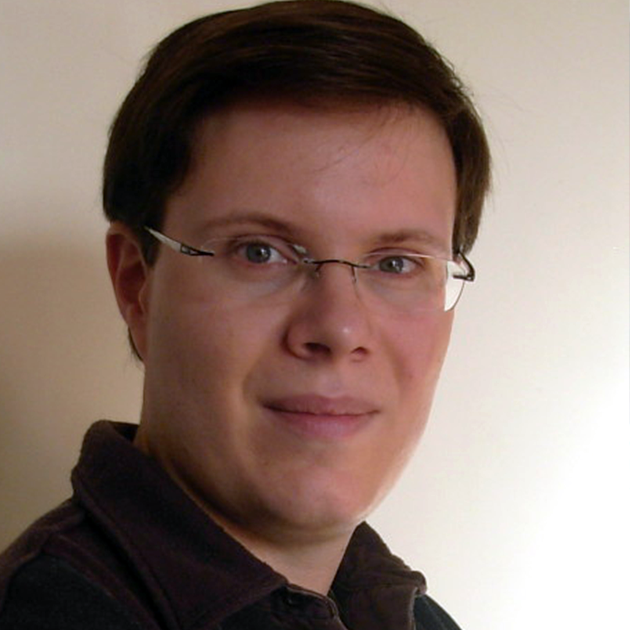
Damien Stehlé is a Professor at the École Normale Supérieure de Lyon (ENS Lyon), affiliated with the Laboratoire LIP (CNRS, ENSL, INRIA, UCBL, U. Lyon) and a member of the AriC team. He is also a member of the Institut Universitaire de France. His research focuses on cryptography, computational number theory, and computer algebra, particularly lattice-based cryptography and its applications in post-quantum security. He has held editorial roles at the Journal of Cryptology and Designs, Codes and Cryptography, and served on committees for major conferences like ASIACRYPT and CRYPTO. His work has led to advancements in lattice reduction algorithms, cryptographic protocols (e.g., signatures, encryption schemes), and security proofs in the quantum random oracle model. Stehlé has supervised numerous PhD students, including Alice Pellet-Mary and Miruna Rosca, and has contributed to open-source lattice reduction software like fplll. His awards include Best Paper Awards at ASIACRYPT 2021 and 2015. He teaches advanced courses on post-quantum cryptography and cryptanalysis at the Master’s level.
Maria Mushtaq is an Associate Professor at Telecom Paris , affiliated with the Information Processing and Communication Laboratory (LTCI) and the Secure and Safe Hardware (SSH) Lab . She received her PhD in Information Security from the University of South Brittany, France (2019) and completed 2 years of postdoctoral research at LIRMM, University of Montpellier under the CNRS excellence post-doc grant. Research Focus: Microarchitectural vulnerability assessment, runtime mitigation against side/covert-channel attacks, cryptanalysis, OS-based security primitives, and hardware-software interface security Technical Expertise: Cache timing attacks, transient execution attacks (Spectre/Meltdown), Hardware Performance Counter analysis, gem5 simulation Her recent work involves RISC-V security analysis using gem5 simulations and machine learning for attack detection. She serves as Guest Editor for the Journal of Applied Sciences special issue on Side Channel Attacks in Embedded Systems and has been on the Program Committee for the European Test Symposium (2020-2021). 2021 HiPEAC Collaboration Grant recipient Organized IP Paris Winter School on Microarchitectural Security (2022) Active in international conferences as panelist and keynote speaker
Sihem Mesnager is a University Professor of Mathematics at the University of Paris VIII, affiliated with the Laboratory of Analysis, Geometry and Applications (LAGA) at Paris XIII (CNRS) and the AGC3 research group (Algebra, Geometry, Combinatorics) . She holds an adjunct professorship at Télécom Paris within the MIC2 Mathematics team of the Computer Science and Networks department (INFRES). Her work bridges pure mathematics and applied cryptography, focusing on Boolean functions, bent functions, and coding theory for secure communication and data protection. PhD in Mathematics, University of Pierre and Marie Curie (Paris VI), Sorbonne University (2002) Habilitation (HDR) in Mathematics, University of Paris VIII (2012) Research Interests Dr. Mesnager specializes in symmetric cryptography and coding theory , particularly their applications to secure digital communication, error correction, and post-quantum cryptographic protocols. Her algebraic approach employs finite fields, exponential sums, algebraic geometry, and finite geometry to analyze and construct cryptographic primitives like S-boxes, APN functions, and optimal linear codes. She also investigates algorithmic aspects of computer algebra in these domains. Scientific Awards George Boole International Prize (2020) PEDR Excellence Scientific Award (2019-2022) PEDR Excellence Scientific Award (2014-2017) Publications & Projects Her recent work includes constructing weightwise perfectly balanced Boolean functions for the FLIP cipher, optimizing Inner Product Masking schemes via coding theory, and developing post-quantum secure functional encryption using multivariate cryptography. She has contributed to Reed-Muller codes, BCH codes, and Gaussian sum-based linear codes with one-dimensional hulls, emphasizing their applications in side-channel attack resistance and quantum error correction.
Weiqiang Wen is an assistant professor at Telecom Paris , affiliated with the Cybersecurity and Cryptography (C²) team within the Information Processing and Communication Laboratory (LTCI) . His academic journey includes a PhD from ENS Lyon under Damien Stehlé (2019), postdoctoral work at IRISA (2019-2021), and a research engineer role at TII (2021). Research Interests: Weiqiang Wen specializes in post-quantum cryptography and lattice-based cryptography . His work explores the hardness of lattice problems and their implications for cryptographic security , particularly in quantum-resistant systems. He has contributed to advancements in Module-NTRU , LWE , and cryptanalysis . Publications: Wen’s research spans lattice reduction algorithms (e.g., BKZ, uSVP), cryptographic constructions (e.g., threshold ring signatures, NIZK), and quantum verification protocols. His work bridges theoretical lattice problems with practical cryptographic implementations, focusing on security reductions , zero-knowledge proofs , and key exposure attacks .
Phong Nguyen is a Research Professor at Inria (Directeur de recherche) and a part-time professor at the Computer Science Department (DI ENS) of École Normale Supérieure (ENS), PSL University in Paris. He leads the ENS Crypto Team (Inria Equipe Projet Cascade) and serves as the principal investigator for the ERC Advanced Grant PARQ (2020) focused on lattices in parallel and quantum computing. He holds a PhD (1999) and Habilitation (2007) from ENS-Lyon, with an agrégation de mathématiques (1997). His research integrates cryptography, algorithmic number theory, and lattice-based computations, emphasizing: Cryptanalysis : Deconstructing cryptographic protocols, especially lattice-based systems Post-quantum cryptography : Developing quantum-resistant solutions Lattice algorithms : Optimization of reduction, enumeration, and sieving techniques Real-world applications : Bridging theoretical constructs with practical security implementations His publications (spanning Eurocrypt, Asiacrypt, and Journal of Cryptology) demonstrate deep expertise in lattice cryptography, with recurring themes in algorithm efficiency, cryptanalysis of NTRU/GGH systems, and theoretical advancements in lattice reduction. Recent work (2024) continues this trajectory with improved BKZ analysis and hypercubic lattice optimizations. Awards include : ERC Advanced Grant (2020) for PARQ project Best Paper Award at EUROCRYPT 2006 Cor Baayen Award (2001) He advises PhD students (e.g., Henry Bambury, Leo Ducas) and interns from institutions like École Polytechnique and ENS. He directs the ENS Crypto Team and previously held leadership roles as: French Director of the Japanese-French Laboratory for Informatics (2015-2019) European Director of LIAMA (Sino-European Computer Science Lab, 2013-2015) Coordinator of ECRYPT II virtual labs (2008-2012)
Professor Damien Stehlé is a faculty member at École Normale Supérieure de Lyon (ENS Lyon), where he is part of the AriC team within the Laboratoire de l'Informatique du Parallélisme (LIP). He is also a distinguished member of the Institut Universitaire de France. His research and teaching activities focus on cryptography, computational number theory, and computer algebra, with particular emphasis on lattice-based cryptographic systems. Stehlé's research primarily centers on the computational aspects of Euclidean lattices and their applications in cryptography. He has made significant contributions to lattice-based cryptography, particularly in the context of post-quantum cryptography. His work addresses fundamental questions about the hardness of lattice problems, algorithmic improvements for lattice reduction, and the development of practical cryptographic schemes based on lattice assumptions. He has been actively involved in the NIST post-quantum cryptography standardization process, contributing to the analysis of lattice-based candidates like Kyber and Saber. His publications span theoretical foundations to practical implementations, demonstrating a rare ability to bridge abstract mathematics with real-world cryptographic applications. Throughout his career, Stehlé has published extensively in top-tier cryptography and theoretical computer science venues. His research has been recognized with multiple best paper awards for groundbreaking contributions to the field. Best paper award at ASIACRYPT 2021 for 'On the hardness of the NTRU problem' Best paper award at ASIACRYPT 2015 for 'Improved security proofs in lattice-based cryptography' Best paper award at EUROCRYPT 2015 for 'Cryptanalysis of the Multilinear Map over the Integers' Professor Stehlé has supervised numerous PhD students over the years, often collaborating with other leading researchers in the field. He serves on program committees of major cryptography conferences and is a member of editorial boards for prestigious journals including the Journal of Cryptology and Designs, Codes and Cryptography. His research group at LIP's AriC team is recognized as a leading center for lattice-based cryptography research in Europe.
Thomas Debris-Alazard is a research scientist at Inria within the Grace project-team and a part-time assistant professor at École Polytechnique. His work focuses on code-based and lattice-based cryptography, with significant contributions to post-quantum cryptographic design and analysis. PhD in Code-Based Cryptography, Sorbonne University (2019) His research interests include code-based and lattice-based cryptography, post-quantum security, quantum algorithms, and information theory. He has made foundational contributions to the understanding of decoding problems, learning with errors, and the design of secure cryptographic primitives resistant to quantum attacks. The recent publications highlight a strong focus on the theoretical underpinnings of code-based cryptography, including hardness reductions, decoding algorithms, and the security of post-quantum signature schemes. His work bridges classical and quantum computational models, with an emphasis on provable security and cryptanalysis. Best Paper Award at Asiacrypt 2019 He has advised PhD students Maxime Bombar and Pierre Loisel. He is the principal investigator of the ANR JCJC COLA project and coordinator of the Wave signature scheme for NIST standardization. His teaching at École Polytechnique includes courses on code-based cryptography, information theory, and quantum computing.
Jean-Luc Danger is a Professor at TELECOM Paris where he currently heads the Digital Electronic Systems Research Group. He is affiliated with the Secure and Safe Hardware (SSH) Research Team within the Information Processing and Communication Laboratory (LTCI). With a career spanning over three decades in academia after 12 years in industrial research at PHILIPS and NOKIA, Professor Danger has established himself as a leading expert in hardware security and cryptographic implementations. Professor Danger received his degree in electrical engineering from SUPELEC in 1981 before embarking on his industrial career. His academic journey began in 1993 when he joined TELECOM Paris, where he has since made significant contributions to the field of hardware security. His educational background in electrical engineering provided the foundation for his later specialization in secure hardware design and analysis. Professor Danger's research primarily focuses on embedded systems security , physically unclonable functions (PUFs) , side-channel attacks and countermeasures , and fault injection techniques . His work bridges the gap between theoretical cryptography and practical hardware implementations, addressing critical security challenges in modern computing systems. His research has evolved from foundational work on cryptographic algorithms to more recent investigations into hardware Trojans, aging effects on security primitives, and automotive security systems. Professor Danger has been particularly influential in developing methodologies for analyzing and protecting against electromagnetic fault injection attacks and side-channel information leakage. His extensive publication record demonstrates a consistent focus on hardware security challenges, with recent work showing increased attention to automotive security systems, machine learning applications for intrusion detection, and reliability issues in security primitives affected by aging and process variations. The trajectory of his research shows a natural progression from pure cryptographic implementations to more holistic security approaches that consider the entire hardware stack and its vulnerabilities. Through his leadership of the Secure and Safe Hardware research team, Professor Danger has fostered a collaborative environment that bridges theoretical security research with practical hardware implementation challenges. His work has contributed significantly to the development of standardized methodologies for evaluating hardware security and has influenced both academic research and industry practices in secure hardware design.
Benjamin Gregoire is a Researcher at INRIA Sophia Antipolis , affiliated with the Marelle Team . His work focuses on compilers , formal verification , cryptography , proof assistants , and type theory . Education : PhD in Computer Science, Université Paris 7 (2003) Research Interests : Dr. Gregoire specializes in formal verification of cryptographic systems, compiler design for security-critical applications, type-based termination, and proof assistants like Coq. His projects include the INRIA-Microsoft Research Joint Lab , ANR Scalp (Security of Cryptographic Algorithms with Probabilities), and ANR DeCert (Certified Decision Procedures). He led the Mobius project (IP FET) and contributed to Java security validation via the JACK tool . Scientific Awards : He received the Best Paper Award at CRYPTO 2011 for 'Computer-Aided Security Proofs for the Working Cryptographer.' Advising & Collaborations : Dr. Gregoire has advised PhD students Michael Armand , Julien Charles , Sylvain Heraud , and Jorge-Luis Sacchini , with former advisee Cesar Kunz . He collaborates with teams including Marelle and INRIA-Microsoft Research .
National Institute of Science and Technology (INSA)France
Christine Solnon is a Professor of Computer Science at INSA Lyon, affiliated with the CITI lab and Inria EMERAUDE team. Her research bridges Ant Colony Optimization (ACO) and Constraint Programming (CP) to solve complex combinatorial problems in vehicle routing, scheduling, and graph algorithms. Deputy head of science at Inria Lyon Centre Co-investigator in projects like ANR MAMUT (2022-2026) and ANR DeCrypt (2019-2022) Her work focuses on hybridizing ACO with CP for optimization, addressing time-dependent problems (e.g., Time-Dependent TSP with Time Windows ), multi-robot coordination, and differential cryptanalysis. Google Scholar lists 15 recent articles (2025-2023) exploring topics like non-crossing path planning for tethered robots, spatio-temporal traffic modeling, and algorithmic ethics. She mentors PhD students in areas such as Time-Dependent Vehicle Routing Problems and Mathheuristics , often co-supervising with institutions like Lab-STICC and LIRIS. Her software tools (e.g., AntSolver, Castor) demonstrate practical applications of her research.
Sorina Ionica is a Lecturer at the University of Picardie Jules Verne, specializing in Cryptography , Mathematics , and Artificial Intelligence . Her research focuses on the application of optimization techniques and algebraic geometry to cryptographic protocols, particularly in the context of genus 3 curves and isogeny-based cryptography. Research Interests: Cryptography, isogeny graphs, complex multiplication, index calculus, and AI-driven optimization algorithms. Projects: Involved in BforSAT (application of SAT solvers to cryptographic problems) and POSTCRYPTUM (post-quantum cryptography research). Recent Articles: Her work spans mathematical cryptography (e.g., CM curves and Weil descent attacks), algorithm optimization (Crossbred algorithm), and AI integration in cryptanalysis (tree search and SAT solvers). Labs: Sorina is affiliated with the OCIA Lab (Optimization and Cryptography, AI).
Guillaume Duc is an Associate Professor (Maître de Conférences) at Télécom Paris , affiliated with the Information Processing and Communication Laboratory (LTCI) and the Department of Computer Science and Networks . His research focuses on embedded systems security, particularly hardware/software interaction, side-channel attacks, and resilient architectures. Education: PhD in Hardware, Software and Cryptographic Support for Secure Process Execution , École Nationale Supérieure des Télécommunications de Bretagne (2007) Master's (DEA) in CryptoPage – an architecture to run secure processes , Université de Rennes 1 (2004) Research Interests: His work spans embedded systems security , with a focus on: Hardware/Software Interaction: Exploring vulnerabilities and defenses at the intersection of hardware and software. Side-Channel Attacks: Investigating power analysis, electromagnetic attacks, and countermeasures, including organizing the DPA Contest . Resilient Architectures: Designing secure memory architectures, FPGA-based protections, and cloud-embedded system trustworthiness. Publications & Patents: He has published extensively in top-tier venues such as Journal of Cryptographic Engineering , ACSAC , and CARDIS , with recent works addressing AI-driven automotive security (2024) and system cost-optimization for security (2019). He holds multiple patents in non-intrusive fault detection and secure electronic component monitoring. Teaching & Leadership: Academic lead for the engineering program at Télécom Paris. Responsible for courses like INF107: From Logic Gates to Operating Systems and SE203: Microprocessor System Tools . Co-instructor for Rust programming modules in executive education. Labs & Teams: He leads research within the Autonomous Critical Embedded Systems (ACES) team at LTCI, collaborating on secure embedded systems for automotive and cloud applications.
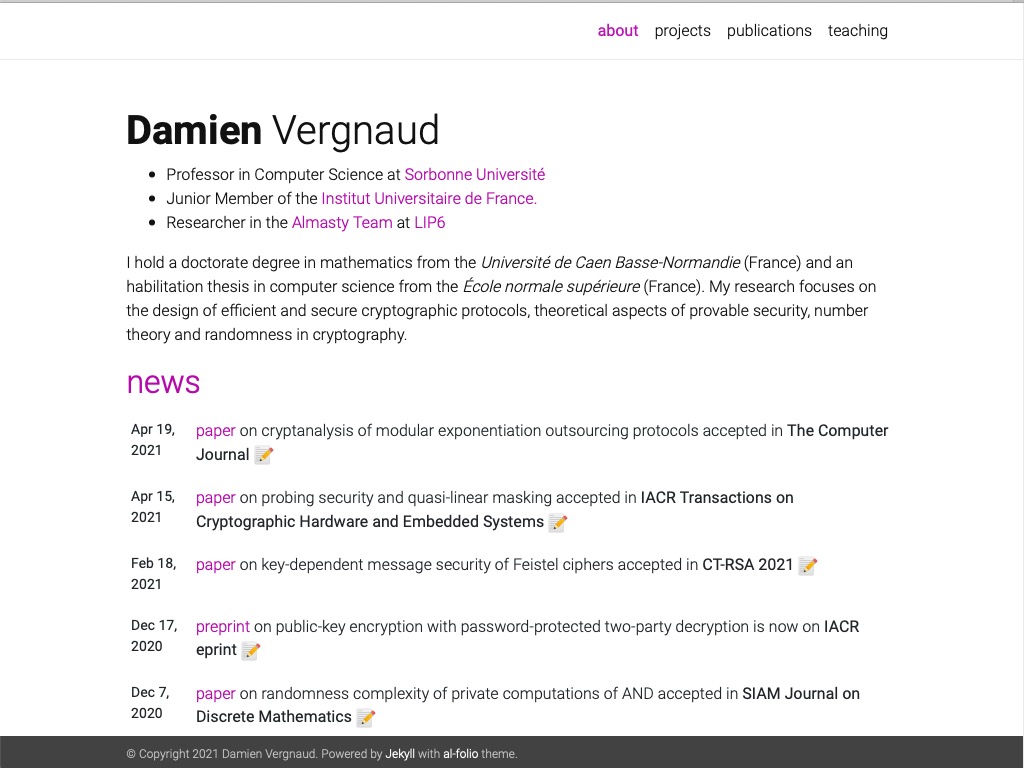
Dr. Damien Vergnaud is a Full Professor at Sorbonne University since September 2017, affiliated with the ALMASTY research team within LIP6 (Laboratoire d'Informatique de Paris 6), the Computer Science department of the Faculty of Science. His office is located at 4 place Jussieu, Paris, France, in Couloir 24-25, Étage 4, Bureau 412. Dr. Vergnaud holds a doctorate degree in mathematics from Université de Caen Basse-Normandie and an habilitation thesis in computer science from École normale supérieure. His research focuses on the design of efficient and secure cryptographic protocols, theoretical aspects of provable security, number theory, and randomness in cryptography. His work spans multiple domains including post-quantum cryptography, zero-knowledge proofs, secure implementation techniques against side-channel attacks, and cryptographic protocol analysis. He actively investigates how quantum computing impacts traditional cryptographic assumptions and protocols, as evidenced by his supervision of PhD students working on quantum-related cryptographic topics. Dr. Vergnaud's recent publications demonstrate a strong focus on post-quantum cryptographic techniques, zero-knowledge argument systems, and secure implementation methodologies. His research output shows consistent collaboration with both academic researchers and industry partners, particularly in practical cryptographic implementations. His work bridges theoretical foundations with practical security considerations, addressing challenges in modern cryptographic systems including resistance to quantum computing threats and side-channel analysis. Dr. Vergnaud actively supervises PhD students, currently mentoring three doctoral candidates and having successfully guided four students to completion in recent years. His supervision spans diverse topics within cryptography, including post-quantum cryptographic techniques, zero-knowledge arguments, secure implementations against physical attacks, and mathematical studies of pseudorandom number generators. He has served on numerous PhD defense committees, indicating his active role in the academic community. Dr. Vergnaud is a member of the ALMASTY research team at LIP6, which specializes in cryptographic algorithms and protocols. The team works on both theoretical foundations and practical implementations of cryptographic systems, with particular emphasis on security against various attack vectors including quantum computing threats and side-channel analysis.
Elena Kirshanova is a part-time Lecturer at I.Kant Baltic Federal University and Lead Cryptographer at Technology Innovation Institute. Her research focuses on practical and theoretical cryptanalysis of lattice-based and code-based cryptographic primitives, with applications to post-quantum security. Research interests include: Lattice-based cryptanalysis Quantum algorithms for cryptographic problems Decoding attacks on McEliece variants Sieving techniques for codes and lattices She teaches courses in lattice-based cryptography, coding theory, and information security. Dr. Kirshanova serves on program committees for major cryptography conferences including Crypto, Eurocrypt, and PQCrypto. Her work bridges theoretical cryptanalysis with practical implementations for post-quantum cryptographic schemes.
Olivier Blazy is a Professor at École Polytechnique, specializing in cryptographic protocols and security analysis. His research spans post-quantum cryptography, implicit cryptography, end-to-end encryption, and online age verification systems. Current affiliations: École Polytechnique (since 2021), LIX Grace Lab Previous institutions: University of Limoges (2014-2021), Ruhr University Bochum (2012-2014), École Normale Supérieure (2009-2012) Blazy’s work focuses on developing quantum-resistant cryptographic solutions, including secret sharing mechanisms, oblivious transfer protocols, and code-based encryption systems. He has contributed to the NIST Post-Quantum Cryptography standardization process. His research includes a taxonomy for post-compromise security, analyzing recovery speeds of protocols like Signal and 5G handover systems. Recent publications explore bivariate proximity tests, cryptographic accumulators, and identity-based revocation schemes. Blazy has been featured in media discussing cybersecurity policy, including: Critique of French government’s StopCovid contact-tracing app (2020-2022) Analysis of EU digital identity frameworks (2024) Commentary on online age verification and privacy (2023) He teaches advanced cryptography courses covering encryption, differential privacy, and cryptanalysis techniques.