Tuuli Mattelmäki is a Professor at Aalto University's School of Arts, Design and Architecture , affiliated with the Department of Design . Her work centers on co-design , service design , and creative practices , with a focus on empathic approaches and societal transformations. Research Interests : Empathic Design : Human-centered methodologies in public sector innovation Transformational Futures : Exploring creative practices for sustainability Service Design : Cross-organizational B2B innovation and prototyping Design Probes : Experimental tools for participatory engagement Recent Articles (2022-2025) reflect expertise in service design , sustainability , and creative interventions , spanning subfields like co-laboratories, inner conditions in co-design, and climate-responsive design. Collaborations include institutions such as University of Sussex, RMIT, and Utrecht. Scientific Awards : Ziman Award (2024) for the CreaTures project Industrial Designer of the Year (2008) by TKO and ORNAMO Dean's Publication Bonus (2012) for the Encore team Teams & Labs : Principal Investigator of the CreaTures (Creative Practices for Transformational Futures) project, leading a multidisciplinary team with partners including Superflux, Kersnikova, and RMIT University.
Namkyu Chun is a Lecturer at Aalto University's Department of Design, specializing in fashion and textile futures. With a focus on sustainability, interdisciplinary collaboration, and redefining design practices, Chun's work bridges fashion theory, material culture, and transformative futures. Their research explores the intersection of human/non-human relationships in design, climate-responsive practices, and ethical material engagement. Key research areas: Fashion Design, Sustainable Practices, Design Futures, Interdisciplinary Collaboration Awards: 2024 Ziman Award (CreaTures Project), 2017 Finnish-Danish Cultural Foundation Scholarship, 2017 Helsinki Urban Facts Grant, 2015 Subtle Visibility Award Recent publications examine topics such as '1.5 Degree Lifestyles,' 'Pluriverse' frameworks, and revival of dressmaking traditions. Chun collaborates with institutions like University of Sussex, RMIT, and Superflux, integrating artistic inquiry with systemic change. Their work appears in journals including Fashion Theory , The Design Journal , and Fashion Practice .
Michael Doolan is a Senior Lecturer at Sydney College of the Arts, University of Sydney. He holds a PhD from Monash University (2013), a Master of Arts (2001), and a Bachelor of Arts (1981). His work explores the intersection of memory, narrative, and objects, using ceramics and mixed media to create sculptures that interrogate childhood narratives and their influence on adult identity. Doolan’s installations often feature disorienting optical effects and fairy tale motifs, reinterpreting classic stories through a contemporary lens. Education: PhD, Faculty of Art Design & Architecture, Monash University (2013) Master of Arts, Monash University (2001) Bachelor of Arts, Monash University (1981) Research Interests: Doolan’s practice focuses on the legacy of fairy tales and their unresolved narratives. By combining handcrafted techniques with digital fabrication, his sculptures critique cultural narratives and materiality. His work often features uncanny, monochromatic ceramic forms that evoke childhood memories while questioning adult perceptions of selfhood. Exhibitions & Awards: Recent highlights include the Deakin University Small Sculpture Award 2024 , participation in the Korean International Ceramics Biennale 2019 , and solo exhibitions such as Stories with Endings Changed (2018) and World without World (2017). His work is featured in major public and private collections internationally. Associations: Member, Australian Network for Art & Technology (ANAT) Member, International Society for the Arts, Sciences and Technology (Leonardo) Current Projects: Researching new sculptural works that blend handcrafting with digital fabrication to reflect contemporary entanglements between human and machine processes.
Jason Nelson is a Professor of Digital Culture in the Department of Linguistic, Literary and Aesthetic Studies at the University of Bergen, Norway. He is a creator of digital poems and fictions, builder of surrealist and politically focused art games and digital creatures. His work is exhibited widely in galleries and journals around the globe at FILE, ACM, LEA, ISEA, SIGGRAPH, ELO and numerous other venues. Nelson serves on organizational boards including the Australia Council Literature Board and the Electronic Literature Organization. Nelson's research focuses on the intersection of digital technology, creative writing, and artistic expression. He explores how AI and machine learning can be harnessed for creative purposes, developing new forms of digital literature and interactive art. His work often involves building expansive visual worlds through collaborative AI processes, creating interactive digital poetry, and developing novel approaches to digital narrative. Nelson's research spans digital humanities, electronic literature, AI-generated art, and interactive media, with particular emphasis on how these technologies transform creative processes and experiences. Over the past decade, Nelson's work has increasingly focused on the creative potential of AI technologies, especially in the areas of text-to-image generation and multimodal authorship. His projects often blend game engines with poetic expression, creating immersive experiences that challenge traditional boundaries between human and machine creativity. Recent works explore themes of multispecies futures, time perception, and the transformation of physical spaces through augmented reality. Nelson has received numerous scientific awards and fellowships including: Fulbright Fellowship at the University of Bergen Moore Fellowship at the National University of Ireland Winner of the Digital Writing Prize, Queensland Literary Awards (15,000 AUD) Winner of the Woollahra Library Digital Poetry Prize (5,000 AUD) Runner-Up Prize at the Videomedeja digital art exhibition Finalist for the Turn-on Literature Prize Finalist for the Queensland Literary Awards, Digital Writing Category Multiple finalist nominations for the New Media Writing Prize Nelson actively participates in academic advising and has secured significant research funding, including a 125,000 AUD grant from the Australia Council of the Arts, Literature Board for his project "Cube Cryptext and Nomencluster," which was recognized as the world's largest interactive art-game. His work "Nine Billion Branches" received multiple awards including the Digital Writing Prize from the Queensland Literary Awards. He has also received a 75,000 NOK grant for the "Flood Mosaic Artwork" project featured in the Floodlines Exhibition at the State Library of Queensland. Nelson is affiliated with the Center for Digital Narrative at the University of Bergen, where he collaborates with researchers like Scott Robert Rettberg and Alinta Krauth. Together they form EphemerLab, exploring new creative processes that move beyond simple "ask and generate" AI methods. Their work involves stitching together hundreds of individual image fragments and components into cohesive visual and narrative concepts, pushing the boundaries of what's possible with current AI technologies.
Tobias Menely is a Professor and Chair of English at the University of California, Davis. His research focuses on ecocriticism, environmental humanities, and British literature from Milton to the Romantics. He has authored two major books: The Animal Claim: Sensibility and the Creaturely Voice (2015) and Climate and the Making of Worlds: Toward a Geohistorical Poetics (2021), both critically acclaimed and award-winning. His work bridges literary analysis with environmental and political theory, emphasizing the intersection of climate, literature, and world-making. Menely’s current projects include studies on megafauna conservation and planetary futures through scenarios and models. He has received notable awards, including the UC Davis Academic Senate Distinguished Teaching Award (2024) and the MLA’s William Riley Parker Prize (2012). His scholarship appears in journals like PMLA , European Romantic Review , and Studies in Romanticism . Education: PhD, Indiana University; BA, Beloit College. Menely also co-edited Anthropocene Reading: Literary History in Geologic Times (2017) and frequently contributes to interdisciplinary dialogues on climate change, ecology, and literature.
Karen Schramm serves as Professor in the Department of English at Delaware Valley University, where she has taught 23 distinct courses since joining this teaching-focused institution. Her academic journey spans appointments at Rutgers University, the University of Delaware, Rowan University, and community colleges, with her current role emphasizing innovative pedagogy and environmental advocacy. As a Partner in Conservation with the World Wildlife Fund, she actively supports global wilderness protection initiatives across the Amazon and American Prairie. Education: Ph.D. in English (American Literature), University of Delaware M.A. in English, Rutgers University B.A. in English, Rutgers University Dr. Schramm's research centers on environmental literature's role in American cultural identity, particularly examining wilderness narratives from the American Renaissance period. Her scholarship bridges literary analysis with conservation ethics through courses like Environmental Literature and Introduction to Literature: Creature Comforts, which explores animal representations in fiction and creative non-fiction. This interdisciplinary approach extends to her personal commitment to nature, demonstrated by her lifelong documentation of cicada emergences since childhood. Her 30+ publications reveal consistent thematic evolution from early pedagogical innovations to current environmental scholarship, featuring definitive contributions in Oxford and Cambridge University Press volumes. While haiku poetry reflects her nature-focused aesthetic, her academic work demonstrates sophisticated analysis of wilderness discourse in American literature and practical applications in educational technology. The publications collectively showcase her dual commitment to advancing literary scholarship and transforming classroom practice through creative methodology. Scientific Awards: $300 award for best article in Teaching for Success (1997) Dr. Schramm has mentored student writers through 15 consecutive years (1998-2013) as advisor and copy-editor for The Gleaner , the university's literary magazine, while developing innovative teaching methodologies like the 'Angered Porcupine' approach. Her scholarly productivity includes six biographical entries for the American National Biography and multiple book chapters addressing technology integration in education, though specific research grants aren't documented in available materials. Her conservation partnership with WWF represents significant professional engagement beyond traditional academic boundaries. No dedicated research laboratories or formal research teams are referenced in her professional documentation, with scholarly activities primarily conducted through individual publication and institutional teaching roles.
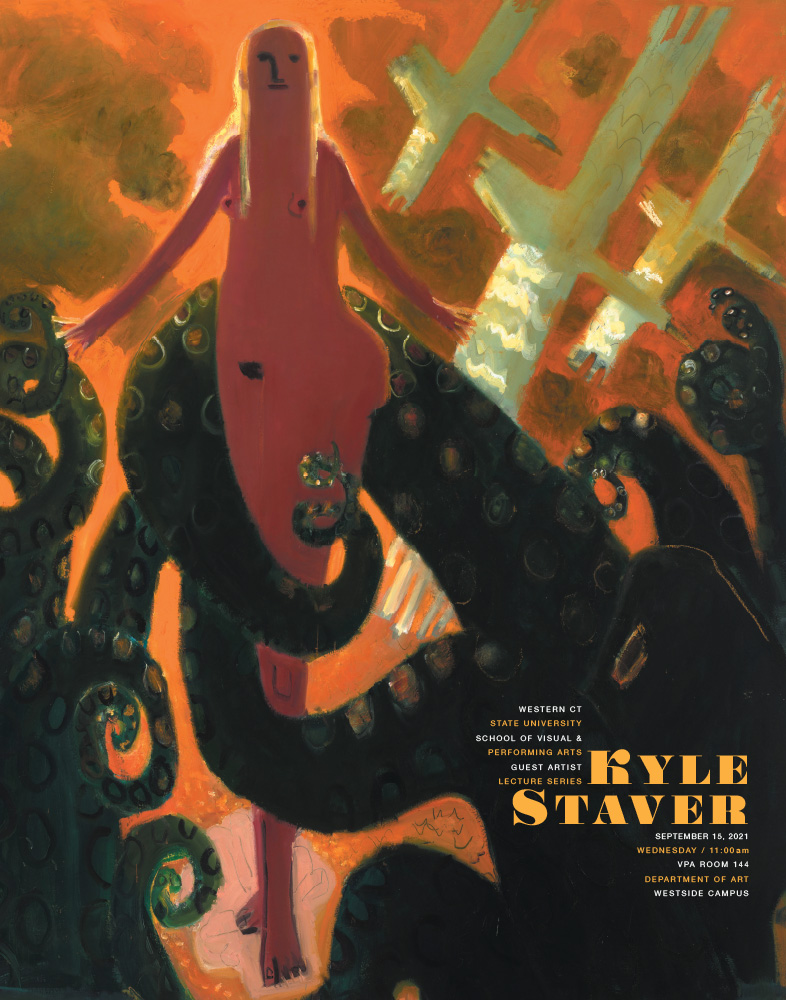
Kyle Staver is a New York-based artist and educator currently teaching at The New York Studio School, with recent visiting artist engagements at Western Connecticut State University (2021), Maryland Institute College of Art, University of Indiana, Chautauqua, and Vermont Studio Center. Her education includes a BFA from Minneapolis College of Art and Design (1976) and an MFA from Yale University (1987). Staver's practice centers on narrative painting, relief sculpture, drawing, and printmaking that reinterprets myths, legends, and fairy tales through a feminist lens. Her vibrant figurative works consistently feature strong female protagonists exploring themes of identity, power, and transformation, while bridging classical traditions with contemporary sensibilities. The artist employs rich oil techniques on diverse supports including panel, canvas, and paper to create visually arresting narratives. Her recent body of work demonstrates continued evolution in mythological reinterpretation, with increasing emphasis on female agency across diverse narrative traditions. The artworks span monumental paintings, intricate reliefs, and intimate works on paper, showcasing technical mastery across multiple mediums while maintaining cohesive thematic exploration of cultural storytelling. Staver's significant recognition includes: Guggenheim Fellowship (2015) American Academy of Arts & Letters Purchase Prize (2015) College Art Association Artist Award for Distinguished Body of Work (2019) Louis Comfort Tiffany Award (2003) ArtPrize for Painting (2013) Benjamin Altman Figure Prize (1996, 1998) Her work is held in major public collections including the National Academy of Design, American Academy of Arts and Letters, and National Arts Club. Staver maintains an active exhibition schedule with recent solo shows at Nino Mier Gallery (Los Angeles), Half Gallery (New York), and Zürcher Gallery (Brussels), demonstrating sustained relevance in contemporary art discourse.
Francesca Leoni is a Research Fellow and curator at the Ashmolean Museum of Art and Archaeology, University of Oxford. She specializes in Islamic art with a focus on cross-cultural exchanges, occult sciences, and modern Middle Eastern art. Her roles include being the Yousef Jameel Curator of Islamic Art (2011–16) and Research Associate at the Khalili Research Centre. She has held teaching and curatorial positions at the Metropolitan Museum of Art and Rice University. Education: Laurea Degree in Oriental Languages and Civilizations from Istituto Universitario L’Orientale di Napoli (1999), MA and PhD from Princeton University (2005, 2008) Her research interests span book arts, cross-cultural interactions between the Islamic world and Europe/Asia, circulation of technologies, occultism, and contemporary Middle Eastern art. She has received grants from the Leverhulme Trust, Barakat Trust, Art Fund, and British Institute for Persian Studies. Recent publications explore Islamicate occult sciences, Sufi talismans, and mystical art. Her work bridges historical analysis with modern artistic interpretations, emphasizing themes like the supernatural, poetic imagery, and cultural authenticity. Notable collaborations include co-editing Islamicate Occult Sciences in Theory and Practice (Brill, 2020) and curating the 2016 exhibition Power and Protection: Islamic Art and the Supernatural . She has contributed to international journals and museum catalogues.
Timothy J Geiger serves as a Professor in the Department of English Language and Literature within the University of Toledo's College of Arts and Letters. He teaches specialized courses in Creative Writing, Poetry, and Letterpress Printing and Book Design, while also directing the Aureole Press letterpress imprint housed at the university since 1997. His educational background includes dual MFA degrees in Poetry and Letterpress Printing from the University of Alabama (1994), establishing the foundation for his integrated creative and technical practice. Geiger's research centers on contemporary poetry creation and the material art of letterpress printing. His work explores nature imagery, philosophical inquiries into existence, and the intersection of scientific concepts with poetic form. The Aureole Press represents a significant scholarly contribution, producing limited-edition poetry volumes that bridge traditional craftsmanship with contemporary literary expression. His creative methodology emphasizes precise imagery, formal innovation, and thematic depth across ecological, mathematical, and metaphysical domains. Recent publications (2021-2024) demonstrate sustained engagement with ecological themes through nature poetry, experimental structural approaches using mathematical and scientific metaphors, and philosophical explorations of perception and existence. These works consistently appear in prestigious literary journals including Poetry , Tar River Poetry , and Mid-American Review , reflecting his prominence in contemporary poetry circles. Geiger's scholarly recognition includes major awards in literary achievement: Pushcart Prize XVIII for exceptional poetry Holt, Rinehart and Winston Award in Literature Vern Rutsala Poetry Prize (2019) for Weatherbox Finalist for State of Ohio Poet Laureate (2019) Sundress Academy for the Arts Writer's Residency Through his teaching and direction of the Aureole Press, Geiger mentors students in both poetic composition and book arts craftsmanship. His creative work has been supported by state and local grants across Alabama, Minnesota, and Ohio, enabling sustained production of poetry collections and letterpress editions that contribute significantly to literary culture. The Aureole Press stands as Geiger's most distinctive scholarly contribution - a letterpress imprint established in 1989 that produces finely printed limited editions of contemporary poetry. Housed at the University of Toledo since 1997, its collections reside in major special archives including Yale University's Beinecke Rare Book Collection, SUNY-Buffalo, and the University of Alabama, cementing its importance in preserving and advancing the art of letterpress poetry publishing.
Jeff Crosby is a Senior Lecturer at the Cambridge School of Art (Anglia Ruskin University), serving as Course Director for the BA (Hons) Animation & Illustration program. His expertise spans illustration, animation, graphic design, and book art, with a focus on children’s picture books and graphic novels featuring fantastical themes. He holds an MFA in Illustration from the School of Visual Arts (New York) and a BFA in Communication Design from the University of North Texas. His career includes 30 years of freelance illustration for major publishers, alongside academic roles at Texas State University and ARU. Crosby is a Fellow of the Higher Education Academy (FHEA) and active in professional organizations like the Association of Illustrators and Society of Children’s Book Writers & Illustrators. Recent creative work includes the 'Dino Knights' trilogy (Scallywag Press), exploring prehistoric worlds through sequential art. His style blends acrylic painting, ink drawing, and digital tools to address themes of empathy, identity, and environmentalism.
Veronika Ambros is a Professor at the Department of Comparative Literature and Slavic Studies, University of Toronto, affiliated with the Faculty of Arts and Science. Her research bridges semiotics, literary theory, and Central European cultural studies, focusing on the enduring influence of the Prague Linguistic Circle , Russian formalists , and the Tartu School . Her work interrogates the semiotics of drama and theatre , exploring how imaginary creatures and intermediality reflect broader cultural tensions. She examines Prague's cityscape as a site of Czech-German-Russian literary convergence , analyzing interactions between multiculturalism and nationalism in urban contexts. Specializes in intermediality between fine arts, architecture, cinema, and theatre Investigates Prague’s role in shaping transnational literary movements Her publications reveal a trajectory from early analyses of socialist realism (e.g., Pavel Kohout ) to contemporary explorations of robotics and golem mythology as metaphors for cultural hybridity. She connects Hašek’s Švejk to carnivalesque traditions and interrogates Čapek’s robots through gender and technological anxiety lenses. While no formal awards are highlighted, her editorial role in the 2009 Structuralism(s) Today and contributions to major comparative literature volumes demonstrate her academic leadership. Her research consistently positions Prague as a fulcrum for Central European cultural and political discourses.
Dr. Emily Alder is a Lecturer in English Literature at Edinburgh Napier University’s School of Arts and Creative Industries, where she also serves as Programme Leader for BA (Hons) English. Her research focuses on intersections of literature and science, environmental humanities, and Gothic/Weird fiction, particularly in the long nineteenth century. She co-convenes the Haunted Shores Research Network and leads the Scottish Shores: Gothic Coastal Environments project, forging connections between Gothic studies and the Environmental Humanities. Education: BA in English Literature (Newcastle University), PhD (Edinburgh Napier University). Research Interests: Nautical Gothic, environmental literature, nineteenth-century fiction, and coastal Gothic narratives. Her work explores Gothic themes in fin-de-siècle literature, science in speculative fiction, and ecological implications in Victorian texts. Grants: £9,940 from the Royal Society of Edinburgh for the Scottish Shores RSE Workshop (2022–2023), and £2,250 for Tagore anniversary events (2011–2015). Advising: Supervises PhD projects on gender-neutral characters in children’s TV, Scottish Gothic, nineteenth-century seafaring superstition, and twentieth-century travel writing.
Daryn Lehoux is a Professor & Head of the Department of Classics & Archaeology at Queen’s University (on sabbatical Jan-June 2025). His research focuses on ancient science, epistemology, Greek/Roman philosophy, and the interplay between science and societal concepts like race/gender. A leading scholar in ancient astronomy, astrology, and medicine, he combines textual analysis with interdisciplinary methods. Education includes advanced training in Classics and Ancient Science, though specific degree details aren't listed here. His work bridges history of science and classical studies, emphasizing how ancient thinkers constructed knowledge systems. Key research areas include: ancient theories of reproduction, Delphic oracle practices, parapegmata (ancient astronomical calendars), and the reception of Lucretius' scientific ideas. His 2012 What Did the Romans Know? redefined understanding of Roman scientific thought, while Creatures Born of Mud and Slime (2017) explores spontaneous generation theories. Publications span monographs, edited volumes, and peer-reviewed articles in ISIS , Journal of Roman Studies , and Zeitschrift für Papyrologie und Epigraphik . Awards include the 2008 History of Science Society Prize for his Observers, Objects, and the Embedded Eye . Lehoux collaborates on digital humanities projects like Reflectance Transformation Imaging of archaeological artifacts. He supervises graduate students in classical studies and ancient science, contributing to Queen's interdisciplinary research environment.
Christine (Neko) Robinson is a Professor of Computer Art at Savannah College of Art and Design (SCAD), serving since 2018. She holds an M.F.A. in Animation from SCAD and a B.F.A. in Studio from Louisiana Tech University. Her work includes curriculum development in digital fluency and student mentorship. Robinson's expertise spans: 3D animation pipeline development Digital art creation and theory Film production workflows Color theory applications in animation Interactive digital communication Her research integrates technical animation skills with artistic visual storytelling. Her creative works demonstrate consistent focus on animation techniques, color theory application, and visual narrative across student films, thesis projects, and commercial productions. Projects consistently explore the intersection of technical execution and artistic expression in both 2D and 3D formats. Major recognitions include: SCAD Graduate Award: Color Mention for Fallen Swan (2017) SCAD Award for student film Kabir (2015) At SCAD, Robinson mentors students toward educational goals and develops digital fluency curricula. Her industry background includes roles as a 3D animator for Syfy Channel productions and as an art vendor for the Baton Rouge Arts Council.
Lara Houston is a Research Fellow at the Global Sustainability Institute within Anglia Ruskin University's Faculty of Science and Engineering. Her research examines sustainability through grassroots practices and citizen-led innovation, focusing on how marginalized communities create alternative knowledge systems. She employs creative, participatory methods in transdisciplinary collaborations with electronics repairers, urban farmers, and citizen scientists. Education: PhD Sociology, Lancaster University MA Cultural Studies, Goldsmiths, University of London BA Design, Goldsmiths, University of London Houston's research centers on repair cultures as sites of socio-technical innovation and environmental justice. She investigates how communities sustain technologies through repair practices and develop alternative infrastructures. Her work intersects sustainability studies, digital anthropology, and participatory design, with emphasis on: Grassroots responses to technological breakdown Creative methods for sustainable futures More-than-human approaches to urban systems Blockchain applications for food justice Her publications demonstrate sustained focus on citizen-led environmental action, with recent work exploring how creative practices stimulate societal transformation and how blockchain technologies might reconfigure human-environment relations. Key thematic threads include repair economies, community sensing, and algorithmic governance of ecological systems. Research Grants: Co-Investigator, Algorithmic Food Justice project (Not-Equal Network+ grant, ESPRC funded) She leads collaborative projects including CreaTures (transformative creative practices) and Citizen Sense (participatory environmental monitoring), working with international networks of artists, designers, and community activists.