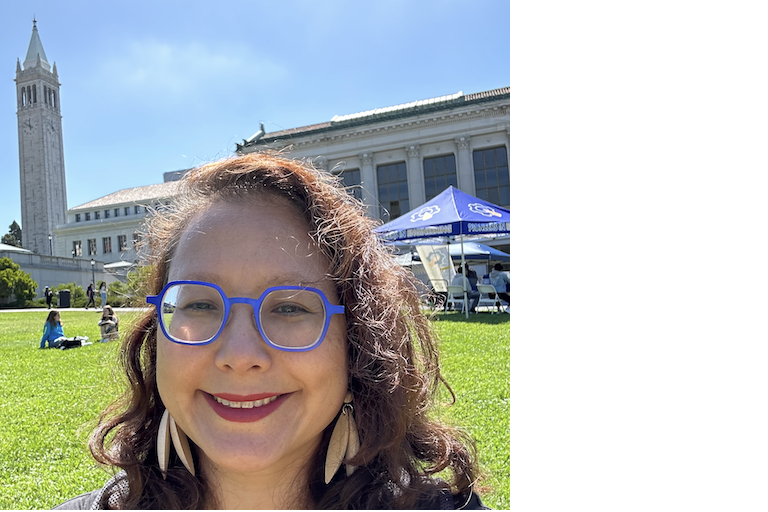
Beth Piatote is an Associate Professor of English and Comparative Literature at the University of California, Berkeley. She holds a PhD in Modern Thought and Literature from Stanford University and is an enrolled member of the Confederated Tribes of the Colville Reservation (Nez Perce). Her work bridges scholarly and creative realms, focusing on Indigenous literature, law, language revitalization, and cultural studies. Education: PhD in Modern Thought and Literature (Stanford University). Research interests include Native American legal systems, Nez Perce language preservation, global Indigenous literatures, and creative writing. She co-founded and chairs Berkeley’s Designated Emphasis in Indigenous Language Revitalization and directs the Arts Research Center, where she leads the Indigenous Poetics Lab. Her publications include Domestic Subjects: Gender, Citizenship, and Law in Native American Literature (2013) and the short story collection The Beadworkers (2019), which received multiple literary recognitions. Her plays Antíkoni and Tricksters, Unite! explore Indigenous narratives through performance. Awards include MLA honorable mentions, PEN/Bingham Prize longlistings, and a 2020 Playwrights Retreat win. Current projects involve a scholarly monograph on sensory representations of Indigenous law and creative works in poetry and essays.
Lindsay Turner is an Associate Professor in the Department of English at Case Western Reserve University. A poet, critic, and translator, her work bridges creative writing, translation theory, and interdisciplinary research. Her prior role as Assistant Professor at the University of Denver’s Department of English and Literary Arts underscores her commitment to literary education. AB in English, Harvard College Masters in cinema studies, Université Paris III Sorbonne-Nouvelle MFA in poetry, New York University PhD in English, University of Virginia Turner’s research spans creative writing , transnational poetry , and gender studies , with a focus on the intersections of literature and labor. Her recent work examines gendered domestic and reproductive labor through poetic forms. Key trends in her publications include experimental translation , queer theory , and postcolonial philosophy . National Translation Awards Best Translated Book Awards French American Foundation recognition She has received grants such as the WPR Creative Grant from Harvard’s Woodberry Poetry Room and multiple French Voices Grants . Her translations have been praised by The New Yorker and The New York Times for their intellectual rigor and stylistic innovation.
Gayle Letherby is a Visiting Professor of Sociology at the University of Plymouth’s Peninsula Medical School (Faculty of Health), and holds visiting roles at the University of Greenwich and the University of Bath’s Centre for Death and Society (CDAS). She is an Academician of the Academy of Social Sciences (since 2007) and recipient of the 2023 Lifetime Contribution to Autoethnography Award. Her research focuses on feminist methodology, health sociology, grief and bereavement, mobility studies, and criminology. She has supervised over 20 doctoral students across multiple universities, including topics like non-motherhood, occupational therapy, and gang culture in African Caribbean communities. Her teaching spans undergraduate and postgraduate levels, covering crime theory, auto/biographical research, and feminist epistemology. Notable collaborations include participatory studies on homeless individuals’ food experiences and ethnographic explorations of medical decision-making. Her interdisciplinary work bridges sociology, criminology, and health studies, with a strong emphasis on autoethnographic and creative methodologies. Recent research explores themes like grief narratives, gendered travel experiences, and the emotional dimensions of doctoral journeys. She has contributed to policy discussions on family-centred care and has been a guest lecturer globally, including at York University (Canada) and University College Cork (Ireland). Awards: Academy of Social Sciences Academician (2007), Lifetime Contribution to Autoethnography (2023) Teaching Expertise: Feminist research methods, criminology, sociology of health, gender studies Key Research Areas: Auto/biography, non-motherhood, medical sociology, mobility, grief studies
Maisha T. Winn serves as the Excellence in Learning Graduate School of Education Professor at Stanford University and is Faculty Director of the Stanford Accelerator for Learning's Equity in Learning Initiative. She leads the Futuring for Equity Lab as Principal Investigator and holds significant leadership positions including President-Elect of the American Educational Research Association and membership in the National Academy of Education. Dr. Winn's research examines how non-dominant youth and communities develop literate trajectories across historical and contemporary settings. As an ethnographer by training, she investigates how communities depicted as under-resourced create their own educational practices, processes, and institutions. Her scholarship bridges historical analysis with contemporary educational practice to build more just, collaborative, and equitable futures in education. Her work spans restorative justice in education, Black literacy studies, and transformative justice approaches, with particular attention to the school-to-prison pipeline, independent Black institutions, and futures-oriented educational frameworks. Dr. Winn analyzes how historical educational models can inform contemporary practices that center community knowledge and cultural identity. Andrew W. Mellon Fellow at CASBS (2022-23) American Educational Research Association Fellow Member of the National Academy of Education Dr. Winn advises doctoral students including Christina Hewko and Misbah Naseer, and leads research initiatives focused on educational equity. Her Futuring for Equity Lab develops frameworks for understanding how marginalized communities have historically created educational spaces that affirm their identities and knowledge systems, with direct implications for contemporary educational practice and policy. Her research team collaborates with community organizations and schools to translate scholarly insights into practical applications that promote educational justice, particularly in areas of school discipline reform and literacy education for marginalized youth.
Dr. Shari Sabeti is a Senior Lecturer in Arts and Humanities Education at the Moray House School of Education and Sport, University of Edinburgh. She holds a PhD in English Literature from the University of Cambridge and is a Senior Fellow of the Higher Education Academy (SFHEA). Her research focuses on arts, cultural heritage, and decolonizing education, with projects in museums, schools, and Pacific Island communities. She has led initiatives in the Marshall Islands, Samoa, and Hawaii, emphasizing participatory and arts-based methodologies. Education: MA (Hons) English (Cambridge, 1994), MA English and American Literature (UCL, 1995), PhD English Literature (Cambridge, 1999), PGCE Secondary English (IOE, 2002). She has taught at the University of Stirling and the University of Edinburgh, where she currently organizes courses on anthropology of education, creative pedagogies, and literacy. Research interests include museum education, decolonizing approaches, Pacific Island education, and creative writing pedagogy. Her work bridges anthropology, ethnography, and arts-based methods, exploring community resilience and identity formation. Recent projects include 'Remediating Stevenson' (AHRC-funded, 2022–2025) and studies on Marshallese displacement through arts education. Awards and grants include a £1M AHRC Standard Grant for decolonizing Pacific literature and multiple GCRF awards for education in the Marshall Islands. She has supervised over a dozen PhD students on topics like museum pedagogy, diaspora education, and creative writing practices. Labs/Networks: Centre for Creative Relational Inquiry, Digital Cultural Heritage Network, Atelier Creative Arts and Social Sciences Network. Her work often involves partnerships with museums, NGOs, and international communities.
Ian Condry is a Professor of Japanese Culture and Media Studies at MIT, affiliated with the Department of Anthropology. He holds a BA in Government from Harvard (1987) and a PhD in Anthropology from Yale (1999). His research focuses on Japanese popular culture, media globalization, and creative industries. He is best known for his seminal work on hip-hop in Japan and anime production, emphasizing collaborative creativity and cultural hybridity. Condry leads the MIT Spatial Sound Lab, exploring immersive audio technologies, and co-founded the music discovery platform Hearby.com. He hosts the 'Near and Far' Japanese hip-hop radio show on WMBR 88.1FM since 2018 and releases music as Leftroman. Condry’s academic roles include former Head of Global Studies and Languages at MIT and Executive Committee member of the Technology Broadcasting Corporation. His work bridges academic research with creative practice, including organizing the Dissolve Music conference and curating multimedia projects. He has pioneered open-access publishing, making his books available under Creative Commons licenses. His research spans media anthropology, youth culture, and digital media’s societal impact. Key projects include the MIT/Harvard 'Cool Japan' research initiative and studies on post-3/11 cultural recovery. Condry’s interdisciplinary approach integrates ethnographic methods with technological innovation, addressing themes of global cultural flows and participatory media production.
Nicholas Mortimer is a Senior Lecturer in Design at Goldsmiths, University of London. He holds an MA in Design Interactions (Royal College of Art, 2013) and a BA in Fine Art Sculpture (University of Brighton, 2005). His work focuses on socially engaged design practices, reimagining historical performance traditions to address contemporary labor and societal issues. As co-founder of Post Workers Theatre (PWT), he explores workers’ theatre and creative resistance through collective writing, performance, and design. His research spans topics like gig economy critiques, housing privatization, and community activism, often blending performance, sound, and participatory methods. Education: MA Design Interactions, Royal College of Art, 2013 BA Fine Art Sculpture, University of Brighton, 2005 Research Interests: Performance as social critique Historical folk traditions and modern labor struggles Community-driven design practices Radical pedagogy and participatory methods Key Projects: Post Workers Theatre : Investigates politically engaged performance, addressing labor inequality through updated workers’ theatre forms. Autohoodening : Critiques Amazon labor practices via a reimagined midwinter ritual. Rave of the Ritualesque : Examines rave culture’s potential for collective resistance. Affiliations: Department of Design, Goldsmiths, University of London IASPIS (Swedish Arts Grants Committee) residency collaborations Labs/Teams: Post Workers Theatre collective Collaborations with institutions like Tate Liverpool, Luleå Arts and Crafts Biennale, and the Maidstone Museum
Laura A. Meek is an Assistant Professor in the Department of Anthropology at the University of British Columbia Okanagan , specializing in Medical Anthropology , Decolonial Science and Technology Studies , and East African research . She holds affiliations with interdisciplinary networks like the UBC-O Science and Technology Studies Collective and co-directs the Storying Otherwise: Creative Ethnographic Writing Hub . PhD, MA in Anthropology (University of California, Davis) MA in Women’s Studies (George Washington University) Honors BA in Comparative Human Development (University of Chicago) Her research examines counterfeit pharmaceuticals and bodily epistemologies in Tanzania, framed through feminist , decolonial , and anti-racist lenses . She investigates leprosy elimination campaigns and fugitive science practices across Africa and Hong Kong, with recent work focusing on creative ethnographic prose and critical disability studies . Her publications span high-impact journals like Social Science & Medicine and Medical Anthropology Quarterly , addressing themes of radical uncertainty and world-making practices . Laura’s 15 most recent articles (2021–2025) analyze: pharmaceutical counterfeits in East Africa, the temporal politics of leprosy , anti-colonial global health , and creative writing as research . Her work bridges Indian Ocean connections and STS frameworks to critique neocolonial health governance. 2025 Collaborative Research Mobility Award 2024 Wenner-Gren Workshop Grant 2023 MAE–MAT Early Career Paper Award 2021 Society for Humanistic Anthropology Creative Ethnographic Prose Prize 2018 Wenner-Gren Dissertation Grant 2013 NSF Doctoral Dissertation Grant She supervises M.A. and Ph.D. students in UBC-O’s Interdisciplinary Graduate Studies programs, particularly in global health , African politics , and STS . Her professional service includes co-chairing the 2026 Cascadia Medical Anthropology Seminar and serving on the American Anthropological Association Nominations Committee .
Dr Elizabeth Hallam is an Associate Professor in Visual, Material, and Museum Anthropology at the University of Oxford's School of Anthropology & Museum Ethnography. She holds additional roles as a Research Affiliate at the Pitt Rivers Museum, Fellow of St Peter's College, and Director of the Interdisciplinary Studies in Cultural Anthropology (ISCA). Her research focuses on the anthropology of the body, death, material and visual cultures, human anatomy, and three-dimensional models in medical education. She is also the Editor of the Journal of the Royal Anthropological Institute and has curated exhibitions such as 'Designing Bodies: Models of Human Anatomy from 1945 to Now'. Her academic journey includes a BA and PhD from the University of Kent, followed by positions at the University of Sussex and Aberdeen University. She has authored/co-authored influential works like Anatomy Museum: Death and the Body Displayed (2016), which won the Wellcome Medal. Her current projects explore museums of anatomy, 3D modeling in anthropology, and collaborative art practices. Key research themes include death and memorializing processes, the role of material culture in knowledge production, and interdisciplinary studies on creativity and improvisation. She advises four DPhil students and has been involved in ARC-funded projects on cemetery futures and postmortem practices. Awards: Wellcome Medal for Anthropology as Applied to Medical Problems (2016) Grants: Projects funded by the Australian Research Council, Henry Moore Foundation, and Royal College of Surgeons Labs/Teams: Collaborations with University of Melbourne and curatorial networks in Europe/USA
Irene Albers is a full Professor at Free University of Berlin's Department of Philosophy and Humanities, holding dual appointments at the Peter Szondi Institute for General and Comparative Literature and Institute for Romance Philology since 2004. She chairs both the Examination Board and Doctoral Committee for General and Comparative Literature, serves as Trustee of Studienstiftung des deutschen Volkes since 2004/05, and has been Principal Investigator for the Friedrich-Schlegel Graduate School for Literary Studies and Cluster Languages of Emotion since 2007. Her research bridges comparative literature, anthropology, and visual culture with institutional leadership spanning editorial projects and international conferences. Her educational background includes: Born in Bremen (1967) Romance Studies, Philosophy, and German Studies at Universities of Tübingen, Tours, and Konstanz M.A. from University of Konstanz (1993) Ph.D. from University of Konstanz (1999) on literature and photography in Émile Zola, Proust, and Claude Simon Albers' core research examines literary anthropology through colonial/postcolonial lenses, focusing on French literary engagement with Africa, surrealism, and literature-photography intersections. She pioneered studies on Michel Leiris' ethnological poetics and Claude Simon's photographic techniques, extending to historical emotion research (anatomy of affects, body language) and romance novella traditions. Her work consistently challenges Eurocentric literary canons through primitivism critique and heteronomy aesthetics, emphasizing textual restitution and cultural reclamation. Recent publications (2018-2025) reveal a sharp turn toward colonial restitution ethics, particularly in oral literature provenance. Articles increasingly analyze literature as colonial loot, connecting French modernism with African/Caribbean contexts through collaborative projects with anthropologists like Eléonore Devevey. This trajectory builds from earlier surrealist studies to concrete frameworks for decolonizing literary scholarship, spotlighting institutional complicity in cultural appropriation while advancing symmetrized modernity revisions. Scientific awards include: Senior Fellow and Prize Winner of the Zukunftskolleg, University of Konstanz (2009) Albers supervises master's and doctoral students through dedicated AVL colloquia while securing major research funding as Principal Investigator for Friedrich-Schlegel Graduate School (2007-present) and Cluster Languages of Emotion (2007-2012). Her current DFG-funded project 'Literature as Colonial Loot?' with Andreas Schmid pioneers philological provenance research. Earlier, she contributed to Collaborative Research Center 511 'Literature and Anthropology' (Konstanz, 1999-2002) and DFG-funded conferences on Claude Simon. She leads the DramaNet research project and co-edits the 'machina' series at transcript Verlag since 2010. As board member (2007-2009) and deputy (2008-2012) of Cluster Languages of Emotion, she coordinates Area D 'Cultural Codings of Emotions'. Her Zukunftskolleg fellowship (2012-2013) and Marcel Proust Society collaborations underscore sustained engagement with literary anthropology networks.
London School of Economics and Political Science (LSE)United Kingdom
Hakan Sandal-Wilson is an Assistant Professor of Gender, Peace and Security at the Department of Gender Studies, London School of Economics and Political Science. His research critically examines intersections of gender, sexuality, ethnicity, religion, and conflict in the Middle East, particularly focusing on Kurdish queer/LGBTIQ+ politics and diasporic movements. He is also invested in creative-critical interdisciplinary research methods, co-editing a volume on politically engaged methodologies. Previously, he served at the University of Cambridge as a Teaching Associate and Affiliated Lecturer, and as Campaigns Officer for Amnesty UK’s LGBTI Network. Education : - PhD, University of Cambridge Centre for Gender Studies - MA in Cultural Studies, Istanbul Bilgi University Research Interests : - Queer Studies in Conflict Zones - Kurdish Social Movements - Diasporic Feminist and Queer Activism - Ethnography and Creative Writing Methodologies Publications Trends : His work bridges theoretical inquiries with activism, emphasizing marginalized queer voices in conflict-affected regions. Recent projects include monographs on Kurdish queer politics and co-edited collections on creative-critical interventions for social justice. Awards & Grants : No awards explicitly mentioned, but his work has been translated into multiple languages and featured in outlets such as openDemocracy and Jadaliyya. Advising & Mentorship : No listed advisees, but directs LSE’s MSc Gender and MSc Gender (Research) programmes, teaching courses like GI402 (Gender, Knowledge & Research Practice) and GI413 (Gender, Race & Militarisation). Labs & Collaborations : Co-convened 'Creaction' interdisciplinary workshops at UCL, fostering global creative-critical social justice research.
Dr. Rebecca Rainof is a Lecturer in the Department of English at the University of California, Berkeley, and an Associate Researcher. Her research focuses on Victorian and Modernist literature, interdisciplinary studies of literature and visual arts, and gender studies. She has held positions at Princeton University and the Catholic University of America. Her work explores topics such as midlife narratives in Victorian novels, Van Gogh’s engagement with Victorian literature, and Japanese American incarceration through familial memory. Her book The Victorian Novel of Adulthood (2015) examines alternative novelistic traditions. Her recent research includes contributions to the Santa Barbara Museum of Art’s 2022 exhibition Through Vincent’s Eyes: Van Gogh and his Sources . She has published on George Eliot, Woolf, and the intersections of art and literature. Her writings on her mother’s experience during WWII Japanese American incarceration appear in Hyphen: Asian America Unabridged and Literary Imagination . Rainof’s grants and fellowships include the Princeton Mellon Fellowship (2018) and the Curran Fellowship (2015). Her teaching and writing emphasize creative nonfiction, feminist literary theory, and pedagogical innovation. Her current projects include a book manuscript on Van Gogh’s literary adaptations and a family memoir rooted in Heart Mountain’s history.
Darshana Sreedhar Mini is an Assistant Professor in the Department of Communication Arts at the University of Wisconsin–Madison, where she teaches and conducts research at the intersection of feminist media, gender & sexuality studies, transnational media, migrant media, and South Asian screen cultures. She is also the Director for Media and Gender Justice at the 4W Initiative and holds affiliations with the Center for Southeast Asian Studies, Gender and Women’s Studies, Center for Visual Cultures, Center for South Asia, and the Havens Wright Center for Social Justice. Ph.D., Division of Cinema and Media Studies, University of Southern California M.Phil., Center for Studies in Social Sciences, Calcutta (CSSSC), India Dr. Mini’s research centers on Global Media Cultures, Transnational Cinemas and Migration, South Asian Cinema, and Feminist Media. Her work critically examines soft-porn cinema in India, media publics, censorship, labor in the entertainment sector, and migrant media practices. Her first book, Rated A: Soft-Porn Cinema and Mediations of Desire in India (UC Press, 2024), is a groundbreaking study that combines archival and ethnographic methods to explore the social and cultural impact of Malayalam soft-porn from the 1970s to the 2000s. Her second book project, Telegeographies of Indian Migration , investigates media flows between South Asia and Southeast Asia, focusing on colonial-era labor migration and its lasting effects on identity and community formation. Her recent publications span a diverse range of topics including South Asian pornographies, digital intimacy, anti-caste activism, #MeToo and intersectional feminism, transnational empathy in cinema, and media infrastructures. These works reflect a strong trend toward interdisciplinary, feminist, and decolonial scholarship that challenges dominant canons in film and media studies. Edward Cameron Dimock, Jr. Prize in the Indian Humanities, AIIS, 2024 Early Career Award, NCA, 2024 Race, Ethnicity and Indigeneity Fellow, IRH, UW-Madison, 2024 Byerly Award for Feminist Political Economy, ICA, 2023 First Book Award, The Center for Humanities, UW-Madison, 2022 SCMS Student Writing Award, 2017 Dr. Mini has been actively involved in academic service and leadership, including directing the Media and Gender Justice initiative, co-organizing seminars on migrant media, and contributing to feminist and anti-caste scholarship. Her research has been supported by prestigious grants from the Social Science Research Council (SSRC), American Institute of Indian Studies (AIIS), National Endowment for the Humanities (NEH), and the University of Wisconsin–Madison. She also leads a significant grant-funded project as Principal Investigator for the 'South Asian Film and Media Collection' at UW-Madison. She is a key member of several collaborative research environments, including the Center for Visual Cultures and Performance Studies (CVCPS), the Wisconsin Center for Film and Theatre Research (WCFTR), and the 4W Initiative, where she directs programming on media and gender justice. These affiliations reflect her commitment to interdisciplinary, socially engaged scholarship and the creation of inclusive academic communities.
Peter Knight is a Professor of American Studies at the University of Manchester , affiliated with the School of Arts, Languages and Cultures (English, American Studies & Creative Writing). He focuses on conspiracy theories and cultural approaches to finance , with over two decades of research grants and leadership in major interdisciplinary projects. UN Sustainable Development Goals (SDG151: United States) Co-editor of Routledge Handbook of Conspiracy Theories His research reconfigures conspiracy theory analysis through cultural lenses, challenging psychological dismissals. Key projects include Everything Is Connected (AHRC, 2016-20) and REDACT (EU CHANSE, 2022-25). Publications span Routledge, Edinburgh UP, and Cambridge UP. Recent work with Clare Birchall and Michael Butter explores coronavirus pandemic conspiracies , while his Reading the Market (2016) examines Gilded Age financial narratives. He co-curated the Show Me the Money exhibition (2014-16), visualizing financial history. Scientific Awards BAAS Book Prize (2017) Peter supervises projects on topics like 19th-20th century American literature , digital conspiracy theories , and financial epistemology . His media commentary (The Conversation, BBC) addresses public understanding of economic and conspiratorial discourse.
Prof. David Treuer is a Professor of English at the University of Southern Carolina. He divides his time between Los Angeles and Minnesota’s Leech Lake Reservation (Gaa-zagaskwaajimekaag in Ojibwe), where he grew up. His work challenges the tragic historical narrative of Native Americans, emphasizing ongoing Indigenous resilience and contributions. He holds a BA in Creative Writing and Anthropology from Princeton University and a PhD in Anthropology from the University of Michigan. Research interests include redefining Native American/Indigenous histories, cultural preservation, and interdisciplinary storytelling. His publications blend fiction, nonfiction, and critical analysis, appearing in Granta , Harper’s , and Esquire . He recently delivered a guest lecture at Freie Universität Berlin, organized with the American Academy in Berlin. Awards: Pushcart Prize, Minnesota Book Awards (2×), California Book Award Gold Medal, NEH and Guggenheim Fellowships Key Works: The Heartbeat of Wounded Knee (National Book Award finalist), The Translation of Dr Apelles His work bridges anthropology and literature, advocating for Indigenous voices in academic and public discourse. Current projects include exploring futures of Native American/Indigenous communities beyond colonial narratives.