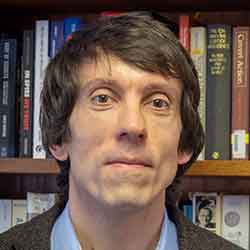
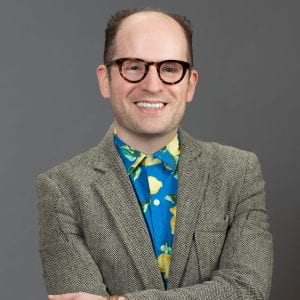
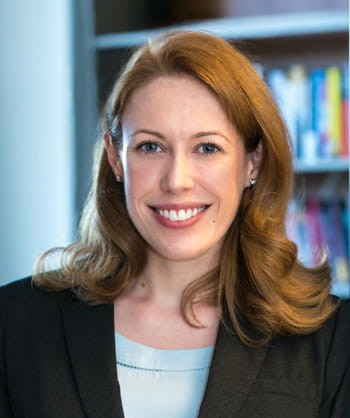
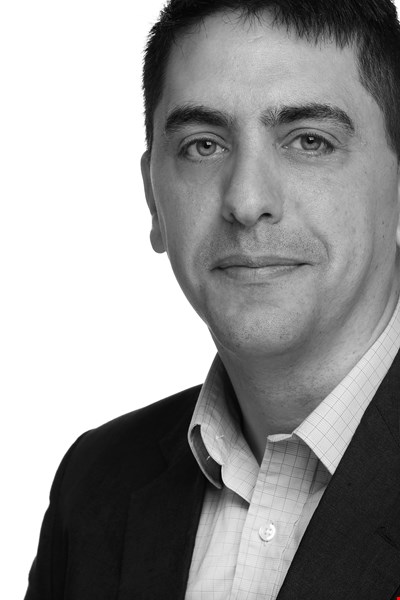
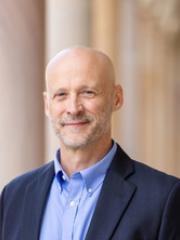
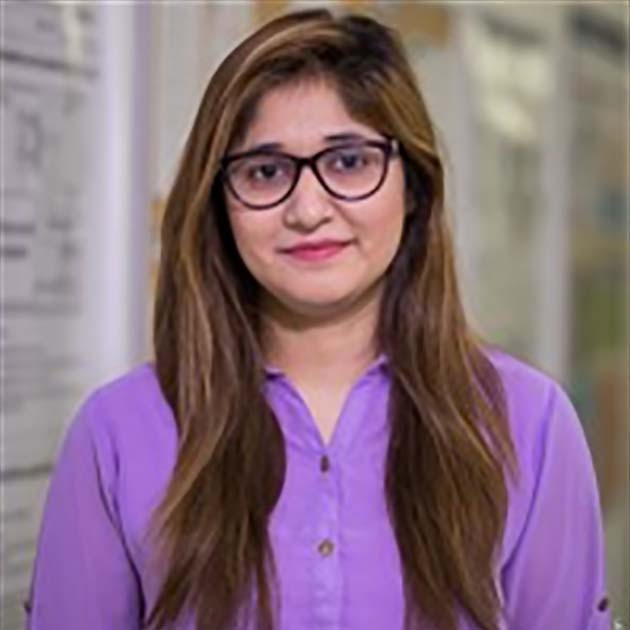
Dr. Luca Trenta is an Associate Professor of International Relations at Swansea University's Department of Political and Cultural Studies. His research focuses on state-sponsored assassinations, US foreign policy, and covert operations, with a notable book The President’s Kill List: Assassination in US Foreign Policy since 1945 (2024). He holds grants from the British Academy and hosts the Out of the Shadows podcast. Trenta’s work bridges academia and public engagement, including media contributions to The Guardian , The New Yorker , and BBC programs. He advises PhD students on topics like Cold War interventions and international drug control. His research emphasizes historical analysis of covert actions and their legal/ethical implications, often appearing at major festivals like Hay-on-Wye and international conferences.
Joshua D. Kertzer is the John Zwaanstra Professor of International Studies and Government at Harvard University, where he also serves as Director of Graduate Studies. His research integrates international security, political psychology, and foreign policy analysis. His work examines public opinion formation, elite decision-making, and experimental approaches to international relations. Recent studies focus on how observers assess resolve in international conflicts, partisan influences on foreign policy attitudes, and the psychological foundations of reputation costs. Publications demonstrate methodological innovation in combining survey experiments with archival research, exploring topics from democratic credibility to signaling in crisis diplomacy. His award-winning research has been recognized by the International Studies Association and American Political Science Association.
Alaa Alameldeen is an Associate Professor in the School of Computing Science at Simon Fraser University (SFU), part of the Faculty of Applied Sciences. Previously, he worked as a Research Scientist at Intel Labs (2006–2020) and held an Adjunct Faculty position at Portland State University (2008–2018). He earned a PhD in Computer Sciences from the University of Wisconsin-Madison (2006), and earlier degrees from Alexandria University, Egypt. His research focuses on computer architecture, including memory systems (processing-in-memory, cache/memory compression, security), energy-efficient architectures, and hardware-software co-design for machine learning. He advises PhD and MSc students in these areas and teaches advanced computing science courses. Key contributions include innovations in memory hierarchies, cache compression techniques, and mitigating hardware vulnerabilities. His work has been published in top conferences (e.g., ISCA, MICRO, HPCA) and patented in areas like near-memory processing and error correction. Alameldeen currently leads a research group exploring secure and high-performance memory architectures. He has supervised multiple graduate students, with many progressing to roles at leading tech companies and academic institutions.
Dr Paul Lashmar is a Reader in Journalism at the Department of Journalism , City, University of London , within the College of Arts and Social Sciences . He previously served as Head of Department (2019–2021) and has extensive experience as a national journalist, having worked for The Observer , The Independent , World in Action , BBC, and Channel 4. His academic and professional background is detailed through the following areas: Education: PhD, Brunel University London, 2015 PDAP (PGSHE Equivalent), Brunel University London, 2011 His research interests center on investigative journalism, media and intelligence agencies, propaganda, slavery and colonial history, and policing. His current research includes the legacy of British landed gentry in colonial slavery, Cold War covert propaganda via the Foreign Office’s Information Research Department (1947–1977), and police-media relations. His recent publications reflect a strong trend in historical and political journalism, with a focus on uncovering hidden power structures, intelligence operations, and colonial injustices. His work spans books, peer-reviewed articles, and public commentary in outlets like The Conversation , The Guardian , and The Observer . Key themes include media ethics, source protection in the digital age, and the role of journalism in democratic accountability. Scientific awards and honors are not explicitly mentioned in the provided text. In terms of advising and grants : Successfully secured a City internal HEIF grant (£4,825) for the Journalism Archive Project, a collaboration with London Metropolitan Archives. Adviser to the AHRC-funded project ‘Writers in Intelligence’ (£415,000). Supervised PhD students including Natricia Duncan, Lin Pan, and Dr Sawsun Tah. He has played a significant role in public engagement, organizing a conference on organ trafficking with the Metropolitan Police and speaking at high-profile events such as the US Embassy’s MP CSCC Training Day. He also led media training within his department and contributed to numerous television documentaries and radio programs on intelligence and crime. He is a founder of the Bureau of Investigative Journalism and has advised The Centre for Investigative Journalism, underscoring his leadership in advancing investigative journalism standards.
David Wentzlaff is a Professor of Electrical and Computer Engineering at Princeton University, with associated faculty roles in Computer Science and the High Meadows Environmental Institute (HMEI). He leads research in computing architecture, green computing, and sustainable system design. As Director of Undergraduate Studies, he shapes educational programs in his field. Education: Ph.D., Electrical Engineering, MIT (2012) M.S., Electrical Engineering and Computer Science, MIT (2002) B.S., Electrical Engineering, University of Illinois at Urbana-Champaign (2000) Research Focus: Future Computing Systems: Designing manycore architectures, cloud computing infrastructure, and chiplet-based systems for exascale computing. Sustainability: Developing energy-efficient hardware, recyclable computing systems, and eco-friendly decommissioning strategies. Hardware-Software Co-Design: Exploring FPGA integration, in-memory computing, and parallel processing frameworks. Advising & Grants: Advises 8 current graduate students, focusing on topics like chiplet design, neural acceleration, and sustainable computing. Recipient of NSF grants for projects like OpenPiton (open-source manycore research platform) and CAREER awards for energy-efficient architectures. Labs & Collaborations: Leads the Wentzlaff Research Group at Princeton. Develops open-source frameworks like PRGA (FPGA prototyping) and OpenPiton (manycore processor).
Dr. Paul McGarr is a Lecturer in Intelligence Studies at King’s College London (since 2023), part of the Department of War Studies within the Faculty of Social Science & Public Policy. He holds an MA in International History from Royal Holloway, University of London, and a PhD from Royal Holloway (2008). Prior to joining King’s, he served as Lecturer and Associate Professor in US Foreign Policy at the University of Nottingham (2011–2023), where he also held an AHRC Postdoctoral Fellowship (2009–2011). He is a Fellow of the Royal Historical Society and Royal Asiatic Society. His research focuses on security and intelligence outside the Anglosphere, clandestine diplomacy, and covert propaganda. Notable projects include a British Academy-funded study (2017–2019) analyzing emotions in British-India security relations and research fellowships at institutions like the Library of Congress and British Library. Dr. McGarr teaches modules on intelligence in war studies, diplomacy, and peace/war contexts. He supervises PhDs in intelligence agencies outside the Anglosphere, covert action, and disinformation. His authored/co-authored books include Spies in South Asia (2024), The Cold War in South Asia (2013), and India at 70 (2019). Recent articles explore topics like Soviet disinformation in India and the Sino-Indian War’s colonial cartographic roots. He contributes to the King’s Centre for the Study of Intelligence, a hub for interdisciplinary intelligence research.
Brad Campbell is an Associate Professor in the Department of Computer Science and Electrical and Computer Engineering at the University of Virginia, where he is a member of the Link Lab, a cross-disciplinary research group focused on cyber-physical systems. His research centers on designing and building scalable, effective, and unobtrusive embedded systems for the Internet of Things, with applications in smart buildings, smart cities, and personal health. His work spans hardware design, networking, and cloud infrastructure, with a strong emphasis on energy-harvesting systems, low-power wireless communication, and resilient embedded operating systems. He has led projects such as the Living Link Lab, a heavily instrumented smart building testbed, and has developed open-source platforms for self-powered sensing and IoT ecosystems. His recent publications reflect a strong trend toward privacy-preserving federated learning, contactless occupancy sensing using WiFi and light, decentralized edge computing, and sustainable IoT systems. These works are published in top venues including SenSys, BuildSys, MobiCom, and IPSN, indicating a high impact in the systems and networking community. NSF CAREER Award (2022) Best Paper Award at DFHS’19 Multiple graduate fellowships and teaching awards for his students UVA Engineering Endowed Graduate Fellowships Link Lab Seminar Award CPS Rising Star recognition Brad Campbell has advised numerous PhD and master’s students, many of whom have gone on to academic and industry roles. He has secured significant research funding, including from the NSF, and has contributed to curriculum development in cyber-physical systems. He is actively involved in teaching courses on computer networking, IoT, and operating systems, and has co-taught wireless IoT courses across multiple institutions. His lab focuses on real-world deployment of IoT systems, emphasizing scalability, fault tolerance, and long-term sustainability. He continues to push the boundaries of what embedded systems can achieve in everyday environments, from homes to cities.
Lindsey O'Rourke is an Associate Professor of Political Science at Boston College's Morrissey College of Arts and Sciences. Her research examines U.S. foreign policy, international security, and covert regime change operations. Her work analyzes the causes, conduct, and consequences of U.S.-orchestrated covert interventions during the Cold War, gender dynamics in terrorism, and the strategic implications of regime change. Her book 'Covert Regime Change: America's Secret Cold War' received significant scholarly recognition. She teaches courses on U.S. foreign policy since 1945, the World Wars, and foreign-imposed regime change. Publications demonstrate three interconnected research streams: 50% on covert operations and regime change, 30% on gender dimensions of political violence, and 20% on contemporary security challenges. Her work combines historical analysis with contemporary policy implications.
Professor Jo Fox serves as Pro Vice-Chancellor (Research & Engagement) and Dean of the School of Advanced Study at the University of London. She previously held leadership roles at Durham University, including the first female Director of the Institute of Historical Research and first female Professor of Modern History. Her research focuses on 20th-century propaganda, psychological warfare, and disinformation, with notable projects on WWII British-German propaganda dynamics and contemporary fake news analysis. Education and Career: Completed PhD in History at Durham University (1999 onward). Key roles include Chair of the Wellcome Trust Early Research Panel and Honorary Communications Director of the Royal Historical Society. Research Interests: Specializes in historical and modern disinformation campaigns, propaganda’s impact on public opinion, and the intersection of media and conflict. Active in projects like the Leverhulme-funded 'Political Warfare Executive' study and AHRC’s 'COVID-19 Rumours' research. Key Projects: Leading collaborative initiatives on covert propaganda’s role in British culture and historical context of disinformation during crises. Formerly examined Nazi cinematic propaganda and WWII documentary film strategies. Awards: National Teaching Fellow (2007), Fellow of the Royal Historical Society, and Fellow of the Royal Society of Arts. Grants and Consultancy: Secured major funding from the Leverhulme Trust and AHRC. Engages in media commentary on historical and contemporary misinformation. Currently chairs Wellcome Trust panels and advises on historical media studies. Labs/Teams: Collaborates with Durham University researchers on propaganda and cultural history projects. Oversees interdisciplinary teams in historical research initiatives.
Dr. Kristian Gustafson is a Reader in Intelligence & War at Brunel University London's College of Business, Arts and Social Sciences , Department of Politics and History. He serves as Deputy Director of BCISS and leads the Distance Learning MA in Intelligence and Security Studies program. PhD in History from Cambridge University MA in History from University of Alberta BA (Hons) in History from Royal Military College of Canada His research focuses on practical intelligence analysis, structured analytical tools, and military doctrine. He has worked on improving counter-poaching outcomes in Africa and reducing gun crime through intelligence methods. Recent publications analyze intelligence failures in Kabul (2021), Ukraine war intelligence (2024), and structured analytic techniques across nations (2025). His work spans both academic journals and policy-oriented publications. Scientific recognition includes: CIA’s Walter L. Pforzheimer Award (2003) for outstanding contribution to intelligence history Co-editor of 'Intelligence Elsewhere' (2013), establishing comparative research agendas Teaching highlights: Convenor of MA Intelligence and Security Studies (Distance Learning) Module convenor for Contemporary Threats & Intelligence Analysis Director of Studies for MA Intelligence & Security Studies Professional experience includes senior lecturer at Royal Military Academy Sandhurst, military service in Canadian and British armies, and consultancy roles with UK MOD and Cabinet Office.
Benjamin Goold is a Professor at the Allard School of Law, University of British Columbia. His research focuses on privacy rights, surveillance technologies, and international border governance, particularly the Canada-US border. He holds degrees including B.Ec./LL.B. from the University of Tasmania, B.C.L. from Oxford, and a D.Phil. from the University of Oxford. His work critiques the balance between security measures and civil liberties, with notable projects funded by SSHRC examining the 2011 Beyond the Border Agreement's impact on cross-border rights. Education: B.Ec./LL.B., University of Tasmania B.C.L., University of Oxford D.Phil., University of Oxford Research Interests: Dr. Goold explores how surveillance technologies, policing practices, and border policies intersect with human rights. Key themes include the ethical implications of public area surveillance, the governance of transnational borders, and the legal frameworks regulating security measures. His work bridges criminology, law, and sociology to address contemporary challenges in security and rights. Grants and Collaborations: He leads a SSHRC-funded project analyzing the Canada-US border's legislative changes post-2011, collaborating with Professors Efrat Arbel and Catherine Dauvergne at Allard School of Law. His research often involves interdisciplinary teams and field studies on covert policing and surveillance practices. Labs/Teams: Active in collaborative networks focused on security governance, privacy rights, and policing ethics, with ongoing projects involving international scholars and policymakers.
Tony Ingesson is a Senior Lecturer in the Department of Political Science at Lund University, specializing in intelligence analysis, counter-espionage, and military decision-making. With a background in the Swedish Armed Forces where he worked with technical data acquisition for airborne weapons systems and communications, he brings practical military experience to his academic work. His research interests span intelligence analysis methodologies, counterintelligence operations, deception and manipulation at tactical levels, clandestine communications, and industrial espionage. Ingesson has developed a particular expertise in how psychological mechanisms and biases influence intelligence analysis, as well as the historical connections between military conscription and democratization. His work bridges theoretical political science with practical security applications. Analysis of his recent publications reveals a strong focus on contemporary security challenges, particularly the intersection of traditional and emerging technologies in intelligence operations. His work examines how historical communication methods persist in modern conflicts, the evolving nature of espionage in high-trust societies like Sweden, and the application of intelligence analysis techniques to non-traditional fields such as precision oncology. Ingesson demonstrates consistent scholarly output across both academic journals and public-facing platforms like The Conversation, indicating his commitment to making complex security issues accessible to broader audiences. Ingesson actively participates in interdisciplinary research projects, including 'Clandestine Communications: Old Technologies, New Opportunities' and 'Greyzone genomics' at the Pufendorf IAS. His teaching portfolio encompasses political science methods, intelligence analysis techniques, counterterrorism, and deception studies, reflecting the breadth of his expertise. While specific details about student advising aren't provided in the available information, his role as Senior Lecturer indicates involvement in mentoring students through his teaching responsibilities. His research team involvement includes collaboration with researchers like Magnus Andersson on clandestine communications and David Gisselsson Nord on the intersection of genomics and security. These collaborations demonstrate his ability to bridge disciplinary boundaries while maintaining focus on core intelligence and security issues.
Dr Richard O'Quinn is a Lecturer in Management & Leadership at the School of Business, University of Queensland. He holds qualifications including a PhD from UQ, an MBA, and military degrees from institutions like the US Army Command and General Staff College. With a 23-year career in the US Army Special Operations Forces, his expertise bridges military strategy and academic leadership studies. Research & Teaching: Richard focuses on leadership, strategic decision-making, and organization studies using practice and process perspectives. He teaches in graduate, MBA, and executive education programs, emphasizing practical applications of leadership theory. Recent Research Trends: His work increasingly addresses veterans’ mental health in workplaces, cybersecurity policy, and organizational improvement. Notable projects include seed-funded studies on cybersecurity decision-making and veteran PTSD disclosure challenges. Grants & Collaborations: Funded projects include a 2022-2024 study on veteran mental health disclosure (East Coast Apprenticeships) and a 2021 project developing strategic decision-making simulations (Practera). He also contributes to UQ Cyber initiatives and national cybersecurity strategy submissions. Awards: None explicitly listed, but his work garners attention for bridging military and civilian organizational challenges.
Abbas Milani serves as a Research Fellow and co-director of the Iran Democracy Project at the Hoover Institution, and as the Hamid and Christina Moghadam Director of Iranian Studies at Stanford University. His expertise centers on US/Iran relations and Iranian cultural, political, and security issues. Milani's research interests span Iranian history, politics, and US-Iran relations, with a particular focus on the evolution of Iranian political thought, regime dynamics, and the historical context of contemporary Iranian politics. His scholarship bridges academic analysis with policy relevance, examining how historical patterns shape current geopolitical realities in the Middle East. His recent publications demonstrate consistent focus on Iranian regime stability, nuclear policy, US-Iran relations, and regional power dynamics. Milani's analytical approach combines historical perspective with contemporary political analysis, revealing patterns in Iranian leadership behavior, regime survival strategies, and the interplay between domestic politics and foreign policy. Member of the American Association of Political Science Member of the American Academy of Political and Social Science Member of the Association of Iranian Studies Milani maintains an active role in mentoring emerging scholars and engaging with policy communities, translating complex historical and political analysis into accessible insights for broader audiences. His work often appears in major media outlets, demonstrating his commitment to bridging academic research and public understanding of critical geopolitical issues.
Maria Mushtaq is an Associate Professor at Telecom Paris , affiliated with the Information Processing and Communication Laboratory (LTCI) and the Secure and Safe Hardware (SSH) Lab . She received her PhD in Information Security from the University of South Brittany, France (2019) and completed 2 years of postdoctoral research at LIRMM, University of Montpellier under the CNRS excellence post-doc grant. Research Focus: Microarchitectural vulnerability assessment, runtime mitigation against side/covert-channel attacks, cryptanalysis, OS-based security primitives, and hardware-software interface security Technical Expertise: Cache timing attacks, transient execution attacks (Spectre/Meltdown), Hardware Performance Counter analysis, gem5 simulation Her recent work involves RISC-V security analysis using gem5 simulations and machine learning for attack detection. She serves as Guest Editor for the Journal of Applied Sciences special issue on Side Channel Attacks in Embedded Systems and has been on the Program Committee for the European Test Symposium (2020-2021). 2021 HiPEAC Collaboration Grant recipient Organized IP Paris Winter School on Microarchitectural Security (2022) Active in international conferences as panelist and keynote speaker