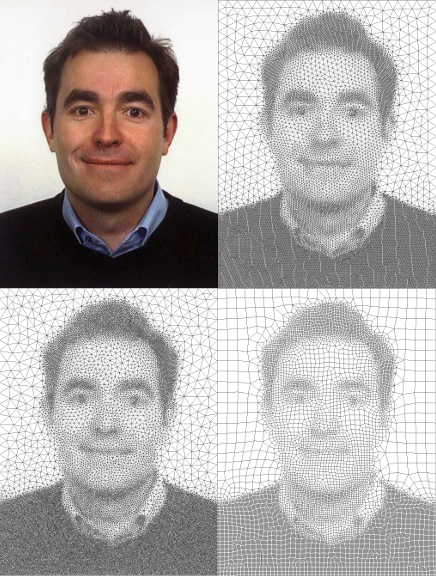
Prof. Christophe Geuzaine is a Full Professor in the Department of Electrical Engineering and Computer Science at the University of Liège , Belgium. He previously held academic positions at Case Western Reserve University (Assistant Professor of Mathematics) and California Institute of Technology (Postdoctoral Scholar in Applied and Computational Mathematics). Research Focus: Computational electromagnetism, biomedical/geophysical modeling, and open-source software development (Gmsh, GetDP) Teaching: Courses in electromagnetic energy conversion, scientific computing, and multiphysics projects Location: Montefiore Institute B28, Quartier Polytech 1, Liège, Belgium His research employs ONELAB tools for high-temperature superconductivity ( Life-HTS ), photonics ( ONELAB-Photonics ), and domain decomposition ( GetDDM ). Current work emphasizes large-scale time-harmonic wave simulations and quantum computing applications.
Professor Wulf Dettmer is affiliated with the School of Aerospace, Civil, Electrical and Mechanical Engineering at Swansea University. He specializes in Finite Element Technology , Computational Fluid-Structure Interaction (FSI) , and Morphing Aircraft research. His work spans disciplines including: Fluid-Structure Interaction Structural Dynamics Renewable Energy Systems Multi-Scale Modeling Key research trends include: Advanced time integration schemes for dynamic problems Machine learning applications in material modeling Cryogenic hydrogen energy systems Partitioned FSI solvers Flexible structures for energy harvesting Professor Dettmer has supervised numerous PhD and EngD projects in collaboration with Prof Djordje Peric and other colleagues, focusing on topics like neural network-based finite element frameworks and multi-scale composite analysis.
Subrata Das is a Postdoctoral Researcher at Virginia Tech's Center for Quantum Information Science & Engineering within the Department of Physics, College of Science. Working under Professor Vito Scarola, he conducts advanced research on quantum many-body systems using Tensor Network methods including Matrix Product States and Tree Tensor Networks. His office is located at 106 Robeson Hall in Blacksburg, Virginia. Das earned his PhD from the Indian Institute of Technology Kharagpur specializing in Quantum Turbulence in Bose-Einstein Condensates. His academic journey began with undergraduate studies at the University of North Bengal, followed by postgraduate work at the University of Calcutta where he received the prestigious DST-INSPIRE Scholarship for academic excellence. His research expertise spans Theoretical Quantum Physics with emphasis on Quantum Gas systems, Bose-Einstein Condensates, and Many-Body Physics. Das utilizes Tensor Network methods and DMRG to investigate Quantum Vortices and Quantum Turbulence in ultracold quantum systems. With over six years of experience, he has developed scientific code in C++ and excels in data post-processing using Python for high-performance computing applications. Das's publication record demonstrates consistent contributions to understanding supersolids, quantum turbulence, and dipolar quantum gases. His work reveals patterns in vortex dynamics, phase transitions in dipolar Bose-Einstein condensates, and computational approaches to quantum many-body problems, often involving collaborations with leading physicists in the field. DST-INSPIRE Scholarship for academic excellence Google Cloud Platform Research Credits ($5,000) for large-scale quantum turbulence simulations As a postdoctoral researcher, Das contributes to Virginia Tech's quantum research ecosystem supported by computational resources including Google Cloud Platform credits. His work bridges theoretical physics with computational approaches to advance understanding of quantum phenomena with potential applications in quantum technologies. Das actively collaborates with the Center for Quantum Information Science & Engineering, engaging with researchers in quantum computing, simulation, and information theory. His current projects focus on vortex dynamics in quantum fluids and computational methods for large-scale quantum systems, positioning him at the forefront of theoretical quantum physics research.
Prof. Dr.-Ing. habil. Jörg Schröder is a full Professor of Mechanics at the University of Duisburg-Essen, Faculty of Engineering, Department of Civil Engineering, and leads the Institute of Mechanics. He has held significant leadership roles, including Vice-Rector for Research and Knowledge Transfer, and is currently Vice-President (2023–2025) and former President (2020–2022) of the International Association of Applied Mathematics and Mechanics (GAMM). He is a member of acatech and the Academy of Sciences and Literature, Mainz. PhD and Habilitation, Universität Stuttgart Professor since 2001, University of Duisburg-Essen Spokesperson, DFG Priority Programme 1748 and Research Unit 1509 Editor-in-Chief, Archive of Applied Mechanics His research centers on computational and continuum mechanics, with a focus on constitutive modeling, finite element methods, and multiscale simulations of materials such as dual-phase steels, high-performance concrete, and magneto-mechanical systems. He employs advanced numerical techniques including mixed and hybrid finite elements, phase-field modeling, and least-squares formulations. His work spans theoretical development and practical applications in manufacturing, civil engineering, and material science. The recent publications demonstrate a strong emphasis on multi-physics problems, including thermo-elastoplastic analysis in laser welding, micromagnetic simulations, sea ice dynamics, and fracture modeling in fiber-reinforced concrete. There is a clear trend toward high-fidelity, multi-scale simulations integrating microstructural details with macroscopic behavior, often using phase-field and reduced-order modeling approaches. Notable scientific recognitions include: Member of the Senate of the German Science Foundation (DFG) Selection Committee, Alexander von Humboldt Foundation Member of acatech and the Academy of Sciences and Literature, Mainz Leadership roles in GAMM Prof. Schröder leads major research initiatives funded by the DFG, serves on editorial boards of leading journals, and collaborates extensively with national and international researchers. He advises numerous doctoral candidates and postdoctoral researchers, though specific student names are not listed in the source text. His team conducts research in areas such as computational inelasticity, multiscale modeling, and simulation of coupled physical phenomena.
Prof. Dr.-Ing. habil. Olaf Kolditz serves as Head of the Department of Environmental Informatics at the Helmholtz Centre for Environmental Research (UFZ) and holds a Full Professorship for Applied Environmental System Analysis at Technische Universität Dresden. His academic career spans multiple prestigious institutions including Tübingen University and Leibniz University of Hannover, with significant leadership roles such as Director of the international Master course 'Applied Environmental Geoscience' and Speaker of the Helmholtz Graduate School HIGRADE. Professor Kolditz's research focuses on environmental fluid mechanics, computational methods, and software engineering with applications in geotechnics, hydrology, and energy storage. His work bridges theoretical research with practical applications in water resource management and environmental protection. He has made substantial contributions to high-performance computing, environmental information systems, and scientific visualization, particularly through his leadership of the OpenGeoSys project. His publication record demonstrates consistent innovation in environmental modeling, with recent work focusing on digitalization for nuclear waste management, geomechanical integrity analysis, and digitally facilitated water management systems. These publications reflect his interdisciplinary approach that integrates computational hydrology, geomechanics, and environmental informatics to address complex environmental challenges. Scientific Awards: Award for outstanding PhD thesis, Academy of Science of GDR (1990) Chinese Academy of Sciences (CAS) President's International Fellowship (PIFI) (2015) UFZ Research Award for the OpenGeoSys research platform (2021) Professor Kolditz serves as Editor-in-Chief for two international journals ( Geothermal Energy and Environmental Earth Sciences ) and leads significant international research collaborations including the Sino-German network initiative 'Research Centre for Environmental Information Science-RCEIS' and the joint priority project 'Managing Water Resources in Urban Catchments - Chaohu'. His work has established him as a leading figure in computational environmental science with global impact.
Prof. Sebastian Huber is a Lecturer at ETH Zürich's Department of Physics within the Institute for Theoretical Physics. His research focuses on classical topological wave phenomena and applications of machine learning to quantum statistical many-body systems. He holds an ERC Consolidator Grant and previously served as an SNSF Professor. Education: Diplom (2004) and PhD (ETH Zürich under Prof. Gianni Blatter), followed by postdoctoral research at the Weizmann Institute of Science supported by SNSF and Swiss Friends of Weizmann fellowships. Research interests span topological materials, metamaterials, and quantum many-body systems. Notable grants include ERC Consolidator (2018-present) and SNSF Professorship (2012-2018). His work bridges theoretical physics with experimental realizations in condensed matter and acoustics. Awards include the Koshland Prize and SNSF Fellowships. Active in teaching via ETH's Zurich Physics Colloquium and advanced graduate courses in theoretical physics.
Prof. Dr. Christian Wieners is a faculty member at the Institute for Applied and Numerical Mathematics , part of the Faculty of Mathematics at Karlsruhe Institute of Technology (KIT) . He has held leadership roles, including Head of the KIT Department of Mathematics (2012-2015) and Speaker of the GAMM activity group on numerical methods for PDEs (2010-2017). Academic Rank: Professor Research Focus: Scientific Computing, Discontinuous Galerkin Methods, Multigrid Algorithms, and Applications in Solid Mechanics and Cardiac Modeling His research spans Numerical Analysis , Computational Mechanics , and Biomedical Engineering , with a focus on parallel finite element methods for wave equations, phase-field fracture, and multi-physics cardiac simulations. Recent work includes adaptive space-time DG methods, visco-acoustic inversion, and digital twins for heart modeling. He has served as an Associated Editor for SIAM Journal of Scientific Computing (2008-2013) and a Section Editor for Numerical Analysis in ZAMM. His publications highlight collaborations in Parallel Computing , Visco-Elastic Models , and Nonlocal Plasticity . Prof. Wieners teaches courses like Numerische Mathematik and Grundlagen der Kontinuumsmechanik , with a history of lectures on Scientific Computing , Machine Learning in Mathematics , and Multigrid Methods . His work integrates Mathematical Rigor with Engineering Applications .
Anton Artemyev is a Professor at the University of California, Los Angeles, affiliated with the Earth, Planetary, and Space Sciences department. His research spans planetary science, space physics, and geophysics, focusing on computational modeling of geophysical and space systems, laboratory simulations of planetary processes, and advanced data analysis techniques for space plasmas. Key research themes include: Planetary magnetospheres and dynamo processes Space plasma dynamics and magnetic reconnection Computational modeling of geophysical phenomena Planetary surface magnetic anomalies Machine learning applications in space weather prediction Wave-particle interactions in solar system plasmas Recent work has concentrated on nonlinear dynamics of magnetospheric plasmas, auroral phenomena, and hybrid simulation approaches. His research has been recognized through competitive funding including: NSF Grant for Computational Modeling of Space Plasmas (2018) NASA Early Career Fellowship (2015) UCLA Distinguished Teaching Award (2022) He actively mentors graduate students across planetary science and space physics disciplines.
Jakub Wiktor Both is a permanent researcher at the Department of Mathematics, University of Bergen (UiB). He is affiliated with the Porous Media Research Group and the Center for Modeling of Coupled Subsurface Dynamics. His research focuses on numerical methods for multiphysics problems in porous media, including image-based data analysis for laboratory experiments and mathematical modeling of CO2 storage. His work involves developing tools like the DarSIA (Darcy Scale Image Analysis) toolbox for fluid displacement analysis and PorePy, a Python simulation framework for fractured porous media. He leads projects on CO2 storage validation and has been awarded an NFR FRIPRO grant for his TIME4CO2 initiative, aiming to enhance CO2 storage capacity through mathematical modeling. Key research themes include optimal transport metrics, robust numerical solvers for coupled systems, and gradient flow structures in dissipative systems. His contributions span experimental validation frameworks (e.g., FluidFlower), digital twins (PoroTwin), and open-source software for subsurface dynamics. Notable awards include election as Chair of the Board of InterPore Norway (2024) and leadership in international projects like ERC CoG MaPSI and NFR Petrosenter CSSR. His interdisciplinary approach bridges mathematics, geoscience, and engineering for sustainable subsurface resource management.
Jeff Oishi is an Associate Professor and Associate Chair in the Department of Mechanical Engineering at the University of New Hampshire (UNH) with an appointment in Integrated Applied Mathematics. His research focuses on complicated fluid dynamics including biophysical/geophysical flows, turbulence, phase changes, magnetic fields, and non-Newtonian fluids. He leads the UNH Complicated Fluids group and co-founded the Dedalus Project for solving partial differential equations. Education: Ph.D. in Astronomy from the University of Virginia Research Interests: His work spans fluid instabilities in diverse contexts from solar dynamos to bacterial biofilms. Key methodologies involve high-performance computing and the Dedalus framework to model magnetohydrodynamics, moist convection, and non-Newtonian fluid behavior. The group specializes in problems requiring multi-physics coupling and three-dimensional turbulence simulations. Publication Trends: Recent articles (2023-2025) emphasize fluid instabilities in astrophysical and geophysical systems, particularly solar/stellar dynamos and atmospheric convection. Collaborative work with the Dedalus team bridges engineering fluid dynamics and astrophysics, with applications ranging from planet formation to biofilm mechanics. Strong focus on numerical methods for multi-scale turbulent flows. Scientific Awards: None mentioned. Advising and Grants: No specific information on advisees or funded grants was provided in the source text. Labs and Teams: Leads the UNH Complicated Fluids group and serves as core developer for the Dedalus Project. The group maintains active collaborations with Dedalus developers globally, focusing on computational frameworks for complex fluid phenomena.
Prof. Dr. Eva Pavarini is a Professor at the Theoretical Nanoelectronics (PGI-2) group within the Peter Grünberg Institute at Forschungszentrum Jülich. Her research focuses on strongly correlated electron systems , with expertise in many-body physics , Dynamical Mean-Field Theory (DMFT) , and Quantum Monte Carlo (QMC) methods. Key research areas include transition-metal oxides , spin-orbit coupling , Mott transitions , and orbital ordering . She leads the Autumn School on Correlated Electrons , an educational initiative on many-body physics. Her recent publications address orbital ordering mechanisms in KCuF 3 , super-exchange Hamiltonians , and spin-orbit effects in ruthenates. Her work combines LDA+DMFT with realistic Coulomb vertex calculations. Current and former group members include Dr. Xue-Jing Zhang, Dr. Guoren Zhang, and Dr. Alessandro Chiesa. She offers PhD and postdoc positions , as well as bachelor/master grants for students.
Julia Kowalski serves as Professor and Chair of the Department of Methods of Model-Based Development in Computational Engineering at RWTH Aachen University's Faculty of Mechanical Engineering. She holds dual appointments on the Steering Committees for the university's Profile Areas in Production Engineering (ProdE) and Modeling & Simulation Sciences, operating from the Collective Building of Mechanical Engineering in Aachen, Germany. Her research integrates computational engineering with geohazard prediction and cryorobotics, developing advanced numerical methods for multiphysics problems including ice-penetration probes, landslide susceptibility mapping, and wind-energy systems. She pioneers machine learning applications that bridge physical models with engineering design while championing FAIR data principles across cryosphere and geohazard research domains. Current projects focus on model coupling techniques for environmental flows and space exploration technologies. Analysis of her 15 most recent publications reveals dominant trends in surrogate modeling for geotechnical stability, cryorobotic exploration systems, and FAIR data frameworks for environmental science. Her work consistently bridges machine learning with physical modeling across renewable energy, planetary science, and natural hazard mitigation through international collaborations like the TRIPLE project. Scientific awards are not documented in provided materials, though her leadership in DLR-funded space exploration initiatives and editorial roles in topical collections indicates significant recognition. As department chair, she oversees graduate advising and research direction within her computational engineering group, with active grant funding evidenced by German Space Agency collaborations and multi-institutional projects targeting geohazard prediction and cryosphere exploration. Her work demonstrates strong industry-academia-government partnerships. Kowalski leads the Methods of Model-Based Development research group, which operates as an integrated lab for numerical simulation, model coupling, and data-driven engineering solutions. Future work focuses on enhancing uncertainty quantification in geohazard models, advancing cryorobotic technologies for extraterrestrial environments, and developing robust frameworks for FAIR geoscientific data.
Jean-Baptiste Colliat is a Full Professor at Polytech Lille , Lille University, specialized in Numerical Simulation of Materials and Structures within Civil Engineering. His work bridges computational mechanics with practical applications in concrete durability, geothermal systems, and biomedical simulations. Develops Enriched Finite Element Methods for heterogeneous materials Focuses on Uncertainty Quantification in multi-scale systems Key applications: Nuclear Waste Containment , Rockfill Stability , and Obstetric Biomechanics Recent research trends include 3D fracture network modeling, stress-permeability coupling in porous media, and stochastic analysis of material heterogeneity. His work integrates X-ray Micro-CT , DEM , and Multiscale Homogenization techniques. Professor Colliat leads computational frameworks for Embedded Finite Element Methods and Excursion Set Theory applications. He actively collaborates with LaMcube (Laboratoire de Mécanique Multi-physique Multiéchelle) on problems ranging from microstructural evolution to large-scale infrastructure failure.
Cécile Daversin-Catty is a Research Scientist at Simula Research Laboratory in the Department of Numerical Analysis and Scientific Computing. Her work bridges computational mathematics and biomedical engineering through advanced finite element methods. Education: PhD in Applied Mathematics (2016, Université de Strasbourg), thesis titled 'Reduced basis method applied to large non-linear multi-physics problems: application to high field magnets design' Her research focuses on scientific computing , finite element methods , and mixed-dimensional coupling , with applications spanning fluid mechanics , cardiac electromechanics , and neurovascular modeling . Recent publications highlight her expertise in computational fluid dynamics for cardiac flow simulations, development of FEniCS-based tools for mixed-domain problems, and modeling of perivascular networks. Key trends in her work include: Development of robust numerical frameworks for multi-physics problems Advancing cardiac electromechanical modeling for heart failure studies Exploring glymphatic system dynamics via mixed-dimensional finite elements Software innovation in computational science tools She collaborates extensively with researchers across computational cardiology and neuroscience, contributing to open-source platforms like FEniCS.
Kent-Andre Mardal is a Professor at the Department of Mathematics , University of Oslo . He specializes in computational mechanics with a strong focus on biomechanical applications in medicine , particularly in modeling brain clearance mechanisms during sleep. His work integrates multi-physics modeling , fluid-structure interaction , and poroelastic couplings to advance understanding of the glymphatic system and cerebrospinal fluid dynamics. Education: PhD (2002) – Simula Research Laboratory Research Interests: Mardal's research spans a wide range of disciplines including: Computational Mechanics – developing robust numerical algorithms for complex physical systems Biomechanical Applications – particularly in neuroscience and medical imaging Brain Clearance During Sleep – modeling the glymphatic system and CSF flow dynamics Multi-Physics Modeling – integrating fluid dynamics, elasticity, and neural networks Finite Element Methods – for accurate and efficient simulations Neural Networks in Scientific Computing – exploring physics-informed neural networks Research Trends from Publications: Mardal's recent publications (2022–2025) demonstrate a clear focus on brain fluid dynamics , particularly the glymphatic system , CSF circulation , and neurodegenerative disease modeling . He employs advanced numerical techniques such as isogeometric analysis , physics-informed neural networks , and parameter-robust preconditioning to solve complex multi-physics problems. His work bridges medical imaging (MRI) with computational modeling to provide insights into brain clearance mechanisms and their impairment in diseases like Alzheimer's. Scientific Awards: No specific awards are mentioned in the provided text. Grants and Projects: Currently, Mardal is the Principal Investigator (PI) of three active research projects: Alzheimer's Physics – exploring the role of fluid dynamics in neurodegeneration Scientific Machine Learning – advancing numerical methods with AI Computational Hydrology – modeling subsurface fluid flow Affiliations and Teams: Mardal was previously a group leader at the Centre of Excellence “Biomedical Computing” at the Simula Research Laboratory. He has authored over 100 papers and several books, and his research homepage is available at https://kent-and.github.io/ .