Sarah Shirazyan is a Lecturer in Law at Stanford Law School , where she designed the Interpol-Stanford Policy Lab. She also serves as Director and Head of Meta's GenAI Product Policy work, overseeing responsible AI development across Meta's platforms. Doctor of Juridical Sciences (J.S.D.) from Stanford Law School LL.M. from SOAS/UCL, University of London Her research focuses on the intersection of national security , public policy , and international law , particularly examining: Effectiveness of UN Security Council responses to WMD terrorism Framework for regional organization collaboration in WMD prevention Platform content policy development and misinformation governance Responsible AI implementation under legal frameworks Key publication themes include: Platform algorithmic accountability Media capture in digital domains Content policy development during crises UN Security Council institutional limitations Regional organization synergies in security Recipient of Gerald J. Lieberman Award for research, teaching, and community service Professional affiliations: Stanford Law School Stanford Center for International Security and Cooperation (CISAC) INTERPOL European Court of Human Rights Council of Europe United Nations
Vipin Narang is the Frank Stanton Professor of Nuclear Security and Political Science at MIT's Security Studies Program. He served as Principal Deputy Assistant Secretary of Defense for Space Policy (2022–2024), awarded the Department of Defense Medal for Distinguished Public Service. His research focuses on nuclear proliferation, strategy, and South Asian security. Narang holds a PhD from Harvard University (2010) and advanced degrees from Stanford and Oxford. He has authored seminal works like *Nuclear Strategy in the Modern Era* (2014) and *Seeking the Bomb* (2022). Education: PhD (Harvard), M.Phil (Oxford), MS/BS (Stanford). Fellowships: Harvard Olin Institute, Belfer Center, Stanford CISAC. Research interests include North Korea's nuclear program, deterrence theory, and geopolitical competition. Key achievements: 2020 ISSS Emerging Scholar Award (ISA), 2015 ISA Best Book Award. Advising focuses on defense policy and nuclear strategy. Active in policy circles, often commenting on India-China tensions, North Korea, and US defense strategy. Labs/Teams: MIT Security Studies Program, affiliated with Project on Managing the Atom (Harvard). Ongoing work explores multipolar deterrence, AI in command systems, and hypersonic weapons implications.
Eglė E. Murauskaitė is a Senior Faculty Specialist at the University of Maryland and a Senior Non-Resident Fellow with the Vilnius Institute for Policy Analysis. She lectures at Vilnius University and Kaunas University of Technology, focusing on international security, gray zone warfare, and unconventional threats. Her work spans academic research, government consulting, and crisis simulations design across Europe, the U.S., and MENA. Education: Master of International Relations (Security Studies, Summa Cum Laude, Sciences Po Paris 2012), Bachelor of Economics (SSE Riga 2008). Research Areas: Nuclear security, WMD proliferation, crisis communication, emotion studies, and interdisciplinary approaches to security challenges. Leadership: PI for DoD Minerva projects on Western assistance in Ukraine and emotions in adversarial campaigns; lead for ICONS Project simulations. Scientific Awards: Senior non-resident fellow at Vilnius Institute for Policy Analysis. Her recent publications analyze Ukrainian resilience, Russian nuclear rhetoric, and foreign fighter risks. She also contributes to public discourse via the NYLA Update podcast and National Drama Theatre discussions.
John Lee is a senior fellow at the Hudson Institute and an adjunct professor at the University of Sydney, with prior adjunct roles at the Australian National University. He is a leading expert on the Chinese political economy and Indo-Pacific strategic affairs, having served as senior national security adviser to Australia’s Foreign Minister. Based in Sydney, he holds a doctorate in international relations from the University of Oxford and law and arts degrees from the University of New South Wales. Education: PhD and MA in International Relations, University of Oxford; LLB and BA (First Class, Philosophy), University of New South Wales Current Affiliations: Senior Fellow, Hudson Institute; Adjunct Professor, University of Sydney; Senior Fellow (Nonresident), United States Studies Centre Former Role: Senior National Security Adviser to Australian Foreign Minister Julie Bishop (2016–2018) Dr. Lee’s research centers on Indo-Pacific security, defense strategy, US-China rivalry, and global trade policy. He is particularly focused on China’s political economy, strategic deterrence, alliance burden-sharing, and the implications of American reindustrialization. His work critically examines the evolving global economic order, the role of tariffs, and the challenges posed by state-led industrial policies, especially in China. He frequently analyzes the AUKUS pact, US alliance dynamics, and the strategic implications of China’s growing influence in the Global South and Middle East. His recent publications demonstrate a strong trend toward policy-relevant analysis of US trade and defense strategy under the Trump administration, with recurring themes of economic statecraft, national security, and the need for allies to increase defense spending and industrial resilience. He emphasizes the strategic logic behind tariffs as tools for reindustrialization and views alliances through a transactional lens of burden-sharing and strategic contribution. Scientific Awards: No awards explicitly mentioned in the text. Dr. Lee is an active advisor and commentator on national security and economic policy. He has not been mentioned as supervising formal students, but his influence is evident through his extensive media contributions and participation in high-level policy discussions. He has co-authored reports, such as on deterring China through nonmilitary costs, indicating collaborative research. His work is frequently cited in major media outlets like The Australian , Financial Review , and The Interpreter . He is associated with research teams and events at the Hudson Institute, regularly participating in panels and conferences on US-China rivalry, Middle East policy, and Indo-Pacific strategy. His work is central to ongoing policy debates about American global leadership, the future of globalization, and the strategic competition with China.
Sharad Joshi is a Professor at the Middlebury Institute of International Studies, specializing in terrorism and nuclear security in South and Southeast Asia. He joined the Institute as a postdoctoral fellow at the James Martin Center for Nonproliferation Studies in 2006 and transitioned to full-time faculty in 2011. He also served as a research associate and interim director of the Monterey Terrorism Research and Education Program. Ph.D. in International Affairs, University of Pittsburgh M.A. in Politics, Jawaharlal Nehru University B.A. (Honors) in Economics, University of Rajasthan His research focuses on terrorism, nuclear weapons, and WMD proliferation, with emphasis on South Asian nuclear rivalry, CBRN terrorism, and transnational extremist networks. His courses include Global Politics , Great Power Competition , and specialized seminars on terrorism and nuclear issues. Recent publications analyze U.S.-India relations, China-Pakistan nuclear deals, and WMD security challenges. He leads the International Strategic Crisis Negotiation Exercise (ISCNE) , simulating Central Asian geopolitical crises involving China, India, Russia, and regional states.
Peter Ivan Belk is an Adjunct Professor at the Security Studies Program within the McCourt School of Public Policy at Georgetown University. His academic role is complemented by a distinguished career in U.S. national security and defense policy. His educational background includes: B.A. in Political Science from the University of Pennsylvania M.A. in National Security Studies from Georgetown University J.D. from Columbia Law School M.S.S. from the U.S. Army War College Mr. Belk specializes in national security, defense readiness, and strategic policy , with deep expertise in weapons of mass destruction, counterterrorism, and international arms control. His career spans high-level government positions in the Department of Defense, National Security Council, and Department of State, where he led strategic planning and policy development. His featured publications reflect his focus on geopolitical strategy, NATO, and international credibility in security affairs. Though no recent articles are listed, his work centers on defense policy, military strategy, and global security cooperation. He is affiliated with the Council on Foreign Relations and has served in both active and reserve components of the U.S. Army as a civil affairs and military intelligence officer. Mr. Belk is also a licensed attorney in Washington, D.C., and New York, with private sector experience in law, finance, and consulting. His academic appointment is held in a personal capacity and does not represent the views of the U.S. government.
James J.F. Forest is a Professor in the School of Criminology and Justice Studies at the University of Massachusetts Lowell, where he serves as Director of Security Studies and teaches undergraduate, master's, and doctoral courses on contemporary security studies, terrorism and counterterrorism, homeland security, and weapons of mass destruction. He is also the Editor-in-Chief of the peer-reviewed scholarly journal Perspectives on Terrorism. Previously, he served as a Senior Fellow for the U.S. Joint Special Operations University (2010-2019) and as a faculty member at the United States Military Academy (2001-2010), where he was Director of Terrorism Studies at the Combating Terrorism Center at West Point for six years and Assistant Dean for Academic Assessment for three years. Dr. Forest's educational background includes a Ph.D. in Higher Education Administration from Boston College (1998), an MA in International Development Education from Stanford University (1994), a BS in Foreign Service from Georgetown University (1993), and an AA in Liberal Arts from De Anza College (1991). His research focuses on international security, terrorism & counterterrorism, national security, military & defense policy, weapons of mass destruction, homeland security, critical infrastructure protection, and transnational organized crime. His recent work has increasingly emphasized digital influence warfare, information operations, and the intersection of social media, propaganda, and political warfare in the modern security landscape. Dr. Forest's scholarly output shows a clear evolution from traditional terrorism studies toward understanding the digital information environment as a critical domain for contemporary security challenges. His recent publications focus on how state and non-state actors leverage social media platforms for influence operations, with particular attention to disinformation campaigns, cognitive warfare, and the strategic manipulation of online information ecosystems. Superior Civilian Service Award (2010), Leadership - Department of the Army America's most esteemed terrorism and national security expert (2006), Service, Community - Foreign Policy Magazine Commander's Award for Public Service (2005), Leadership - Department of Army Commander's Award for Civilian Service (2004), Leadership - Department of Army Achievement Medal for Civilian Service (2003), Service, Community - Department of the Army Mary T. Kinnane Award for Excellence in Higher Education (1998), Scholarship/Research - Boston College Dr. Forest has provided expert testimony and briefings to the intelligence community and U.S. Senate committee hearings. He has served as an expert witness in terrorism-related court cases and has been involved in significant research projects including grants from the Ford Foundation, Department of Defense, and FBI Counterterrorism Branch. His work with the Center for Terrorism & Security Studies at UMass Lowell has established it as a prominent research hub for contemporary security challenges, particularly focusing on the evolving nature of terrorism in the digital age.
Victoria Time is Professor of Sociology & Criminal Justice at Old Dominion University, specializing in risk analysis, homeland security, and emergency management. Her research develops computational frameworks for risk communication and assesses threats ranging from natural disasters to cybersecurity. Recent publications focus on AI-enhanced risk messaging (2025), climate impacts on supply chains (2022), and validation methodologies for hierarchical models (2019). Her work integrates software engineering with mixed-methods research to address complex security challenges.
Dr Daniel Salisbury is a Visiting Research Fellow at the Centre for Science & Security Studies (CSSS) within King’s College London’s Department of War Studies. He has held senior research roles at CSSS, including a three-year Leverhulme Trust Early Career Fellowship (2020-2023). His work focuses on nuclear proliferation, sanctions evasion, Cold War history, and arms control. Salisbury is also an Associate Fellow at RUSI and has contributed to global capacity-building workshops on sanctions and export controls. Education: PhD, MA, and BA in War Studies from King’s College London. Awards include Fellow of the Royal Historical Society and editorial roles at journals like Strategic Trade Review . Key research interests encompass illicit trade networks, nuclear security, and UN Security Council Resolution 1540 implementation. His book Secrecy, Public Relations and the British Nuclear Debate (2020) examines UK nuclear policy communication strategies from 1970–1983. Publications span peer-reviewed articles, edited volumes, and policy reports, including analyses of North Korean sanctions evasion, Russian arms embargoes, and historical case studies of proliferation networks. His work bridges academic research and policy impact, addressing contemporary security challenges through historical and geopolitical lenses.
Colin Kahl is a Steven C. Házy Senior Fellow at Stanford University’s Center for International Security and Cooperation (CISAC) and a courtesy Professor of Political Science. He serves as faculty director of CISAC’s Program on Geopolitics, Technology, and Governance. Previously, he held senior U.S. government positions including Under Secretary of Defense for Policy (2021-2023), where he authored the 2022 National Defense Strategy and led responses to crises in Ukraine and the Indo-Pacific. He also served as Deputy National Security Advisor to Vice President Biden (2014-2017) and Deputy Assistant Secretary of Defense for the Middle East (2009-2011). His academic credentials include a Ph.D. in Political Science from Columbia University (2000) and a B.A. from the University of Michigan (1993). Kahl has held teaching positions at Georgetown University and the University of Minnesota, along with fellowships at Harvard University, the Council on Foreign Relations, and the Penn Biden Center. Research focuses on U.S. defense policy, nuclear nonproliferation, Middle East security, and the intersection of technology with global governance. Key publications include Aftershocks: Pandemic Politics and the End of the Old International Order (2021) and States, Scarcity, and Civil Strife in the Developing World (2006). His recent work addresses AI governance, U.S.-China strategic competition, and diplomatic solutions to Iranian nuclear challenges. Recipient of the Department of Defense Distinguished Public Service Medal (2023), Kahl’s career bridges academia and policy-making. He advises on NATO modernization, AUKUS defense agreements, and India’s role in Indo-Pacific stability. Current research explores post-pandemic geopolitical shifts and the evolving international order.
Dr. Joshua Sinai is a Professor of Practice in the Department of Intelligence and Global Security Studies at Capitol Technology University, based in the Washington, D.C. area. He holds a Ph.D. and M.A. from Columbia University’s Political Science/Comparative Politics program, and a B.A. from SUNY New Paltz. His career spans over 35 years in international/national security with U.S. government agencies, academia, and private sector firms. He has served as a senior intelligence analyst at the Library of Congress, worked with the FBI’s Foreign Terrorist Tracking Task Force, and contributed to Virginia Tech’s Center for Technology, Security, and Policy in developing counterterrorism educational programs. Dr. Sinai’s research focuses on terrorism/counterterrorism, intelligence methodologies, and security policy. His notable works include the Active Shooter: A Handbook on Prevention and over 50 peer-reviewed articles analyzing topics like lone-actor terrorism, future warfare trends, and critical infrastructure resilience. He emphasizes proactive prevention strategies and has developed frameworks for assessing and mitigating emerging threats. His professional affiliations include ASIS International, AFCEA International, and the Middle East Institute. Sinai advises on counterterrorism measures for businesses and governments, blending academic rigor with practical field experience. His work bridges theoretical analysis and actionable security solutions for modern threats.
Dr. Patricia Shamai is an Associate Head (Students) and Senior Lecturer in the School of Area Studies, Sociology, History, Politics, and Literature at the University of Portsmouth. She holds a PhD from the University of Southampton and has served in academic roles since 2011, progressing to Principal Lecturer/Associate Head in 2021. Her expertise spans international relations, security, and deterrence, with a focus on WMD norms, modern deterrence strategies, and gender equality in security policy. She teaches undergraduate and postgraduate modules, including 'Security Challenges in the 21st Century' and 'Defence and Deterrence,' and supervises MRes and PhD students. Shamai is also the School’s Equality and Diversity Lead, advocating for inclusive policies in security studies. Her research explores three core areas: the stigmatization of WMD, evolving deterrence in the digital age, and gender barriers in security collaboration. She has contributed to national/international media and collaborates with organizations bridging military, academic, and policy sectors. Shamai’s teaching modules address contemporary threats like cyber warfare, nuclear non-proliferation, and terrorism, with 100% postgraduation employment rates for her International Relations students. She is affiliated with the Centre for European and International Studies Research and the Peace, Conflict and Security Research Group. Her work emphasizes interdisciplinary approaches to security challenges and has influenced policy discussions through media commentary and academic publications.
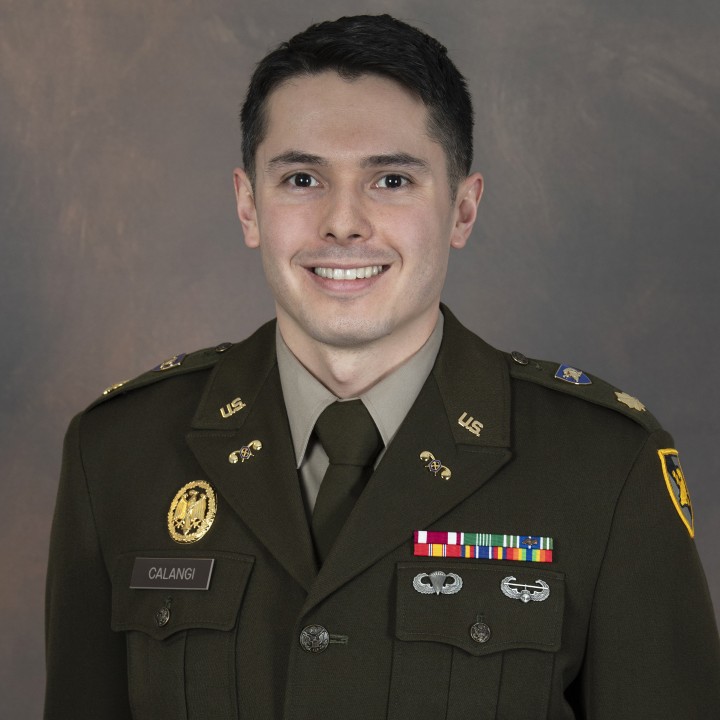
Major Nicholas L. Calangi is a Senior Lecturer teaching CH275 Introduction to Biology. He earned a B.S. in Biology, a B.A. in History, and a minor in Theology from Loyola University-Chicago in 2013, followed by an M.S. in Biology (Microbiology and Infectious Disease) from George Mason University and an M.S. in Environmental Management from Webster University . His research focuses on Virology and identifying therapeutic gaps in viral treatment strategies through the characterization of anti-viral synthetic peptides . While his academic background aligns with microbiology and environmental management, his published work emphasizes military applications, including chemical reconnaissance, technical escort operations, and force protection in field artillery units. Recent publications span topics such as STEM education gaps in CWMD operations , precise response tactics , and protection strategies for artillery units , reflecting his dual expertise in virology and military operational planning.
Kristina Hummel serves as a Lecturer in the Department of Social Sciences at the United States Military Academy (West Point) and holds the influential position of Co-Editor-in-Chief for the CTC Sentinel at the Combating Terrorism Center (CTC). Her professional trajectory bridges academia and frontline security analysis, following prior experience as an Al-Arabiya News producer covering Middle Eastern affairs from UN headquarters and work in magazine editing. Her academic foundation includes: Bachelor of Arts in Business Administration (University of Florida) Master of Public Administration (University of Southern California) Higher Education Teaching Certificate (Derek Bok Center for Teaching and Learning, Harvard University) Hummel's research centers on the nexus of counter-terrorism and global security architecture, with emphasis on operational implementation across governmental sectors. Her work examines: Transnational terrorist network disruption mechanisms Biodefense and public health security integration Financial intelligence as a counter-terrorism tool Regional security dynamics in conflict zones Policy coherence between military, law enforcement, and public health agencies Analysis of her CTC Sentinel publications reveals a strategic focus on interagency counter-terrorism coordination. The "CT Foxhole" interview series systematically maps institutional interfaces—from Treasury Department financial tracking to Homeland Security prevention programs—demonstrating how biodefense, military operations, and diplomatic channels converge in modern counter-terrorism. This cross-sectoral approach highlights evolving threats requiring integrated responses beyond traditional military frameworks. As Co-Editor-in-Chief of the CTC Sentinel, Hummel operates within the Combating Terrorism Center's research ecosystem at West Point, which functions as a critical node connecting military education with real-world counter-terrorism practitioners. The CTC's output directly informs U.S. national security policy through its practitioner-focused analysis and global network of subject matter experts.
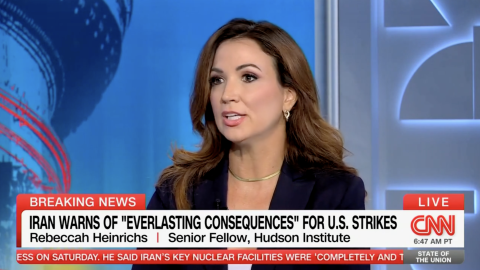
Rebeccah L. Heinrichs is a senior fellow at the Hudson Institute and director of its Keystone Defense Initiative, where she focuses on U.S. national defense policy and strategic deterrence. She is also an adjunct professor at the Institute of World Politics, teaching nuclear deterrence theory, and serves on several high-level advisory bodies including the Strategic Posture Commission and U.S. Strategic Command Advisory Group. Ph.D. in Defense and Strategic Studies, Missouri State University (with distinction) M.A. in National Security and Strategic Studies, U.S. Naval War College (highest distinction, Director’s Award) B.A. in History and Political Science, Ashland University (Ashbrook Scholar) Her research spans strategic deterrence, nuclear policy, missile defense, arms control, and U.S. foreign policy, with a particular emphasis on U.S.-Israel relations, Iran, Russia, and China. She frequently contributes to public discourse through media appearances and commentaries. Her recent publications and media appearances reveal a consistent focus on strengthening U.S. deterrence credibility, countering revisionist narratives in foreign policy, and advocating for robust alliances. Themes include the strategic use of military force, the dangers of isolationism, and the importance of maintaining a strong nuclear posture against peer adversaries. Director’s Award for academic excellence, U.S. Naval War College Dr. Heinrichs advises on national security policy and has contributed to congressional commissions and defense strategy panels. She is a contributing editor of Providence: A Journal of Christianity and American Foreign Policy and serves on the Board of Trustees at Ashland University, though she does not lead a formal academic lab or research team. Her work bridges academia, policy, and public engagement.