
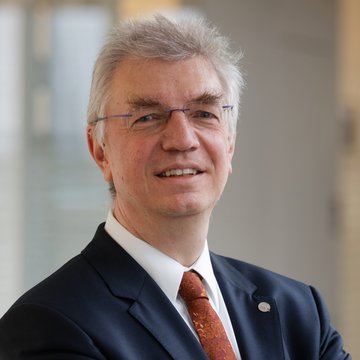
Matthias Steinmetz serves as the Scientific Chairman of the Leibniz Institute for Astrophysics Potsdam (AIP) and Director of the Research Branch "Extragalactic Astrophysics and Cosmology". He is also a University Professor at the University of Potsdam. His leadership extends across the international astronomical community, including his current role as Scientific Member of the German Delegation to ESO Council and former presidency of the German Astronomical Society (2014-2017). His educational background includes: Physics and Mathematics studies at Saarland University (1986-1988) Physics studies at Technical University of Munich (1988-1991) Diploma Thesis at MPI for Astrophysics: "Carbon-Detonations in differentially rotating, highly deformed White Dwarfs" PhD Thesis: "On the formation and morphology of galaxies" (summa cum laude) from MPI for Astrophysics / Technical University of Munich (1991-1993) Steinmetz's research focuses on galaxy formation and evolution, particularly the Milky Way. He has pioneered high-resolution simulations of galaxy formation and is heavily involved in developing and exploiting spectroscopic surveys like the 4m Multi-Object Spectroscopic Telescope (4MOST) for ESO, scheduled to begin operations in 2025. His work bridges theoretical astrophysics with observational data to understand galactic structure, dynamics, and chemical evolution. He is also co-initiator of the German National Center for Astrophysics, currently being established in Goerlitz. Analysis of his recent publications reveals a consistent focus on Milky Way structure and evolution, with particular emphasis on galactic bars, stellar migration, metallicity gradients, and the circumgalactic medium. His research leverages data from major surveys like APOGEE and Gaia, combined with sophisticated computational methods including orbit superposition techniques and machine learning approaches. The interdisciplinary nature of his work connects stellar dynamics, chemical evolution, and cosmological context to build a comprehensive understanding of our galaxy's history. His scientific achievements have been recognized with numerous prestigious awards: 1984: 1. State Prize and 2. Federal Prize in Physics Jugend forscht 1986: 1. State Prize and 4. Federal Prize Earth and Space Sciences Jugend forscht 1988-1991: Stipend of the Studienstiftung des deutschen Volkes 1993: Otto-Hahn-Medal of the Max Planck Society 1998: Alfred P. Sloan Fellowship 1998: David and Lucile Packard Fellowship 2011: Architectural Award Brandenburg 2013: Elected member of the Berlin Brandenburg Academy of Sciences and Humanities 2015: Wilhelm-Foerster Award of the Urania Potsdam for Communicating Science As a leader in the astronomical community, Steinmetz has mentored numerous students and researchers, though specific names aren't listed in the provided text. His significant grant funding includes leadership roles in major international projects like 4MOST and participation in ESO initiatives. He has served on numerous advisory boards including the Science Advisory Board of the MPI for Astronomy and the Square Kilometre Array (SKA) Science and Engineering Advisory Committee. At the Leibniz Institute for Astrophysics Potsdam, Steinmetz leads the Extragalactic Astrophysics research branch, which investigates topics ranging from the structure and dynamics of the Milky Way to the formation of galaxies and the large-scale cosmic web. His team is actively involved in developing next-generation instruments for ESO's Paranal Observatory and the Extremely Large Telescope (ELT), as well as establishing research data infrastructure for astronomy. The institute's collaborative environment connects theoretical modeling with observational astronomy and technological development.

