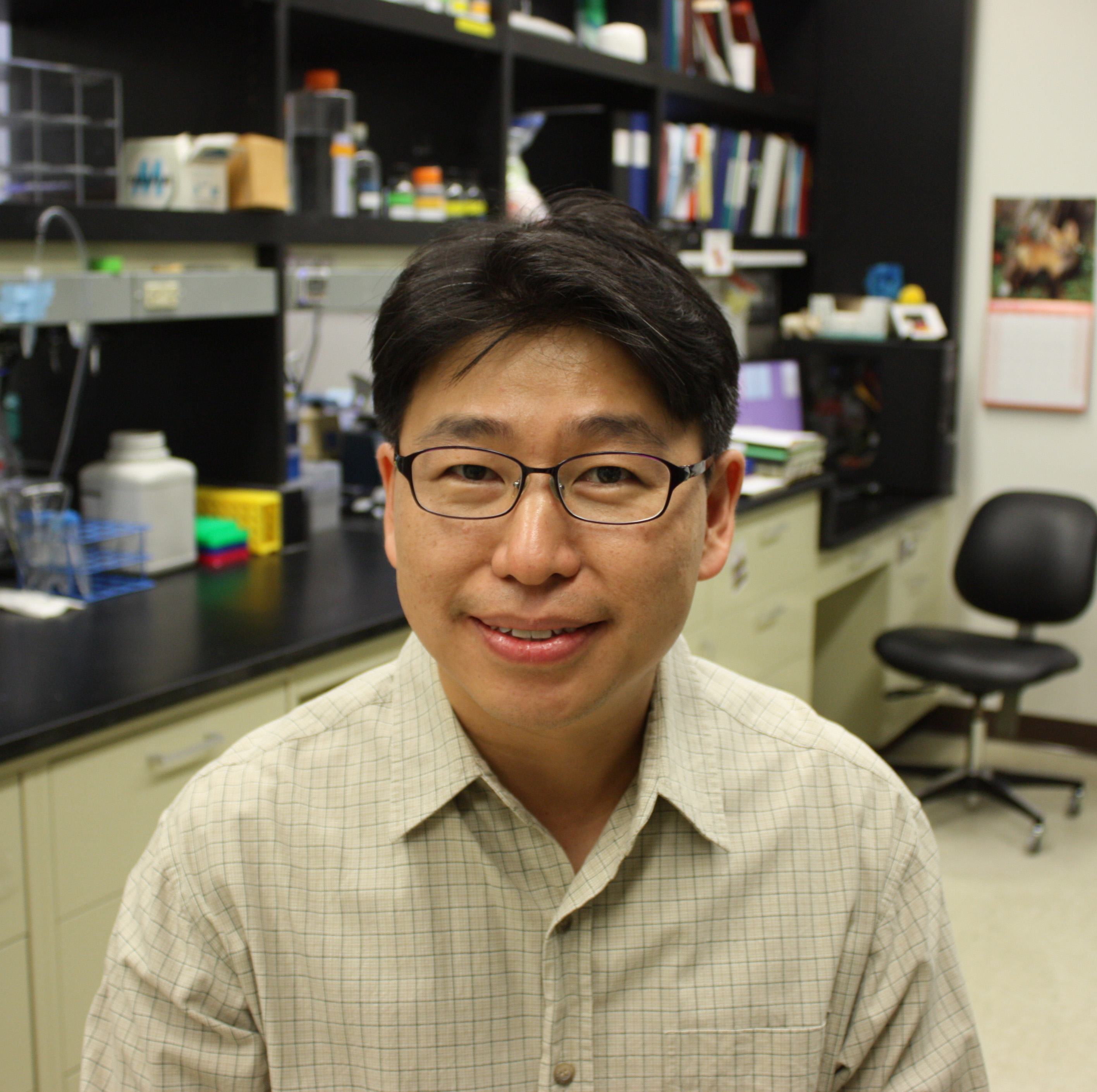
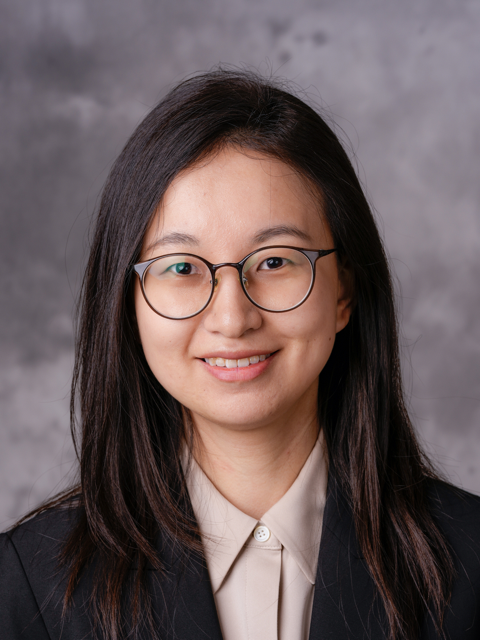
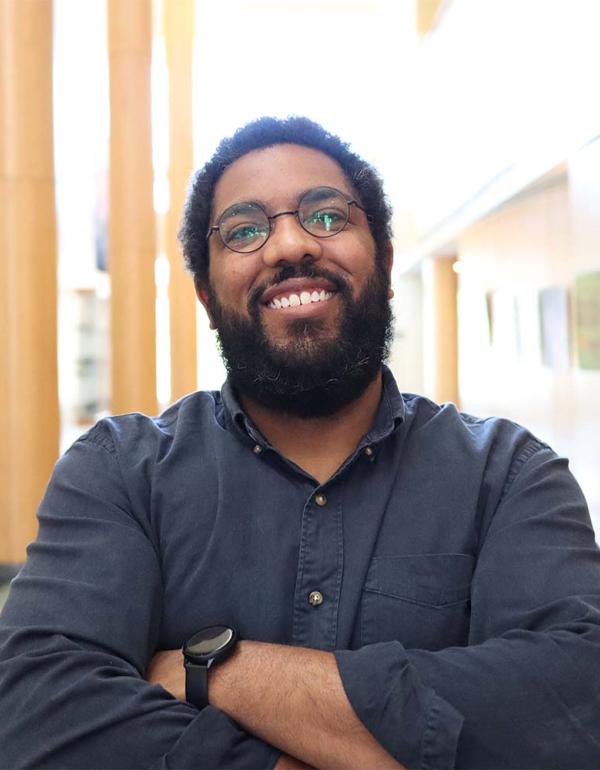
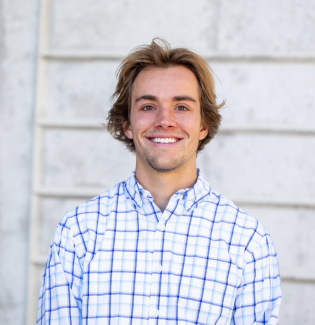
Sungjin Park is an Associate Professor at the University of Utah in the Department of Neurobiology . His research focuses on cell signaling, neuron-glial interactions, and the role of GPI-anchored proteins in nervous system development. B.S. from Seoul National University Ph.D. from Johns Hopkins University Research interests include: ECM organization in synaptic development Regulated release of GPI-anchored proteins Bi-directional neuron-astrocyte communication Mechanisms of neurodevelopmental disorders High-throughput neuronal activity assays Recent publications highlight: Key roles of GPI-anchored proteins in ECM assembly Novel pathways for synaptogenic factor release Development of live-cell neuronal activity reporters Genetic models for studying protein cleavage mechanisms Implications in autism and schizophrenia Current work involves in vivo analysis using knock-in mouse models and advanced imaging techniques.
Guang Xu is a Research Professor in the Department of Microbiology at the University of Massachusetts Amherst. His research spans microbial biotechnology and pathogenic microbiology, with a focus on interdisciplinary applications in biomedical engineering and bioelectronics. He is affiliated with the Morrill Science Center IVN on campus. Research Interests: Microbial Biotechnology Pathogenic Microbiology Recent Publications: Guang Xu's recent work explores advanced optogenetic tools, graphene-based microelectrodes, and silicon photodiode arrays for neural interrogation. His research integrates materials science, photonics, and computational modeling to enable high-resolution neurophysiological studies. Contact: Email: gxu@umass.edu | Phone: 413-545-2051 | Location: 209D Fernald, University of Massachusetts Amherst.
Dr. Derek Garden is a Lecturer at the University of Aberdeen's School of Medicine, Medical Sciences and Nutrition. His research focuses on understanding neuronal dysfunction in autism spectrum disorders (ASDs) through integrative studies of synaptic integration, ion channel function, and circuit organization in brain regions like the entorhinal cortex and inferior olive. University of Aberdeen - Lecturer (2022-present) University of Bristol - PhD in Neuroscience University of Edinburgh - Postdoctoral Researcher University of Aberdeen - Biomedical Sciences undergraduate degree Dr. Garden's research combines ex-vivo electrophysiology and advanced microscopy to investigate whether ASD-linked genes converge on common neuropathological pathways. His lab uses optogenetics and viral approaches to study: Monogenic ASD model convergence Critical period reversal of neuronal changes HCN1 channel function in cerebellar circuits Dendritic spine morphological changes Pharmacological intervention development His published work reveals key insights into: Grid cell cluster organization Entorhinal cortex memory systems Synaptic integration mechanisms Autistic spectrum disorder pathologies Neurotransmission dynamics Cerebellar learning processes Dr. Garden teaches courses in: Developmental Neuroscience (AN4301) Neuroscience and Neuropharmacology (BM3502) Neuroscience Research Topics (BM3804)
Xiaoxuan Yang is an Assistant Professor in the Department of Electrical and Computer Engineering at the University of Virginia . Her research focuses on processing-in-memory-based system design , biologically plausible systems , and hardware accelerators for emerging applications. She has held postdoctoral positions at Stanford University's Robust Systems Group and served as a research scientist at the University of Virginia. Ph.D. : Electrical and Computer Engineering, Duke University M.S. : Electrical Engineering, University of California, Los Angeles B.S. : Electrical Engineering, Tsinghua University Her research integrates neuromorphic computing , LLM acceleration , and hardware-software co-design , with specific interests in ReRAM crossbars , photonic neural networks , and memristor synapses . Current projects address stochastic noise resilience , quantization optimization , and energy-efficient AI . The 15 most recent publications explore PIM architectures (38%), neuromorphic systems (30%), ML hardware (25%), and optical computing (7%). Key trends include large language model acceleration , hardware robustness , and emerging memory technologies . Third Place ACM Student Research Competition (ICCAD) Best Research Award ACM SIGDA Ph.D. Forum (DAC) Best Paper Award GLSVLSI 2025 Rising Star in EECS NSF iREDEFINE Fellow Machine Learning and Systems Rising Star Rising Scholars Postdoc Fellow
Giuseppe Luppino is a Full Professor of Physiology at the Faculty of Medicine and Surgery, University of Parma, since 2006. His career spans multiple academic roles, including Associate Professor (1992–2002) and Assistant Professor (1990–1992) at the same institution, with international experience at Duke University (1985) and Nihon University (1992). Education: MD in Medicine and Surgery, University of Parma (1982) Specialization in Neurology, University of Parma (1986) PhD in Neurological Sciences, Rome (1988) His research focuses on neuroanatomy , motor control , and cortical connectivity in primates, particularly examining thalamic gradients, insular networks, and cortico-basal ganglia circuits. His publications from 2019–2025 reveal a consistent emphasis on large-scale sensorimotor networks , cross-hemisphere projections , and hodological architecture using neural tracers and neuroimaging. Recent articles (2020–2025) analyze ventral visual stream integration , claustrum involvement in cortico-basal ganglia loops, and functional connectivity patterns in macaque brains. These works highlight his expertise in anatomical-functional correlations and cognitive-motor systems .
Dr. Marcel Oberländer leads the In-Silico Brain Sciences research group at the Max Planck Institute for Neurobiology of Behavior - caesar and is affiliated with the University of Bonn's Transdisciplinary Research Area: Life and Health. His research integrates network anatomy, cellular physiology, and computational modeling to understand neural mechanisms underlying perception and decision-making. Using the rodent whisker system as a model, his team develops anatomically constrained network simulations to study sensory-guided behaviors like texture discrimination. Recent work reveals how horizontal projections in cortical deep layers gate output signals and how structural heterogeneity maintains excitation-inhibition balance in neural circuits. Oberländer employs multidisciplinary approaches including in vivo electrophysiology, neural tracing, and biologically realistic simulations to establish structure-function relationships in cortical microcircuits.
Nikolas Francis is Assistant Professor in the Department of Biology at University of Maryland and member of the Brain and Behavior Institute. His research investigates neural mechanisms of auditory perception and decision-making using in vivo electrophysiology, 2-photon imaging, and automated behavioral paradigms in mice. He develops computational approaches to analyze cortical network dynamics during sensory-guided behavior. Education: PhD, Massachusetts Institute of Technology (2011) BA, University of Iowa (2003) His lab examines how auditory cortex represents and transforms sound information during perceptual tasks, focusing on neural coding principles, attention mechanisms, and decision processes. Recent work explores how psilocybin modulates cortical processing while preserving basic auditory representations. He has developed automated home-cage systems for longitudinal behavioral monitoring that reveal circadian patterns in task engagement. Analysis of his publications shows emphasis on information coding strategies across cortical layers, with recent work examining network-level information transfer and psychedelic modulation of sensory processing. His NIH-funded research combines neurophysiological recordings with computational modeling to understand neural sequence generation during decision-making. He teaches courses in neurobiology and mentors graduate students through UMD's Neuroscience and Cognitive Science program. His lab maintains collaborations with machine learning researchers developing novel analysis methods for neural ensemble data.
Laurentius (Renzo) Huber is a researcher at the National Institute of Mental Health (NIH), USA, working as a Staff Scientist in the Functional Magnetic Resonance Facility. Previously, he was an Assistant Professor and VENI-Fellow at Maastricht University's Faculty of Psychology and Neuroscience (2019-2022). His expertise lies in high-resolution fMRI method development, particularly layer-fMRI, and advancing ultra-high field MRI techniques. Huber completed his PhD in Physics at the Max Planck Institute for Human Cognitive and Brain Sciences (2015), followed by postdoctoral work at NIH on sub-millimeter MRI methods. Research Interests: High-resolution fMRI, layer-fMRI applications, advanced imaging protocols (multi-echo, 3D-EPI), open science initiatives (software like LAYNII), and validation of layer-specific signals. Current projects include whole-brain layer-fMRI protocols, clinical applications of layer-fMRI, and software development for neuroimaging analysis. Publications & Projects: Over 40 peer-reviewed articles on laminar fMRI, artifact correction, and MRI method validation. Key contributions include the LAYNII software suite and collaborative work on layer-fMRI in auditory cortex and connectivity analysis. Online Presence: Active on Twitter (@layerfMRI), GitHub (LAYNII repository), and a dedicated blog (layerfMRI.com), focusing on sharing methodological advancements and educational content in neuroimaging.
Kuhar Andrijana is a Lecturer at the Institute of Electronics within the Faculty of Electrical Engineering and Information Technologies (FEIT) at Ss. Cyril and Methodius University in Skopje. She holds a BSc (2006), MSc (2010), and PhD (2018), all from FEIT. Her academic work focuses on applied electromagnetics and computational methods, with affiliations to research in electromagnetic field exposure and grounding systems. Her research interests span: Electromagnetics : Human exposure modeling near transmission lines and wireless networks. Numerical Methods : Finite Element Method (FEM), Method of Moments (MoM), and circuit-based simulations. Biomedical Engineering : ECG signal processing and cortical activity analysis. Electrical Safety : Grounding systems optimization and EMF impact assessment. Her recent publications (2017–2023) demonstrate a consistent focus on: Modeling electromagnetic exposure risks from infrastructure (e.g., transmission lines, 5G networks). Advancing numerical techniques for electrostatic and grounding problems. Exploring biomedical applications like ECG noise handling and neural signal representation. No scientific awards or student advisories are documented in available sources. She is affiliated with the Institute of Electronics' research initiatives but no specific labs or teams are detailed.
Prof. Dr. Benjamin Grewe is an Associate Professor at the Department of Information Technology and Electrical Engineering at ETH Zürich. His research focuses on the intersection of artificial intelligence, neuroscience, and neural networks, with a particular emphasis on cortical hierarchies, continual learning, and biologically plausible algorithms. He leads projects involving deep feedback control, synaptic connectivity analysis, and neural ensemble dynamics. Grewe teaches courses such as Learning in Deep Artificial and Biological Neuronal Networks and Reinforcement Learning Basics , integrating theoretical and applied perspectives. His work bridges computational models with biological insights, contributing to advancements in medical robotics, process control, and AI safety. His research interests span neural network architectures , continual learning , and biological neuronal systems . Recent projects explore synaptic plasticity in cortical microcircuits and the application of AI to surgical planning and industrial automation. Grewe’s publications reflect a multidisciplinary approach, addressing challenges in both technical and biological domains. No scientific awards are explicitly mentioned in the provided texts. His advising and grant activities remain unspecified in the available data. His lab, part of the Neural and Intelligent Systems group, focuses on developing biologically inspired algorithms and neural interfaces.
Alexandre Medina de Jesus is an Associate Professor in the Department of Pediatrics at the University of Maryland School of Medicine . His research focuses on neuronal plasticity , multisensory integration , and fetal alcohol spectrum disorders (FASD) using ferret and mouse models . He has held academic positions since 1999, including prior appointments at Virginia Commonwealth University. Education: B.S. in Biology (Universidade Santa Ursula), M.Sc. in Zoology (Universidade Federal do Rio de Janeiro), D.Sci. in Neuroscience (Universidade do Estado do Rio de Janeiro), Post-Doc in Neuroscience (Virginia Commonwealth University) Research Interests: His work investigates how developmental insults like alcohol exposure disrupt activity-dependent plasticity and multisensory integration , with recent studies analyzing cortical layer-specific effects and transcription factor mechanisms (CREB, SRF, MEF2). He also explores clinical applications in neonatal hypoxia , traumatic brain injury , and heavy metal exposure in NICU settings. Article Trends: His publications span neuroscience (8/15), alcohol research (5/15), and pediatric neurology (4/15), with recurring subfields in synaptic plasticity , animal models , and developmental neurotoxicology . Awards: President of the Fetal Alcohol Spectrum Disorders Study Group (2015-2016) NIH/NIAAA grants R01AA13023 and R01022455 VA grant I01BX005678 Collaborations: He works with clinical departments on human subject studies and leads multidisciplinary efforts in molecular neuroscience , electrophysiology , and neuroimaging .
Margaret Elizabeth Ross is a Professor of Neuroscience and Nathan Cummings Professor in Neurology at Weill Cornell Medical College , affiliated with the Brain and Mind Research Institute . Her career spans over four decades, combining clinical neurology and fundamental research into neurodevelopmental disorders. MD and PhD in Neurogenetics (Cornell University, 1979-1982) BA in Biology (SUNY Binghamton, 1975) Research Focus: Elucidating genetic and epigenetic mechanisms underlying neural tube defects and related disorders. Key projects examine: Role of LRP6 , Cyclin D2 , and LIS1 in cortical development Gene-environment interactions in folate-responsive NTDs Single-cell isoform sequencing to map brain development Epigenetic regulation of neurovascular integrity Scientific Contributions: Over 600 publications with high impact citations, including foundational work on: Wnt signaling in neural tube closure Protein isoform diversity in neurodevelopment Organoid models for schizophrenia and ASD Cyclooxygenase and nitric oxide pathways in ischemic injury Grant Leadership: Principal investigator for NIH-funded projects including: NINDS R01 (2025-2030): Glucose transporter 1 in neural development NICHD R01 (2023-2028): Genetic complexity in spina bifida Co-investigator roles in psychiatric disease biobank initiatives Collaborative Networks: Integrates genomic analysis with clinical translation through partnerships with: All of Us Research Program West Virginia Health Connection Interdisciplinary brain organoid working groups
Professor Martina Callaghan is a leading academic in MRI Physics at University College London , affiliated with the UCL Queen Square Institute of Neurology and the Wellcome Centre for Human Neuroimaging . She holds the title of Professor of MRI Physics since 2020 and has been Head of the Research Department of Imaging Neuroscience since 2022. Her research focuses on microstructural and quantitative imaging of the human brain to understand cortical layers and functional organization. BSc in Applied Physics from University of Limerick (2001) PhD in MRI Physics from Imperial College London (2005) Her research interests include: Microstructural imaging of the human brain Quantitative MRI techniques High-resolution image acquisition and reconstruction Modeling neural organization at cortical layers Application of Gadgetron and SPM software Development of 7T MRI systems for intra-cortical studies Her recent publications emphasize advancements in 7T MRI methodologies , motion artifact correction , and biophysical modeling for studying brain microstructure and cognition. She leads the Wellcome-funded Discovery Research Platform for Naturalistic Neuroimaging , aiming to enable neural recordings during real-world interactions. Martina also lectures on the MSc for Advanced Neuroimaging and contributes to international conferences like ISMRM and OHBM. At UCL, she oversees the Physics Group at the Functional Imaging Laboratory (FIL), collaborating extensively in neuroimaging infrastructure development. Her work bridges computational neuroscience , clinical neurology , and medical imaging technology .
Shaihan Malik is a Professor of Imaging Physics at the Centre for the Developing Brain, Imperial College London. His work focuses on advancing Magnetic Resonance Imaging (MRI) methodologies for neonatal and fetal brain imaging , with a strong emphasis on ultra-high field (7T) MRI , quantitative relaxometry , and motion correction techniques . He collaborates extensively with institutions like King's College London and University College London. Doctor of Science, Imperial College London (2008) Master of Research, Imperial College London (2004) Master in Science, University of Cambridge (2003) His research addresses pediatric epilepsy , neonatal brain development , and in vivo MRI applications . Projects include 7T Sodium MRI for focal lesions and VR-integrated ultra-high field MRI for neurodevelopmental studies. His work contributes to UN Sustainable Development Goal 4 (Quality Education) through advanced imaging education initiatives. Recent publications highlight innovations in RF pulse design , specific absorption rate (SAR) optimization , and fetal placental biomarkers . He is a recipient of the 2012 I.I. Rabi Young Investigator Award for basic science and has secured grants from Wellcome Trust , MRC , and Action Medical Research .
Mark F. Yeckel, Ph.D., serves as Professor of Medical Sciences at Quinnipiac University within the School of Medicine. His academic appointment is based in the Medicine, Nursing, and Health Sciences building (room 307L) with institutional mail directed to NH-MED. With over three decades of neuroscience research, Dr. Yeckel maintains an active laboratory investigating fundamental mechanisms of cognitive function and neural disorders. His educational foundation includes: BA from University of California, San Diego PhD from University of Southern California Dr. Yeckel's research program centers on ion channel physiology and calcium signaling dynamics in cortical and subcortical circuits. He employs electrophysiological, molecular, and behavioral approaches to investigate how KCNQ potassium channels, TRPC channels, and intracellular calcium waves regulate neuronal excitability in prefrontal cortex, hippocampus, and nucleus accumbens. His work specifically addresses mechanisms underlying working memory deficits in stress conditions, schizophrenia-related cognitive impairments, and addiction pathways, with significant translational implications for neuropsychiatric disorders. Analysis of his publication history reveals a cohesive research trajectory focused on the intersection of molecular neurobiology and cognitive neuroscience. His work consistently demonstrates how ion channel modulation (particularly SK, TRPC, and KCNQ channels) and calcium signaling cascades influence synaptic plasticity and information processing in neural circuits governing executive function and reward. A critical contribution includes identifying KCNQ channels as therapeutic targets for stress-induced working memory impairment, bridging basic science with potential clinical applications. No scientific awards or honors were documented in the available materials. Information regarding Dr. Yeckel's advisory roles for graduate students, research grant funding, or laboratory team composition was not provided in the source materials. His research appears to be conducted through independent investigation with extensive publication output spanning multiple neuroscience subdisciplines.