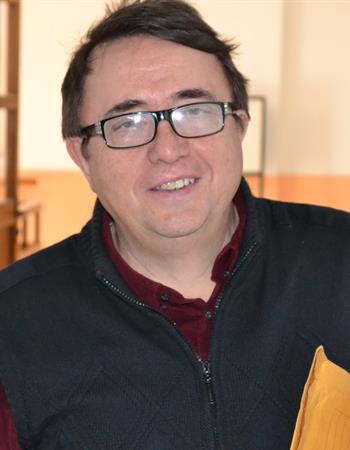
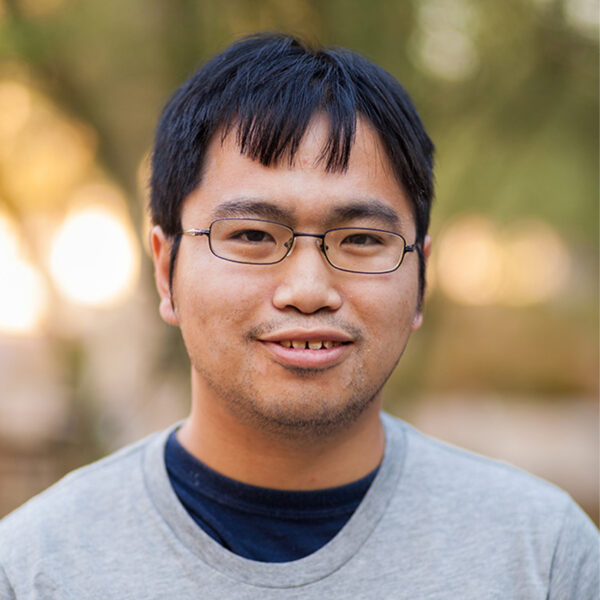
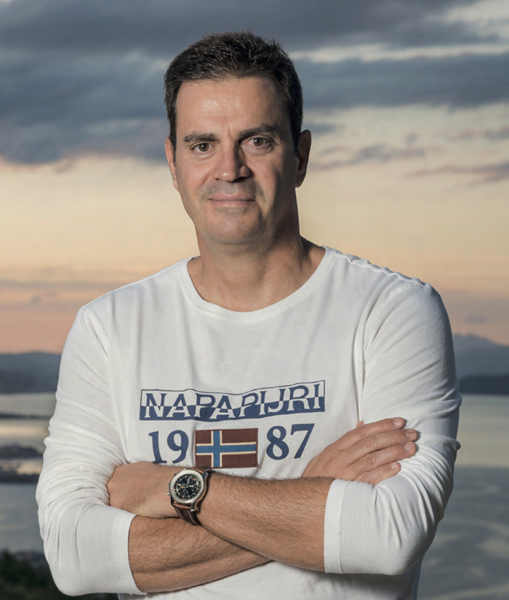
Motagh M. is a Researcher at the Deutsches GeoForschungsZentrum (GFZ) in Potsdam, Germany. With expertise in Remote Sensing and Geodesy , their work focuses on geohazard assessment through satellite-based interferometric techniques. Current research explores land subsidence in Afghanistan and Iran using Sentinel-1 data Developing hybrid machine learning models for landslide susceptibility assessment Pioneering quantum machine learning applications in deformation detection Investigating mining-induced subsidence in Germany's Hambach region Contributing to multi-sensor InSAR integration for complex geological analysis Publications since 2011 demonstrate sustained contributions to: Earthquake source modeling (e.g., Christchurch 2011, Maule Chile 2010) Volcanic deformation studies in Iceland Environmental geoscience applications across three continents Collaborations span institutions in: New Zealand (University of Canterbury, GNS Science) Iran (University of Tehran, K. N. Toosi University) Germany (GFZ Potsdam, Technical University Munich) USA (University of Miami)
Asaf Shapira is a Professor at the School of Mathematical Sciences, Tel-Aviv University. His research focuses on combinatorics, graph theory, and extremal problems, with notable contributions to Ramsey theory, probabilistic methods, and algorithmic applications. He has authored over 50 publications in top-tier journals and has taught advanced courses such as Extremal Graph Theory and Probabilistic Methods in Combinatorics. His research interests include extremal combinatorics, hypergraph theory, and structural graph theory. Recent work includes advancements in removal lemmas, partition properties, and algorithmic testing of graph properties. Shapira has also contributed to foundational results in property testing and combinatorial optimization. His teaching spans undergraduate and graduate levels, covering topics like combinatorial analysis, algebraic methods, and advanced algorithms. While no explicit awards are listed, his extensive publication record reflects significant scholarly impact.
Prof. Dr. Béla Vizvári is a faculty member at the Industrial Engineering Department of Eastern Mediterranean University (EMU), TRNC. He holds a PhD in Mathematics/Operations Research from the University of Budapest (1979) and a dr.sc.nat. from Technical University of Merseburg/GDR (1987). He has served in prominent academic roles, including visiting professorships at Rutgers University and Bilkent University. His research focuses on optimization theory, integer programming, scheduling, and supply chain management. He has supervised numerous PhD and MSc theses, including recent works on vaccine inventory management, humanitarian logistics, and smart product design. Education: PhD: University of Budapest, Mathematics/Operations Research (1979) MSc: University of Budapest, Mathematics/Operations Research (1973) Research interests span operations research methodologies, with notable contributions to the Frobenius problem and Lagrange multipliers in integer programming. His work integrates theoretical advancements with practical applications in manufacturing, logistics, and healthcare. Over 90 journal papers and book chapters highlight his prolific output. He has received several awards for academic excellence and teaching. Notable grants include projects on stochastic programming, non-convex optimization, and market trend analysis. Administrative roles include directing the Institute of Mathematics I at Eötvös Loránd University and editorial roles in journals like Periodica Mathematica Hungarica and Pure Mathematics and Applications .
Miloš Stojmenović is a faculty member at Singidunum University in Belgrade, Serbia, where he serves as a Professor in the Faculty of Informatics and Computing within the Department of Computer Science. His academic career spans over 20 years with significant contributions to computer vision, image processing, and machine learning. Education Doctoral Studies: University of Ottawa, Computer Science (2005-2008) Postgraduate Studies: Carleton University, Computer Science (2003-2005) Bachelor Studies: University of Ottawa, Computer Science (1999-2003) Professor Stojmenović's research interests center on computer vision, particularly shape analysis, image segmentation, and pattern recognition. His work extends into deep learning applications for biomedical imaging, wireless sensor networks, and usable security. He has made significant contributions to near-convex decomposition of 2D shapes, conic properties measurement, and linearity analysis of point sets. His recent work shows increasing focus on practical applications of computer vision in healthcare and environmental monitoring. Analysis of his 15 most recent publications reveals a strong trend toward interdisciplinary research, particularly in biomedical applications of computer vision. Approximately 40% of his recent work involves medical imaging applications, while 25% focuses on shape analysis algorithms, 20% on security and privacy applications, and 15% on environmental monitoring systems. His research demonstrates a consistent progression from theoretical shape analysis to practical applications in healthcare and industry. Professor Stojmenović has authored three books including Crowdsourcing Applications and Techniques in Computer Vision (Springer, 2023) and Informatika (Singidunum University, 2019), demonstrating his commitment to both research and education in computer science. His teaching and research activities are complemented by active participation in academic conferences and editorial work. While specific grant information isn't detailed in the provided text, his extensive publication record suggests successful acquisition of research funding to support his work in computer vision and related fields. Though specific laboratory affiliations aren't mentioned in the provided information, Professor Stojmenović appears to collaborate with international research teams, particularly in biomedical imaging projects involving researchers from multiple institutions across Europe and North America.
Mohit Tawarmalani is the Executive Associate Dean of Faculty and the Allison and Nancy Schleicher Chair of Management at Purdue University's Mitch Daniels School of Business. He holds a courtesy appointment as a Professor of Chemical Engineering. With a Ph.D. and M.S. from the University of Illinois at Urbana-Champaign and a B.Tech. from the Indian Institute of Technology Delhi, his expertise spans optimization, mathematical programming, and global optimization software (e.g., BARON). His research bridges computer science, operations research, and engineering, focusing on applications in business and energy systems. His awards include the INFORMS Computing Society Prize (2004), Beale-Orchard-Hays Prize (2006), and the 2024 Computing in Chemical Engineering Award. He led Purdue’s team to win the 2023 INFORMS UPS George D. Smith Prize for educational innovation in analytics training. Prof. Tawarmalani directs the Krenicki Center for Business Analytics and Machine Learning, co-founded the Master’s in Business Analytics program, and redesigned the Mitch Daniels School of Business structure. His grants include NSF and Air Force funding for optimization and network research.
Mateusz Majka is an Assistant Professor in Stochastics at the School of Mathematical & Computer Sciences, Heriot-Watt University, Edinburgh. His research focuses on probability theory, stochastic analysis, numerical analysis, optimization, optimal transport, computational statistics, and machine learning. He holds a PhD from the University of Bonn (2017) and has held postdoctoral positions at the University of Warwick and King's College London. Education: PhD in Applied Mathematics, University of Bonn (2017) Research Fellow, University of Warwick (2018–2020) Research Associate, King's College London (2017–2018) Research Interests: Stochastic differential equations Mathematical foundations of machine learning (mean-field optimization, optimal transport, stochastic gradient algorithms) Lévy processes Ergodicity of Markov processes Monte Carlo methods (MCMC, Multi-Level Monte Carlo) Recent Research Trends: His work emphasizes algorithmic development for stochastic systems, including mean-field games, Wasserstein geometry, and convergence analysis of numerical schemes. Notable contributions span Lévy processes, Euler schemes, and coupling techniques for Markov chains. Awards: None explicitly listed. Advising & Grants: Supervises PhD students Linshan Liu (since 2021) and Razvan-Andrei Lascu (since 2022). Active in securing research funding through collaborative projects. Labs/Teams: Engaged in cross-disciplinary collaborations in computational statistics and stochastic analysis at Heriot-Watt University.
Gennaro Notomista is an Assistant Professor at the University of Waterloo, part of the Full-time faculty. His research focuses on robotics, control systems, and multi-agent coordination. Key areas include swarm intelligence, optimization of robotic tasks, and safety-critical control algorithms. He is affiliated with the Robotarium, a remotely accessible multi-robot testbed, and explores applications in autonomous vehicles, environmental monitoring, and creative robotics projects like music-driven swarm painting. His work emphasizes energy-efficient task allocation, decentralized control strategies, and safe navigation frameworks. Notable contributions include advancements in control barrier functions for ensuring safe operation and resilient task execution in dynamic environments. Recent publications address challenges in persistent environmental monitoring, long-duration autonomy, and the design of wire-traversing robots. Notomista’s research also bridges robotics with real-world applications, such as using robot swarms to model epidemiological dynamics and enhance teleoperation systems. His interdisciplinary approach combines optimization theory, machine learning, and mechanical design to tackle complex robotic systems challenges.
Houra Mahmoudzadeh is an Associate Professor at the University of Waterloo, affiliated with groups such as Data Analytics, Applied Operations Research, and Healthcare. Her research focuses on optimization techniques applied to healthcare systems, particularly radiation therapy planning, robust decision-making under uncertainty, and pandemic-era staff scheduling. She specializes in developing advanced algorithms for IMRT treatment planning and addressing challenges in healthcare operations through mathematical modeling. Her work integrates robust optimization frameworks with clinical applications, emphasizing practical solutions for radiation therapy delivery, resource allocation in healthcare, and multi-objective decision-making. Key contributions include methodologies for inverse optimization in medical contexts, Pareto robust optimization strategies, and pandemic-specific staff scheduling models. Recent publications highlight innovations in dose-based constraint generation, light Pareto robust optimization, and effective budget of uncertainty formulations. Her research bridges theoretical operations research with real-world healthcare challenges, aiming to improve treatment efficacy and operational efficiency in medical settings.
Xavier Allamigeon is a researcher at INRIA and CMAP (Centre de Mathématiques Appliquées) at École Polytechnique, where he also serves as a part-time associate professor in the Applied Mathematics Department. His research focuses on optimization, combinatorics, tropical geometry, game theory, and formalization of mathematics in proof assistants, with a particular emphasis on computational aspects of these fields. He earned his Ph.D. in 2009 from École Polytechnique with a thesis on static analysis of memory manipulations and tropical polyhedra. His work bridges theoretical mathematics and practical applications, including contributions to emergency call center modeling and epidemic monitoring during the COVID-19 pandemic. Key awards include the 2022 Prix Inria–Académie des sciences, the 2021 SIAM SIGEST award, and the 2010 Gilles Kahn Prize for Best Dissertation in Computer Science. His research has led to the development of tools like the Tropical Polyhedra Library (TPLib) and formal proofs in proof assistants such as Coq. He has supervised multiple Ph.D. students and contributed to funded projects such as URGE (2023–2026) and CAPPS (2018–2021). His interdisciplinary work spans optimization, formal methods, and applied mathematics, with applications in healthcare systems and computational geometry.
Kristoffer Arnsfelt Hansen is an Associate Professor at the Department of Computer Science, Aarhus University. His research focuses on algorithmic game theory, computational complexity, and equilibrium computation in multi-player games. He explores topics such as stochastic games, Nash equilibria, convex optimization, and fair division. His work bridges theoretical computer science with economic applications, particularly in mechanism design and market analysis. Selected publications include studies on PPAD-membership via convex optimization, complexity of Pareto-optimal lotteries, and the computational challenges in analyzing Nash equilibria. He has contributed to conference proceedings like WINE 2022 and SAGT 2021, showcasing his engagement with international research communities. Research interests emphasize theoretical foundations of game theory with practical implications for resource allocation, fair division, and multi-agent systems. His work often intersects with complexity theory, exploring boundaries of efficient computation in economic and strategic scenarios. No awards or grants are explicitly mentioned in the provided data. Advising activities and lab affiliations are not detailed here.
Ning Bao is an Assistant Professor in the Departments of Physics and Mathematics at Northeastern University's College of Science. His research bridges high energy theory and quantum information science, focusing on topics such as holographic correspondences, quantum entanglement classification, and quantum algorithm development. He explores the interplay between quantum information principles and fundamental physics concepts like black hole thermodynamics and spacetime geometry. His work often involves cutting-edge techniques from machine learning and applied mathematics to address questions in quantum gravity and condensed matter systems. Key research interests include the information-theoretic properties of black holes, entanglement structure in holographic systems, and the application of quantum information tools to machine learning. He contributes to foundational studies in quantum error correction, entanglement wedge reconstruction, and the ER=EPR conjecture. His articles span topics from AdS/CFT correspondence to quantum cellular automata, reflecting his interdisciplinary approach to theoretical physics. Bao’s research is supported by contributions to holographic entropy inequalities, tensor network models, and the exploration of quantum algorithms through frameworks like classical shadows and reinforcement learning. His work has advanced understanding of entanglement in gauge theories, quantum complexity measures, and the interplay between geometry and quantum information in gravitational systems.
Minos Garofalakis is a Professor at the School of Electrical and Computer Engineering , Technical University of Crete, and serves as Director of the Information Management Systems Institute at the Athena Research & Innovation Center in Athens. He has held senior research roles at Bell Labs, Intel Research, Yahoo! Research, and academic positions at UC Berkeley as an Adjunct Associate Professor. Currently, he is a Senior Research Consultant at Huawei Edinburgh Research Center and co-founder of Agora Labs , focusing on medical data privacy. Research Interests His work centers on Big Data Analytics , encompassing private data analytics , machine learning , federated analytics , and blockchain systems . He has pioneered advancements in data stream management , query optimization , and approximation algorithms , with applications in distributed systems and privacy-preserving technologies. Scientific Awards ACM Fellow (2018) IEEE Fellow (2017) Excellence in Research Award, Technical University of Crete (2015) FP7 Marie-Curie International Reintegration Fellowship (2010-2014) Bell Labs President’s Gold Award (2004) Central Bell Labs Teamwork Award (2003) Patents and Citations Garofalakis holds 29 issued US patents (36 filed) with applications in data management and analytics. His research has garnered over 16,000 citations on Google Scholar and an h-index of 69.
Thomas Schlumprecht is a Professor at the Department of Mathematics, Texas A&M University (College of Arts & Sciences), holding a concurrent adjunct position at the Czech Technical University, Prague. He earned his Ph.D. (1988) and Diplom (1982) from Ludwig-Maximilians-Universität, München. His research focuses on Functional Analysis, Banach spaces, Probability Theory, Convex Geometry, and Mathematics in Finance. He has held various roles at Texas A&M since 1992, including Associate Head for Graduate Studies (2001–2005) and Professor since 1999. Schlumprecht’s work includes editorial roles for the Journal of Functional Analysis and Banach Journal of Mathematical Analysis . His teaching contributions span courses like Functional Analysis and Infinite Combinatorics. Recent research emphasizes metric embeddings, operator theory, and geometric functional analysis. Education: Ph.D. in Mathematics, Ludwig-Maximilians-Universität, München (1988) Diplom (M.Sc.), Mathematics, Ludwig-Maximilians-Universität, München (1982) Research Highlights: Advances in Banach space geometry and asymptotic properties Studies on metric embeddings and coarse rigidity Investigations into operator ideals and closed ideals in Banach algebras His recent publications explore topics such as greedy algorithms, transportation cost spaces, and stochastic embeddings, reflecting a deep engagement with both theoretical and applied aspects of functional analysis.
Florent Baudier is an Assistant Professor at Texas A&M University's Department of Mathematics, part of the College of Arts & Sciences. His research focuses on Functional Analysis, Metric Geometry, Banach Space Geometry, and Geometric Group Theory. He is actively involved in workshops such as the Banach and Metric Space Geometry Research Seminar and the STEaLTH Workshops. His work explores embeddings of metric spaces, Ribe Program, Kalton Program, and the geometry of graphs and Banach spaces. Key research interests include the study of metric embeddings, stability of metric spaces, and the interplay between nonlinear geometry and Banach space theory. He has organized conferences and participated in programs such as the Workshop in Analysis and Probability at Texas A&M. His teaching spans courses like Real Variables, Foundations of Mathematics, and Differential Equations. Recent research trends in his articles emphasize metric distortion, coarse geometry, and embeddings into Banach spaces, with contributions to understanding expander graphs, Wasserstein metrics, and operator algebras. His work bridges abstract mathematical structures with applications in theoretical computer science and geometric analysis.
Shokhrukh Ibragimov is a Researcher at the Department of Mathematics and Computer Science, University of Münster. He is affiliated with the Applied Mathematics Münster: Institute for Analysis and Numerical Analysis. His research focuses on machine learning, particularly neural networks and optimization challenges in high-dimensional spaces. Collaborating with prominent figures like Arnulf Jentzen, he investigates topics such as the curse of dimensionality, gradient descent convergence, and the behavior of local minima in neural network training. His work bridges theoretical analysis and computational methods, contributing to advancements in deep learning and numerical analysis. Research interests include the mathematical foundations of neural networks, numerical approximations for high-dimensional problems, and the theoretical underpinnings of optimization algorithms in machine learning. His recent publications address critical gaps in understanding neural network limitations and the effectiveness of gradient-based methods.