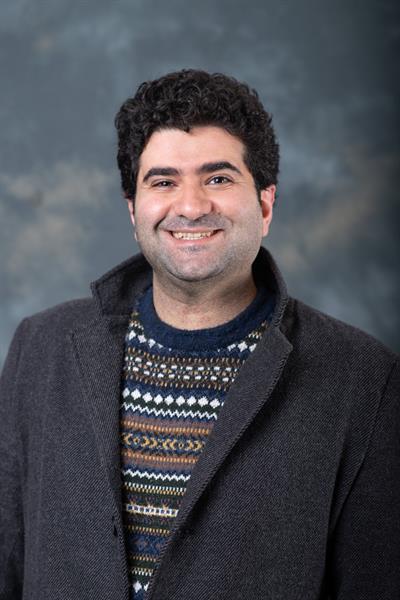
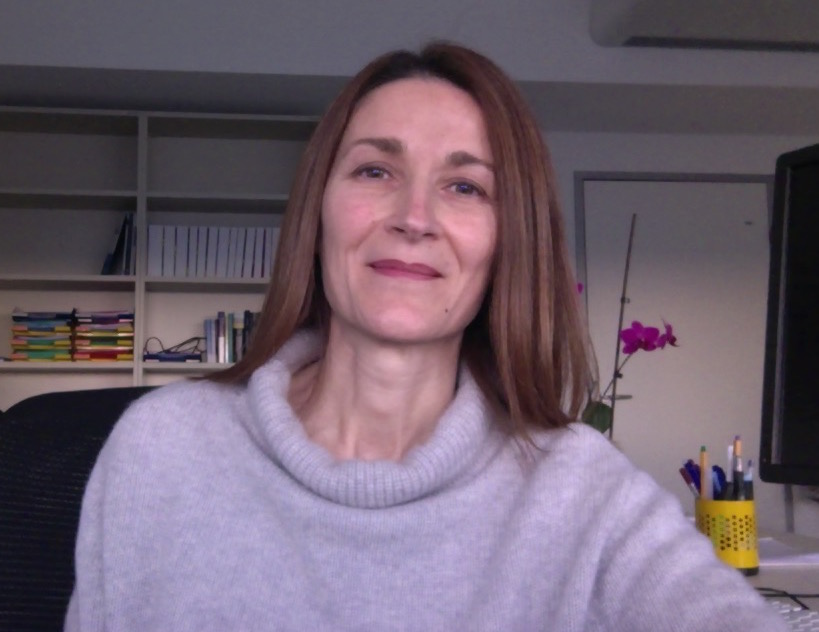
Professor Ulrik Lund Andersen heads the quantum information group at DTU Physics, Technical University of Denmark. His research develops quantum technologies including quantum computation, secure communication, and quantum-enhanced measurement systems. His group generates entangled optical states and investigates diamond-photon interactions for quantum nonlinearities. Key research areas: Quantum computing architectures Continuous-variable quantum information Quantum key distribution Quantum-enhanced sensing Solid-state quantum systems Recent work advances error correction, quantum state engineering, and quantum sensing algorithms. Publications demonstrate consistent focus on practical quantum technology implementation. Awards include multiple Sapere Aude research grants and the Eliteforsk Award from the Danish Ministry of Science.
Angela Capel Cuevas is an Assistant Professor of Quantum Information Theory/Theoretical Quantum Computation at the University of Cambridge's Department of Applied Mathematics and Theoretical Physics (DAMTP). Previously, she held a Junior Professorship at Eberhard Karls Universität Tübingen (2021-2024) and was an MCQST Distinguished PostDoc at TU München (2020-2021). Her research focuses on the intersection of quantum information theory and quantum many-body systems, particularly studying thermalization dynamics via quantum functional inequalities. She is a recipient of the Simons Emmy Noether Fellowship and Forbes 30 Under 30 (Spain 2023). Education: PhD in Mathematics, Universidad Autónoma de Madrid/ICMAT (2015-2019) Master in Computational Engineering and Mathematics, URV/UOC (2016-2018) Bachelor in Mathematics, Universidad de Granada (2009-2014) Research: Angela's work applies analytic and geometric tools to quantum systems, emphasizing decay of correlations in Gibbs states and quantum dissipative evolutions. Key topics include entropy inequalities, modified logarithmic Sobolev inequalities, and thermalization rates in spin chains. Her recent work bridges quantum functional analysis with practical implications for quantum computing and thermalization phenomena. Grants & Roles: PI of CRC TRR 352 'Mathematics of Many-Body Quantum Systems' (7M€) Co-PI of QuantERA project TouQan (1.25M€) Organized workshops at BIRS and Tübingen (2023-2024) Awards: Simons Emmy Noether Fellowship (2023) Forbes 30 Under 30 (2023) Vicent Caselles RSME-FBBVA Award (2022) Labs/Teams: Leads a group studying quantum dissipative systems and thermalization at DAMTP. Collaborates with institutions globally on quantum functional inequalities and Gibbs state properties.
Seth Lloyd is a Professor of Mechanical Engineering at the Massachusetts Institute of Technology (MIT), where he directs the Center for Extreme Quantum Information Theory (xQIT). His work bridges theoretical physics, quantum information science, and complex systems theory. He has made significant contributions to the foundations of quantum computing and quantum information processing. Lloyd received his education from prestigious institutions: B.A. from Harvard College (1982) M.Phil from Cambridge University (1984) as a Marshall Scholar Ph.D. in Physics from Rockefeller University (1988) Lloyd's research focuses on quantum information science, particularly quantum computation and quantum communications. He has pioneered work in quantum analog computation, quantum error correction, and quantum metrology. His research explores how quantum mechanics can be harnessed for information processing tasks, with applications ranging from quantum computing to understanding biological processes like photosynthesis. Lloyd is also known for his work on complex systems and the relationship between information and physical systems, arguing that the universe itself can be viewed as a quantum computer. His publication record shows a clear progression from foundational quantum computing work to applications in quantum machine learning and quantum biology. The most recent articles reveal a strong focus on quantum algorithms for machine learning, quantum metrology, and the intersection of quantum mechanics with biological systems. His work on the HHL algorithm for solving linear systems has been particularly influential in quantum machine learning, though its practical advantages have been debated following Ewin Tang's classical algorithms. Lloyd has received numerous scientific honors: Lindbergh Fellow (1994) Finmeccanica Professorship (1996) Edgerton Prize (2001) Fellow of the American Physical Society (2007) Quantum Communication Award (2012) International Quantum Communication Award (2012) Throughout his career, Lloyd has mentored numerous students and researchers in quantum information science. He has secured significant research funding for his work in quantum computing and complex systems. His research has been supported by various foundations and government agencies interested in advancing quantum technologies. Lloyd has also been involved in interdisciplinary collaborations, particularly with biologists studying quantum effects in photosynthesis. Lloyd directs the Center for Extreme Quantum Information Theory (xQIT) at MIT, which brings together researchers from physics, computer science, and engineering to tackle fundamental challenges in quantum information processing. His lab has been at the forefront of developing theoretical frameworks for quantum computing and exploring practical implementations of quantum information protocols.
Meng Cheng is an Assistant Professor of Physics at Yale University, specializing in condensed matter theory. He holds a B.S. from Nanjing University (2008) and a Ph.D. in Condensed Matter Theory from the University of Maryland (2013). After a postdoctoral position at Microsoft Research Station Q (2013–2016), he joined Yale in 2017. His research focuses on quantum criticality, fractonic phases, and symmetric topological phases, with a particular emphasis on classification and characterization of exotic quantum matter. He has received prestigious awards including the NSF CAREER Award (2019) and the Alfred P. Sloan Fellowship (2019). Key research interests include topological superconductivity, global symmetry interactions, and applications in quantum information. His work bridges theoretical frameworks with experimental implications, exploring topics like Wilson loop operators, disorder operators, and entanglement entropy in gapless systems. He has contributed to advancements in understanding symmetry-enriched topological phases and their surface topological order. Publications span high-impact journals and cover topics such as fractionalization in electronic insulators, quantum Hall effects, and topological stabilizer models. His talks highlight interdisciplinary approaches, including seminars at the Perimeter Institute and Université de Montréal on fractonic topological phases and infinite-component Chern-Simons theories. Awards and grants underscore his contributions to advancing theoretical physics, with a focus on fostering innovation in quantum materials and computational methods. Teaching and mentorship activities further his commitment to education within the Yale Physics Department.
Assoc Prof Ying Chen is an Associate Professor at the National University of Singapore , affiliated with the Department of Mathematics, Asian Institute of Digital Finance (as Academic Director of PhD Program in Digital FinTech 2022–2024), Risk Management Institute (2019–2023), Department of Statistics and Data Science (2019–2023), and Department of Economics (2018–2023). She also contributes to NUS Graduate School for Integrative Sciences and Engineering since 2016. Research Interests include: AI forecasting and quantum computing for finance Nonstationary time series and functional data analysis Energy data analytics and precision medicine Network autoregression and spatial-temporal modeling Explainable AI and citation metrics Portfolio liquidation and market-making algorithms Article Trends demonstrate expertise in: Adaptive forecasting for gas flows and electricity prices Blockchain network influence detection Quantum computing applications in finance Functional autoregression with mixed predictors Credit rating fairness and explainability High-resolution implied volatility modeling Scientific Awards include: ISI Elected Member (2016–) International Statistical Institute Council (2023–2027) IASC Scientific Secretary (2017–2019, 2023–2025) Advisory roles for EU FIN-TECH and xAIM projects
Prof. Norbert Lütkenhaus is a Professor and Executive Director of the Institute for Quantum Computing (IQC) at the University of Waterloo, cross-appointed to the Department of Applied Mathematics. He holds affiliations with Perimeter Institute and the Centre for Applied Cryptographic Research. His research focuses on quantum communication theory, particularly quantum key distribution (QKD) and quantum repeaters. He has pioneered methods to bridge abstract quantum protocols with practical optical implementations, emphasizing secure key rate calculations and overcoming quantum channel limitations. Education: PhD (2003) in Physics from University Erlangen-Nürnberg, MSc (1993) and BSc (1990) from Ludwig-Maximilians-Universität München and RWTH Aachen, respectively. Awards include the 2015 American Physical Society Outstanding Referee Award and a 2009 University of Waterloo Excellence Award. Research interests span QKD protocols (e.g., decoy-state BB84, phase-error mitigation), quantum repeater architectures, and entanglement verification. He develops numerical tools for key rate analysis and addresses implementation security loopholes. His work includes theoretical frameworks for long-distance quantum communication and practical QKD system optimizations. Teaching includes courses on quantum information processing (PHYS 768/QIC 890) and mechanics (PHYS 115). He contributes to international standards via ETSI’s QKD-ISG and the QCrypt steering committee. His patents cover QKD system designs and phase-randomization techniques.
Rui Soares Barbosa is a Staff Researcher at the Quantum and Linear-Optical Computation group at the International Iberian Nanotechnology Laboratory (INL). He holds a BSc in Computer Science from Universidade do Minho (2009), an MSc in Mathematics and Foundations of Computer Science from the University of Oxford (2010), and a DPhil in Computer Science from Oxford (2015) with a thesis on Contextuality in quantum mechanics and beyond. Prior to joining INL, he held post-doctoral positions at Oxford (2015–2019) and the University of Edinburgh (2019–2020), and a Research Fellowship at the Simons Institute for the Theory of Computing, UC Berkeley (2017). Barbosa's research lies at the intersection of Computer Science, Physics, and Mathematics, focusing on quantum foundations, quantum computer science, and the mathematics of quantum theory. His work emphasizes logical, structural, and compositional aspects, particularly investigating non-locality and contextuality - phenomena that distinguish quantum theory from classical physics and have been linked to quantum informatic advantage. He employs mathematical tools from category theory, logic, probability, algebraic topology, and operator algebras to achieve a structural understanding of quantum systems' non-classical features. His recent publications demonstrate a strong focus on contextuality as a quantum resource, exploring its connections to causality, computational advantage, and logical structures. The research spans theoretical foundations to practical quantum computing applications, with particular attention to mathematical frameworks like sheaf theory that elegantly express quantum contextuality. His work often involves collaborations with leading researchers in quantum foundations and theoretical computer science. Barbosa actively advises multiple PhD and MSc students including Angelos Bampounis, Rafael Wagner, Nico Witrock, and others. His research group at INL, the Quantum and Linear-Optical Computation group, conducts cutting-edge research at the intersection of quantum theory and computer science, regularly presenting findings at major conferences like the International Conference on Quantum Physics and Logic (QPL).
Seth Lloyd is a Professor in the Department of Mechanical Engineering at the Massachusetts Institute of Technology (MIT), with adjunct appointments at the Santa Fe Institute since 1988 and as a Fellow at the Institute for Scientific Interchange since 2000. His research spans quantum information science, quantum control theory, and complex systems analysis. His educational background includes: B.A. from Harvard University (1982) M. from the University of Cambridge (1984) Ph.D. from Rockefeller University (1988) Lloyd's work focuses on quantum computation, quantum communications, and quantum limits to control and sensing. He has pioneered research in quantum algorithms, quantum metrology, and applications of quantum information to complex biological and physical systems. His research bridges theoretical physics, computer science, and engineering, with over 200 publications and two patents in quantum information processing. Analysis of his recent publications reveals dominant trends in quantum machine learning, quantum metrology, and quantum communication protocols, with increasing interdisciplinary applications in quantum biology and quantum gravity. His work consistently explores fundamental limits of quantum information processing. His scientific awards include: Lindbergh Fellow (1994) Finmeccanica Professorship (1996) Edgerton Prize (2001) Fellow of the American Physical Society (2007) Quantum Communication, Measurement, and Computation Prize (2012) Lloyd serves on the editorial board of Quantum Information Processing and holds significant MIT service roles including Course 2 Undergraduate Committee coordinator and membership on the Institute Foreign Scholarships Committee. He teaches advanced courses in quantum information, dynamics, and computational methods, shaping the next generation of quantum scientists and engineers. As a member of the American Physical Society, he maintains active research collaborations across quantum information science, with ongoing work in quantum algorithms and quantum-enhanced sensing technologies.
Olivier Pfister is a Professor in the Department of Physics at the University of Virginia , with courtesy appointments in Electrical and Computer Engineering (2022–). His research focuses on experimental quantum optics and quantum information , particularly leveraging optical frequency combs to develop scalable quantum computing platforms. The Quantum Fields and Quantum Information (QFQI) group , which he leads, has pioneered techniques for generating multipartite entanglement in continuous-variable systems, achieving cluster-state entanglement in 60+ qumodes (with potential scaling to thousands). Collaborations span institutions like NIST, University of Sydney, CUNY, and Jefferson Laboratory, with applications in quantum simulation , non-Gaussian state characterization , and hybrid quantum technologies . Key contributions include the 2013 APS Fellowship for groundbreaking work on quantum frequency combs, NSF Distinguished Research Awards , and patents in quantum photonic devices. His group’s NSF-funded research (e.g., QLCI Preliminary Proposal, $3.2M; RAISE-EquIP, $750K) explores fault-tolerant quantum computing, machine learning integration, and microresonator-based entanglement. Pfister’s scientific awards include the 2013 UVA Distinguished Research Career Award and the 1996 JILA Clever Idea Contest Second Prize . His students and postdocs (e.g., Amr Hossameldin , Miller Eaton , Rajveer Nehra ) have published extensively on quantum tomography, cluster states, and photonic detector design. Pfister also serves on advisory and planning committees at UVA, emphasizing interdisciplinary collaboration across physics , engineering , and quantum information .
Professor Terry Rudolph is a Professor of Quantum Physics at the Department of Physics within the Faculty of Natural Sciences at Imperial College London. His affiliations include the Quantum Engineering, Science and Technology group, Quantum Optics and Laser Science Group, and The Light Community. His research focuses on quantum-anything, encompassing optical physics, quantum computing, photonics, and related interdisciplinary fields such as nanotechnology and communications technologies. Rudolph’s work emphasizes photonic quantum computing architectures, entanglement generation, and fault-tolerant quantum systems. His recent publications highlight advancements in cluster state generation, photonic multiplexing, and reconfigurable entangling systems. He has contributed to scalable quantum hardware design, including silicon photonic platforms and error-correction protocols. His academic contributions span theoretical and experimental quantum mechanics, with a focus on bridging quantum theory and practical implementation. Notable themes in his research include deterministic teleportation, photonic integrated circuits, and fusion-based quantum computing. He has also engaged in educational initiatives to introduce quantum information science to high-school students. Affiliations: Quantum Optics and Laser Science Group, Quantum Engineering Centre, and The Light Community at Imperial College London.
Pavel Etingof is Professor of Mathematics at the Massachusetts Institute of Technology (MIT), Department of Mathematics, where he has been a distinguished faculty member for many years. He serves as the Chief Research Adviser of MIT-PRIMES, an all-year high school math research program that provides exceptional research opportunities for talented high school students. Additionally, he holds the prestigious position of Editor-in-Chief of Selecta Mathematica. Professor Etingof's research spans multiple advanced areas of pure mathematics with a particular focus on representation theory, tensor categories, Lie algebras, Hecke algebras, and algebraic structures. His work consistently bridges algebra, geometry, and mathematical physics, revealing deep connections between abstract algebraic structures and physical phenomena. His research has evolved to increasingly explore tensor categories in positive characteristic, connections between representation theory and fractal structures, and applications to quantum field theory. His recent publications (2021-2025) demonstrate continued productivity and innovation, with numerous papers on tensor categories in various characteristics, representation theory of Lie groups, and connections to mathematical physics. These works show sophisticated exploration of representation theory in prime characteristic, novel applications to quantum field theory, and deep investigations into the structure of tensor categories. Editor-in-Chief of Selecta Mathematica Chief Research Adviser of MIT-PRIMES Professor Etingof has mentored numerous Ph.D. students at MIT and other institutions, establishing a significant mathematical genealogy in representation theory. His teaching includes advanced courses on algebraic groups, Lie theory, representation theory, and specialized topics. He has also co-organized many student seminars on cutting-edge mathematical topics including Deligne categories, symplectic reflection algebras, quantum cohomology, and double affine Hecke algebras, fostering collaborative research environments for students and colleagues.
Lauren K. Williams is the Dwight Parker Robinson Professor of Mathematics at Harvard University and the Sally Starling Seaver Professor at the Radcliffe Institute. Her research focuses on algebraic combinatorics, cluster algebras, and mathematical physics, with notable contributions to the study of the positive Grassmannian, amplituhedron geometry, and integrable systems. She holds affiliations with Harvard’s Department of Mathematics and the Radcliffe Institute for Advanced Study. Her work bridges combinatorics, algebraic geometry, and physics, particularly in understanding geometric structures like the amplituhedron, which encode scattering amplitudes in quantum field theory. Key areas include cluster algebras, Schubert varieties, and applications of combinatorial methods to stochastic processes such as the asymmetric exclusion process (ASEP). Recent activities include organizing conferences on combinatorics, mathematical physics, and the legacy of mathematicians like Richard P. Stanley. Her research often explores connections between discrete structures and continuous systems, with a focus on positivity and geometric positivity principles. Awards and grants are not explicitly listed in the provided texts, but her contributions have been recognized through invitations to major international conferences and leadership in the field. She actively mentors students and postdocs in combinatorics and algebraic geometry.
Saeed Mehraban is an Assistant Professor of Computer Science at Tufts University's School of Engineering and an Assistant Professor in the Department of Physics & Astronomy within the School of Arts and Sciences. He joined Tufts University in June 2022 as an Assistant Professor after serving as a Visiting Assistant Professor from June 2021 to May 2022. Prior to his position at Tufts, he was an IQIM Postdoctoral Scholar at the California Institute of Technology and a research fellow at the Simons Institute for the Theory of Computing during spring 2020. Doctor of Philosophy in Electrical Engineering and Computer Science from MIT (2019) Master of Science from MIT (2015) B.Sc. in Physics from Sharif University of Technology, Iran (2013) B.Sc. in Electrical Engineering from Sharif University of Technology, Iran (2013) Saeed Mehraban's research focuses on quantum computation and information, exploring the profound connections between computer science and physics. His work particularly addresses quantum computational complexity and continuous variable systems. A significant portion of his recent research concerns delineating the boundary between classical and quantum computing in noisy intermediate-scale quantum devices. His research bridges theoretical computer science with quantum physics, examining fundamental questions about what quantum computers can and cannot efficiently solve, with particular emphasis on mathematical foundations and computational complexity aspects of quantum information processing. Mehraban's publication record demonstrates a strong focus on quantum computing theory, with particular emphasis on quantum complexity, quantum algorithms, and the mathematical foundations of quantum information. His recent work (2021-2023) has explored topics like unitary t-designs, holomorphic representations of quantum computations, and quantum-inspired identities. Earlier publications (2015-2020) examined computational complexity in quantum theories, approximation algorithms for matrix problems, and connections between classical algorithms and quantum many-body systems. His research consistently sits at the intersection of theoretical computer science and quantum physics, addressing fundamental questions about computational advantages of quantum systems. Gold Medalist, National Physics Olympiad (2007) Bronze Medalist, National Astronomy Olympiad (2005) Identified as Exceptional Talent by the Iranian Educational System (2004) Mehraban teaches dissertation research courses at Tufts University, indicating his involvement in mentoring graduate students. His teaching activities include specialized courses in quantum information science, quantum computer science, and quantum complexity theory. His professional activities show invitations to speak at prestigious institutions including Microsoft Research Station Q, Mila Institute in Quebec, and the Simons Institute, suggesting recognition of his research contributions. His postdoctoral work at Caltech's Institute for Quantum Information and Matter (IQIM) demonstrates his connection to leading quantum research groups. While specific lab affiliations at Tufts aren't explicitly detailed in the provided information, Mehraban's teaching of specialized quantum courses and his research profile suggest he likely contributes to quantum computing research initiatives at Tufts University. His background at Caltech's IQIM and involvement with the Simons Institute's Quantum Wave in Computing Program indicate strong connections to the broader quantum information science community.
Ilaria Perugia is a University Professor (Univ.-Prof.) and Chair of Numerics of PDEs at the Department of Mathematics, Faculty of Mathematics, University of Vienna. She also serves as Deputy Head of the Research Platform Erwin Schrödinger International Institute for Mathematics and Physics. Her research focuses on numerical methods for partial differential equations with applications in computational physics and engineering. Professor Perugia's primary research interests include: Numerical methods for PDEs Finite element methods Discontinuous Galerkin methods Trefftz methods Virtual element methods Space-time methods Computational electromagnetics Wave propagation problems Nonlinear reaction-diffusion problems Her work spans theoretical analysis, algorithm development, and practical implementation of numerical methods for solving complex physical phenomena. Her recent publications demonstrate a strong focus on space-time methods, virtual element methods, and structure-preserving discretizations for wave equations, heat equations, and other PDEs. She has made significant contributions to the development of stable and efficient numerical schemes that preserve important physical properties of the underlying continuous problems, particularly in the context of wave propagation and computational electromagnetics. Professor Perugia leads a research group comprising several researchers and students including Mattia Corti, Matteo Ferrari, Monica Nonino, Andrea Scaglioni, Paul Stocker, Enrico Zampa, and Marco Zank. Her group actively collaborates on projects related to numerical analysis and scientific computing, with particular emphasis on developing novel discretization techniques for challenging PDE problems.
Prof. Zheshen Zhang is a Professor in the Department of Electrical and Computer Engineering at the University of Michigan College of Engineering . He leads the Quantum Engineering Lab , focusing on harnessing quantum mechanical resources like entanglement to advance sensing, communication, and computing systems. Academic Rank: Professor Institution: University of Michigan School: College of Engineering Department: Electrical and Computer Engineering Research Interests: His work spans quantum engineering, emphasizing: Quantum computing architectures using continuous-variable cluster states Quantum communication via entanglement-assisted protocols Quantum sensing for precision metrology and dark matter detection Hybrid photonic circuits with Scandium Aluminum Nitride and Silicon Nitride Application of machine learning to quantum information processing Publications Trends: Recent articles highlight: Advances in integrated photonics for scalable quantum devices Development of entanglement-enhanced sensors for covert and precision applications Exploration of exceptional points in optical cavities for metrology Quantum network prototypes enabling open-access quantum computing Machine learning integration with quantum data acquisition