Manuel Del Pino is Professor at the University of Bath's Department of Mathematical Sciences and Royal Society Professor specializing in nonlinear partial differential equations. His research focuses on singularity formation, geometric evolution equations, and asymptotic analysis in fluid dynamics and mathematical physics. His investigations encompass blow-up phenomena in heat equations, vortex dynamics in Euler flows, and minimal surface theory. Current projects examine infinite-time singularity formation in parabolic equations and asymptotic properties of vortex configurations. Del Pino has received the Royal Society Professorship and leads multiple grants including 'Asymptotic patterns in nonlinear evolution problems' (EPSRC). He maintains collaborations with researchers globally through projects on singularity formation in PDEs.
Dr. Konstantin (Kostia) M. Zuev serves as Teaching Professor in the Computing + Mathematical Sciences Department at California Institute of Technology , where he has made significant contributions to network science and computational statistics since 2016. His dual PhDs in Mathematics (Moscow State University, 2008) and Civil Engineering (HKUST, 2009) underpin his interdisciplinary research spanning differential geometry, stochastic simulation, and network dynamics. Education PhD in Mathematics, Lomonosov Moscow State University (2008) PhD in Civil Engineering, Hong Kong University of Science & Technology (2009) His research focuses on network science , particularly course-prerequisite networks and complex financial systems , with recent work extending to network navigability in cosmological models and rare event simulation. Over his career, he has developed innovative Bayesian inference methods and geometric preferential attachment theories while maintaining active collaborations across mathematics, physics, and biomedical domains. Recent publications highlight network analysis in education ( 2023 ), hyperbolic graph theory ( 2024 ), and pandemic-informed cancer mortality studies ( 2023 ). His 15 most recent articles demonstrate methodological innovations across disciplines including statistics, physics, finance, and cosmology. Scientific recognition includes Humboldt Research Fellowship (2021) Carver Mead Seed Fund Grant (2023) ASCIT Teaching Award (2018, 2023) Northrop Grumman Teaching Excellence Prize (2019) As Graduate Option Representative for Information and Data Sciences at Caltech and faculty advisor for multiple student organizations including the Caltech Karate Club and Caltech Chess Club , he actively bridges academic rigor with community engagement through outreach initiatives like the virtual math education channel and university math circles for K-12 students.
Professor Keshav Dasgupta holds the position of Professor in Physics at McGill University since March 2021. His academic journey includes a MSc from the Indian Institute of Technology, Delhi and a PhD from the Tata Institute of Fundamental Research, Mumbai. Postdoctoral research followed at the Institute for Advanced Study (Princeton, USA) and Stanford University (USA). He transitioned to faculty roles at McGill starting as an Assistant Professor (2005-2010), then Associate Professor (2010-2021), and currently as a full Professor. His research interests span Superstring Theory (focusing on flux compactifications and gauge/gravity dualities), String Cosmology (exploring de Sitter spaces and primordial phenomena), Quantum Field Theories (confinement dynamics in thermal QCD), and Mathematics (non-Kähler manifolds and Lie group applications in string theory). He also investigates Knot Theories within M-theory frameworks. Recent work emphasizes de Sitter vacua in string theory, leveraging Glauber-Sudarshan states and confronting swampland conjectures. His publications address topics like holographic QCD, quantum gravity equations, and non-perturbative string solutions. He teaches advanced courses such as PHYS 562: Electromagnetic Theory (Winter 2023).
Prof. Igors Gorbovickis is an Associate Professor of Mathematics at the Department of Mathematics, School of Computer Science and Engineering, Constructor University (formerly Jacobs University Bremen). His research focuses on complex dynamical systems, including topics such as renormalization theory, bifurcation analysis, Julia sets, and applications to mathematical physics. He also contributes to discrete geometry, particularly exploring conjectures like the Kneser-Poulsen problem. His work bridges pure mathematics with interdisciplinary applications, emphasizing rigorous analysis of nonlinear systems and geometric configurations. Key areas of investigation include critical point accumulations, Hausdorff dimension estimates, and equidistribution phenomena in parameter spaces. Recent publications highlight advancements in understanding chaotic systems, circle maps, and the interplay between algebraic structures and dynamical behavior. Prof. Gorbovickis collaborates internationally, with co-authored papers appearing in journals like Advances in Mathematics , Ergodic Theory and Dynamical Systems , and Nonlinearity . His office is located at Research I, Room 128 on the Constructor University campus in Bremen, Germany.
Associate Professor Oliver Diessel is a faculty member at the University of New South Wales (UNSW) within the School of Computer Science and Engineering. He has been actively teaching and conducting research at UNSW since at least 2000, with teaching experience spanning various computer architecture and digital systems courses. Dr. Diessel completed his education at the University of Newcastle, Australia, earning a B.E. (Computer, Hons) and B.Math. in 1991, followed by a PhD in 1998. His academic career has focused on reconfigurable computing systems and computer architecture. His primary research interests center around the design, test, and implementation of digital systems in reconfigurable logic devices called Field-Programmable Gate Arrays (FPGAs). Specifically, he focuses on dynamically reconfigurable digital systems where circuits can be modified while the system is operational. His work aims to develop architectures, design methods, and tools that enhance the benefits and reduce the costs of reconfigurable systems. Current research projects include fault-tolerant FPGA-based systems for space applications and fine-grained accelerators for heterogeneous devices. Dr. Diessel has published extensively with 2 books, 1 book chapter, 16 journal articles, 67 conference papers, 1 edited conference proceedings, and 7 conference presentations to his credit. His publications reflect a strong emphasis on reconfigurable technology, computer architecture, and electronic design automation. As a supervisor, Dr. Diessel currently mentors two MPhil students: Tong Wu working on Runtime reconfiguration and Junning Fan working on Fault-tolerance of FPGA-based applications. He has previously supervised six students to completion. His supervision interests include reconfigurable technology and systems, electronic design automation, and computer architecture. Dr. Diessel is an active member of the professional community, serving on the Editorial Board of ACM Transactions on Reconfigurable Technology and Systems and as an IEEE Member. He has taught numerous courses including Configurable Systems (COMP4601), Computer Architecture (COMP3211, COMP4211), Digital Systems (COMP3222), and FPGA Implementation of Digital Systems using Verilog.
David Verbuč is an Assistant Professor at the Faculty of Humanities, Charles University in Prague, Czech Republic, since 2014. His research and teaching focus on socio-cultural anthropology, ethnomusicology, and popular music studies, particularly examining DIY (do-it-yourself) music scenes, Roma music in North Slovenia, and the intersections of music, community, and space. He earned his Ph.D. (2014) and MA (2010) in Ethnomusicology from the University of California, Davis, and a BA (2007) in Ethnomusicology from the Academy of Music, Ljubljana. Employment: 2014–present: Assistant Professor, Department of Social and Cultural Anthropology, Faculty of Humanities, Charles University 2024–2025: Part-time Guest Researcher, Department of Musicology, Faculty of Arts, University of Ljubljana Research Areas: Slovenian village and urban music DIY venues and scenes Electronic dance music cultures Roma music in North Slovenia Music and community dynamics His book DIY House Shows and Music Venues in the US (Routledge, 2021) explores the anthropology of DIY music spaces. His recent work investigates the social life of DIY zines, economic configurations in DIY scenes, and methodological challenges in Roma music research. Publications appear in journals like American Music , Ethnomusicology Forum , and Journal of Contemporary Ethnography . He has received the Marnie Dilling Memorial Prize (2014) and the Bilinski Fellowship (2012–2013). Current projects include a study of Roma music in Slovenia funded by the Slovenian Research and Innovation Agency (ARIS).
Xavier Brusset is a Professor in Supply Chain at SKEMA Business School since 2016, where he also serves as Director of the PRISM Research Center since 2017. Previously, he held professorial positions at Toulouse Business School (2015-2016) and ESSCA School of Management (2009-2015), where he was responsible for the Master 2 in Purchasing and Supply Chain Management program. His academic journey includes a PhD in Management Sciences from Université Catholique de Louvain (2010) and a Habilitation à Diriger des Recherches from Université Paris Ouest Nanterre La Défense (2016). His research spans multiple critical areas in supply chain management, with particular focus on supply chain resilience, blockchain applications, weather risk management, and pandemic impacts on supply chains. Brusset has developed innovative approaches to understanding how supply chain partners interact, how information affects their behavior, and how external disruptions like weather anomalies and pandemics impact operational efficiency. His work bridges theoretical models with practical applications, often developing decision-support tools for managers facing complex supply chain challenges. Brusset's publication record shows a clear evolution of research interests, beginning with foundational work on supply chain contracts and information sharing, then expanding to weather risk management, and most recently focusing on pandemic disruptions and blockchain applications. His 15 most recent publications (2018-2025) demonstrate increasing sophistication in modeling complex supply chain phenomena, with particular emphasis on network effects, ripple effects, and multi-echelon optimization under disruption scenarios. Editorial board member of Logistics Research Editor of International Journal of Retail and Distribution Management (2022-2023) Recognized EU expert for CINEA research projects evaluation Organizer of the Colloquium on European Research in Retailing (CERR) Reviewer for multiple top journals including International Journal of Production Economics As an advisor, Brusset has supervised doctoral students including R. Alkhudary (co-director, Université Paris 2 Panthéon-Assas) and V. Capocasale (rapporteur). His professional experience extends beyond academia to include industry roles in financial markets and logistics technology, having co-founded WebLogistix, a platform for sharing logistics information in Argentina. His research has practical applications across multiple sectors, particularly in retail, food supply chains, and manufacturing, where he develops tools to help managers mitigate risks and optimize operations under uncertainty.
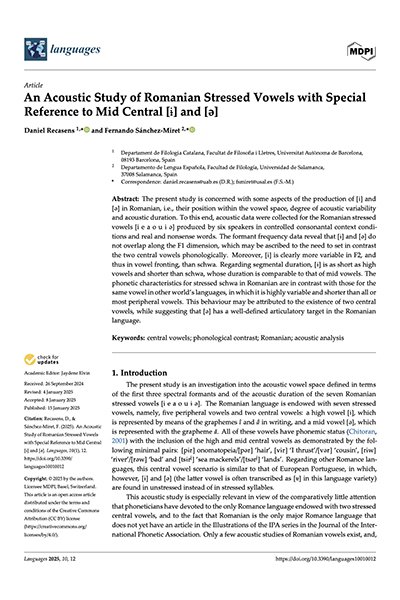
Daniel Recasens is a Full Professor in the Department of Catalan Philology at the Faculty of Arts, Autonomous University of Barcelona, where he has been a permanent faculty member since 1985. He is also affiliated with the Institute for Catalan Studies as a researcher. His academic work centers on experimental phonetics and phonology, with a focus on Romance languages, particularly Catalan. Research Interests: Daniel Recasens specializes in Experimental Phonetics , Phonology , Sound Change , and Phonetic and Phonological Universals . His research investigates articulatory and acoustic aspects of speech production, including coarticulation, assimilation, blending, and the phonetic motivations behind diachronic sound changes in Romance languages. He employs advanced techniques such as ultrasound imaging, electropalatography (EPG), and acoustic analysis to study consonant clusters, vowel-consonant interactions, and the evolution of phonological systems. Scientific Publications and Trends: His recent publications (2020–2025) reflect a consistent focus on the articulatory and acoustic foundations of phonological processes. Key themes include dynamic blending in fricative sequences, tongue configuration in stop-liquid clusters, and the phonetic causes of palatalization and vowel changes. His work combines empirical data with theoretical models such as the Degree of Articulatory Constraint (DAC) model, contributing significantly to laboratory phonology and historical linguistics. Scientific Awards: Member, Academy of Europe (Academia Europaea), 2018 Advising and Research Grants: Daniel Recasens has mentored several doctoral and postdoctoral researchers, including Clara Isabel Rodriguez Casado, Aina Espinosa, and Fernando Sánchez-Miret. While specific grant details are not listed, his extensive publication record and leadership in experimental phonetics suggest sustained research funding and collaborative projects in phonetic and phonological research. Labs and Research Teams: He is associated with the Center for Theoretical Linguistics (CLT) at the Autonomous University of Barcelona, a research group dedicated to theoretical and experimental studies of language. His work often involves collaboration with phonetics laboratories and international scholars in the fields of articulatory phonetics and historical linguistics.
Andrew Rice is a Professor of Computer Science at the University of Cambridge's Department of Computer Science and Technology, and holds the Hassabis Fellowship in Computer Science. He is also the Director of Studies in Computer Science at Queens' College. His research focuses on programming languages, software engineering, and machine learning applications in software development. He leads projects like Isaac Computer Science and ALTA (Automated Language Teaching and Assessment), advancing adaptive learning technologies. His work includes static analysis tools such as Error Prone at Google, energy efficiency studies in computing infrastructure, and contributions to the Computing for the Future of the Planet initiative. His teaching emphasizes practical skill development through flipped classrooms and video lectures, earning him the 2014 Pilkington Prize for teaching excellence. He has held visiting roles at Google and collaborated on energy consumption research for mobile devices and data centers. His research spans systems, networking, and natural language processing, with a strong focus on applying computational methods to real-world challenges. Key Projects: Isaac Physics/Computer Science, ALTA, Error Prone Static Analysis Research Themes: Programming Languages, Machine Learning, Energy Efficiency Awards: Pilkington Prize (2014)
Professor Athanassios Manikas holds the Chair of Communications & Array Processing in the Department of Electrical & Electronic Engineering at Imperial College London, part of the Faculty of Engineering. He is a Fellow of both the IET and IMA, and has held significant editorial roles including Associate Editor for IEEE Transactions on Aerospace and Electronic Systems. His research focuses on wireless communications, radar systems, antenna array processing, and applied mathematics, with over 50 supervised PhD students and 150+ Masters projects. He leads Imperial's research group in array processing and has extensive industry collaborations, including technical leadership of the University Defence Technology Centre in Signal Processing (2008-2013). Awards include the IEEE PIMRC 2022 Best Paper Award and recognition as an IEEE COMSOC Distinguished Lecturer (2016-2017). His work integrates differential geometry principles with array processing, as detailed in his monograph Differential Geometry in Array Processing . Professor Manikas has served as an expert witness in high-profile cases and contributes to academic governance roles such as the Royal Society's International Fellowship Committee. His research group is affiliated with the Space Lab at Imperial, focusing on innovative applications of array signal processing in aerospace and defense systems.
Carme Torras Genís is a Research Professor at the Spanish National Research Council (CSIC), affiliated with the Institute of Robotics and Industrial Informatics (IRI) in Barcelona and the Technical University of Catalonia (UPC). Her career spans over three decades, focusing on robotics, neurocomputing, and artificial intelligence with applications in healthcare and deformable object manipulation. M.Sc. in Mathematics (University of Barcelona, 1978) M.Sc. in Computer Science (University of Massachusetts, 11981) Ph.D. in Computer Science (UPC, 1984) Research Interests : Robotic manipulation of deformable objects (especially textiles) Neurocomputing and machine learning for robotic control Human-robot interaction and assistive robotics Computational topology for cloth state representation Ethics in social robotics and AI Medical applications of robotics for neuromuscular disease assessment Scientific Leadership : ERC Advanced Grant recipient (2016) IEEE and EurAI Fellow Coordinator of Horizon Europe project SoftEnable and former ERC project CLOTHILDE Editorial leadership in IEEE Transactions on Robotics and multiple journals Active in ethics committees and AI policy advisory boards Advisory Committee of Ethics in AI (Catalan Government) Vice-President of CSIC Ethics Committee Member of Royal Academy of Engineering (Spain)
David Eppstein is a Distinguished Professor of Computer Science at the University of California, Irvine (UCI), affiliated with the Donald Bren School of Information & Computer Sciences. He holds academic leadership roles as director of the Center for Algorithms and Theory of Computation and associate director of the Center for Algorithms, Combinatorics, and Optimization. His research focuses on graph algorithms, computational geometry, discrete mathematics, and geometric graph theory. Eppstein earned a B.S. in Mathematics from Stanford University (1984) and a Ph.D. in Computer Science from Columbia University (1989). Research Interests: Graph drawing, information visualization, dynamic graph algorithms, mesh generation, optimal triangulation, K-shortest paths, subgraph isomorphism, data depth, exponential-time algorithms for NP-hard problems. Awards: ACM Fellow (2012), AAAS Fellow (2017), Distinguished Professor (2020), Best Paper Awards (2023, 2022), and SIAM recognition. Grants: Co-PI on a $1.2M NSF grant (2022) for geometric graph research, and previous NSF grants for algorithm studies (2016). His work bridges theoretical computer science and practical applications, including contributions to graph visualization, geometric algorithms, and combinatorial optimization. Notable recent achievements include resolving open questions in graph biplanarity and authoring the book Forbidden Configurations in Discrete Geometry (2018).
Kazushi Ueda is an Associate Professor at the Graduate School of Mathematical Sciences, The University of Tokyo, where he has been since April 2015. His research spans algebraic geometry, symplectic geometry, and mathematical physics, with a focus on homological mirror symmetry and its applications to moduli spaces, Calabi-Yau manifolds, and singularities. He previously held academic positions at Osaka University from 2006 to 2015, including roles as Assistant Professor and Associate Professor. Ueda has also had visiting appointments at institutions such as the University of Oxford, Max Planck Institute for Mathematics, and Korea Institute for Advanced Study. Bachelor of Science, Kyoto University (1997-2001) Master of Science, Kyoto University (2001-2003) Doctor of Science, Kyoto University (2003-2006) Ueda's research explores the deep interplay between complex and symplectic geometry through mirror symmetry, particularly in the context of Calabi-Yau varieties, toric degenerations, and dimer models. His work addresses derived categories, stability conditions, and moduli problems, with recent contributions to noncommutative algebraic geometry and applications in mathematical physics. He has collaborated extensively with researchers like Akira Ishii, Masahiro Futaki, and Shinnosuke Okawa. His publications highlight homological mirror symmetry for K3 surfaces, Grassmannians, and singularities, as well as studies on modular forms, cluster transformations, and the Grothendieck ring. Ueda is a member of the Mathematical Society of Japan and has contributed to educational programs, including graduate lectures on mirror symmetry and symplectic geometry.
Ivan Flechais is an Associate Professor in Software Engineering at the Department of Computer Science, University of Oxford. His work focuses on the intersection of security engineering and human factors, developing approaches that balance technical security requirements with usability considerations in real-world contexts. Dr. Flechais earned his BSc and PhD in Computer Science from University College London. He holds dual French-British nationality and was educated in France until university level. His academic journey reflects an international perspective that informs his research on security systems across different cultural contexts. Flechais's research centers on developing methods for creating secure systems that account for real-world usability constraints. His work addresses the complex challenge where security competes with other system requirements like functionality, usability, and efficiency. He is particularly known for developing the AEGIS design methodology, which provides a cost-effective approach to security design that incorporates usability considerations. His current research explores socio-organizational factors in secure systems design, with recent work focusing on smart home security and privacy, remote work security challenges, and the intersection of security culture with technical implementation. His publication record shows a strong trajectory in usable security research, with recent work (2020-2024) increasingly focused on smart home environments, privacy in domestic settings, and the security challenges of remote work. His research demonstrates consistent attention to the human element in security systems, examining how users interact with security mechanisms in real-world contexts across different cultural settings and technological domains. Smart home security and privacy challenges User experience of security mechanisms Socio-organizational aspects of security implementation Cross-cultural security and privacy considerations Security for distributed and remote work environments Dr. Flechais has supervised numerous PhD and Master's students, including Sarah Alromaih, Varad Vishwarupe, George Chalhoub, and Martin J. Kraemer, among others. His supervision work often focuses on the practical application of security principles in emerging technologies, with students frequently examining security challenges in smart homes, IoT devices, and remote work contexts. His research has been supported through various projects including webinos and Sponstaneous Security, which address security challenges in distributed mobile applications and ad-hoc network environments.
Christian Bargetz is a Professor of Functional Analysis at the University of Innsbruck, Austria, affiliated with the Faculty of Mathematics, Computer Science, and Physics (MIP). His primary research focuses on nonlinear functional analysis, Banach space theory, and distribution theory. He teaches advanced courses such as Optimization, Distribution Theory, and Functional Analysis, demonstrating his expertise in both theoretical and applied aspects of his field. Education: Completed his PhD in 2012 at the University of Innsbruck under the supervision of Norbert Ortner. His diploma thesis (2008) explored differential behaviors with Ulrich Oberst. Bargetz has held continuous academic positions since 2008, including roles as a lecturer and researcher. Research Interests: Specializes in iterative projection methods, generic properties of nonexpansive mappings, Fréchet spaces, and vector-valued distributions. His work bridges functional analysis with geometric measure theory and optimization, with applications in metric geometry and topological tensor products. Publications: Over 30 peer-reviewed articles in prestigious journals such as Canadian Journal of Mathematics , Journal of Mathematical Analysis and Applications , and Proceedings of the American Mathematical Society . Recent work includes studies on extremal nonexpansive mappings and Lipschitz function spaces. Grants & Projects: Principal investigator in FWF-funded projects on nonexpansive mappings and Banach spaces. Collaborates internationally, including with institutions in Israel, Poland, and Serbia. Teaching: Leads advanced courses in functional analysis, optimization, and distribution theory. Supervises bachelor's theses and master's projects on topics like extension operators for Lipschitz functions. Affiliations: Active member of the Functional Analysis working group and regularly participates in international conferences such as the Banach Afternoon, Winter School in Abstract Analysis, and DMV-ÖMG Annual Conferences.