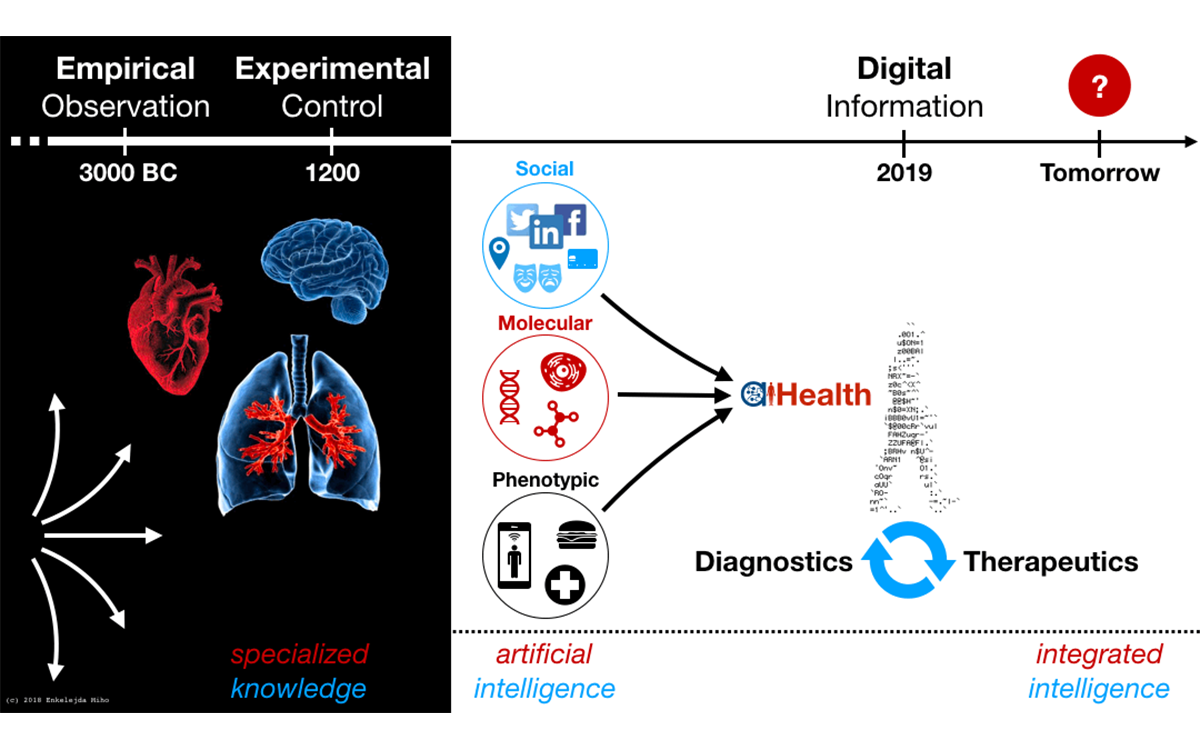
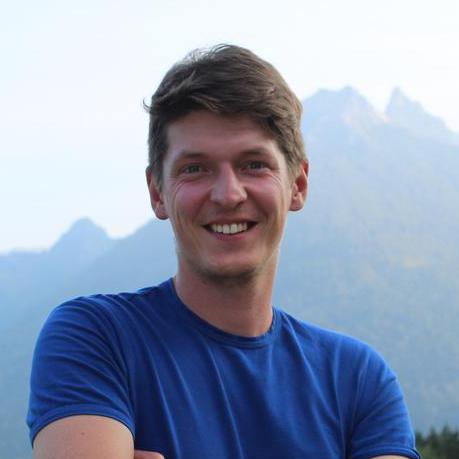
Prof. Enkelejda Miho is a Professor of Digital Life Sciences at the School of Life Sciences, FHNW, leading the aiHealthLab. Her work bridges computer science/AI with life sciences, focusing on drug discovery, personalized medicine, and immunology. She holds roles as Team Leader at aiHealthLab and Group Leader at the Swiss Bioinformatics Institute. Research Interests : She applies machine learning to analyze immune repertoires, antibody engineering, and autoimmunity diagnostics. Her lab develops computational tools like the RWD-Cockpit for real-world data analysis and synthetic antibody-antigen models (Absolut!) to advance biotherapeutics. Her work on dengue immunity and monoclonal gammopathies highlights translational applications. Key Projects : The aiHealthLab focuses on AI-driven diagnostics and therapeutics. Her contributions include AI frameworks for antibody specificity prediction, age-related immune repertoire changes, and large-scale network analysis of antibody repertoires. Labs/Teams : Leads aiHealthLab and collaborates with the Swiss Bioinformatics Institute, integrating computational and experimental immunology.
Niklas Linde is a full professor at the University of Lausanne's Faculty of Geosciences and Environment, leading the Department of Earth Sciences. He holds a PhD in Geophysics from Uppsala University (2005) and has held roles including Assistant Professor (2008), Associate Professor (2013), and Full Professor (2019). His research focuses on transforming geophysical signals into realistic hydrogeological models with rigorous uncertainty quantification. Key areas include probabilistic inversion, Bayesian methods, and geostatistical modeling applied to environmental and subsurface processes. Education: PhD in Geophysics (Uppsala University, 2005), postdoctoral positions at Lawrence Berkeley National Lab (USA), CNRS-CEREGE (France), and ETH Zurich (Switzerland). He joined UNIL in 2008 as an Assistant Professor in Environmental Geophysics. Research interests span geophysical inversion techniques, subsurface heterogeneity characterization, and the integration of geophysical and hydrological data. Current projects emphasize Bayesian approaches for model selection and rare event estimation, supported by grants from the European Commission and Swiss National Science Foundation. Collaborations involve international teams addressing challenges in hydrogeology, rock fracture dynamics, and 4D hydrogeology. Publications reflect advancements in inverse problem solving, stochastic simulation, and machine learning applications. His work bridges theory and practice, with field studies in alpine environments, fractured media, and environmental monitoring. Students under his supervision have explored topics like deep generative networks and Bayesian hydrogeological inversion. Advising: Supervised over a dozen PhD students, including recent works on variational Bayesian methods and geophysical data fusion. Grants include projects on uncertainty quantification and experimental design. Active in scientific societies and editorial roles, contributing to methodological advancements in Earth sciences.
Michal Bassani-Sternberg is an Assistant Professor on conditional pre-tenure at the Faculty of Biology and Medicine, University of Lausanne (UNIL), and an Assistant Member at the Ludwig Institute for Cancer Research, Lausanne. She leads the Antigen Discovery Group and the Immunopeptidomics Unit at the Center for Experimental Therapies, Department of Oncology, UNIL-CHUV. Her work bridges proteogenomics, mass spectrometry, and computational biology to advance personalized cancer immunotherapy. Her educational background includes a Bachelor, Master, and Doctorate in Biology from the Technion – Israel Institute of Technology, Haifa, all earned with Cum Laude distinction. She completed postdoctoral training at the Technion and the Max Planck Institute for Biochemistry, Germany, in the group of Prof. Matthias Mann. Dr. Bassani-Sternberg's research focuses on identifying cancer-specific Human Leukocyte Antigen (HLA) ligands to guide the development of personalized immunotherapies. Her group develops cutting-edge proteogenomic and mass spectrometry-based immunopeptidomics approaches to discover tumor-associated antigens, neoantigens, and non-canonical peptides. A key contribution is the development of NeoDisc, a continuous bioinformatics pipeline that integrates genomics, transcriptomics, and immunopeptidomics data for direct neoantigen identification in clinical trials. Her recent publications, appearing in high-impact journals such as Nature , Nature Biotechnology , Immunity , and Nature Cancer , reflect a strong trend in integrating multi-omics data to understand tumor immunogenicity, T cell responses, and antigen presentation dynamics. Her work increasingly incorporates machine learning to improve neoantigen prediction and TCR specificity inference. She has been recognized with the Pfizer Research Prize in 2021 for her contributions to immuno-oncology. Pfizer Research Prize (2021) Dr. Bassani-Sternberg leads an active research group involved in phase I clinical trials for personalized cancer vaccines and adoptive T cell therapies. Her lab is supported by major grants from the Swiss Cancer League, Swiss National Science Foundation, and ISREC Foundation. She mentors doctoral and postdoctoral researchers and collaborates extensively within the Lausanne immuno-oncology ecosystem, including CHUV and Ludwig Lausanne. Her lab, the Bassani-Sternberg Lab, is part of the Department of Oncology’s research platforms and focuses on immunopeptidomics, antigen discovery, and the development of analytical tools for personalized immunotherapy.
Felix Gille is a researcher at the University of Zurich , affiliated with the Institute for Implementation Science in Health Care under the Faculty of Medicine. He leads the DSI-funded project "Data handling, security and protection: reaching conceptual equivalence for the concept of public trust in national electronic health records in Switzerland and neighboring countries," collaborating with Prof. von Wyl (IfIS/DSI, UZH) and Prof. Thouvenin (Faculty of Law, UZH). His work bridges health system and policy research, digital health, data law, and data security. Education: BSc in European Public Health, Maastricht University MMedSc in Health Economics, Policy and Management, Karolinska Institute PhD in Public Trust in Healthcare Systems, London School of Hygiene and Tropical Medicine Research Focus: Gille specializes in public trust dynamics within healthcare systems, particularly examining data governance, health policy, and ethical dimensions of digital health innovations. His projects analyze cross-national trust frameworks, biobanking ethics, AI in healthcare, and pandemic data sharing mechanisms. Scientific Contributions: His publications address critical issues such as GDPR impacts on research, trustworthiness of mHealth apps, and interdisciplinary approaches to health data policy. Articles span 2015–2025, emphasizing conceptual trust models, policy harmonization, and stakeholder engagement in health data systems. Awards & Roles: Fellow of the Swiss School of Public Health Associate Editor for Public Health Reviews
Markus Christen is a researcher and Managing Director of the Digital Society Initiative at the University of Zurich, where he leads the Digital Ethics Lab within the Institute of Biomedical Ethics and History of Medicine. His work bridges empirical ethics, neuroethics, and ICT ethics with a focus on data analysis methodologies. Affiliation: University of Zurich (Faculty of Medicine) Role: Managing Director of the Digital Society Initiative Lab: Digital Ethics Lab Christen’s research explores ethical challenges in AI, cybersecurity, and digital health. He investigates value conflicts in technology design, moral sensitivity training through serious games, and human-AI accountability frameworks . His recent publications address digital twins in medicine , AI accessibility for disabled students , and cross-cultural responsibility gaps in AI systems. Key trends in his work include: Empirical ethics applied to AI and cybersecurity Neuroethical dimensions of technology Responsible AI integration in education and healthcare Data privacy and fairness in insurance Cross-cultural ethical assessments Christen’s lab develops frameworks for value-sensitive design and human-AI collaboration , with projects like "Responsible AI in practice" and "DSI AI-WEEK."
Michael Krauthammer is a Professor of Medical Informatics and Chair of the Department of Quantitative Biomedicine at the University of Zurich, affiliated with the University Hospital of Zurich. His lab focuses on Clinical Data Science and Translational Bioinformatics, leveraging AI and machine learning to address healthcare challenges. Key areas include cancer genomics, federated learning, and automated medical imaging analysis. Education and affiliations: Krauthammer leads an interdisciplinary team supported by major funding agencies. His research spans bioinformatics, clinical decision support systems, and multimodal data integration. Notable projects include AI-assisted diagnosis in rheumatology and prime editing efficiency prediction. Recent work emphasizes longitudinal cfDNA analysis, drug interaction modeling, and personalized oncology. The lab collaborates across disciplines, with projects funded by Swiss and international grants. Students and postdocs work on topics like machine learning for radiology reports, longitudinal disease trajectories, and protein design. Key projects include the NTCIR-18 RadNLP challenge, prime editing prediction models (Nature Biotechnology 2024), and vision transformers for capillaroscopy analysis. The lab advocates for reproducible data science and ethical AI in healthcare.
Prof. Dan Olteanu is a full professor at the Department of Informatics, University of Zurich, leading the Data Systems and Theory (DaST) group. He holds visiting professorships at the University of Oxford and is an emeritus fellow of St Cross College. His academic journey includes a PhD from Ludwig Maximilian University (2005), postdoctoral roles at Saarland University and Cornell University, and prior faculty positions at Oxford (2007–2020). He has also worked in industry with companies like LogicBlox and RelationalAI, focusing on database systems and AI. Education: Bachelor’s in Computer Science, Politehnica University of Bucharest (2000) PhD in Computer Science, Ludwig Maximilian University (2005) Professional Roles: Full Professor, University of Zurich (since 2020) Visiting Professor, University of Oxford Emeritus Fellow, St Cross College Editorial Roles: ACM TODS, VLDBJ, SIGMOD Conference Chair: ICDT Council (since 2022) His research focuses on data systems theory, including query optimization, probabilistic databases, factorized databases, and in-database machine learning. He co-authored the seminal book Probabilistic Databases (2011) and has pioneered algorithms for efficient machine learning over relational data and incremental maintenance of analytical workloads. His work emphasizes scalable, theoretically grounded solutions for real-world data challenges. Awards: ICDT 2019 Best Paper Award ACM SIGMOD 2018 Distinguished PC Member Award ERC Consolidator Grant (2016) Oxford Outstanding Teaching Award (2009) Grants & Funding: Supported by Google, Microsoft Azure, Amazon AWS, EPSRC, and the European Commission. His research bridges academia and industry, with contributions to commercial systems like LogicBlox and RelationalAI. Labs & Teams: Heads the DaST group at Zurich, focusing on data systems theory and applications. Collaborates widely in the database and AI communities.
Jordan Boyd-Graber is a Professor in the Department of Computer Science at the University of Maryland's College of Computer, Mathematical, and Natural Sciences. He serves as a leading researcher in Natural Language Processing with significant contributions across multiple NLP subfields. His work bridges theoretical advances with practical applications requiring human-AI collaboration. His research interests span Natural Language Processing , Question Answering systems , Human-AI collaboration , Machine Translation , and Topic Modeling . He focuses on developing systems that work effectively with humans rather than replacing them, emphasizing interpretability and user-centered design. His work often involves creating evaluation frameworks that better capture real-world utility rather than just technical metrics. His publication record shows consistent leadership in the field, with numerous papers at top venues including ACL, EMNLP, and NAACL. Recent work (2023-2024) demonstrates strong engagement with LLMs, human evaluation methodologies, and practical applications in health and translation domains. His research often involves student collaborators, indicating active mentorship. ACL Fellow (2021) Program Chair for ACL 2023 Organizer of prompt hacking competition Leader in human-centered NLP evaluation Boyd-Graber has secured substantial funding for his research, particularly in projects involving human-AI collaboration and question answering systems. His work often involves interdisciplinary teams spanning computer science, linguistics, and domain-specific applications. He has mentored numerous graduate students who have gone on to successful careers in academia and industry. He leads research groups focused on developing interpretable NLP systems that work effectively with humans, particularly in high-stakes domains like healthcare and education. His lab frequently develops novel evaluation methodologies that better capture real-world utility rather than just technical metrics.
Isabella Di Lenardo is a Lecturer and Scientist at the Digital Humanities Institute (DHI) at École Polytechnique Fédérale de Lausanne (EPFL), where she also serves as the coordinator of the EPFL Time Machine Unit and the European Local Time Machines. She holds affiliations across multiple departments, including DHI-GE, SAR-ENS, SHS-ENS, and EDDH-ENS, reflecting her interdisciplinary role in teaching and research. Her educational background includes a PhD in Theories and Art History, with postdoctoral and faculty experience at institutions such as INHA (Paris), EPFL, and IUAV (Venice). Her research spans Digital Humanities, Art History, Urban History, and GIS , with a focus on digital urban reconstruction, historical cadastres, and AI applications in cultural heritage. She employs advanced computational methods including machine learning, 4D modeling, and semantic segmentation to analyze historical maps, cadastral records, and art archives. Her work bridges humanities scholarship with computer science, particularly in reconstructing urban evolution and analyzing visual patterns. The recent publications reveal a consistent trend in AI-powered historical data analysis , especially in processing non-standardized historical documents, reconstructing urban spaces, and developing open-source tools for digital heritage. Her work frequently involves large-scale datasets from Venice, Lausanne, Paris, and Jerusalem, demonstrating a transnational and interdisciplinary approach. She has contributed to significant collaborative projects such as the Venice Time Machine , Parcels of Venice , and Time Machine Organization , often acting as a principal investigator or project leader. Her role involves coordinating diverse teams of researchers, engineers, and cultural institutions. Scientific contributions include: Development of the Morphograph tool for visual pattern recognition in art archives Automatic vectorization and analysis of Napoleonic cadastres Creation of 4D models for historical cities AI-driven text and pattern extraction from historical maps Building discovery engines for digital art history She actively teaches ex cathedra courses in Digital Urban History and Art History at EPFL and internationally. Her work in grants and projects emphasizes open data, reproducibility, and interdisciplinary collaboration. She has led research funded by organizations supporting digital heritage innovation. She is a key member of the Digital Humanities Laboratory at EPFL and the Time Machine Organization , where she fosters collaboration between computer scientists, historians, and cultural institutions. Her work in the Replica Project and ARCHiVe center highlights her leadership in digitizing and making accessible large art historical archives.
Daniel Paul Armstrong is a Doctoral Assistant at the Laboratory of Artificial Chemical Intelligence (LIAC) within the Institute of Chemical Sciences and Engineering (ISIC) at École polytechnique fédérale de Lausanne (EPFL). He is concurrently enrolled as a doctoral student in the Doctoral Program in Chemistry and Chemical Engineering (EDCH) at EPFL, indicating an active research and academic trajectory in the domain of chemistry and advanced materials. His academic training and research are situated within the School of Basic Sciences, focusing on the integration of artificial intelligence with chemical discovery and materials design. The interdisciplinary environment of LIAC suggests a strong emphasis on computational modeling, machine learning for molecular systems, and innovation in functional chemical materials. Although no publications authored by Daniel Paul Armstrong are listed in the provided data, the research output of the broader group includes significant contributions in organic semiconductors, perovskite materials, electrochemical transistors, and advanced polymer systems. These areas reflect the likely thematic context of his doctoral work, particularly at the intersection of AI-driven chemical design and electronic materials. No scientific awards or recognitions are mentioned in the available information. As a doctoral researcher, he is likely involved in collaborative projects, possibly advising or mentoring junior students indirectly, though no formal advisees are listed. There is no mention of independent grants, but he may be supported through institutional or group-level funding associated with the LIAC laboratory. The Laboratory of Artificial Chemical Intelligence (LIAC) serves as his primary research environment, promoting innovation in intelligent systems for chemical synthesis, materials optimization, and molecular engineering, aligning with EPFL’s leadership in interdisciplinary science and technology.
Martin Rajman is a Senior Scientist at École Polytechnique Fédérale de Lausanne (EPFL) with multiple affiliations across the institution. He holds positions in the School of Computer and Communication Sciences (SIN - Teaching, SCI IC MR Group, SSC - Teaching) as well as in the Vice Presidency for Strategic Development (VPS Artificial Intelligence) and the Vice Presidency for Academic Affairs (SNAI Administration). He serves as the Executive Director of Nano-tera.ch, a large Swiss Research Program funding collaborative multi-disciplinary projects in Health and the Environment. Rajman's research spans the intersection of artificial intelligence, natural language processing, and information retrieval. His work demonstrates a consistent focus on developing practical applications of computational linguistics and machine learning techniques. Early in his career, he contributed significantly to syntactic parsing, stochastic language models, and vector space representations for text. More recently, his research has expanded into deep learning applications for 3D reconstruction, empathetic conversational agents, and distributed analytics systems. His publications reveal a trajectory from foundational NLP research toward increasingly applied and interdisciplinary work connecting AI with healthcare, environmental monitoring, and human-computer interaction. Analysis of his recent publications (2015-2024) shows a clear evolution toward more applied AI research with strong interdisciplinary connections. While maintaining his core expertise in natural language processing and information retrieval, his work has expanded into computer vision, healthcare applications, and sustainable computing. The publications demonstrate increasing collaboration across disciplines, with applications in medical imaging, mental health support systems, environmental monitoring, and human-centered AI. His leadership role in the Nano-tera.ch program reflects this interdisciplinary approach, connecting computing research with real-world challenges in health and environmental contexts. Rajman has mentored several PhD students including Ailomaa Marita, Eckard Emmanuel, Melichar Miroslav, and Veselý Martin. His research has been supported through the Nano-tera.ch program, which has funded more than 100 research projects with over 95 million CHF in public funding. He has also managed more than 20 European projects during his tenure as Director of the EPFL Global Computing Center. As Executive Director of Nano-tera.ch, Rajman leads a significant research initiative connecting EPFL with national and international partners. His work bridges academic research with industry applications, notably through collaborations with eBay on product ranking technology and with Elsevier on article recommendation systems. His leadership extends to managing large-scale research programs while maintaining an active research agenda and mentoring the next generation of computer scientists.
Dr. Dandolo Flumini is a Researcher at the Zurich University of Applied Sciences (ZHAW), School of Engineering, specializing in Applied Complex Systems Science. His research focuses on artificial life, morphological computation, blockchain applications, and computational modeling. He serves as team member or project lead in multiple interdisciplinary initiatives including Bio-HhOST (bio-hybrid tissues), Agroforestry Carbon Token System, and blockchain-based voting solutions. His primary research interests include: Complex Systems Science : Emergent behaviors in biological and artificial systems Morphological Computation : Physical systems performing computational tasks Artificial Chemistry : Programmable chemical systems using droplet networks Blockchain Applications : Decentralized finance and voting systems Computational Ethics : Responsible implementation of AI and modeling Flumini's recent publications (2019-2023) demonstrate strong focus on microfluidic systems, droplet agglomeration physics, programmable chemistry, and ethical AI. His work frequently appears in artificial life and computational modeling venues, with increasing emphasis on real-world applications in sustainability and decentralized systems. He maintains active collaborations through the Applied Complex Systems Science research group at ZHAW, contributing to projects involving microfluidic device design, blockchain architectures, and bio-hybrid tissue engineering.
Prof. Dr. Jochen Menges is a Professor at the University of Zurich , holding the Chair of Human Resource Management and Leadership within the Department of Business Administration under the Faculty of Business, Economics and Informatics . He serves as Director of the Center for Leadership in the Future of Work and contributes to the DSI Community Work. Research Interests: His work bridges leadership studies , emotional intelligence , mindfulness practices , and digital transformation in work environments. Key areas include charismatic leadership attribution , AI-human collaboration , emotion regulation , and future of work dynamics . Recent Publications: Menges explores how anthropomorphic AI affects workplace emotions, develops VR-based organizational simulations , and investigates the role of awe in leadership perception . His 2024 guest editorial on human-centered future of work emphasizes balancing technological and human needs. Emerging Insights: Studies on emotional responses to AI , mindfulness interventions , and gender dynamics in emotional intelligence demonstrate his focus on emotional and psychological dimensions of modern work. His populist support research connects negative affect with global political trends.
Jakub Macina is a Doctoral Fellow at the ETH AI Center and a PhD Candidate at ETH Zürich . He works in the intersection of Natural Language Processing and Learning Sciences as part of the Language, Reasoning and Education Lab (led by Prof. Mrinmaya Sachan) and the Professorship for Learning Sciences and Higher Education (led by Prof. Manu Kapur). Forbes 30 Under 30 in Science & Education 2023 Recipient of ETH AI Center Fellowship ( Co-founder of a health-tech startup with seed investment Research Interests : Focus on generative large language models (LLMs), dialogue tutoring systems , pedagogical alignment of AI models, and mathematical reasoning . His work explores: Reinforcement learning for pedagogical steering LLM evaluation frameworks Socratic question generation Stepwise error detection and remediation Student-teacher interaction modeling Publications span top conferences like EMNLP , ACL , NeurIPS , and RecSys , with particular emphasis on educational applications of LLMs and dialogue-based learning systems . Scientific Awards : Forbes 30 Under 30 in Science and Education (2023) 2nd Place in ACM IT SPY Computer Science Master's Thesis Competition (2017) ETH AI Center Fellowship (2021) Leadership & Teaching includes: Managing team of 6 data scientists Teaching Assistant for Machine Learning and NLP courses at ETH Zurich Developing large-scale ML pipelines for recommender systems Open-source contributions to Discourse and Google Summer of Code projects
Simon Ruffieux is a Senior Researcher and Lecturer at the Department of Computer Science, University of Fribourg, and a member of the Human-IST Institute. He currently leads the HIP-Initiative (Human-IST x SwissPost Initiative) and coordinates academic projects related to Swiss Post. His academic roles include Lecturer and Senior Assistant , reflecting his active engagement in teaching and research. His research focuses on leveraging advanced technologies to support individuals, particularly those with special needs. Key areas include: Machine Learning and Data Science for urban systems (e.g., bike-sharing optimization) Human-Computer Interaction (HCI), especially gesture recognition and multimodal interfaces Augmented and Virtual Reality applications in rehabilitation and assistance Development of smart glasses for visually impaired users Physiological signal analysis for workload classification The 15 most recent publications reveal a strong trend in applying AI and data science to real-world challenges, particularly in assistive technologies and urban mobility. His work often involves interdisciplinary collaboration, integrating computer science with psychology, rehabilitation, and industrial applications. There is a consistent emphasis on user-centered design and real-world usability. Simon Ruffieux has not been mentioned as receiving specific scientific awards in the provided text. He has advised or collaborated with several researchers, including Nicolas Spycher, Samuel Torche, and Nicolas Ruffieux, on projects related to forecasting, AR, and gesture recognition. While no formal grant details are listed, his leadership of the HIP-Initiative suggests involvement in externally funded academic projects. His work is closely tied to the Human-IST Institute, where he contributes to interdisciplinary research in human-centered computing. He is actively involved in research teams focused on assistive technologies, gesture interaction, and data-driven urban solutions. The Human-IST Institute serves as the primary hub for his collaborative efforts, particularly through the HIP-Initiative with Swiss Post.