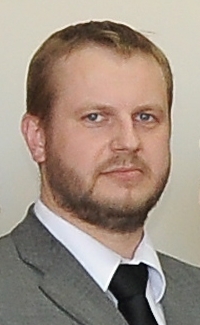
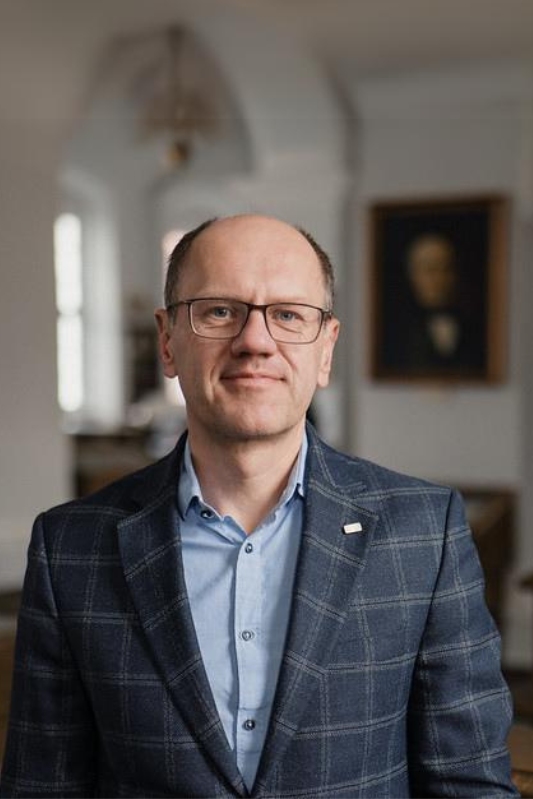
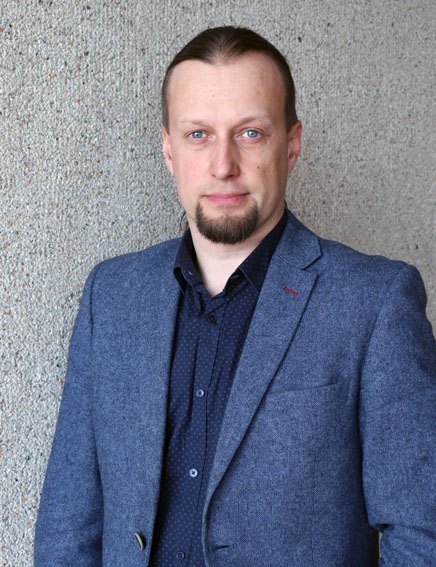
Eduardas Kutka serves as a Lecturer at the Faculty of Mathematics and Informatics, Vilnius University, with documented teaching activity spanning from the 2016/2017 academic year through the upcoming 2025/2026 term. His academic focus centers on: Computer Networks (primary teaching responsibility) High Performance Computing infrastructure Supercomputing applications and education He integrates practical experience through MIF supercomputer facility excursions, emphasizing hands-on learning in computational systems for undergraduate students, particularly evident in his first-year lecture series "Supercomputer - what and for whom?"
Rimantas Kybartas , Associate Professor at Vilnius University's Faculty of Mathematics and Informatics , specializes in machine learning and software systems architecture . His research focuses on multi-class classification methodologies, including pair-wise classifiers and fuzzy template systems. Current academic affiliation: Vilnius University Key research domains: Neural Networks, Ensemble Learning, Pattern Recognition Teaching focus: Software Systems Architecture and Design His publication record from 2010-2012 demonstrates expertise in solving multi-classification challenges through innovative ensemble architectures and similarity feature engineering. Notably, he has developed frameworks for mineral recognition and generalized multi-category neural network systems. Recent publications reveal emphasis on: Optimizing pair-wise classifier ensembles Addressing complexity in neural network design Domain adaptation techniques for classification tasks Statistical learning in multi-class contexts
Prof. habil. dr. Gintautas Dzemyda is a leading Lithuanian computer scientist, Professor and Senior Researcher at Vilnius University Institute of Data Science and Digital Technologies (VU DMSTI), and Head of the Cognitive Computing Group . He is simultaneously affiliated with the Institute of Mathematics and Informatics (MII) in Vilnius, where he has built an internationally recognized scientific school in visual data analysis. Education & Qualifications 1984 – Candidate of Technical Sciences (PhD equivalent), thesis on “Problem Structure Analysis – a Tool for More Effective Optimization”. 1997 – Habilitation Doctor of Technical Sciences, dissertation on “Isolation of Necessary Knowledge to Improve Optimization Efficiency”. 1992 – Associate Professor, Institute of Mathematics and Informatics, Vilnius. 1998 – Professor, Kaunas University of Technology. Research Interests Prof. Dzemyda’s research integrates data science, artificial intelligence, optimization, and cognitive computing . Core topics include dimensionality reduction, multidimensional data visualization, neural-network–based analytics, parallel and distributed computing, multi-criteria decision support, and advanced AI applications in medicine (ophthalmology, cardiology, oncology). His work has pioneered Lithuanian capabilities in visual analytics and large-scale data exploration. Publication Trends Across 270+ refereed works and 2 Springer monographs (2013, 2023), recent outputs (2021–2025) emphasize geometric multidimensional scaling for big-data visualization, deep learning for pancreatic-cancer detection on CT images, reinforcement learning for autonomous navigation, and fraud-detection techniques for highly imbalanced financial datasets. These contributions appear in Springer LNCS/LNNS, Informatica, Journal of Global Optimization, Engineering Applications of Artificial Intelligence , and other top venues. Awards & Recognition Lithuanian State Science Prize (2001 & 2021) Honorary Doctor of the University of Latvia (2019) Knight's Cross of the Order “For Merit to Lithuania” (2007) Doctoral Supervision & Committees He has mentored 28 doctoral graduates (15 direct, 13 through academic descendants) and currently supervises: Dalia Breskuvienė – Classifier training-set optimization Modestas Motiejauskas – Emotion recognition in photographs Victor Bulava – Machine-learning methods for cyber-incident early detection He also chairs or serves on doctoral and habilitation committees at VU, KTU, VGTU, VMU and MII. Laboratory & Projects As Head of the Cognitive Computing Group , Prof. Dzemyda coordinates several national and EU projects, including the current Lithuanian Research Council grant “Geometric Method for Multidimensional Scaling” (S-MIP-20-19, 2020-2022) and the SMART programme project “CognitiveSTATS” (2021-2023) focused on combating misinformation during pandemics. His team develops open-access tools for large-scale data visualization and contributes to the MIDAS national research-data archive.
Assoc. Prof. Dr. Gintautas Tamulevičius serves as Director of the Institute of Data Science and Digital Technologies at Vilnius University. His primary affiliation is with the Image and Signal Analysis Group, where he contributes as a Senior Researcher and Chief Researcher in projects. Doctor of Science in Technology (2008) Pedagogical Title: Associate Professor (2014, Vilnius Gediminas Technical University) Active in IEEE Computer Society and Signal Processing Society Dr. Tamulevičius specializes in speech signal processing, with research spanning three core domains: Speech Modeling : Autoregressive/linear prediction, nonlinear fractal modeling, non-parametric approaches Recognition Systems : Deep learning-based methods, Hidden Markov models, Wave-U-Net architectures Quality Assessment : Voice phonation evaluation, vocal fold condition analysis using acoustic methods His publication trends show strong focus on: Deep learning applications for speech processing 2D feature space analysis for recognition tasks Fractal dimension-based emotion classification Language preservation through technological development Human-centered AI applications Biomedical signal processing As an educator, he has taught: Digital Signal Processing (VGTU 2012–present) Speech Signal Processing (VGTU 2008–present) Data Visualization (VGTU 2015) User Interface Design (VU 2018–present) Audio Signal Processing (VU 2020–present) His editorial contributions include reviewing for: Informatica IEEE Access Neurocomputing Baltic Journal of Modern Computing Nonlinear Analysis: Modeling and Control IEEE Journal of Biomedical and Health Informatics International Journal of Applied Mathematics and Computer Sciences He has supervised doctoral research including: Daniel Zakševski (2023–2027): Deep learning models for speech enhancement Monika Danilovaitė (2020–2026): Voice quality assessment methods Tatjana Liogienė (2012–2016): Multistage speech emotion classification
Prof. Dr. Virginijus Marcinkevičius is a Professor at Vilnius University , serving as the head of the Smart Technologies Research Group and the Artificial Intelligence Laboratory within the Institute of Data Science and Digital Technologies . He is also a Senior Researcher , Project Lead Researcher , and Group Leader . Based in Vilnius, Lithuania, he has been instrumental in advancing research in machine learning , artificial intelligence , cybersecurity , and natural language processing . Research Interests: Machine Learning & AI Cybersecurity & Threat Detection Natural Language Processing Hyperspectral Imaging & Remote Sensing Autonomous Systems & Robotics Big Data & Cloud Computing His work spans both theoretical and applied aspects, including IoT security , visual analytics , and intelligent decision support systems . Recent projects include the development of propaganda detection systems , hyperspectral unmixing algorithms , and autonomous driving agents . Doctoral Supervision: He has supervised 19+ PhD students and 5+ consultants , covering topics from machine learning in cybersecurity to neural machine translation and autonomous UAV navigation . Projects & Grants: He has led or contributed to 15+ national and EU-funded projects , including: CognitiveSTATS – COVID-19 data literacy platform Propaganda and Disinformation Research – ML-based detection DAMIS – Data mining system for national research Raštija 2 – Lithuanian language resource integration Publications: He has authored or co-authored 60+ peer-reviewed publications in journals like IEEE Access , Informatica , Frontiers in Psychology , and Machine Vision and Applications . Professional Memberships: He is a member of the Lithuanian Computer Society , Lithuanian Mathematical Society , and Lithuanian Operations Research Society .
Prof. Dr. Remigijus Paulavičius is a Senior Researcher, Professor, and Group Leader at the Blockchain and Quantum Technologies Group of Vilnius University. He earned his Doctor of Science degree in Computer Science in 2010 from Vilnius University's Institute of Mathematics and Informatics, focusing on global optimization with simplex subdomains under the supervision of Dr. J. Žilinskas. Research Interests : His work bridges global optimization methods with blockchain and quantum computing. Key areas include non-convex bilevel programming, derivative-free optimization algorithms (e.g., DIRECT), and applications in blockchain scalability, consensus protocols, and quantum circuit design. Scientific Awards : Best Paper Award, Journal of Global Optimization (2014) Funding from Lithuanian State Science and Studies Foundation for doctoral students (2007–2009) Member, Young Academy of the Lithuanian Academy of Sciences (since 2019) Projects & Leadership : Leads research on blockchain simulators, quantum machine learning frameworks, and optimization toolboxes (e.g., DGO, DIRECTGO). Involved in international collaborations and conference committees, including AIChE and EUROPT. Publications : Over 70 works on global optimization algorithms, blockchain applications, and quantum computing, with recent focus on generative AI, energy consumption in blockchains, and reproducibility in machine learning.
Dr. Ernestas Filatovas is a Senior Researcher and Chief Researcher in the Project at Vilnius University's Institute of Data Science and Digital Technologies (formerly Institute of Mathematics and Informatics), where he has been affiliated since 2013. He leads the Blockchain and Quantum Technologies Group, focusing on cutting-edge research at the intersection of quantum computing, blockchain, and artificial intelligence. Previously, he served as an Associate Professor and Lecturer at Vilnius Gediminas Technical University's Faculty of Fundamental Sciences from 2013 to 2019. Dr. Filatovas earned his Doctor of Technology in Computer Science Engineering from Vilnius University Institute of Mathematics and Informatics in 2012. His dissertation, supervised by Prof. Dr. Olga Kurasova, focused on the interactive solution of multi-criteria optimization problems. His research spans multiple high-impact domains, with particular expertise in blockchain technologies, quantum computing, artificial intelligence, and machine learning. He has pioneered work in quantum blockchain implementations, reproducibility of AI research through blockchain verification, and quantum machine learning applications. His research bridges theoretical computer science with practical applications in financial markets, healthcare, and distributed systems. His extensive publication record—over 50 scientific papers, with more than 25 in Clarivate Analytics-indexed journals—demonstrates consistent productivity and international collaboration. Recent work shows a clear trajectory toward quantum-enhanced AI systems, blockchain-based research verification frameworks, and quantum algorithms for practical problems. Laureate of the 4th LMA Young Scientists' Conference (2014) INFOBALT scholarship 2nd place winner (2014) Lithuanian State Science and Studies Foundation funding recipient (2009, 2010) Recognized as one of Lithuania's most active doctoral students Master's degree with honors (2006) Dr. Filatovas leads multiple significant research projects, including the 2021-2024 project 'Solving the problems of reproducibility of scientific research in the field of artificial intelligence using blockchain technologies' as team leader, and the 2023-2027 project 'Development and validation of quantum machine learning methods using prepared datasets' as Chief Researcher. He has also contributed to international collaborations such as the Spanish-funded 'High Performance Solutions for Modern Scientific Computing Challenges' (2019-2021). His popular science contributions, including the VU news portal article 'Quantum Computing: Who and Why?', demonstrate his commitment to science communication. As a key member of Vilnius University's Blockchain and Quantum Technologies Group, Dr. Filatovas contributes to Lithuania's growing reputation in quantum computing research and blockchain innovation, working closely with international collaborators across Europe.
Professor Julius Žilinskas is a distinguished academic at Vilnius University, serving as Chief Researcher and Group Leader of the Global Optimization Group within the Institute of Data Science and Digital Technologies. He is also a Member of the Senate of Vilnius University and serves on the Expert Committee of Natural and Technical Sciences of the Research Council of Lithuania. His academic career spans multiple institutions including Vilnius Gediminas Technical University and Kaunas University of Technology. Vilnius University, Institute of Data Science and Digital Technologies (Current) Vilnius Gediminas Technical University (Professor appointment, 2012) Kaunas University of Technology (Doctorate awarded, 2002) Professor Žilinskas' research interests focus on global optimization algorithms , multidimensional scaling , and parallel computing for complex optimization problems. His work bridges theoretical computer science with practical applications in facility location, data analysis, and educational assessment. He has made significant contributions to developing and analyzing algorithms for black-box global optimization, particularly in constrained and competitive settings. His recent publications reveal a strong focus on Bayesian optimization techniques , facility location problems , and educational data analysis . The research demonstrates increasing interdisciplinary collaboration, particularly with economists and educational researchers. His work shows a consistent trajectory from theoretical optimization methods to practical applications in diverse fields. Professor Žilinskas has served in numerous leadership roles including: Member of the Senate of Vilnius University Member of the Expert Committee of Natural and Technical Sciences of the Research Council of Lithuania Editor for special issues of the Journal of Global Optimization He leads the Global Optimization Group, which focuses on developing and implementing advanced optimization algorithms for complex real-world problems. The group maintains strong international collaborations and contributes to both theoretical advances and practical applications of optimization techniques.
Šubonienė Aušra is a junior researcher and PhD student at the Cognitive Computing Group of Vilnius University's Institute of Data Science and Digital Technologies. She works on applying machine learning techniques to medical imaging, particularly for pancreatic cancer detection using CT scans. Field: Computer Science Supervisor: Prof. Dr. Olga Kurasova Study Period: 2023–2027 Research Focus : Her work centers on semi-supervised learning and pseudo-labelling methods for improving diagnostic accuracy in medical imaging. She has contributed to developing deep learning models that identify cut-off points for pancreatic cancer detection, with applications in CT scan analysis. Publication Trends : Recent articles demonstrate expertise in medical image segmentation , neural network optimization , and clinical decision support systems , primarily focused on oncology and radiology.
Dr. Jolita Bernatavičienė serves as a Senior Researcher at Vilnius University's Institute of Data Science and Digital Technologies within the Image and Signal Analysis Group. With a Doctorate in Technological Sciences (Informatics), she has established herself as a leading researcher in medical image analysis and artificial intelligence applications in healthcare. Her extensive research portfolio spans over 15 years of continuous contributions to the field. Dr. Bernatavičienė's research interests primarily focus on medical image analysis, particularly in ophthalmology and oncology applications. Her work integrates advanced machine learning techniques with medical diagnostics, specializing in eye fundus image analysis for glaucoma detection and prostate MRI analysis for cancer identification. She has made significant contributions to deep learning architectures, signal processing methodologies, and data analysis frameworks applicable to biomedical challenges. Her publication record demonstrates strong trends in applying cutting-edge AI techniques to solve concrete medical problems, with a noticeable shift toward more sophisticated deep learning architectures in recent years. The research spans multiple medical domains including ophthalmology, cardiology, oncology, and renewable energy systems monitoring, reflecting her interdisciplinary approach to data science applications. Leader of International Conference 'Data Analysis Methods for Software Systems (DAMSS)' 2015-2024 Member of IEEE Computer Society section (since 2022) Member of the Council of the Lithuanian Computer Association, Artificial Intelligence Section Member of the Lithuanian Operations Research Society Expert at the Science, Innovation and Technology Agency (MITA) (2020-2022) Dr. Bernatavičienė actively supervises doctoral and master's students, with current doctoral student Roman Surkant working on prostate MRI analysis. She leads multiple significant research projects including 'Developing Talents in Artificial Intelligence to Solve Disruptive Environmental Problems' and serves as scientific leader for the Research Council of Lithuania funded project on cardiac MRI texture analysis. Her work has been supported by various national and international funding mechanisms including COST activities, EuroHPC programs, and Lithuanian national research grants. She is principal investigator for the long-term project developing a database of depersonalized fundus images (2018-2030) and has led numerous projects related to medical image analysis, AI applications in healthcare, and data science methodologies. Her research group maintains strong international collaborations through COST actions and other European research networks.
Žydrūnas Vaišnoras is a PhD student, junior assistant, and researcher at Vilnius University's Institute of Data Science and Digital Technologies, working within the Cognitive Computing Group. His research focuses on developing machine learning methods for intrusion detection in computer networks, supervised by Prof. Dr. Olga Kurasova. His work is conducted at Akademijos St. 4, Vilnius, with a study period spanning 2019–2026, including academic vacation periods. PhD Student, Vilnius University JUNIOR ASSISTANT, Cognitive Computing Group RESEARCH INTEREST: Intrusion Detection Systems Vaišnoras has presented his research at multiple doctoral conferences, including the Conference of Doctoral Students in Computer Science (2022) and the Informatics Doctoral Student Conference (2021, 2020). His presentations consistently centered on applying machine learning techniques to enhance network security. Scientific Production: Presentations at 4 doctoral conferences (2020–2022) Thesis topic: "Development of Machine Learning Methods for Detecting Intrusions in Computer Networks"
Gražina Korvel is a Professor and Senior Researcher at the Image and Signal Analysis Group of Vilnius University's Faculty of Mathematics and Informatics. Her work bridges speech signal processing , machine learning , and natural language processing , with a focus on applications like noise profiling , Lombard effect modeling , and propaganda detection . She leads projects such as the HUMAN-INSPIRED SPEECH ENHANCEMENT (2024–2027) and CLINICAL NLP FOR RECORDS (2024). Education : Doctor of Science in Computer Engineering (2013, Vilnius University), Master’s in Computer Science (2009, Vilnius Pedagogical University), Bachelor’s in Mathematics (2007, Vilnius Pedagogical University). Her research interests include speech enhancement , deep learning for audio analysis , and cross-linguistic emotion recognition . Recent work explores fake news detection , synthetic speech , and Lithuanian language modeling . From 2020–2024, she taught Natural Language Processing at Vilnius University. She has held visiting research roles at Gdańsk University of Technology and International Hellenic University, and serves on editorial boards for Journal of Intelligent Information Systems and Informatica .
Tadas Žvirblis serves as an Associate Professor within the Interdisciplinary Statistical Research Group at Vilnius University's Institute of Data Science and Digital Technologies, maintaining his research office at Akademijos St. 4, room 604A in Vilnius. His academic profile bridges theoretical statistics with practical engineering and medical applications through advanced computational methodologies. His research program centers on machine learning and deep learning innovations for complex signal analysis, with dual specializations in biomedical diagnostics (EEG, NIRS, cardiovascular monitoring) and industrial systems (conveyor mechanics, gear fault detection, engine emissions). Key methodological contributions include novel data augmentation techniques for time series, generative modeling of vibration signals, and prognostic frameworks for reliability engineering, demonstrating consistent interdisciplinary collaboration across medical and engineering domains. Analysis of his 13 publications from 2023-2025 reveals a strategic research trajectory applying deep learning to data-scarce scenarios, particularly in biomedical signal interpretation and industrial predictive maintenance. His work shows increasing focus on clinical applications since 2024, including ECMO mortality prediction and aortic morphology studies, while maintaining strong industrial engineering output through IEEE conference publications on conveyor systems and engine diagnostics. Dr. Žvirblis actively supervises doctoral research as Senior Researcher for Gajane Mikalkėnienė's project (2023-2027) developing EEG-based depression diagnosis methods under Informatics field N 009. His grant portfolio includes multiple industry-collaborative projects evidenced by co-authorship with clinical researchers and engineering teams across Lithuania, Poland, and Germany. As a core member of the Interdisciplinary Statistical Research Group, he contributes to the unit's mission of advancing statistical methodologies for real-world data challenges, with particular emphasis on time-series analysis in non-stationary environments. His laboratory work integrates signal processing hardware with deep learning frameworks to address industrial automation and medical monitoring challenges.
Sandra Virbukaite is a Lecturer at Vilnius University's Department of Lecturers. She is currently pursuing doctoral studies (2020–2024) at Vilnius University Institute of Data Science and Digital Technologies, focusing on deep learning methods for identifying pathological changes in fundus images under Dr. Jolita Bernatavičienė. Master’s degree in Applied Statistics (Vilnius Gediminas Technical University, 2011) Bachelor’s degree in Engineering Informatics (Vilnius Gediminas Technical University, 2009) Recent certificates from Oxford University's Machine Learning Summer Schools (2023–2024) and DeepLearn 2021 Summer Her research centers on medical imaging and artificial intelligence applications for eye disease detection, particularly glaucoma through optic disc and cup segmentation . Analysis of her 15 most recent publications (2020–2024) shows focus areas in convolutional neural networks , image preprocessing , and segmentation accuracy in fundus imaging. Presenter at 8 major conferences including DAMSS (2021–2022), WSCG (2022), and AI Technologies in Medicine (2023–2024) Contributor to 5 peer-reviewed publications in IEEE Access and Nonlinear Analysis: Modelling and Control She teaches Database Query Languages at Vilnius University since 2020, demonstrating both pedagogical and research expertise in applied statistics and deep learning domains.
Gediminas Navickas is a Lecturer at Vilnius University's Institute of Data Science and Digital Technologies (DMSTI) within the Faculty of Mathematics and Informatics, specializing in the Image and Signal Analysis Group. His work bridges academic research with practical applications in Lithuanian language technologies. His primary research focuses on automatic Lithuanian speech recognition, speech signal processing, speech synthesis methods and algorithms, and speech synthesis quality assessment. Navickas has made significant contributions to developing speech technologies specifically for the Lithuanian language, addressing the challenges of resource scarcity compared to more widely spoken languages. His work demonstrates strong interdisciplinary connections between computer science, linguistics, and cognitive science. Navickas's publication record reveals a consistent trajectory of innovation in speech technology, with recent work emphasizing cognitive approaches to evaluating synthetic speech, particularly examining differences in perception between blind and sighted users. His research has evolved from foundational work on neural network architectures for speech synthesis to comprehensive studies on speech corpus development and accessibility applications. He has been instrumental in major EU-funded projects including the LIEPA series (2013-present), which have developed comprehensive speech recognition and synthesis systems for Lithuanian. These projects have produced practical applications ranging from educational robots to voice-controlled mobile services and assistive technologies for the visually impaired. Member of Lithuanian Computer Society (LIKS) Council Member of IEEE organization Active participant in COST actions including UniDive and Multi3Generation Navickas regularly engages with the public through media appearances on LRT radio and television, where he explains complex speech technology concepts to general audiences. His science communication efforts demonstrate a commitment to making technical research accessible and relevant to Lithuanian society.