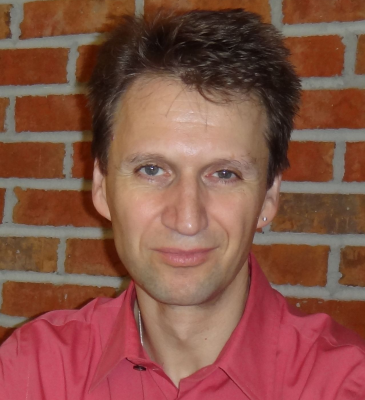
Markus Hofinger joined the Vision and Learning (VLO) Group at the Institute of Computer Graphics and Vision (ICG), Graz University of Technology, in June 2017 as a PhD student under the supervision of Prof. Thomas Pock. His research focuses on computer vision, particularly optical flow estimation and its applications, alongside machine learning and deep learning techniques. Education Diplom-Ingenieur (DI(FH)) from University of Applied Sciences Upper Austria (2009) Master's degree in Electrical Engineering from Graz University of Technology (2015) Hofinger combines academic research with industry collaboration, working with companies such as HS-Art digital service GmbH (video colorization), Mapillary GmbH (optical flow research), and Rubner Group (deformation analysis in wood). Prior to his academic career, he spent several years in microelectronics development.
Dr. Eva Mayr is a Senior Researcher at the University for Continuing Education Krems, affiliated with the Center for Cultures and Technologies of Collecting . Her work focuses on user-centered design, casual information visualization, digital humanities , and cognitive and media psychology . She leads major projects such as the Bibliotheca Eugeniana Digital (2022–2024) funded by the Austrian Academy of Sciences, and previously directed initiatives like In/Tangible European Heritage (2020–2023, EU-funded) and Uncertainty visualization of cultural heritage data (2017–2020, state-funded). Her research emphasizes innovative visualization techniques for cultural heritage, including methods to handle uncertainty in data and enhance accessibility for casual users. She teaches Usability and Research Methods , and actively contributes to organizations like the OCG IIID . Key contributions include frameworks for integrating cultural data (e.g., InTaVia ) and advancing narrative visualization approaches for historical and biographical data. Publications span journals like Frontiers in Big Data and IEEE Computer Graphics and Applications , with a focus on cultural heritage digitization, set visualization, and mental models in design. Projects often bridge academia and applied contexts, addressing challenges in accessibility, collaboration, and data quality within cultural institutions.
Clemens Holzmann is a Professor at the Upper Austria University of Applied Sciences (FH OÖ), affiliated with the Research Center Hagenberg and its Centers of Excellence in Automotive/Mobility and Smart Production. His research focuses on Human-Computer Interaction, Pervasive Computing, and their applications in automotive systems, augmented reality (AR), and visual analytics. He has led or contributed to multiple projects, including AutoSimAR (enhancing AR usability in automated driving) and X-PRO (user-centered cross-virtuality analytics methods). Holzmann has received notable awards, including the FH OÖ Forschungspreis 2013 and Excellence in Teaching Award (2017). He actively participates in academic activities, serving on committees for conferences like the International Conference on Advances in Mobile Computing & Multimedia Intelligence (MoMM) series and the International Conference on Human Computer Interaction Theory and Applications. His research outputs analyze AR and VR technologies in automated driving contexts, emphasizing user experience, safety, and traffic flow optimization. Projects like AutoWSD investigate windshield display complexity and user interface design, while Digitally Connected Industry Network explores industrial value chains and smart production systems.
Manuela Waldner is an Associate Professor in the Department of Computer Graphics at Technische Universität Wien (TU Wien). Her research focuses on visual data exploration, human-computer interaction, and immersive analytics. She leads projects like 'Visual Analytics and Computer Vision meet Cultural Heritage' (FWF doc.funds.connect) and 'Joint Human-Machine Data Exploration' (FWF). She teaches courses including 'Computer Graphics', 'Information Visualization', and 'Visual Research Methods'. Awards include the Best Paper Award at EuroVA 2024. Her work spans medical visualization, VR navigation, and bias analysis in AI models. She advises numerous PhD and Master's students, contributing to 43+ publications.
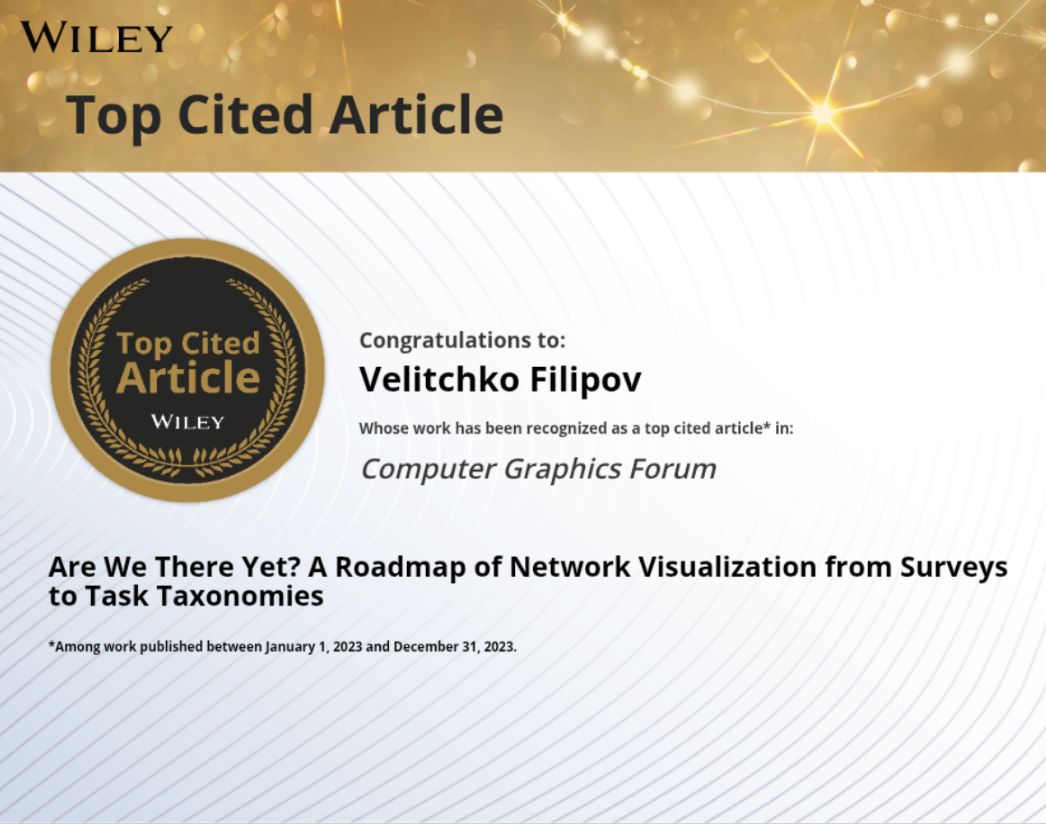
Velitchko Filipov is a PostDoc Researcher at the Institute of Visual Computing & Human-Centered Technology within the Faculty of Informatics at Vienna University of Technology (TU Wien). His work focuses on advancing Information Visualization and Visual Analytics, with a strong specialization in Dynamic Network Analysis. He is currently involved in multiple research projects including ArtVis (2022-2027), SANE (2024-2027), VaCoViCu2 (2023-2027), and SMGV-Esprit (2024-2027), with ArtVis funded by the Austrian Science Fund (FWF). Dr. Filipov completed his doctoral dissertation titled "Networks in time and space: visual analytics of dynamic network representations" at TU Wien in 2024. Prior to that, he completed his Diploma Thesis "Visual exploration and comparison of multiple resume: focus on time and space" at the same institution in 2017. His research centers on creating innovative visual representations and interactive techniques for exploring complex, time-varying networks. These approaches have significant applications in Art History, where understanding the evolution of artistic movements is crucial, and Information Diffusion. His work also benefits computational social sciences and digital humanities by providing tools to uncover patterns within evolving relational data. He has made notable contributions to uncertainty visualization, network physicalization, and the visualization of historical networks. Dr. Filipov's publication record shows a clear progression from foundational work on CV visualization and biographical trajectory mapping toward increasingly sophisticated techniques for dynamic network analysis. His recent work demonstrates a strong focus on making network data tangible through physicalization techniques and on addressing uncertainty in network representations, reflecting the evolving challenges in the visualization field. His scientific achievements have been recognized with several prestigious awards: Best Paper Award at EuroVis 2025 for "NODKANT: Exploring Constructive Network Physicalization" Top Cited Article 2025 in Computer Graphics Forum for "Are We There Yet? A Roadmap of Network Visualization from Surveys to Task Taxonomies" Nominee for Best Dissertation Award 2024 at TU Wien Informatics Best Paper at VIS4DH 2019 Graph Drawing Contest winner in 2019 and 2018 Dr. Filipov actively supervises students, with recent theses including "Dynamic network analysis with centrality measures" (2024) and "Utilizing visual analytics for network exploration in the domain of art history research" (2023). His research is supported by multiple grants, most notably the FWF project ArtVis. He collaborates extensively with researchers across Europe, particularly with Silvia Miksch, Wolfgang Aigner, and Renata Raidou. He is a key member of the Visual Analytics research group at TU Wien, participating in interdisciplinary collaborations that bridge computer science with art history and digital humanities. His work on the ArtVis project exemplifies this approach, developing visualization techniques specifically tailored to address the research challenges faced by art historians studying artistic networks and influence.
Markus Steinberger is an Associate Professor at Graz University of Technology (TU Graz), leading the GPU Computing and Visualization Group at the Institute for Computer Graphics and Vision. He holds a PhD (2013) and Habilitation (2020) in Computer Science from TU Graz. His research focuses on GPU scheduling, parallel computing, real-time rendering, and procedural content generation. He has held roles including Assistant Professor (2015–2021) and Director of Cloud Rendering at Huawei (2021–present). Education: MSc (2010), PhD (2013), Habilitation (2020) in Computer Science from TU Graz PostDoc and Research Positions: NVIDIA (2013–2014), Max Planck Institute (2015–2017) Research interests include dynamic resource scheduling, GPU algorithms, and high-performance visualization. His work has been recognized with awards such as the GI Dissertation Prize (2014), Eurographics Best Paper (2021), and the Heinz Zemanek Prize. Key Projects: Cloud-native rendering, procedural planet rendering, and GPU-optimized algorithms Advising includes PhD student Karl Haubenwallner. His lab explores cutting-edge techniques in real-time graphics and parallel computing.
Zhang Jun is a Full Professor of Physics and Mathematics and Co-director of the Applied Math Lab at the Courant Institute, New York University (NYU), USA. He also serves as Co-director of the NYU-ECNU Joint Physics Research Institute in Shanghai, China, and holds an Affiliated Professorship at NYU Shanghai. His research focuses on experimental fluid physics, particularly fluid-structure interactions in biological and geophysical contexts, including bio-locomotion, flapping wings, and continental dynamics. Zhang has authored over 290 invited talks and peer-reviewed papers in journals like Nature and Physical Review Letters. He received the 2017 APS Fellow award for pioneering work in fluid-structure interactions. Beyond academia, he is a freelance illustrator with plans to publish a book of sketches. Education: PhD in Physics (1994), Niels Bohr Institute, University of Copenhagen PhD Candidate (1990-1991), Hebrew University of Jerusalem BSc in Physics (1985), Wuhan University Research Interests: Zhang’s work bridges physics, biology, and geophysics, exploring phenomena like flapping wing aerodynamics, animal locomotion, and Earth’s core-mantle interactions. His experiments often use novel fluid dynamics setups to model natural systems. Awards: APS Fellow (2017) Milton Van Dyke Award (2014) Antarctica Service Medal (2015) Labs & Teams: Co-directs the Courant Institute’s Applied Math Lab, specializing in fluid dynamics experiments. Collaborates with institutions globally, including NYU Shanghai and Aix-Marseille University.
Pedro Larrañaga is a Full Professor in Computer Science and Artificial Intelligence at the Technical University of Madrid (UPM) since 2007. He co-leads the Computational Intelligence Group at UPM. Previously, he held academic positions at the University of the Basque Country, including Professor, Associate Professor, Assistant Professor, and Lecturer roles in the Department of Computer Science and Artificial Intelligence from 1985–2007. Academic Rank: Professor Departments: Department of Artificial Intelligence (UPM), Department of Computer Science and Artificial Intelligence (University of the Basque Country) His research focuses on machine learning with applications in biomedical domains, neuroscience, industry, and sports analytics. Key contributions include structure learning algorithms for Bayesian networks, probabilistic graphical models for multi-dimensional classification, feature subset selection methods, and the development of estimation of distribution algorithms as an evolutionary computation metaheuristic. Research trends span machine learning methodologies and their interdisciplinary applications in Biomedicine, Bioinformatics, Neuroscience, Industry4.0, Sport Analytics , and Multi-label classification . Scientific Awards: National Prize of the Spanish Association for Artificial Intelligence (2018) Spanish National Prize in Computer Science, Aritmel Award (2013) ECAI-Fellow (2012)
Christos Terzis is a Postdoctoral Researcher in the Research Group 'Ancient Music' at the Austrian Academy of Sciences, Vienna, maintaining dual institutional ties with Athens, Greece through the Academy's branch office. His research integrates philological rigor with digital innovation across interconnected domains: Ancient Greek music theory (harmonics and acoustics), reconstruction of musical instruments and notation systems, Greek paleography, and textual philology. He pioneers methodologies in Digital Humanities for scholarly editions while advancing reconstructions of ancient Greek language pronunciation and vocal practices. Terzis currently directs two major initiatives: the DiAGRAM project (Digitizing Aspects of Graphical Representation in Ancient Music) and the Documentation and Interpretation of Dion's Organ, merging computational approaches with material culture studies to decode ancient musical heritage.
FH-Prof. Dr. Markus Seidl is a Professor in the Department of Media and Digital Technologies at the University of Applied Sciences St. Pölten. He leads the Creative Computing (BA) program and serves as interim head of the Media Computing Research Group within the Institute of Creative Media/Technologies. His roles include academic director and former Managing Director (2015–2020). Seidl holds a PhD in Computer Vision from TU Wien (2016) and has extensive experience in interdisciplinary projects, particularly in digital cultural heritage. His research focuses on computer vision techniques for analyzing rock art (petroglyphs) and enhancing museum experiences through multi-touch interfaces and BYOD integration. Key projects include the Europa Nostra-award-winning rock art analysis work and multi-touch table applications exhibited globally. He has supervised over 20 theses on topics like medieval manuscript analysis and AI-driven cultural artifact understanding. Notable contributions span 120+ publications, including work on 3D surface segmentation, flood level estimation from social media, and interactive museum technologies. His work bridges computer science with archaeology, design, and education, emphasizing experiential learning and technology-driven cultural preservation.
Shahzad Ahmad is a Researcher at the Institute of Networks and Security within Johannes Kepler University Linz (JKU), actively affiliated with the LIT Secure and Correct Systems Lab. His work bridges theoretical cryptography and practical security implementations with geometric data applications. Master of Science (MSc) degree holder His research concentrates on cryptographic security mechanisms, including control flow integrity verification and deniable encryption systems, while also advancing geometric algorithms for point cloud manipulation. This dual focus demonstrates significant interdisciplinary contributions to both computer security and spatial data processing domains. Publication analysis reveals consistent innovation in cryptographic protocol design, particularly in malware-resistant instruction chaining and plausibly deniable storage systems. His geometric research shows methodological evolution from Euclidean foundations toward customized metric spaces for complex point cloud relationships. No scientific awards were documented in the source materials. Available records indicate no formal student advising responsibilities or grant funding disclosures. As a core contributor to JKU's LIT Secure and Correct Systems Lab, Ahmad participates in developing formally verified security architectures and cryptographic implementations resistant to side-channel attacks.
Rainer Alexandrowicz is an Associate Professor and Head of the Department of Methodology at Alpen-Adria-Universität Klagenfurt. His research focuses on psychometrics, item response theory (IRT), applied statistics, and psychological methodology, with applications in clinical research and software security assessment. Affiliation: Institute of Psychology, Department of Methodology Key Research Areas: Psychometric validation, Bayesian hierarchical modeling, clinical diagnostics Recent publications highlight his work in developing statistical tools (e.g., Rmx/piccc) and cross-cultural adaptations of psychological inventories. He has contributed to understanding team dynamics in sports and analyzing diagnostic scales like the Beck Depression Inventory. His methodological expertise spans IRT, Rasch modeling, and software development for statistical analysis. He actively engages in teaching and consultation, with office hours available by appointment.
Maja Osojnik is a lecturer for composition at the Salzburg University of Applied Sciences since 2018 and teaches improvisation/KEP Contemporary Music Performance at the Music and Arts Private University of the City of Vienna (MUK) since 2020 within the Faculty of Music. Her research interests span experimental sound art, electroacoustic composition, and contemporary improvisation. Osojnik deconstructs sonic boundaries through lo-fi electronics, field recordings, and unconventional instruments including Paetzold bass recorders, cassette players, and broken sound libraries. Her work explores the limbo between analog and digital, virtual and real spaces, combining experimental techniques with elements of noise, rock, early music, and traditional forms. Her most recent publications reveal trends in radio play hacking, networked performance, and graphic score production. Osojnik's work consistently investigates sound degradation, circuit bending, and the transformation of broken instruments into new sonic palettes. 2023: hörspiel_hacking (radio play composition) 2020: DRUCK (collaborative circuit-bending project) 2018: Berlin Radio Play Festival First Prize (WENDY PFERD TOD MEXICO) 2014: City of Vienna Composition Prize 2009/2019: Austrian State Composition Scholarship Osojnik leads multiple ensembles including Rdeča Raketa, Broken.Heart.Collector, and the Maja Osojnik Band. She founded MAMKA RECORDS in 2018 for self-produced recordings and graphic sound scores. Her sound installations and performance projects often involve custom-built electronics, field recordings, and collaborative networks across Austria, Slovenia, and international festivals.
Klaus Mueller is a Professor in the Computer Science Department at Stony Brook University , with additional appointments in Biomedical Engineering and Radiology. He serves as Director of the Visual Analytics and Imaging (VAI) Lab, Liaison for the SUNY Korea CS Program, and Interim Chair of the Department of Technology and Society . His career spans roles at Brookhaven National Lab and leadership positions at SUNY Korea. Dr. Mueller earned his PhD in Computer and Information Science (1998), MS in Computer and Information Science (1996), and MS in Biomedical Engineering (1990) from The Ohio State University , alongside a BS in Electrical Engineering (1987) from the Polytechnic University of Ulm, Germany. His research focuses on visual analytics , explainable AI , algorithmic fairness , computational imaging , and medical imaging . He has pioneered GPU-accelerated CT reconstruction techniques, bias mitigation frameworks (e.g., D-BIAS), and tools like DOMINO for causal reasoning. His work bridges data science , human-computer interaction , and medical applications , often integrating large language models for visualization tasks. Recent publications highlight advances in multivariate volume rendering , LLM-driven bias detection , and mDDPM-based medical image synthesis . His articles span IEEE Transactions , Nature Machine Intelligence , and conferences like IEEE VIS and ACM CHI . Award highlights include NSF CAREER (2000), SUNY Chancellor Award (2011), IEEE Golden Core Award (2016, 2022), induction into the National Academy of Inventors (2018), and elevation to IEEE Fellow (2024). He has chaired major conferences and served as Editor-in-Chief of IEEE Transactions on Visualization and Computer Graphics (2019-2022). He teaches graduate and undergraduate courses in visualization , medical imaging , and GPGPU programming , and leads the Visual Analytics Seminar (CSE 648). His lab ( VAI Lab ) fosters interdisciplinary research in GPU-accelerated analytics and ethical AI.
Keith Andrews is an Associate Professor at the Graz University of Technology , affiliated with the Department of Human-Centred Computing. His research spans Human-Computer Interaction (HCI), Information Visualization, and Web Usability, with a focus on improving interactive tools, responsive design, and accessibility in data visualization. Andrews' work emphasizes practical applications, including the development of responsive SVG chart libraries and pedagogical strategies for teaching HCI to large undergraduate cohorts. His research integrates principles from Computer Science, User Experience (UX), and Software Engineering. Scientific Awards Best Paper Award at IWAIT 2019 Certificate of Appreciation 2006 Heinz Zemanek Preis 1998 Steirische Vielfalt visualisiert 2016 Recent publications highlight trends in Information Visualization , Responsive Web Design , and Active Learning algorithms. His projects, such as DYONIPOS and UX Day Graz, demonstrate a commitment to interdisciplinary collaboration and real-world impact.