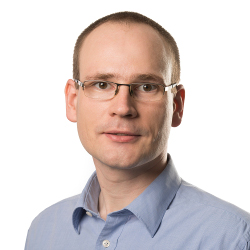
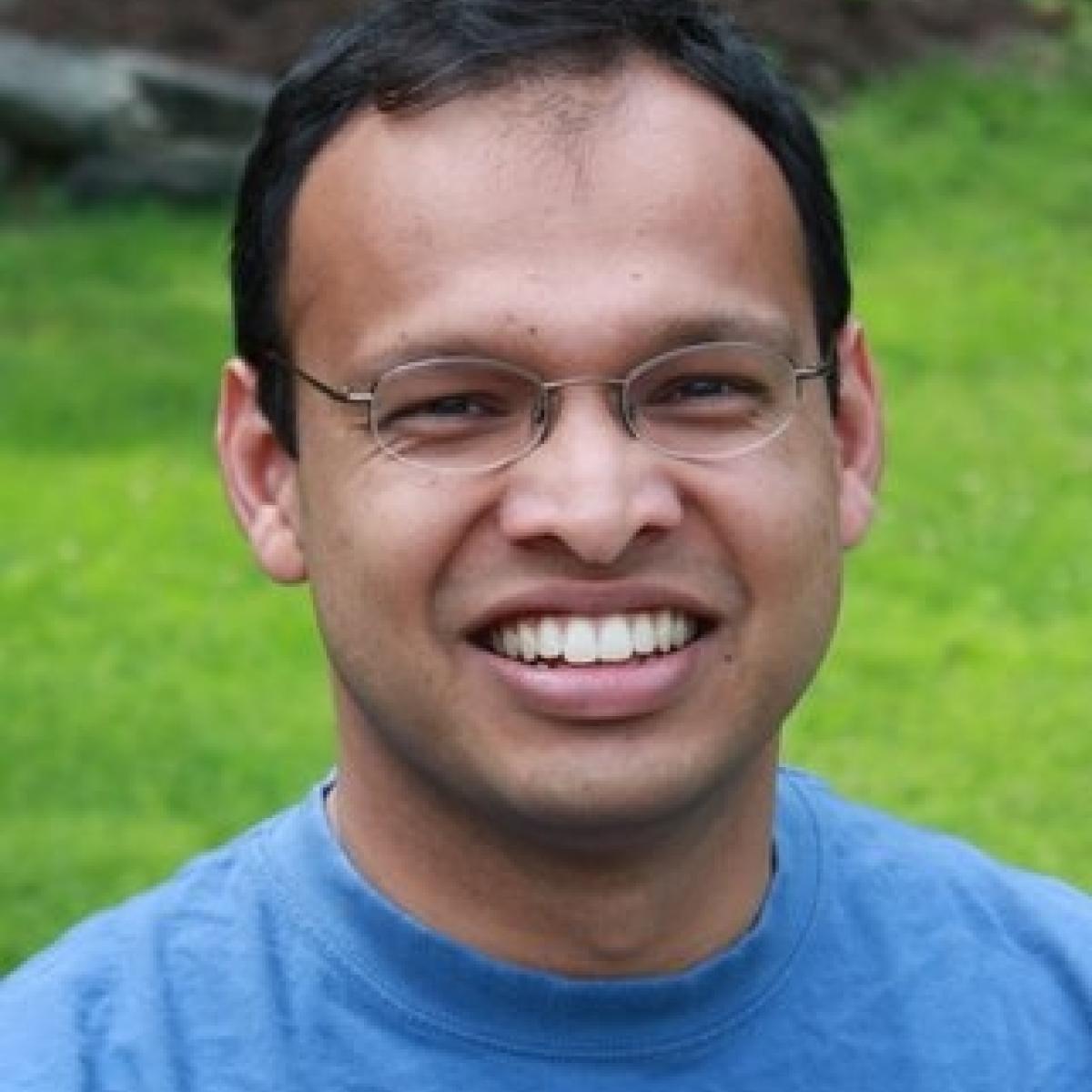
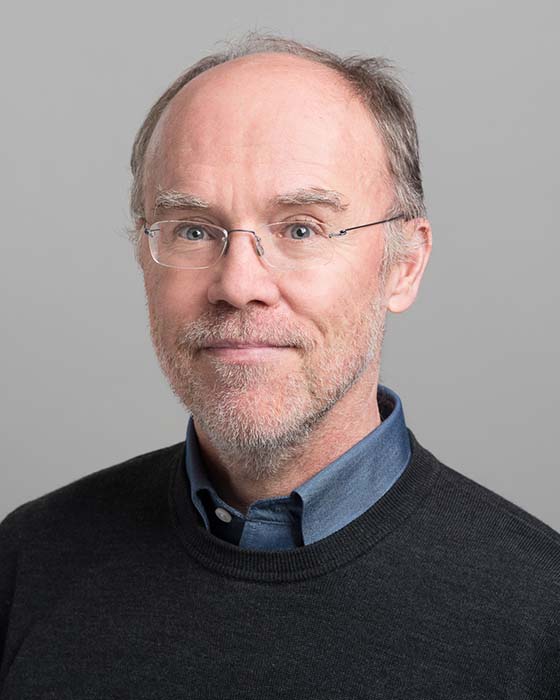
Christian Ikenmeyer is Professor in Computer Science and Mathematics at the University of Warwick. His research focuses on algebraic complexity theory, geometric complexity theory (GCT), and representation theory, with emphasis on tensor rank, Kronecker coefficients, and polynomial identity testing. Research Focus: Dr. Ikenmeyer develops mathematical frameworks to solve fundamental problems in computational complexity, including P vs NP. His work connects representation theory with algebraic geometry to establish complexity lower bounds and classify computational hardness. Leadership: He organizes workshops on algebraic complexity and GCT, including the 2023 Algebraic Complexity Theory Workshop at ICALP. His research is funded by EPSRC and DFG grants, supporting investigations into homogeneous complexity and branching programs. Teaching: Courses include 'Groups and Representations' and programming contest coaching. He has previously taught at MIT, Texas A&M, and Saarland University, developing lecture notes on GCT.
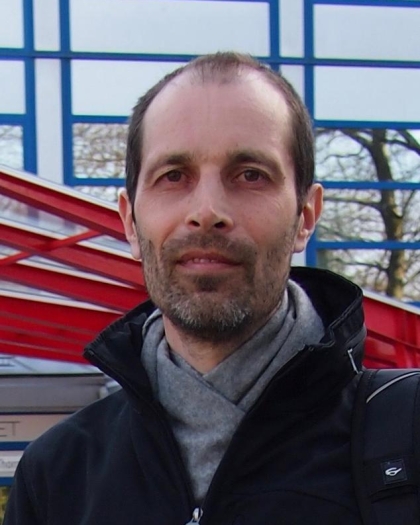
Wilfried Gansterer is a Professor at the Faculty of Computer Science, University of Vienna, leading the Theory and Applications of Algorithms research group. His work focuses on numerical algorithms, distributed computing, and machine learning, with notable contributions to graph neural networks and fault-tolerant systems. Active in projects such as Algorithmic Data Science for Computational Drug Discovery (2020–2028) and REPEAL (Resilience vs. Performance in Numerical Linear Algebra, 2016–2020). Research Interests: Dr. Gansterer’s expertise spans graph neural networks, matrix compression, adversarial defense mechanisms, and high-performance computing. His work addresses challenges in efficient computation, resilience against node failures, and optimizing distributed systems. Projects : Algorithmic Data Science for Computational Drug Discovery (2020–2028) REPEAL: Resilience vs. Performance in Numerical Linear Algebra (2016–2020) Verteiltes Rechnen (Distributed Computing, 2007–2014) Awards : 2023 Best Paper Award for work on Crossfire: An Elastic Defense Framework for Graph Neural Networks. Labs/Teams : Directs the Theory and Applications of Algorithms group, focusing on algorithmic innovation in distributed and high-performance computing environments.
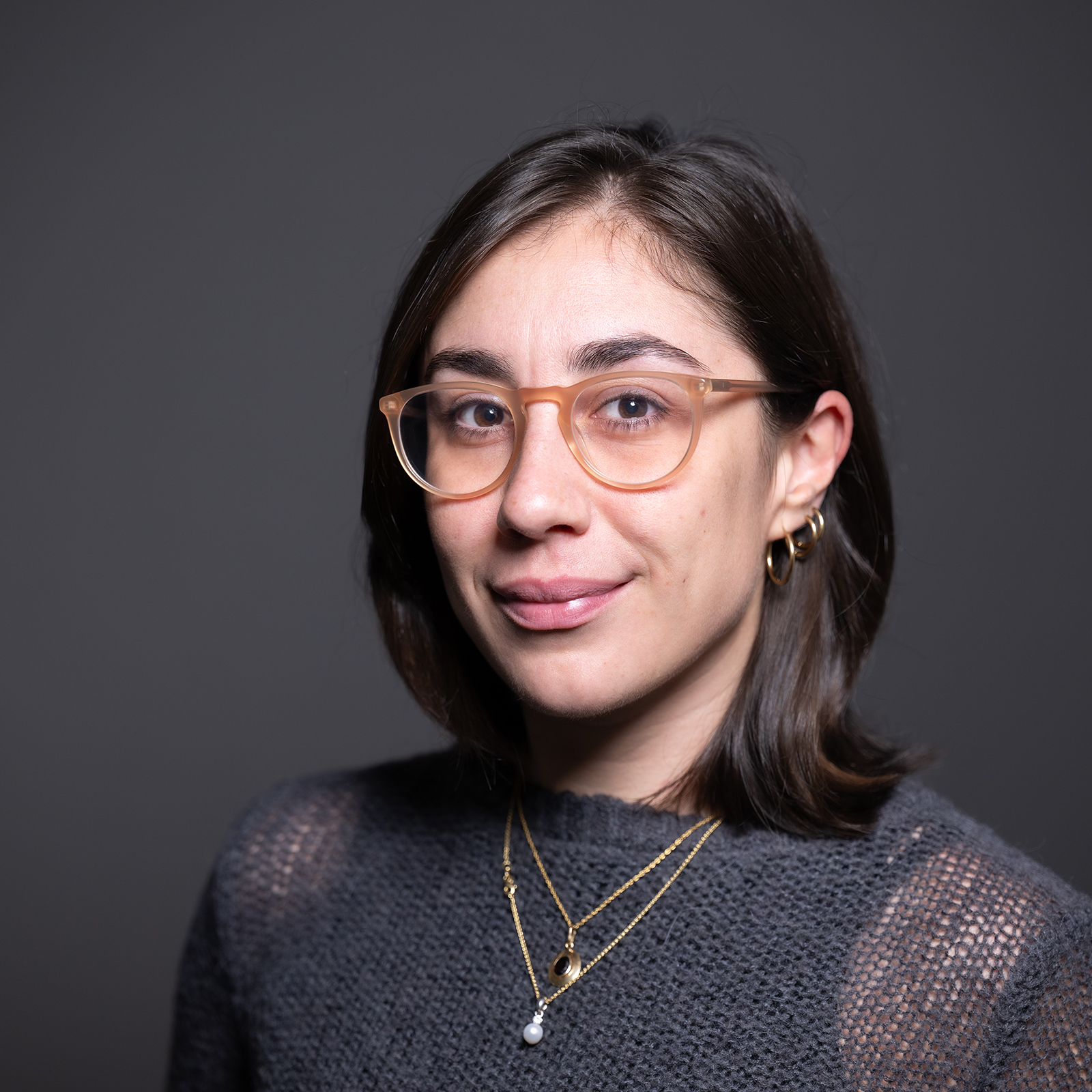
Giulia Guidi is an Assistant Professor of Computer Science at Cornell University, affiliated with the Cornell Ann S. Bowers College of Computing and Information Science. She leads the Cornell High-Performance Computing (HPC) Group and is an Affiliate Faculty at Lawrence Berkeley National Laboratory’s Performance and Algorithms Research Group. Her research focuses on high-performance computing for computational sciences, sparse linear algebra, and scalable software infrastructure for parallel systems. She holds a PhD in Computer Science from UC Berkeley (2022) and has been recognized with awards including the 2024 SIAG/Supercomputing Early Career Prize and the 2023 ISSNAF Young Investigator Award. Her work addresses challenges in genomics, population genetics, and scalable computational methods through collaborations like the NSF-funded 'ACED' project with April Wei’s Lab. Guidi mentors a diverse group of PhD, MEng, and undergraduate students, emphasizing parallel programming and HPC applications. Her lab’s research spans GPU-accelerated algorithms, sparse matrix computations, and bioinformatics tools like the Popcorn and BELLA aligners. She is also a Graduate Field Faculty in Computational Biology and Applied Mathematics at Cornell.
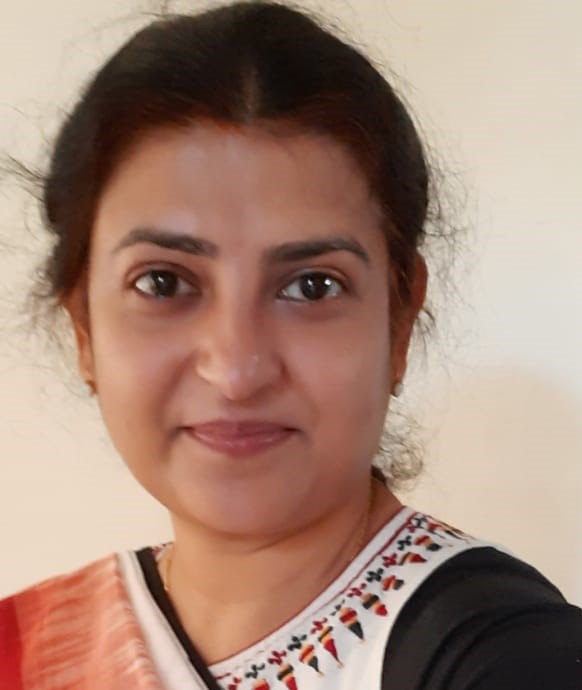
Dr. Dipanwita Thakur serves as Assistant Professor at the Department of Computer Engineering, Modeling, Electronics and Systems (DIMES) at the University of Calabria, Italy since July 2023. She is an active member of the European Cooperation in Science & Technology (COST Action CA22104) focusing on cybersecurity and serves in the IEEE Future Networks Working Group for Artificial Intelligence/Machine Learning. Previously, she held a 15-year Assistant Professor position at Banasthali University, Rajasthan, and has industry experience at TechMahindra and C-DAC. Education: Ph.D. in Smart Healthcare from West Bengal University of Technology, Kolkata M.Tech. in Software Engineering from Banasthali Vidyapith MCA from NIELIT, Government of India B.Sc. from University of Calcutta Her research pioneers Green Artificial Intelligence with emphasis on energy-efficient federated learning and smart healthcare applications. She develops privacy-preserving human activity recognition systems using multimodal data fusion, focusing on performance evaluation and environmental sustainability. Her work bridges theoretical machine learning with practical healthcare solutions, optimizing AI systems for reduced carbon footprint while maintaining clinical efficacy through hardware-algorithm co-design and quantization techniques. Recent publications reveal a strong trajectory toward sustainable AI, with increasing focus on energy-aware federated learning frameworks, multimodal medical segmentation, and non-IID data handling. Her work consistently addresses the critical balance between model accuracy, convergence speed, and energy consumption across edge devices, with growing emphasis on quantization techniques and hardware-algorithm co-design for real-world deployment. Scientific Awards: Elevated to IEEE Senior Member (2024) Dr. B.C. Roy Memorial Scholarship for outstanding 10th Board results (1992) Student Science Seminar Award by West Bengal Government (1990) Dr. Thakur actively mentors students as evidenced by her congratulations to advisee Farwa for paper acceptances. She serves as Associate Editor for Information Fusion (Elsevier) and IEEE Sensors Journal, and holds editorial roles at Scientific Reports. Her research is advanced through COST Action CA22104 and IEEE working groups, though specific grant details aren't listed in the source material. She has organized key workshops including Green-Aware AI 2024 and Green Federated Learning at IJCNN 2025. She leads research within the MONAI community on data quality and federated learning, and contributes to IEEE IoT and Future Networks initiatives. Her work with the COST Action CA22104 Behavioral Next Generation in Wireless Networks connects cybersecurity with sustainable AI development, while her Missouri S&T visiting scholar position focuses on energy optimization for federated learning systems.
Dr. Thomas Chaffey is a Lecturer in the School of Electrical and Computer Engineering at The University of Sydney. His research focuses on nonlinear control theory, convex optimization, and neuromorphic systems. He obtained his PhD from the University of Cambridge (2022) and held the Maudslay-Butler Fellowship at Pembroke College, Cambridge (2022–2025). Education: PhD in Control Theory, University of Cambridge (2022) Maudslay-Butler Fellowship in Engineering, Pembroke College, Cambridge (2022–2025) Master's in Mechanical Engineering, University of Sydney (Australia) Bachelor's in Mathematics and Computer Science, University of Sydney (Australia) Research Interests: Nonlinear control theory and its intersections with optimization and circuit theory Development of neuromorphic systems and analog hardware simulation Monotone operator methods and large-scale optimization algorithms Key Research Trends in Articles: Advances in graphical methods for nonlinear system analysis (e.g., scaled relative graphs) Analysis of neuromorphic circuits using convex optimization frameworks Exploration of symmetry properties in physical systems Awards: Best Student Paper Award, 2021 European Control Conference Outstanding Student Paper Award, 2021 IEEE Conference on Decision and Control Labs/Teams: Leading projects on learning in physical systems and monotone circuits Collaborations with institutions like Lund University and University of British Columbia
Jaakko Timo Henrik Järvi is a Professor in the Department of Informatics at the University of Bergen, Norway, with additional affiliations at the University of Turku, Finland. His research focuses on programming language design, generic programming, and human-computer interaction, particularly in GUI frameworks and software reuse. His research interests include generic programming, programming language design (especially the Magnolia language), high-performance computing, array programming, and GUI engineering. He emphasizes formal methods and algebraic specifications to build reusable and efficient software systems. His work bridges theoretical foundations with practical applications in software development and education. The recent publications highlight a strong trend in declarative GUI frameworks, multi-selection models, and generic programming. His work explores domain-specific languages for GUI structure manipulation, reusable selection semantics across platforms, and optimizing array computations using the Mathematics of Arrays. These efforts reflect a consistent focus on software abstraction, correctness, and reusability. Jaakko Järvi has supervised doctoral students, including Tetiana Yarygina, whose dissertation explored microservice security. While no specific grants are detailed, his work on VisAST was supported by the Research Council of Norway (Project 250683), indicating active external funding. He frequently collaborates with researchers like Magne Haveraaen, Knut Anders Stokke, and Sean Parent. He contributes to tools and frameworks such as the MultiselectJS library and the VisAST educational tool. These are outcomes of collaborative research teams focused on improving software development practices and computer science education.
Nikhil Bansal holds the prestigious Patrick C. Fischer Professorship of Theoretical Computer Science in the Department of Computer Science & Engineering at the University of Michigan's College of Engineering. His research program has established him as a leading figure in theoretical computer science, with significant contributions to algorithm design and analysis, particularly in discrete optimization problems. Bansal's research focuses on theoretical computer science with emphasis on design and analysis of algorithms for discrete optimization problems. His work spans multiple areas including discrepancy theory, approximation algorithms, randomized algorithms, combinatorial optimization, complexity theory, machine learning theory, and probability. He has made significant contributions to understanding the limits of approximation algorithms and developing novel techniques for combinatorial optimization problems. Analysis of Bansal's recent publications reveals a strong focus on discrepancy theory, online algorithms, and combinatorial optimization. His work often bridges theoretical computer science with discrete mathematics and probability theory. A recurring theme across his publications is the development of novel algorithmic techniques for solving NP-hard problems with provable guarantees. His research has evolved from foundational work in approximation algorithms to more recent contributions in quantum computing complexity and stochastic optimization. Patrick C. Fischer Professor of Theoretical Computer Science Bansal has advised numerous PhD students including Marek Elias, Shashwat Garg, and Greg Koumoutsous, as well as mentoring several postdoctoral researchers. He has served on editorial boards for top journals including Journal of the ACM, Theory of Computing, and Stochastic Models, and has been active on program committees for major conferences such as STOC, FOCS, SODA, and ICALP, including serving as chair for ICALP 2021. Bansal has organized multiple academic workshops including the STOC 2020 Workshop on Recent Advances in Discrepancy and Applications, several SDP Days at CWI Amsterdam, and the Semester on Bridging Continuous and Discrete Optimization at UC Berkeley in Fall 2017.
Nikhil Bansal is a Professor in Theoretical Computer Science at the University of Michigan, Ann Arbor. He earned his PhD from Carnegie Mellon University and previously worked at IBM Research, TU Eindhoven, and CWI Amsterdam. His research focuses on algorithm design, discrepancy theory, and combinatorial optimization. Education: PhD, Carnegie Mellon University Bansal's work bridges classical and quantum computing, with recent publications exploring k -Forrelation, vector balancing, and stochastic scheduling. His algorithmic approaches often combine geometric insights and probabilistic methods. Scientific Awards: Patrick C. Fischer Professor of Theoretical Computer Science NSF Career Award (2023) He has advised numerous PhD and postdoctoral researchers, including Marek Elias, Shashwat Garg, and Makrand Sinha. Bansal actively contributes to program committees (ICALP 2021, STOC 2020, FOCS 2018) and organizes workshops on discrepancy theory and optimization.
Professor Martin Hyland is a Professor of Mathematical Logic in the Department of Pure Mathematics and Mathematical Statistics within the Faculty of Mathematics at the University of Cambridge. His work bridges mathematical logic, category theory, and theoretical computer science, with significant contributions to lambda calculus, realizability, and game semantics. Professor Hyland's research spans three interconnected domains: Mathematical Logic (focusing on Lambda Calculus, Recursion Theory, Realizability, Proof Theory, and Linear Logic), Category Theory (specializing in Topos Theory, Categorical Algebra, Operads, and Higher-dimensional Categories), and Theoretical Computer Science (exploring Applications of Category Theory, Domain Theory, Polymorphism, and Game Semantics). His work demonstrates how abstract mathematical structures can illuminate computational phenomena. His recent publications reveal a continued focus on categorical structures for computation, with increasing attention to higher-dimensional categorical frameworks. His work connects foundational logic with practical computational models, showing how category theory provides unifying principles across diverse computational paradigms. The progression from lambda calculus to game semantics to higher categorical structures demonstrates deepening connections between abstract mathematics and computation. Professor Hyland has made foundational contributions to game semantics, categorical models of lambda calculus, and the categorical understanding of algebraic theories. His work on computational effects, particularly in papers like 'Combining algebraic effects with continuations' and 'Combining computational effects: Commutativity and sum,' has influenced both theoretical computer science and practical programming language design.
Jorg Liebeherr is a Professor in the Department of Electrical and Computer Engineering at the University of Toronto, holding the Nortel Chair of Network Architecture and Services. His research focuses on computer networks , particularly network calculus , self-organizing networks , protocol design , and traffic scheduling . Education: Diplom-Informatiker (with distinction), University of Erlangen (Germany), 1988 PhD, Computer Science, Georgia Institute of Technology, 1991 His recent work includes low-cost LoRa mesh networks for environmental sensing and mathematical frameworks for traffic control in 5G and IoT systems. Publications span journals like IEEE Internet of Things Journal and conferences such as IEEE Infocom and ACM Sigmetrics . Scientific Awards: IEEE Fellow (2008) Outstanding Service Award, IEEE ComSoc TC on Computer Communications (2006) ACM Sigmetrics Best Student Paper Award (2005) NSF CAREER Award (1996) Advising and Grants: Supervised 15+ theses (MASc/PhD) and secured grants from NSF, Virginia Engineering Foundation, and industry partners. Labs: Leads the Network Research Lab and HyperCast projects, an open-source platform for application-layer internetworking.
Jonathan Leake is an Assistant Professor in the Department of Combinatorics and Optimization at the University of Waterloo. His research lies at the intersection of combinatorics, optimization, and theoretical computer science, with a focus on log-concave and Lorentzian polynomials and their applications in discrete and continuous settings. Assistant Professor, University of Waterloo (2022–present) Dirichlet Postdoctoral Fellow, TU Berlin (2020–2022) Postdoctoral Fellow, Institut Mittag-Leffler, Stockholm (Spring 2020) Postdoctoral Fellow, KTH, Stockholm (Fall 2019) James H. Simons Fellow, Simons Institute, UC Berkeley (Spring 2019) His research explores the deep connections between algebraic structures and combinatorial phenomena, particularly through polynomial capacity and Lorentzian polynomials. He applies these tools to problems in optimization, sampling, and representation theory. His work often involves developing new algebraic and analytic techniques to tackle longstanding conjectures and algorithmic challenges. The recent publications highlight a consistent focus on Lorentzian polynomials, capacity bounds, and their applications in combinatorics, optimization, and theoretical computer science. Key themes include matroid theory, log-concavity, sampling algorithms, volume approximation, and connections to Lie theory and representation theory. The research spans both theoretical developments and algorithmic applications, often in collaboration with leading researchers in the field. Dirichlet Postdoctoral Fellowship, TU Berlin Postdoc Fellowship in Algebraic and Enumerative Combinatorics, Institut Mittag-Leffler James H. Simons Fellowship, Simons Institute, UC Berkeley Jonathan Leake has advised or collaborated with several researchers, though formal advisees are not listed in the provided text. His work has been supported by prestigious fellowships and collaborations with institutions such as the Simons Institute and TU Berlin. He has taught courses including CO 250: Introduction to Optimization, MATH 239: Introduction to Combinatorics, and CO 739: Lorentzian Polynomials at the University of Waterloo and TU Berlin. While specific lab or research group names are not mentioned, Leake's collaborative work with researchers like Petter Brändén, Nisheeth Vishnoi, and Leonid Gurvits suggests active participation in research teams focused on algebraic combinatorics, optimization, and theoretical computer science. His publicly shared code for sampling from HCIZ densities and verifying positivity in Lie-theoretic contexts indicates an active computational research component.
Carlos Palazuelos Cabezón is a Professor in the Department of Mathematical Analysis and Applied Mathematics at the Faculty of Mathematical Sciences, Universidad Complutense de Madrid (UCM), with a joint affiliation at the Instituto de Ciencias Matemáticas (ICMAT). He holds a Ramón y Cajal contract and has been a Full Professor since 2024, following his role as Associate Professor from 2019 to 2024. His work bridges deep mathematical theory and quantum information science. Research Interests: His primary research lies at the intersection of functional analysis and quantum information theory. He investigates operator spaces and their applications to quantum entanglement, Bell inequalities, quantum channels, and nonlocal games. A second major line involves noncommutative harmonic analysis, particularly hypercontractivity in von Neumann algebras. His work is highly theoretical and appears in top mathematical and physics journals. Publication Trends: His recent publications demonstrate a consistent focus on the mathematical foundations of quantum information, particularly using tools from operator space theory and Banach space geometry to analyze quantum nonlocality, entanglement, and computational models. There is a strong trend toward solving foundational problems in quantum theory using advanced functional analysis. Scientific Awards: Premio Extraordinario de Doctorado (2008/2009) Doctorado Europeo Advising and Grants: While no specific students are listed, he is part of the MathQI research group and has likely mentored graduate students. He has been supported by prestigious postdoctoral and permanent research contracts in Spain, including the Juan de la Cierva and Ramón y Cajal programs, which are highly competitive grants for early-career and established researchers, respectively. Labs and Teams: He is a member of the MathQI research group (Mathematical Quantum Information) at UCM and is affiliated with ICMAT, a leading mathematics research institute in Spain. These affiliations provide a collaborative environment for interdisciplinary research in mathematical physics and quantum information.
Jill Dunham is an Associate Professor in the Department of Mathematics at Schmid College of Science and Technology , Chapman University. Her research spans topological graph theory , computational problems in discrete mathematics , recreational mathematics , and pedagogy , focusing on tactile learning and course assessment. She earned a B.Sc. from Iowa State University and M.Sc. and Ph.D. from George Mason University. Education: B.Sc. in Mathematics, Iowa State University M.Sc. in Mathematics, George Mason University Ph.D. in Mathematics, George Mason University Her research projects include finding the maximum touching number for coin graphs , enumerating solutions to paper-folding problems , and applying graph theory to commutative algebra structures . She also contributes to pedagogical innovations through hands-on activities in undergraduate mathematics education. Recent publications include work on round-robin tournaments , edge colorings in Hamiltonian cycles , and coin graph representations . Her collaborations appear in volumes like The Mathematics of Various Entertaining Subjects and Numery .
Rudi A. Pendavingh is an Assistant Professor at Eindhoven University of Technology's Mathematics and Computer Science department, specializing in Combinatorial Optimization. He earned his PhD at the University of Amsterdam in topological graph theory and has since contributed to diverse areas of combinatorics and geometry, with recent focus on matroid theory. His teaching spans mathematical programming topics including linear, integer, and semidefinite optimization. Education: PhD in Topological Graph Theory (University of Amsterdam) His research integrates combinatorial structures with geometric and algebraic methods, particularly in matroid theory, graph embeddings, and tropical geometry. Key publication themes include optimization algorithms, excluded matroid minors, and geometric invariants. Collaborations extend to institutions in mathematics and applied sciences, with notable academic output (67 research items) and external partnerships. Recent research outputs (2022-2025) highlight his work on the Colin de Verdière parameter, Dressian bounds, and tropical amoebas. While no explicit awards are mentioned in the provided text, his contributions to combinatorial optimization and network collaborations underscore his academic impact. He has supervised 29 students and contributed to 7 courses, including Discrete Optimization Modeling and Mathematics II.
Ralf Hiptmair is a Full Professor at ETH Zürich, serving as Head of the Seminar for Applied Mathematics and Deputy Head of the Department of Mathematics. He also holds the position of Director of Studies for ETH BSc and MSc in Computational Sciences and Engineering (CSE). His research spans computational mathematics, numerical analysis, finite element methods, boundary element methods, computational electromagnetism, multigrid methods, discrete differential forms, shape optimization, wave propagation, and kinetic equations. Hiptmair's work on auxiliary space methods was recognized as a breakthrough in computational science in the 2008 DOE Report on recent significant advancements in computational science. His research focuses on developing and analyzing numerical methods for partial differential equations, with particular emphasis on structure-preserving discretizations, computational electromagnetism, and boundary integral equations. His work has significant applications in engineering, physics, and computational science. Hiptmair's publications demonstrate a strong focus on advancing numerical techniques for electromagnetic problems, wave propagation, and shape optimization. His recent work shows increasing interest in computational topology, geometric numerical integration, and interdisciplinary applications of numerical methods. Featured as breakthrough in computational science in the 2008 DOE Report on recent significant advancements in computational science (for Auxiliary space methods) Hiptmair has supervised numerous doctoral, master's, and bachelor's students across mathematics, computational science and engineering, and related fields. His research group has received funding for developing advanced numerical methods with applications in electromagnetism, fluid dynamics, and computational physics. He is actively involved in teaching numerical methods courses at both undergraduate and graduate levels. Hiptmair leads research efforts in the Seminar for Applied Mathematics, collaborating with industry partners like ABB Corporate Research and Siemens on practical applications of computational methods. His work bridges theoretical numerical analysis with real-world engineering challenges.