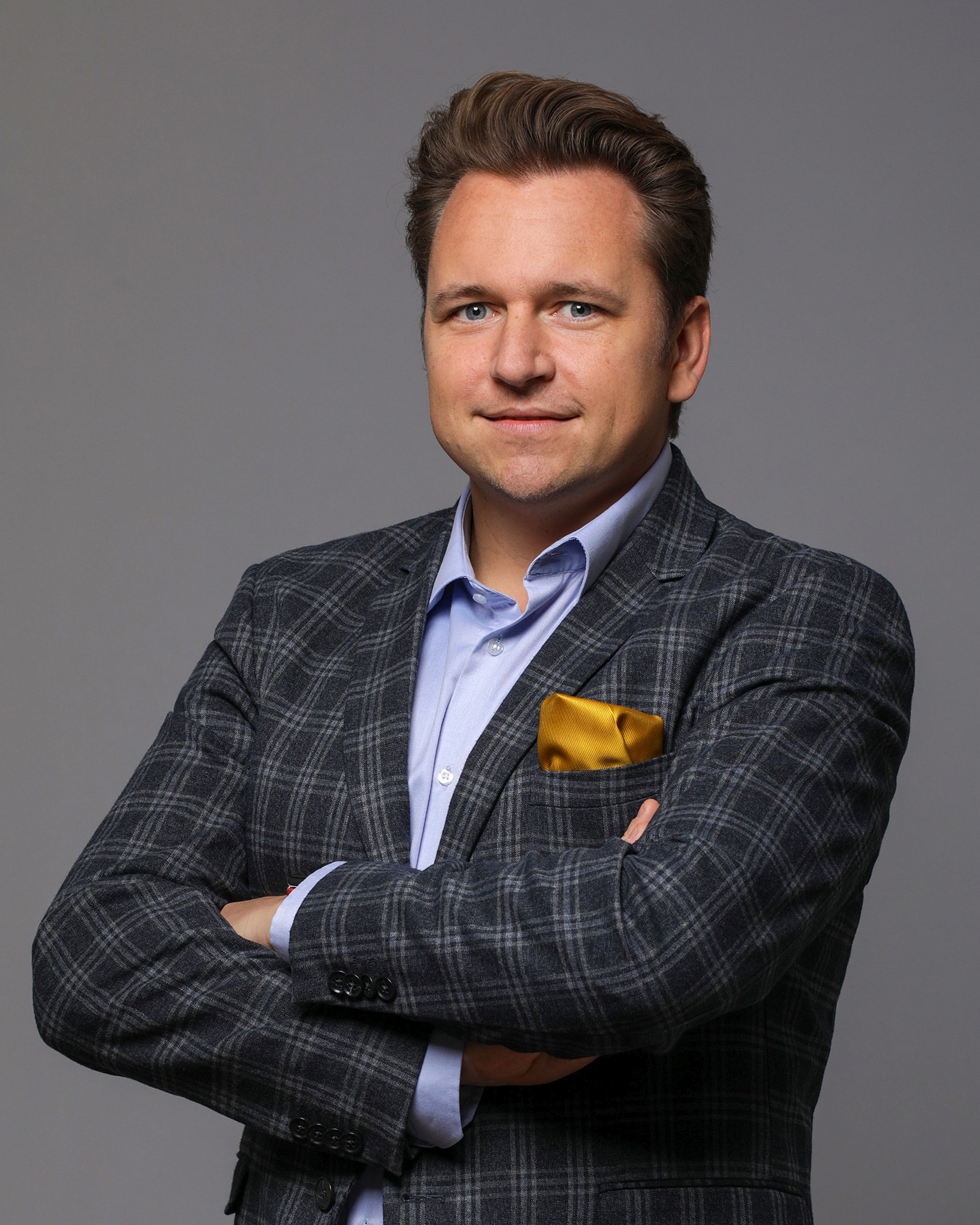
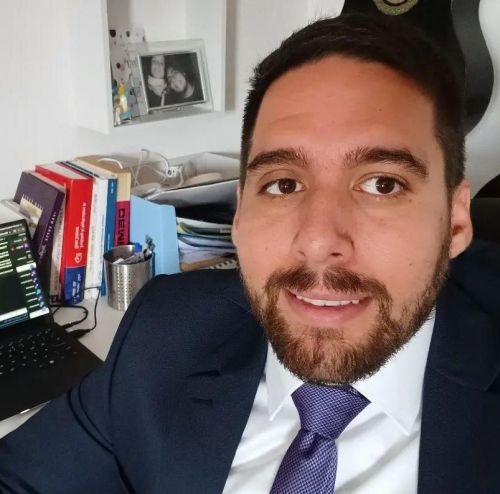
Nikola Mišković is a Full Professor at the Department of Control and Computer Engineering, Faculty of Electrical Engineering and Computing, University of Zagreb. His work focuses on marine robotics and autonomous systems. Marine Robotics Autonomous Underwater Vehicles (AUV) Human-Robot Interaction Control Systems Sonar Data Processing His research explores underwater localization, formation control, and sensor integration with applications in aquaculture and environmental monitoring. Projects include EU-funded initiatives like FP7 CADDY , H2020 EXCELLABUST , and subCULTron . Key collaboration networks involve institutions in Croatia, Israel, and EU marine robotics consortia. His work demonstrates strong integration of simulation (Gazebo, LabVIEW) and real-world deployment.
Marko Martinović is a Senior Lecturer at the University of Slavonski Brod, affiliated with the College of Technical Sciences, Department of Informatics and Information Technology. He holds a PhD in Economics from the University of Osijek (2022) and a master's degree in Computing from the University of Zagreb (2006). His career spans academia and industry, with prior roles at the Polytechnic of Slavonski Brod and private sector experience in IT. PhD in Economics, University of Osijek, 2022 MSc in Computing, University of Zagreb, 2006 His research is centered on Artificial Intelligence , Machine Learning applications , and Financial Engineering . He explores AI in diverse domains including financial markets, renewable energy, sports technology, and ethical computing. His work often bridges technical computing with economic and social implications. The recent publications highlight a strong trend in applied AI , particularly using neural networks for forecasting (financial indices, currency, demand), optimization (edge AI, microcontrollers), and societal analysis (search engine bias). His work combines theoretical models with real-world datasets, emphasizing practical implementation and performance evaluation. Marko actively mentors students, supervising numerous undergraduate theses in computing and informatics. He is involved in institutional research projects such as the MOD-INO project (2019–2022), contributing to curriculum and research development. He has not received any explicitly mentioned scientific awards or major grants in the provided text. He teaches core courses including Basics of Artificial Intelligence , Python Programming , Neural Networks and Deep Learning , and Basics of Informatics . His technical expertise is complemented by a CCNA certification, reflecting a strong foundation in networking.
Ivan Lorencin is an Assistant Professor at the Faculty of Informatics in Pula , University of Pula. He holds a PhD in Electrical Engineering and Computer Science (2022) from the University of Rijeka, where he also graduated in 2018. His academic roles include Vice-Dean for Business Cooperation and Science, and he teaches courses such as Artificial Intelligence, Network Systems, and Mechatronics. PhD: 2022, University of Rijeka MSc: 2018, University of Rijeka Dr. Lorencin’s research focuses on Artificial Intelligence , Robotics , and High-Performance Computing . His work spans biomedical applications (e.g., cancer diagnostics), maritime domain (e.g., vessel recognition), and energy systems (e.g., power plant optimization). He has published over 90 papers, with 31 in Q1/Q2 journals. His recent publications emphasize machine learning in healthcare (bladder/cervical cancer diagnosis), symbolic regression for energy systems, and computer vision applications (YOLO algorithms, CLIP). He collaborates on international projects like DATACROSS , EDIH Adria , and Erasmus+ WICT . He serves as an editor for the journal Mathematics and contributes to scientific consortia including the Science Center for Excellence in Data Science . His teaching portfolio includes courses in artificial intelligence, data science, and robotics, with a focus on practical exercises and thesis supervision.
Siniša Miličić is an Assistant Professor at the Faculty of Informatics in Pula, University of Pula, where he also serves as Vice Dean for Teaching and Students since 2021. He holds a PhD in mathematics from the University of Zagreb (2013) and previously worked as a junior researcher at the Faculty of Electrical Engineering and Computing in Zagreb from 2007 to 2017. Dr. Miličić's research focuses on the theory of dynamical systems and fractal dimensions, with applications extending to informatics and computer science, particularly in data science. His work bridges theoretical mathematics with practical computational applications, demonstrating expertise in both pure mathematical theory and its implementation in modern technological contexts. His teaching portfolio spans from foundational mathematics to advanced computational topics, including Differential and Integral Calculus, Geometry and Linear Algebra, Functional Programming, and Statistics across undergraduate, graduate, and integrated programs. His publication record shows a clear evolution from theoretical mathematics toward applied computational methods. Early works (2006-2013) focused on fundamental aspects of dynamical systems, fractal geometry, and differential equations. More recent publications (2018-2025) emphasize time-frequency analysis, image processing, and signal denoising, reflecting his growing interest in practical implementations of mathematical theory in data science applications. As Vice Dean for Teaching and Students, Dr. Miličić actively participates in the development of courses and design of study programs at the Faculty of Informatics in Pula. He teaches a comprehensive range of mathematics courses from introductory level to advanced topics including methodological courses in mathematics teaching, demonstrating his commitment to both theoretical foundations and practical applications of mathematics in informatics education.
Sun Yacheng is a Professor at the School of Economics and Management, Tsinghua University, where he actively contributes to research on digital transformation in the manufacturing sector. His expertise bridges economic theory and practical industrial applications. Professor Sun's research focuses on how intelligent sensing technology can drive digital transformation in manufacturing. His work particularly emphasizes the application of IoT, computer vision, and RFID technologies to create closed-loop systems of 'perception-analysis-decision-execution.' He investigates how high-precision 3D spatial reconstruction, end-to-end customer flow tracking, and multi-source data fusion can provide businesses with comprehensive market understanding and process optimization capabilities. His research shows how AI and machine learning can advance analytics from descriptive to predictive and prescriptive models, enhancing business decision-making. As part of Tsinghua School of Economics and Management's 'Two Sessions Through a Financial Perspective' series, Professor Sun provided expert analysis of the Government Work Report's call to accelerate digital transformation in manufacturing. He highlighted the strategic importance of cultivating service providers who understand both industry processes and digital technologies, with particular attention to the challenges facing small and medium enterprises in digital adoption.
Professor Quoc Chi Nguyen serves as Vice Dean of the Faculty of Mechanical Engineering at Ho Chi Minh City University of Technology, Vietnam. He also holds the position of Head of the Department of Mechatronics since 2018. With a strong academic background including a Ph.D. from Pusan National University, Korea, and a Marie Curie FP7 postdoctoral fellowship at Tel Aviv University, Professor Nguyen has established himself as a leading researcher in control engineering and robotics. Professor Nguyen's educational journey began with a B.S. in Mechanical Engineering from Ho Chi Minh City University of Technology in 2002, followed by an M.S. in Cybernetics from the same institution in 2006. He completed his Ph.D. in Mechanical Engineering at Pusan National University, Korea, in 2012, and then pursued postdoctoral research at Tel Aviv University from 2013-2014. His research expertise spans Robotics , Crane Control , Vibration Control , Nonlinear Analysis , Dynamic Analysis , and Advanced Control Theory . Professor Nguyen's work focuses on developing innovative control algorithms for flexible structures, industrial automation systems, and mechatronic applications. His recent publications demonstrate a strong emphasis on practical industrial applications of control theory, including robotics integration, computer vision systems, and energy-efficient pneumatic systems. With 58 publications that have accumulated 32,041 reads and 782 citations, Professor Nguyen has established a significant research impact. His publication trend shows consistent productivity with recent work extending to projected 2025 publications, indicating an active and ongoing research program. The breadth of his work spans from fundamental control theory to practical industrial applications across multiple sectors including manufacturing, agriculture, and logistics. Marie Curie FP7 Postdoctoral Fellowship Professor Nguyen currently leads research activities through his lab at Ho Chi Minh City University of Technology. His leadership roles as Vice Dean and Department Head provide substantial resources and opportunities for research collaboration. With numerous co-authors and international connections, particularly stemming from his time at Tel Aviv University, he maintains an active global research network that benefits his students and colleagues.