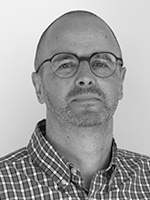
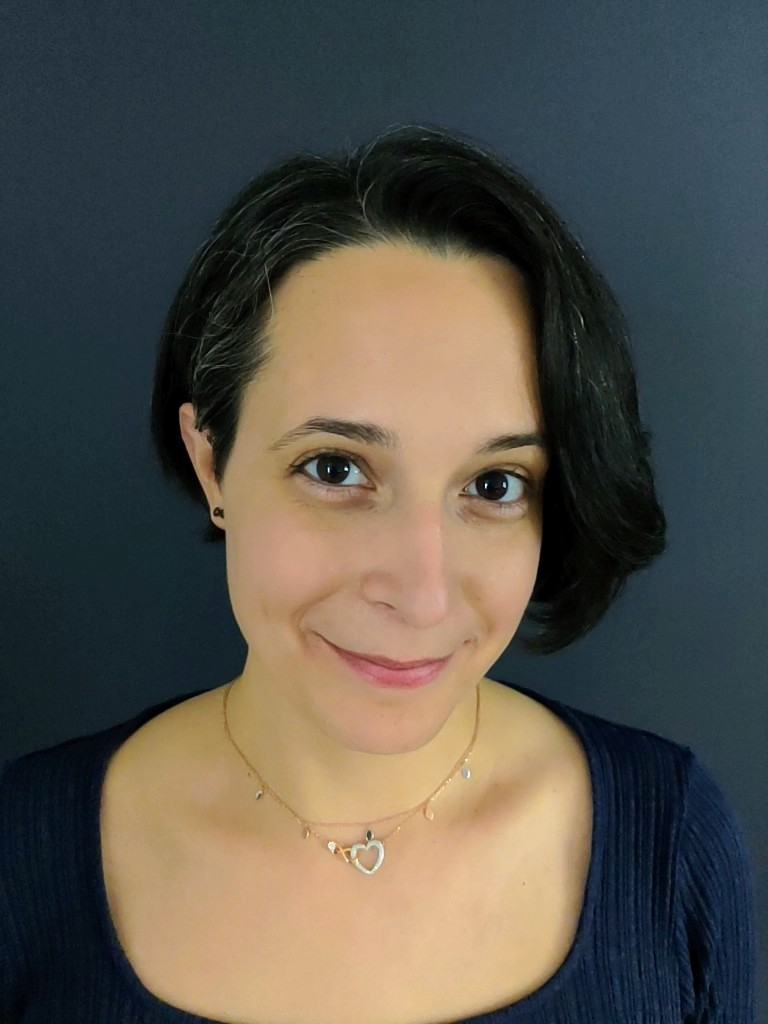
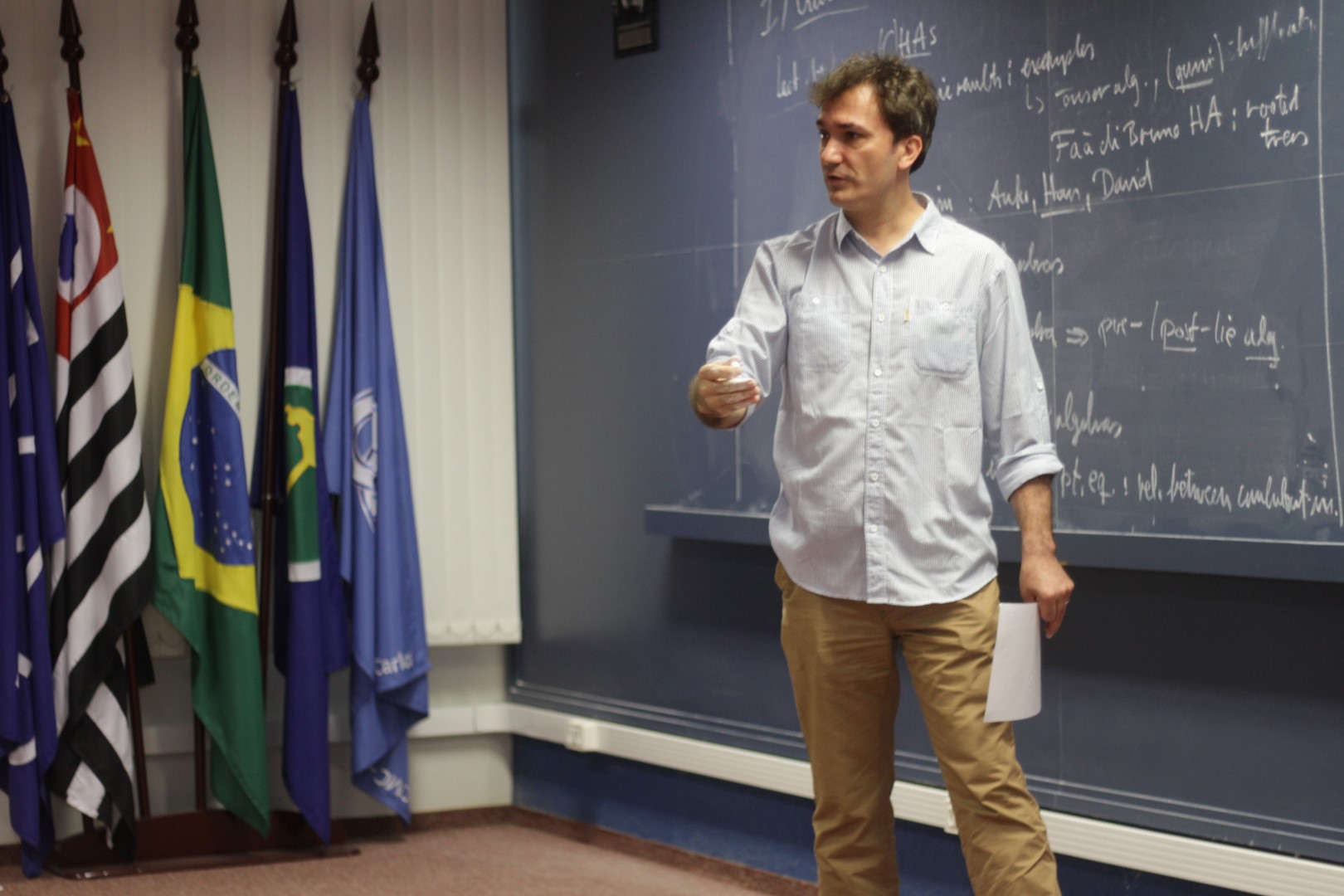
Dr. Usman Ghafoor is a researcher specializing in robotics, IoT security, and neuroengineering. His work bridges machine learning with biomedical systems, focusing on brain-computer interfaces (BCIs), neuromodulation, and robotic control mechanisms. Key Research Areas: Robotics, IoT Malware Detection, Hybrid EEG-fNIRS Systems, Deep Learning Applications His recent publications highlight interdisciplinary approaches to multibody robot control, neurorehabilitation, and real-time BCI optimization. Collaborative work with experts like Keum-Shik Hong demonstrates his integration into cutting-edge neuroscience and robotics projects. While specific institutional affiliations are not detailed in the provided text, his contributions to journals such as Robotics , Scientific Reports , and Frontiers in Neurorobotics indicate significant academic engagement.
Cristina Paupini is a Research Fellow at Oslo Metropolitan University, affiliated with the Department of Computer Science under the Faculty of Technology, Art and Design. She actively contributes to the Universal Design of ICT (UD-ICT) research group, focusing on inclusive technology design and human-computer interaction in critical contexts. Her research spans: Human-Computer Interaction (HCI) and Universal Design principles Privacy management in Internet of Things ecosystems Disaster risk reduction through situational awareness systems Digital fieldwork methodologies in home environments Social implications of smart home technologies Cross-cultural studies of technology adoption Analysis of her 2021-2023 publications reveals consistent exploration of technology's role in high-stakes scenarios. She investigates how ICT can address situational disabilities during disasters, examines privacy dynamics in IoT households across cultural contexts, and develops innovative remote fieldwork techniques. Her work combines qualitative methods with intersectional analysis to uncover systemic barriers and user experiences. Paupini is deeply embedded in the UD-ICT research group, which pioneers inclusive design frameworks for digital systems. The group's initiatives focus on mitigating exclusion in technology deployment, particularly for vulnerable populations during crises, while addressing ethical challenges in connected home environments.
Paulo Ferreira is a Professor in the Department of Informatics at the University of Oslo's Faculty of Mathematics and Natural Sciences. He specializes in programming technology with a focus on distributed systems, mobile computing, and fog/cloud computing. His research interests include: Distributed systems and programming of mobile devices Concurrency, parallelism, and replication Fog and cloud computing architectures Software security and adaptability Algorithms for garbage collection Professor Ferreira teaches "Programming Ubiquitous Things" (IN5600) in Spring and "Fog and Cloud Computing" (IN5700) in Autumn. His recent publications show a strong focus on transport mode detection using edge and fog computing, garbage collection optimization, and mobile application development. His work demonstrates trends toward more efficient resource utilization in distributed environments, particularly in mobile and edge contexts. He has received numerous awards including: Best Prize for Master Thesis supervision (Norsk Regnesentrals pris, Dec. 2023) Two Best Paper Awards at the ACM/IFIP/Usenix Middleware Conference Recognition of Service Award from ACM "Excellent teaching" awards at the University of Lisbon (2010/2011 and 2013/14) Professor Ferreira currently supervises PhD students Mahdieh Kamalian (transport mode detection) and Lyla Naghipour Vijouyeh (fog emulator development). He has led more than 15 research projects, served as an expert for the European Union for assessment of projects proposals under the 7th Framework Program, and serves on various program committees (e.g. Middleware, ICDCS, DAIS, etc.). He is a senior member of ACM and IEEE, serves on the editorial board of the Springer Journal of Internet Services and Applications, and is a member of the Steering Committee of EuroSys (ACM European Chapter of the Special Interest Group on Operating Systems).
Mr. Venkata Raghava Shashank Viswanathuni serves as a PhD Research Fellow in the Department of Information and Communication Technology at the University of Agder (UiA), Norway. This position involves conducting doctoral research under faculty supervision while contributing to the department's academic and research initiatives within UiA's engineering and technology framework. Research in the Department of Information and Communication Technology spans critical technological domains including Computer Science , Information Systems , Telecommunications Engineering , Network Security , Wireless and Mobile Communications , and Data Analytics . The department emphasizes applied research addressing real-world challenges through interdisciplinary collaboration and innovation in digital infrastructure development. As a PhD Research Fellow, Mr. Viswanathuni engages in doctoral-level research within UiA's academic ecosystem. While specific grant details are not publicly documented, University of Agder actively participates in Norwegian and EU-funded research initiatives across information and communication technology domains. The department maintains strategic partnerships with industry leaders and academic institutions to advance technological solutions.
Phaneendra Kumar Yalavarthy is a Professor at the Department of Information and Communication Technology, University of Agder. His academic work focuses on core areas of ICT, including network systems, data communication, and cybersecurity. Research interests span telecommunications infrastructure, digital technologies, and secure information systems. Email: phaneendra.k.yalavarthy@uia.no
Elisavet Kozyri is an Associate Professor at UiT The Arctic University of Norway's Department of Informatics within the Faculty of Science and Technology, where she conducts research in computer security and information flow control. Her office is located in Realfagbygget A232 in Tromsø. Her research focuses on: Information flow properties and enforcement mechanisms Privacy-preserving technologies and GDPR compliance Reactive information flow systems Formal methods for security verification Diversity and inclusion in computer science education She leads the Better Balance in Informatics (BBI) project and participates in the Cyber Security Group (CSG). Her publications demonstrate a consistent focus on information flow control, privacy enforcement, and security formalization, with recent expansion into educational equity research. Analysis shows strong emphasis on: Formal modeling of security properties (60% of publications) Practical implementation of privacy frameworks (25%) Educational initiatives in computer science (15%) Teaching responsibilities include: Advanced Computer Security (2023-2025) Computer Security (2022-2025) Computer Communication (2022) Professional activities include: IEEE Computer Security Foundations Symposium PC member (2021-2026) Deputy Representative to Informatics Europe (2023-present) EUGAIN Management Committee member (2022-2024)
Tor-Arne Schmidt Nordmo serves as Associate Professor in the Department of Informatics at UiT The Arctic University of Norway. His work bridges artificial intelligence research with practical applications across multiple domains. His research spans Artificial Intelligence , Edge Computing , and Cyber Security , with specific projects including Sports Technology , Systems Support for AI , and Forecasting Tipping Points in Human Health . He actively contributes to the Cyber Security Group (CSG) while developing multimedia forensics solutions for sustainable fisheries and privacy-sensitive edge environments. His recent publications reveal a strong focus on real-world AI implementation challenges, particularly in edge computing systems, environmental monitoring, and ethical AI deployment. Key themes include trustworthy data handling from untrusted nodes, sustainable resource management, and human-AI interaction failures. As an educator, he leads core courses INF-2600 Artificial Intelligence, Methods and Applications and INF-1600 Introduction to Artificial Intelligence , shaping next-generation AI practitioners at UiT. His research integrates with practical field applications through projects like Edge Computing and Forecasting Tipping Points in Human Health , demonstrating commitment to translating theoretical AI advances into societal benefits.
Lothar Fritsch serves as Associate Professor in Digital Security at the University of Oslo and concurrently holds a Professorship at Oslo Metropolitan University's Department of Information Technology. His research bridges technical cybersecurity mechanisms with societal implications, focusing on privacy engineering and critical infrastructure security through active publications and media engagement. Research interests span cybersecurity, privacy, societal security, and risk assessment methodologies. His work examines privacy harm categorization frameworks for organizational risk management, develops multilateral analysis methods for mobile applications, and investigates societal dimensions of cybersecurity failures. Current projects address practitioner adoption of privacy frameworks and infrastructure resilience in critical systems like energy grids. Analysis of recent publications reveals a clear trajectory toward operationalizing privacy frameworks in real-world contexts. The 2025 Journal of Information Security and Applications paper demonstrates how practitioners implement privacy harm categories in risk assessments, while the 2019 Annual Privacy Forum contribution established foundational methods for Android app privacy analysis. This consistent focus on practical privacy engineering tools reflects growing industry demand for actionable security methodologies that address both technical vulnerabilities and human factors.
Janne Merete Hagen is an Associate Professor in Digital Security at the University of Oslo. She specializes in critical infrastructure security, focusing on smart grids, intrusion detection systems, and risk management frameworks. Her work bridges technical security solutions with policy implications. Expertise in Industrial Control Systems (ICS) security Active in Norwegian energy sector cybersecurity research Collaborates across institutions including HSLU, NTNU, and NVE Her research explores practical challenges in deploying security technologies within electric utilities, with a focus on hardware-in-the-loop testing environments and cloud-integrated advanced metering systems. Publications highlight interdisciplinary approaches combining technical security measures and organizational risk management. Recent work trends show increasing focus on smart grid security, cloud compliance, and policy readiness for modern energy systems. She contributes to projects like CyberHunt and investigates the intersection of security management and technical implementations in critical infrastructure.
Johan Gustav Bellika is a Professor of Medical Informatics at the Department of Clinical Medicine, Faculty of Health Sciences, UiT The Arctic University of Norway, and serves as Chief Research Informatics Officer (CRIO) for PraksisNett, a national research infrastructure for primary health care. He has worked at the National Center for e-Health Research at the University Hospital of North Norway since 1997. Master’s (1997) and PhD (2006) in Informatics from UiT Research focus: Privacy-preserving health data reuse and learning healthcare systems Contributed to >100 scientific publications Supervision of Master’s, PhD, and postdocs His work spans health data security , ontology-based terminologies , e-health modernization , and federated learning . Key projects include DigSam (digital security), PraksisNett (primary care research infrastructure), and ASCLEPIOS (secure cloud solutions). Articles highlight expertise in distributed health analytics , patient confidentiality , and clinical decision support systems . Scientific contributions include: Advancing privacy-preserving statistical computation with Statistics Norway Implementing SNOMED CT standardization Developing secure platforms for health data analysis
Anita Torabi is a Professor in Structural Geology at the University of Oslo , affiliated with the Department of Geosciences. Her research focuses on structural geology, fault mechanics, fluid flow in deformed reservoirs, CO2 storage, geothermal reservoirs, and seismicity. She employs advanced methods such as 3D seismic analysis, fault asperity studies, and machine learning for geological applications. Key affiliations: University of Oslo, NORCE (2015-2018), Uni Research CIPR (2008-2018) Education: PhD in Geosciences (2008) - University of Bergen Research Interests include: Fault mechanics and deformation processes Fluid flow in faulted reservoirs CO2 storage and green energy solutions Geomechanics and seismic risk assessment Machine learning in structural geology Basement rock fracture analysis Recent Publications highlight trends in: 3D fault characterization using deep learning Fluid dynamics in siliciclastic-carbonate systems Seismic attribute analysis for fault geometry Compaction bands in Tertiary-Quaternary sequences Ontology-driven geological modeling Machine learning applications for CO2 storage Research Leadership includes projects such as: CO2 Seal and Bypass – COPASS CO2SafeQuest (fault behavior for CO2 storage) gigaCCS@UiO (Center of Excellence in Carbon Capture) VICCO (volcanic-sedimentary CO2 storage) Pool Studies CO2 Storage research group
Kurusch Ebrahimi-Fard is a Professor in the Department of Mathematical Sciences at the Norwegian University of Science and Technology (NTNU) in Trondheim, Norway. He is an active member of the Differential Equations and Numerical Analysis (DNA) group at IMF-NTNU, with extensive international collaborations across Europe and North America. His research spans a remarkable breadth of mathematical disciplines, focusing on the surprising convergence of algebraic and combinatorial structures across seemingly disparate fields. His work bridges geometric integration methods, nonlinear control theory, rough paths theory, free probability theory, and perturbative quantum field theory. The common thread throughout his research is the central role of algebraic and combinatorial structures on graphs, partitions, and other combinatorial objects. Dr. Ebrahimi-Fard's recent publications reveal strong trends in the application of Hopf algebraic structures to probability theory and stochastic analysis, with significant contributions to understanding signatures in rough path theory and their applications to image analysis. His work consistently demonstrates how abstract algebraic structures can provide powerful tools for concrete problems in numerical analysis and mathematical physics. Juan de la Cierva fellowship Ramón y Cajal fellowship Fellow of the Studienstiftung des Deutschen Volkes Fellow of the Evangelisches Studienwerk e.V. Fellow of the German Academic Exchange Service (DAAD) Fellow of the European Post-Doctoral Institute (EPDI) Throughout his career, Dr. Ebrahimi-Fard has organized numerous international conferences and workshops, including the 18th Santaló Summer School on Algebraic and Combinatorial Methods in Stochastic Calculus. His editorial work includes special issues on theoretical and computational aspects of dynamical systems, non-commutative algebra, and algebraic structures in perturbative quantum field theory. He has also secured research funding through various grants including the BBVA Foundation Research Grants. Dr. Ebrahimi-Fard maintains active collaborations with researchers worldwide and participates in several research networks focused on the intersection of algebra, combinatorics, and mathematical physics. His work with the DNA group at NTNU continues to explore fundamental mathematical structures with applications across scientific disciplines.
Åsmund Dæhlen serves as a Research Fellow within the Department of Informatics at the University of Oslo, operating under the Faculty of Mathematics and Natural Sciences. He is actively engaged with the Digital Innovation research group, contributing to the department's academic and research missions. His research interests encompass Digital Innovation, Computer Science, Information Technology, Digital Infrastructure, and Digitalization. These areas align with the department's broader research sections including Digital infrastructure and security, Digitalization, Machine Learning, and Programming, reflecting contemporary challenges in informatics and digital transformation. Based at Gaustadalléen 23B, 0373 Oslo, with postal address Postboks 1080 Blindern, 0316 Oslo, Åsmund contributes to the vibrant research ecosystem at one of Scandinavia's leading academic institutions in computer science and informatics.
Edward Chlebus is an Adjunct Associate Professor of Computer Science at the Illinois Institute of Technology , where he serves as director of the Network Modeling and Teletraffic Analysis Lab (NEMTAL) . He holds an M.S. and Ph.D. in electrical engineering from Cracow University, Poland. Ph.D., Electrical Engineering, Cracow University (1990) M.S., Electrical Engineering, Cracow University (1985) His research focuses on network modeling, teletraffic engineering, and performance evaluation of computer and communications systems. He pioneered the statistical analysis of handoff traffic in wireless systems through his 1995 ICUPC paper. Recent publications highlight his work on Wi-Fi network performance, traffic modeling with heavy-tailed distributions, and email traffic characterization. His research spans wireless infrastructure, commercial network analysis, and statistical methods for internet traffic. Scientific Awards : 1985 Best MS Thesis Award (SEP, Poland) 1990 & 1991 Best Paper Awards (Polish Symposium on Communications) Advisor of 1992 SEP Best MS Thesis Award Dr. Chlebus has received research funding from France Telecom, Telecom Australia Research Laboratories, and Motorola. He contributes to academic discourse as an editor of The Open Information Systems Journal and frequent reviewer for IEEE publications.
Malcolm Langford is Professor at the Faculty of Law, University of Oslo, and Deputy Director of TRUST: Norwegian Centre for Trustworthy AI. He is a jurist and social scientist with over 150 publications spanning human rights, international investment law, international development, comparative constitutionalism, technology and law, and the legal profession. He serves on the Pedagogical Academy at the University of Oslo, the national expert group on digital learning analytics, and boards of the European Implementation Network (EIN), JustLabs, Hahdi Africa, and Avant Garde. He founded the Forum for International Researchers in Oslo (FIRO). Langford's research interests focus on the intersection of law, technology, and human rights, particularly in the areas of socio-economic rights, investor-state dispute settlement (ISDS), AI in legal systems, and Nordic legal exceptionalism. His work examines how legal frameworks can effectively address complex social issues while adapting to technological advancements. He has pioneered research on computational methods in international law and the impact of digital transformation on legal education and practice. His recent publications reveal a strong trend toward interdisciplinary research combining legal scholarship with data science, AI, and learning analytics. He has been instrumental in developing new methodologies for analyzing international investment arbitration and examining the implementation of socio-economic rights. His work increasingly addresses the challenges and opportunities presented by AI in legal systems, including issues of transparency, accountability, and fairness. 2025 I•CON International Journal of Constitutional Law Peer Reviewer Prize 2021 Meritterte underviser (Merited Teacher) - University of Oslo 2020 Studentparlementets utdanningpris (Student Parliament's Education Prize) 2019 Utdanningspris (Education Prize) - University of Oslo 2017 John Jackson Prize for best article in Journal of International Economic Law 2015 Prize for younger researchers from European Society of International Law Langford has led numerous major research projects including COPIID (Compliance Politics and the International Investment Disputes), Nordic Branding: Politics of Exceptionalism, and Sexual and Reproductive Rights Lawfare: Global Battles. As Director of the Centre for Experiential Legal Learning (CELL), a Centre of Excellence in Education, he has transformed legal education through digital innovation, including the Digital Lawyer and Digital Courtroom initiatives. His work on learning analytics has positioned him as a leader in educational technology within Norwegian higher education. He leads the TRUST Centre for Trustworthy AI and has established significant collaborations between law, computer science, and educational research. His work bridges theoretical legal scholarship with practical implementation challenges, particularly in the areas of AI governance, digital rights, and legal education transformation.