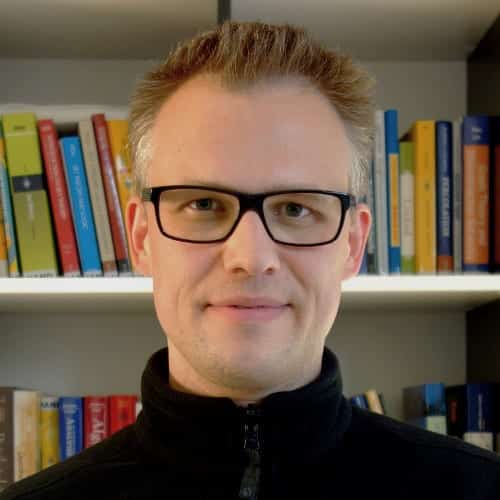
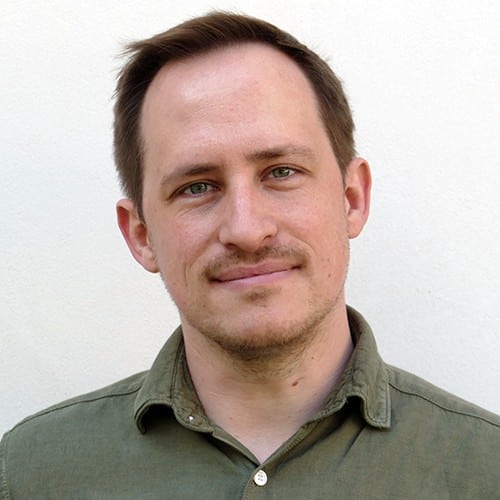
Søren Debois is an Associate Professor at the IT University of Copenhagen , specializing in the intersection of process technologies and IT security . His research focuses on technical solutions for trust between parties, including applications of blockchain to process management and declarative process models for legal-compliant municipal systems. He is a principal author on the DCR process modelling notation and architect of the DCR Workbench , contributing to the commercial dcrgraphs.net engine. He leads a work package in the Innovation Fund Denmark -funded EcoKnow project, aiming to align municipal case-management with legal compliance. A frequent expert in Danish media on IT security, he teaches Distributed Systems , Security I , and Security II at ITU. His accolades include the 2017 ITU Excellence in Teaching Award and a BPM '18 Best Paper Honorable Mention .
Lorenzo Gentile is a Research Engineer at Consensys specializing in cryptographic protocols for multiparty computation and blockchain applications. He has been affiliated with institutions such as the IT University of Copenhagen (ITU), Politecnico di Milano (PoliMi), and research centers including Center for Information Security and Trust (CISAT), Concordium , and CROSSING at TU Darmstadt. Education : PhD in Cryptography (ITU), Master's in Computer Engineering (PoliMi). Research Interests : Focus on cryptographic protocols for multiparty computation (MPC), blockchain technology, operations research, game theory, and secure protocols. His work bridges theoretical cryptography with practical applications in decentralized systems and mathematical optimization. Scientific Collaborations : Participated in research projects at ITU's Business IT Department, PoliMi's Department of Mathematics, and Osservatori Digital Innovation. His PhD involved collaboration as a Scientific Partner with Concordium and a visit at TU Darmstadt's CROSSING research group. Professional Background : Formerly worked at Moxoff (a PoliMi spin-off) on applied mathematics and as a Freelance Software Engineer. Currently contributes to the Linea team at Consensys, focusing on blockchain infrastructure.
Mark Strembeck is an Associate Professor at the New Media Lab, part of the Institute for Information Systems at the Vienna University of Economics and Business (WU). He is also a faculty member at the Complexity Science Hub and a key researcher at the Secure Business Austria research center, reflecting his interdisciplinary engagement in complex systems and information security. His research focuses on the analysis of complex systems, particularly in social media environments. Key interests include emotion detection, bot-human interactions, structural communication patterns during crises, and misinformation dynamics. His work combines network science, data analytics, and computational social science to understand human behavior in digital spaces. Mark's recent publications (2017–2024) reveal a strong trend in analyzing emotional motifs, community structures, and information diffusion during high-impact events such as wars, elections, and natural disasters. His studies often involve multiplex and temporal network models applied to platforms like Twitter, Facebook, and YouTube. He has collaborated extensively with researchers such as E. Kušen and M. Moser, contributing to journals like Computers in Human Behaviour , Applied Network Science , and IEEE Internet Computing . His methodological expertise spans sentiment analysis, motif detection, and network modeling. Mark Strembeck received his doctoral degree in business informatics from WU in 2003 and completed his habilitation in 2008. He holds two diploma degrees from the University of Essen, Germany. Prior to his academic career, he worked as a software developer and researcher in Germany and Austria. Scientific Contributions and Affiliations: Associate Professor, New Media Lab, WU Vienna Faculty Member, Complexity Science Hub Key Researcher, Secure Business Austria Active contributor to COMPLEXIS, ASONAM, and SNAMS conferences He has advised no students listed in the provided text and has not received any explicitly mentioned scientific awards. His work is supported by participation in national and international research projects, though specific grants are not detailed. He is involved in teams focusing on crisis informatics, bot detection, and emotional dynamics in social networks.
Johannes Wachs is an Associate Professor at the Institute of Data Analytics and Information Science, Corvinus University of Budapest, and a Research Fellow at the Centre for Economic and Regional Studies. He is affiliated with the Complexity Science Hub Vienna, where he has been a faculty member since April 2020. His interdisciplinary research bridges data science, network science, and complexity to study digital economies, open source software, and societal challenges. PhD in Network Science, Central European University (2019) MS in Applied Mathematics, Central European University (2012) BS in Mathematics and Economics, Tulane University (2009) His research focuses on the application of network and data science to understand social, economic, and technical systems. Key interests include open source software ecosystems, AI’s impact on knowledge sharing, corruption detection, urban inequality, and digital innovation. He uses large-scale digital trace data to model complex behaviors in online communities, software development, and public policy. His recent publications reveal a strong trend in analyzing digital platforms such as GitHub and Stack Overflow, studying brain drain in tech, and assessing climate and health risks in Austria. His work combines network modeling, machine learning, and empirical analysis to uncover patterns in human behavior and systemic risk. IMF Anti-Corruption Challenge Winner (2020) Principal Investigator, CRISP Project (2021–2024), funded by FFG Grants from Hungarian Research Funding Agency (OTKA), City of Vienna, and WU Projects Johannes Wachs actively supervises PhD and Master’s students, including Hannah Schuster and Brigi Németh. He has taught courses in computational social science, social networks, and data mining at institutions including RWTH Aachen, CEU, and WU Vienna. He is launching a new MSc in Social Data Science at Corvinus in 2025. He leads the CRISP project, which builds semantic data pools for real-time crisis response and intervention, integrating heterogeneous data sources for impact forecasting and policy transparency.
Christian Graugaard is a Professor of Sexology at Aalborg University, affiliated with the Faculty of Medicine and the Department of Clinical Medicine. He is a key member of the Center for Sexology Research and leads Project SEXUS, aiming to study Danish sexual behavior comprehensively. His work emphasizes the intersection of biological, psychological, and cultural factors in human sexuality, challenging simplistic gender-based stereotypes. Research interests include gender differences in sexual behavior, societal norms influencing sexual health, and the cultural dimensions of human sexuality. He actively participates in public discourse, as seen in his DR-podcast interview on 'Ramt af kærlighed,' where he discussed the complex interplay between biology and culture in shaping sexual identities. Though no specific awards or grants are detailed here, his publications span advanced technical domains like spatiotemporal data analysis, federated learning, and trajectory modeling, suggesting interdisciplinary research collaborations. His work on systems like OneDB and SWASH highlights contributions to distributed computing and data science, which may underpin his methodologies in large-scale sexual behavior studies. He currently holds no listed students or formal advisees in the provided texts, and his involvement in labs/teams is limited to the Center for Sexology Research and Project SEXUS.
Ryutaro Yamashita is an Adjunct Professor in the Department of Mathematical Sciences at Aalborg University's Faculty of Engineering and Science. His research spans quantum computing, cryptography, and machine learning. Focus areas include quantum error correction, secret sharing schemes, and adversarial attacks on depth estimation networks. Collaborates on entanglement-assisted codes and finite field applications. Recent work highlights trends in securing quantum information systems and enhancing neural network robustness.
Winnie Jensen is a Professor at the Department of Health Science and Technology , Faculty of Medicine , Aalborg University , where she serves as Vice-head of institute for research and Head of the Neural Engineering and Neurophysiology research group since 2010. Her work bridges animal and human research to develop implantable neural rehabilitation technologies. Ph.D. in Biomedical Science and Engineering (2005) from Aalborg University Research Interests : Focuses on neural engineering , neuroplasticity , and implantable neural interfaces for sensory/motor rehabilitation. Key areas include TENS-based neurostimulation , phantom limb pain , brain-computer interfacing , and animal-to-human translational models . Article Trends : Recent work emphasizes functional brain connectivity , ulnar nerve electrophysiology , and pain alleviation via cortical modulation , leveraging porcine models and medical device innovation . Scientific Awards : Vanførefonden Forskningspris (2016) Order of the Dannebrog (2024) 3rd Best Paper Award (2023) Advising & Grants : Supervised 14 Ph.D. students, co-supervised 3, and mentored 9 postdocs. Secured major EU grants (FP7 STREP projects TIME and EPIONE) and Marie Curie fellowships. Labs & Teams : Co-founded the Center for NeuroEngineering Solutions in Stroke Rehabilitation (2014–2020) and collaborates with EU clusters and international companies.
Jonas Juul is an Assistant Professor in Data Science Networks, Data, and Society at the IT University of Copenhagen. His research employs statistical methods, mathematical modeling, and computer simulations to study social networks, spreading processes, and human behavior, with particular focus on content diffusion online and disease spread mitigation in human populations. His research interests span multiple domains: Epidemiological modeling and forecasting Social network analysis and information diffusion Contagion dynamics in biological and social contexts Mathematical modeling of complex systems Public health intervention strategies Dr. Juul's publication record shows consistent output since 2018, with a strong focus on contagion processes across different contexts. His work bridges theoretical physics approaches with practical data science applications, particularly in epidemiology and social dynamics. Recent publications demonstrate expansion into genomic epidemiology and cultural evolution while maintaining his core focus on network-based spreading processes. Key scientific recognitions: Data Science Emerging Investigator 2024 grant from the Novo Nordisk Foundation Carlsberg Foundation Fellowship Dr. Juul currently leads the InForM project (Inference, Forecasts and Mitigation of future epidemics), a major research initiative funded by the Novo Nordisk Foundation running from 2025-2030 with significant policy impact (referenced in policy sources) and media attention (picked up by 11 news outlets). He has also contributed to Denmark's COVID-19 response as part of Statens Serum Institut's expert group during the 2020 reopening phase. He maintains external research positions as a Member (Representing ITU) at Det Koordinerende Organ for Registerforskning and as a Guest researcher at Danmarks Statistik, demonstrating his expertise in data governance and statistical analysis beyond his primary appointment.
Aslan Askarov serves as Associate Professor in the Department of Computer Science at Aarhus University, Denmark, focusing on foundational security mechanisms and programming language theory. His work bridges theoretical rigor with practical applications in privacy-enhancing technologies. Research interests center on computer security and programming languages, with specialized expertise in information flow control, type systems, and traffic analysis mitigation. His investigations address critical vulnerabilities in metadata privacy for instant messaging systems, oblivious execution techniques for reactive programs, and formal verification of virtual machine safety. This work consistently targets provable security guarantees against sophisticated adversaries while maintaining practical performance constraints. Recent publications reveal a concentrated trajectory toward metadata protection in communication systems, combining language-based security with cryptographic techniques. Key contributions include novel approaches to metadata privacy beyond conventional tunneling, traffic-oblivious execution with bounded overheads, and formal methods for virtual machine safety verification. These efforts demonstrate a unified focus on eliminating side-channel leaks through principled system design. Recognition includes the 2022 award for research on misinformed privacy perceptions in messaging applications. Misinformed messaging app choices based on privacy misconceptions (2022) Currently leads the ProPrIM project (2023-2025) developing provable privacy frameworks for metadata protection. Supervises 2 PhD students and maintains active media engagement on metadata privacy issues since 2022. Collaborative networks span European institutions with significant cross-border research coordination. Research operations integrate formal methods with systems security through Aarhus University's computer science infrastructure, leveraging international partnerships for experimental validation of privacy-preserving protocols.
Hans-Jörg Schulz serves as an Associate Professor in the Department of Computer Science at Aarhus University, Denmark, specializing in visual analytics and information visualization. His research bridges computer science with interdisciplinary applications in food science, neuroscience, and material engineering. He earned his Doctorate in Computer Science (2010) and Diplom (Master's equivalent, 2004) from the University of Rostock, focusing on explorative graph visualization and visual data mining for complex structures. His academic trajectory reflects deep expertise in transforming complex data into actionable visual insights through innovative methodological frameworks. Schulz's research centers on advancing visual analytics methodologies, particularly progressive visual analytics where data processing and user interaction occur simultaneously. His work establishes foundational techniques for visual guidance systems, explainable AI interfaces, and specialized visualization tools for domains like EEG analysis and food rheology. Recent publications demonstrate a strategic expansion into haptic feedback integration, agent-based visualization design, and cross-disciplinary applications requiring novel visual fingerprinting techniques. Analysis of his 2023-2025 publications reveals three dominant trends: (1) Human-centered progressive analytics with focus on trust calibration and cognitive load management, (2) Domain-specific visualization frameworks for complex data like anisotropic food structures and EEG artifacts, and (3) Novel interaction paradigms incorporating force feedback and malleable interfaces. His work consistently emphasizes practical usability while pushing technical boundaries in visual representation. Schulz's contributions have been recognized with significant awards including IEEE InfoVis Best Poster (2010), EuroVis 3rd Best Paper (2012), VDA Best Paper (2015), Cybercartography Competition 1st Place (2022), and IEEE SciVis Contest 2nd Place & Most Innovative Work (2023). These accolades highlight both theoretical innovation and practical impact in the visualization community. As an educator, he supervises PhD candidates and teaches core visualization courses including Data Visualization, Information Visualization, and Visual Analytics. His current ArtiPlex project (2024-present) develops multiplex analytics for EEG artifact detection, securing active research funding while demonstrating his commitment to translating visualization research into domain-specific solutions. Collaborative patterns across his 79 publications indicate strong partnerships with food scientists, neuroscientists, and HCI researchers.
Philipp Georg Haselwarter is an Assistant Professor at the Department of Computer Science , Aarhus University . His expertise lies in programming languages , formal verification , and cryptographic proofs . His research interests include Higher-order probabilistic programming Separation logic for program analysis Modular cryptographic proofs in Coq Resource-aware and cost-bounded formal methods Key trends in his recent publications span Formal verification techniques for probabilistic and cryptographic systems Integration of separation logic with cost and error analysis Development of frameworks like SSProve for cryptographic proofs Applications of type theory and higher-order logic in programming languages
Brian Danielsen is a Lecturer at the Department of Electrical and Computer Engineering , part of AU Engineering at Aarhus University . His work bridges emerging technologies like web and mobile applications with real-world problem-solving, focusing on scalability, security, and user-implementation alignment. His research interests span: Web and mobile application development User-centered design methodologies Internet of Things (IoT) integration Interdisciplinary approaches to technology implementation Educational tools for technical and societal contexts Selected publications include work on IoT education frameworks and mobile health applications, emphasizing accessible and robust solutions. He is active in projects like: AFTERCARE (2021–present): Developing a relapse-prevention mobile app for substance use CEED (2020–2024): Advancing computational tools in education Contact: Email: bvd@ece.au.dk Phone: +45 93 52 19 64
Wahab Ali Gulzar Khawaja is affiliated with the Department of Electrical and Computer Engineering at Aarhus University . His work focuses on wireless communication systems, particularly in the context of unmanned aerial vehicles (UAVs) and mmWave technologies. Research Interests: Wireless Communication, mmWave Technology, UAVs, Signal Processing, Automation, and Control Systems. Recent Publications highlight his contributions to UAV detection using radar systems and modeling of mmWave UAV channels. His work intersects telecommunications and computer science, with applications in autonomous systems and high-frequency networks. Contact: Email wahabgulzar@ece.au.dk for collaboration or inquiries.
Lars Nørvang Andersen is an Associate Professor at the Department of Mathematics, Aarhus University, affiliated with the Stochastics research group. His academic journey includes a Ph.D. in applied probability theory (2009) and a master's degree in statistics from Aarhus University. Research focus: statistical learning, bioinformatics, stochastic modeling Former positions: Postdoctoral researcher at Bioinformatics Research Centre (Aarhus) and Stanford University's Department of Biology Academic service: Assessment committees and Danish Statistical Society treasurer His research spans statistical learning, machine learning, and stochastic modeling in bioinformatics and operations research. Recent publications highlight interdisciplinary work in Gaussian process models, population genetics, and differentially private learning algorithms. Key trends in publications include: Advancements in self-distillation techniques (2021) Applications of phase-type distributions in genetics Stochastic modeling for rare event simulations (2018) Optimization algorithms for logistics and machine learning Teaching activities cover applied statistics, theoretical statistics, and modern statistical learning at bachelor's and master's levels, with industry collaborations in student projects.
Marco Carbone is a Professor of Theoretical Computer Science at IT University of Copenhagen. His research focuses on session types , concurrency theory , structured communication , and formal verification of distributed systems. He leads the Center for Information Security and Trust and serves as Head of Education for the Master of Science in Computer Science program. Research Areas: Session Types, Concurrency, Security Protocols, Trust Management, Programming Logic Projects: GAINER (2023-2024), MECHANIST (2021-2025), PROBABILIST (2025-2028), BeHApi (2018-2023) Scientific Awards: International Prize (2018) His recent work explores probabilistic choreographies, asynchronous session subtyping, and mechanized proofs for session type systems. He has published extensively in venues like Logical Methods in Computer Science and Lecture Notes in Computer Science .