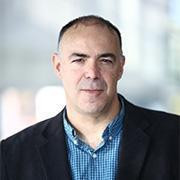
Prof. Yair Weiss is a faculty member at the School of Computer Science and Engineering, The Hebrew University of Jerusalem . He holds a PhD in Brain and Cognitive Sciences from MIT and an MSC in Applied Mathematics from Tel-Aviv University. Education: MSc in Applied Mathematics, Tel-Aviv University (1993) PhD in Brain and Cognitive Sciences, MIT (1998) His research focuses on Human and Machine Vision , Machine Learning , Bayesian Methods , and Neural Computation . Recent work explores adversarial examples, generative models, and robustness in neural networks. Recent publications highlight trends in: Understanding neural network representations Advancements in GANs and adversarial training Image restoration and translation techniques Perceptual distance modeling Bayesian approaches to computer vision Mathematical analysis of deep learning architectures
Aryeh Kontorovich is a Professor in the Computer Science Department at Ben-Gurion University. His research primarily focuses on theoretical machine learning, with expertise in probability, statistics, Markov chains, and metric spaces. His research interests span theoretical machine learning, with particular emphasis on: Probability theory and concentration inequalities Statistical learning theory Markov chains and mixing time estimation Metric space learning Kernel methods Sample compression schemes Professor Kontorovich's recent publications (2021-2025) demonstrate a continued focus on theoretical foundations of machine learning. His work shows strong trends in statistical estimation for Markov processes, distribution learning, metric space analysis, and sample compression. Many papers explore the intersection of probability theory and machine learning, particularly examining concentration inequalities, minimax optimality, and theoretical guarantees for learning algorithms. His research consistently bridges abstract mathematical theory with practical machine learning applications. Scientific awards and recognitions: Distinguished contribution award at MLG 2007 for "A Universal Kernel for Learning Regular Languages" Professor Kontorovich has advised numerous students and collaborated extensively with researchers in theoretical machine learning. His work spans both theoretical foundations and practical applications, with significant contributions to understanding the mathematical limits of learning algorithms. While specific grant information isn't provided in the source material, his extensive publication record in top venues suggests successful funding for his research programs. He maintains active collaborations with researchers worldwide, including prominent names like L. Gottlieb, D. Berend, and S. Hanneke.
Prof. Danny Dolev is a distinguished academic holding the Berthold Badler Chair in Computer Science at The Hebrew University of Jerusalem's Rachel and Selim Benin School of Computer Science and Engineering. He is an ACM Fellow and IEEE Fellow. His research focuses on distributed computing, fault-tolerant systems, algorithms, and secure protocols. He has held leadership roles, including Director of his school (1999–2002) and Chair of the Israeli National Committee for Information Technology (1994–1998). Education: B.Sc., The Hebrew University of Jerusalem, 1971 M.Sc., Weizmann Institute of Science, 1973 PhD., Weizmann Institute of Science, 1979 Research Interests: Danny Dolev's work spans distributed algorithms, Byzantine fault tolerance, consensus protocols, and hardware algorithms. His contributions include groundbreaking research on self-stabilizing systems, secure communication, and fault-tolerant clock synchronization. His HEX and Chronos protocols exemplify innovations in scalable synchronization and network security. Publications: His recent work emphasizes Byzantine agreement, asynchronous fault tolerance, and game-theoretic distributed systems. Key papers address optimal resilience in consensus algorithms and secure multi-party computation. Awards: ACM Fellow (2010) IEEE Fellow (2004) Grants & Leadership: Member of the Scientific Council, European Research Council (2010–2014) Chair of Israel's National Committee for Information Technology (1994–1998) Leadership roles at IBM Almaden Research Center (1987–1993) and Stanford University (1979–1981) Labs & Teams: His research group at Hebrew University focuses on distributed systems, with collaborations on projects like Steward (wide-area Byzantine replication) and Self-Stabilizing Circuits .
Lihi Zelnik-Manor is a Professor at the Faculty of Electrical and Computer Engineering at the Technion - Israel Institute of Technology . Her research focuses on digitizing the sense of touch, integrating Haptics , Robotics , and Computer Vision to create digital representations of physical properties and develop haptic feedback devices for virtual interactions. Executive Vice President for Innovation and Industry Relations (2023-2026) Vice Dean for Graduate Studies (2022-2023) General Chair: CVPR’21, ECCV’22 Her work spans Neural Architecture Search (NAS) , 3D Reconstruction , and Image Processing , with recent publications on haptic devices (2025), diffusion models (2025), and soft-tissue simulation (2024). She actively contributes to academic leadership through roles in top conferences and community initiatives like the Schmidt Postdoctoral Award steering committee.
Prof. Dan Peer is a full Professor at Tel Aviv University (TAU), serving as Vice President for Research and Development since October 2020. He is the Director of the Laboratory of Precision NanoMedicine and founder of the Center for Translational Medicine and the SPARK TLV program at TAU. His work pioneers systemic, cell-specific delivery of RNA molecules (RNAi, mRNA, circRNA, DNA) and genome editing tools using lipid nanoparticles (LNPs), with transformative applications in cancer (glioblastoma, ovarian cancer, blood cancers) and inflammatory diseases. Research Interests RNA Therapeutics Genome Editing (CRISPR) Cancer Immunotherapy Inflammatory Bowel Diseases Nanoparticle-Based Drug Delivery His lab has produced groundbreaking publications in Nature Nanotechnology , Science , and Nature Biotechnology , and he has authored over 140 patents. Scientific awards include the Kenneth Rainin Foundation Innovator/Breakthrough Awards (2010-2013), AAAS Award, Nanos Award (2017), Litwin IBD Pioneers Award (2020), Roche Distinguished Scientist (2021), and GenScript Distinguished Research Award (2022). He was elected to the US National Academy of Engineering (2023) and the Israel Young Academy (2014). Prof. Peer’s work has led to five spin-off companies and collaborations with BioNTech, Roche, and Merck. His lab combines materials science, molecular biology, and computational drug discovery to translate academic findings into clinical settings.
Omri Abend is an Associate Professor at The Hebrew University of Jerusalem, affiliated with the School of Computer Science and Engineering and serving as Chair of the Department of Cognitive and Brain Sciences. His research lies at the intersection of Computational Linguistics, Natural Language Processing, and Cognitive Science, with a focus on semantic representation and language acquisition modeling. His primary research interests include: Computational modeling of child language acquisition Semantic representation frameworks, particularly Universal Conceptual Cognitive Annotation (UCCA) Statistical learning and machine translation Unsupervised grammar learning and lexical relation induction Cross-lingual and cross-domain alignment in language models Evaluation methodologies for NLP systems His recent publications demonstrate a strong trend toward analyzing large language models (LLMs), exploring human-like patterns in AI, improving evaluation metrics, and applying NLP to humanitarian domains such as Holocaust testimony analysis. His work combines theoretical linguistic insights with practical machine learning applications. Scientific awards include: Outstanding Paper Award at ACL 2017 Area Chair Award for Best Paper in the Track at ACL 2023 He has supervised and collaborated with numerous researchers and students across projects in semantic parsing, machine translation, and cognitive modeling. His work has been supported by community-wide initiatives such as the MRP shared tasks, which he co-organized. He also leads research on ethical AI, open human feedback, and the computational analysis of historical narratives. Omri Abend leads several research teams focused on: The development and application of the UCCA framework for semantic annotation Cross-lingual and cross-domain knowledge representation in LLMs Computational modeling of language acquisition Evaluation and improvement of NLP systems Application of NLP to digital humanities and historical testimony analysis
Jonathan Kahana is a Researcher in the Computer Science department at the Hebrew University of Jerusalem . His research spans Machine Learning and Computer Vision , focusing on Weight Space Learning , Representation Learning , and Zero-Shot Model Search . He develops methods for probing neural network weights to extract information, including ProbeGen and Spectral DeTuning . His recent work includes mapping model weights into shared embedding spaces (ProbeX), recovering pre-fine-tuning weights of generative models, and improving zero-shot labeling with distribution priors. He contributes to open-source implementations, such as the ProbeGen GitHub repository. Research trends from his publications emphasize: Weight space analysis (ProbeGen, DSiRe) Model retrieval and classification (ProbeLog, Model Atlas) Disentanglement and invariance (Contrastive Objective, Red PANDA) Efficiency in probing (30-1,000x FLOPs reduction in ProbeGen) His work has been accepted at top-tier conferences including ICML , ICLR , and ECCV , with arXiv preprints covering topics like dataset size recovery and model tree analysis.
Prof. Roni Katzir is a faculty member in the Department of Linguistics at Tel Aviv University, affiliated with the School of Languages. He specializes in formal semantics, computational linguistics, and linguistic theory, with a focus on grammar induction, neural networks, and Minimum Description Length principles. His research integrates theoretical linguistics with cognitive science, exploring topics like large language models (LLMs), scalar implicatures, and phonological learning. He collaborates extensively with researchers such as Nur Lan, Emmanuel Chemla, and Danny Fox, contributing to venues like Linguistic Inquiry , Natural Language Semantics , and ACL conferences. Education details are not explicitly listed, but his work reflects advanced expertise in linguistics and computational methods. Research interests emphasize cognitive plausibility in grammar learning, communicative stability, and the application of computational models to linguistic theory. Publications span over two decades, with recent focus on LLMs' implications for linguistic cognition, neural network generalization, and MDL-based frameworks. His work bridges formal semantics, syntax, and phonology, addressing challenges in language learning and processing. Prof. Katzir's contributions include pioneering the use of Minimum Description Length in linguistic learning models and advancing understanding of logical operators' typological distribution. He maintains an active research lab and collaborates internationally, as evidenced by his co-authored works and conference presentations.
Ari Shnidman is an Associate Professor in Mathematics at the Hebrew University of Jerusalem. For the 2024/25 academic year, he is a member of the Institute for Advanced Study in Princeton. His research focuses on number theory, particularly arithmetic geometry, special values of L-functions, and arithmetic statistics. Research Interests: Shnidman investigates deep connections between algebraic curves, abelian varieties, and L-functions. His work spans Tate-Shafarevich groups, Ceresa cycles, Heegner cycles, and rank distribution in elliptic curves. Key methodologies include algebraic geometry, representation theory, and computational number theory. Publications: Recent papers explore Ceresa cycles, torsion in Tate-Shafarevich groups, and arithmetic of curves like Picard curves. Collaborative work dominates his output, with frequent co-authorship on papers involving elliptic curves, L-functions, and geometric invariants. Theoretical frameworks are often complemented by computational experiments. Funding: European Research Council Israel Science Foundation Academic Leadership: Shnidman co-organizes the HUJI-BGU Workshop in Arithmetic and leads seminars including: Lunch Seminar on Transcendental Number Theory (Spring 2024) Seminar on Honda-Tate Theory (Spring 2023) Fundamental Lemmas and Fourier Transform Seminar (Spring 2021)
Ran Gelles is an Associate Professor at the Faculty of Engineering, Bar-Ilan University. He received his B.Sc. (Summa Cum Laude) and M.Sc. from the Technion–Israel Institute of Technology in 2003 and 2009, respectively, and his Ph.D. from UCLA in 2014. After a postdoctoral research associate position at Princeton University (2014–2016), he joined Bar-Ilan University in 2016. His research focuses on resilient communication protocols and distributed systems. Education B.Sc., M.Sc. – Technion–Israel Institute of Technology Ph.D. – University of California, Los Angeles (UCLA) Visiting Positions CWI, Amsterdam (2011) AT&T, New Jersey (2012) Princeton University (2013) Paderborn University (2022–2023) CISPA – Helmholtz Center for Information Security (2023) His recent work includes a 2024 publication in Interactive Coding with Unbounded Noise at RANDOM 2024, reflecting his expertise in noise-tolerant communication and distributed systems. He is also co-advising Ph.D. student Agajan Sahedov. Notable affiliations include sabbatical stays at Paderborn University, CISPA, and the Max Planck Institute for Informatics (2022–2023). In February 2025, he joined the editorial board of Scientific Reports (Springer-Nature).
Idit Keidar is currently the Dean of the Viterbi Faculty of Electrical and Computer Engineering at the Technion - Israel Institute of Technology, where she also holds the Lord Leonard Wolfson Academic Chair. She received her BSc, MSc, and PhD (all summa cum laude) from the Hebrew University of Jerusalem in 1992, 1994, and 1998 respectively, with Danny Dolev as her PhD advisor. She completed her postdoctoral studies at MIT with Nancy Lynch. Her academic lineage includes notable figures such as Copernicus, Leibniz, Jacob Bernoulli, Euler, Lagrange, Laplace, and Poisson. Keidar's research focuses on fault-tolerant distributed and concurrent algorithms and systems, with particular interest in distributed storage theory and systems, concurrent data structures and transactions, and scalable Byzantine fault-tolerance. She approaches her work with the goal of finding theoretical foundations that can help explain and improve practical implementations. Her research has significant implications for large-scale distributed systems, cloud computing, and multi-core architectures. Keidar has made substantial contributions to the field through her editorial work as editor of the ACM SIGACT News Distributed Computing Column from 2007-2013 (previously co-editing with Sergio Rajsbaum from 2000-2007). Her publications span theoretical foundations, practical applications, and educational aspects of distributed computing. The trends in her work show a consistent focus on bridging theory and practice in distributed systems, with increasing attention to large-scale systems, transactional memory, and Byzantine fault tolerance as these areas have gained practical importance. Scientific Awards and Recognition: Lord Leonard Wolfson Academic Chair Editor of ACM SIGACT News Distributed Computing Column (2000-2013) Keidar has held significant leadership positions in the distributed computing community, serving as PC Chair for PPoPP 2019 and PODC 2018, Organizing Committee Chair for DISC 2013 in Jerusalem, and PC Co-Chair for LADIS 2021. She has been actively involved with the Networked Software Systems Laboratory at the Technion. Beyond her technical work, Keidar is also a creative writer, with a short story winning 2nd place in the Shirat Ha'Mada creative writing contest for scientists.
Ido Dagan is a Professor at the Department of Computer Science at Bar-Ilan University , Israel, and founder of the Natural Language Processing (NLP) Lab . He is a Fellow of the Association for Computational Linguistics and served as ACL President (2010) and Executive Committee member (2008–2011), leading the establishment of Transactions of the Association for Computational Linguistics . Dagan’s research focuses on applied semantic processing , including textual entailment , natural semantic representation , multi-text information consolidation , and interactive text summarization . His recent work addresses attributable text generation , summary-source alignment , and cross-sentence argument detection , with applications to fact verification and hallucination detection. Key trends in his publications include cross-document coreference resolution , question-answering systems , semantic parsing , and interactive summarization . Notable collaborative projects involve UI trajectory analysis and long-context QA with Arman Cohan and Jacob Goldberger. Scientific Awards Fellow, Association for Computational Linguistics (ACL) President, ACL (2010) Executive Committee, ACL (2008–2011) Advising & Collaborations Dagan has supervised numerous PhD, MSc, and postdoctoral students since 1997, including Shachar Mirkin and Shmuel Amar . He collaborates with researchers like Ori Ernst , Avi Caciularu , and Aviv Slobodkin , with grants from institutions like IBM Haifa Scientific Center and AT&T Bell Laboratories .
Prof. Liran Carmel is a Professor of Genetics at the Hebrew University of Jerusalem's Alexander Silberman Institute of Life Sciences (Faculty of Science). His lab focuses on ancient DNA analysis to study human evolution, paleo-epigenetics, and molecular evolution. Recent work includes reconstructing Denisovan anatomy through epigenetic maps and analyzing Bronze Age population dynamics in the Southern Levant. Research Interests: Decoding genetic and epigenetic changes driving human evolution Reconstructing ancient DNA methylation patterns Studying RNA biology mechanisms like splicing and nonsense-mediated decay Developing computational tools for paleogenomics (e.g., RoAM, Gene ORGANizer) Key Achievements: Identified Denisovan morphological traits through epigenomic analysis Discovered Neolithic-era metabolic adaptations via ancient methylation studies Received the 2021 Massry Prize and 2020 Science Breakthrough award Lab Activities: Current members: 4 PhD students, 1 MSc student, lab managers, and programmers Alumni include 19 researchers now in academia and industry roles worldwide Hosts annual retreats and collaborates internationally on projects like the Punic genome study
Eran Treister is an Assistant Professor at the Ben Gurion University of the Negev in the Department of Computer Science. He completed his postdoctoral fellowship at the University of British Columbia (2014-2016) and earned his PhD from the Technion in 2014 under Prof. Irad Yavneh. His research spans computational science, numerical methods, and machine learning, with a focus on: Scalable algorithms for inverse problems Graph Neural Networks (GNNs) optimization Seismic and optical imaging via PDE solvers Low-precision deep learning acceleration Multilevel preconditioning techniques Recent work explores: Graph neural networks for PDEs with adaptive meshes Deep learning approaches to Helmholtz equation modeling 3D shape reconstruction via parametric level sets He serves on editorial boards: SIAM Journal on Scientific Computing (2024-) Copper Mountain Conference on Multigrid Methods (2025) International Conference on Machine Learning (ICML) as Area Chair (2025) Current teaching: Optimization Methods for Data Science (Spring 2025) Deep Learning Mini-Project (Winter 2024/5) Advanced Numerical Optimization (Spring 2025)
Hila Peleg is an Assistant Professor in the Department of Computer Science at the Technion – Israel Institute of Technology, where she co-leads the TecSE lab with Prof. Shachar Itzhaky. Her research lies at the intersection of Programming Languages, Software Engineering, and Human-Computer Interaction, focusing on program synthesis and interactive developer tools. Her research interests center on creating intelligent, theory-driven tools that enhance programmer productivity and correctness. She explores interaction models that integrate formal methods like separation logic into practical synthesis systems, enabling more versatile and reliable code generation. Her work spans both foundational models and real-world applications, from web layout synthesis to computational crafting. The trend in her recent publications shows a strong focus on interactive and practical program synthesis, blending formal verification with user-centered design. She investigates how synthesis can be made more usable through live programming, best-effort results, co-design of tools and languages, and integration with developer workflows. Her work increasingly emphasizes the human aspect of programming tools. Distinguished Paper Award, PLDI 2021 Distinguished Artifact Award, SPLASH 2020 Hila Peleg advises multiple graduate students, including PhD and MSc candidates, and leads the ERC-funded EXPLOSYN project, which supports advanced research in program synthesis. She has taught advanced courses such as User-Centered Programming Tools and seminars in programming languages, and is actively involved in the academic community through conference service and organization. She is a core member of the TecSE lab, which focuses on advancing software engineering through programming language theory and interactive systems. The lab fosters interdisciplinary research at the boundary of formal methods and human-centered tool design.