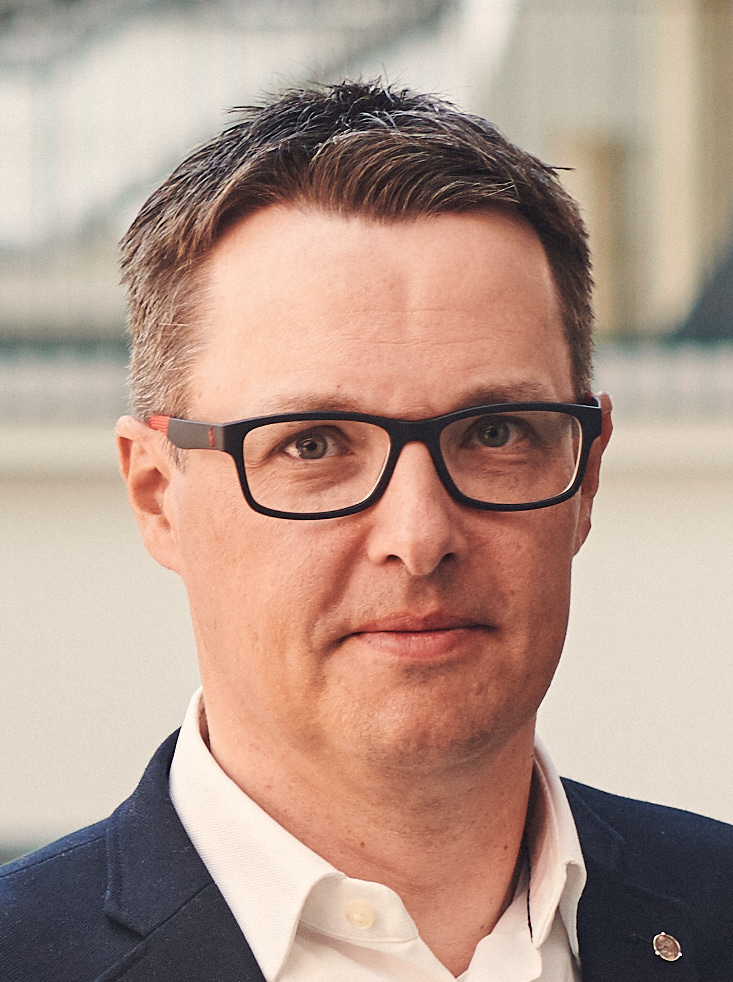
Matti Haavisto is a University Instructor in the Department of Computing Sciences at Tampere University's Faculty of Information Technology and Communication Sciences. He is affiliated with the Hervanta Campus and can be reached via email matti.haavisto@tuni.fi or phone number +358401981478. While explicit research interests are not detailed in the provided information, his department affiliation suggests expertise in areas such as software engineering, data science, and cybersecurity. No recent articles, grants, or awards are listed in the text.
Toni Kotnik is an Associate Professor in the Department of Architecture at Aalto University, Finland. He holds dual expertise in mathematics and architecture, with a Ph.D. from the University of Zurich and a second degree in architecture. His roles include principal of d’HKL , a Zurich-based experimental architecture firm, and adjunct lecturer at institutions like Harvard University and the Bartlett School of Architecture. His research focuses on integrating science, engineering, and computation into architectural design, emphasizing structural innovation and sustainability. Education: Ph.D. in Mathematics (Dr. sc. Nat.), University of Zurich, 1999 Second degree in Architecture Research Interests: Computational design and generative systems Structural aesthetics and neuroaesthetics Sustainable urban and architectural solutions Parametric modeling and material systems Key Contributions: Advances in graphic statics and form-finding Design strategies for high-density urban environments Integration of AI and generative tools in architectural practice Recent Work Trends: Recent articles emphasize computational methods for industrial layout optimization, AI’s role in architecture, and embodied perception in structural design. His work bridges theoretical research with practical applications, such as the Singapore Hawker Centre redesign and experimental structures like hypar-combined shells. Awards: Aalto University Doctoral Thesis Awards (2022) Best Presentation Award (2019) Oscari-Vilamo Award (2023) Advising & Grants: Supervised 4 theses, including recipients of awards like the Metex Award shortlist. Active in international academic networks, serving on conference committees (e.g., International Association for Shell and Spatial Structures) and editorial roles (e.g., Automation in Construction journal). Labs & Teams: Leads the d’HKL studio, collaborating globally on projects like the AA/ETH Pavilion and the Hypercube for Gardens by the Bay. Research focuses on experimental design and material systems.
Petteri Nurmi is a Professor of Computer Science at the University of Helsinki, affiliated with the Department of Computer Science and the Helsinki Institute of Sustainability Science (HELSUS). His research focuses on IoT systems, environmental monitoring, AI-driven solutions, and sustainable computing. He leads projects such as the NordForsk-funded initiative (2024-2028) and the Team Finland Knowledge programme (2024-2026), emphasizing large-scale IoT deployments and quantum computing integration. Key research interests include drone-based air quality monitoring, low-cost sensor networks, and AI applications in environmental science. Nurmi has published extensively in top venues like IEEE IoT Journal and ACM workshops. His work bridges technical innovation with societal challenges, such as urban pollution reduction and sustainable resource management. He supervises doctoral students in the Computer Science program and collaborates internationally on projects like underwater plastic detection (SEAGULL) and smart city infrastructure. Nurmi’s contributions to edge computing and pervasive sensing have been recognized through grants totaling over €2M. His lab develops tools for data-intensive systems, including thermal imaging for energy efficiency analysis and AI-driven sensor fusion frameworks.
Sebastian Szyller serves as an Assistant Professor in the Department of Computer Science at Aalto University, Finland, where he is a core member of Adjunct Professor N. Asokan's research group. His academic role centers on advancing security frameworks for machine learning systems through rigorous theoretical and empirical research. His research expertise spans machine learning security , adversarial machine learning , and model ownership verification , with particular emphasis on defense mechanisms against model extraction attacks, unintended interactions among security measures, and intellectual property protection for AI models. Key contributions address the tension between model confidentiality and practical deployment requirements in real-world systems. Analysis of his 2019-2024 publications reveals an evolving research trajectory from foundational model extraction defenses (e.g., PRADA, 2019) to sophisticated analyses of defense interactions (SoK, 2024) and ownership resolution frameworks (False Claims, 2024). His work consistently bridges theoretical security principles with practical ML deployment challenges, establishing critical benchmarks for model protection. Dr. Szyller actively contributes to premier security venues including IEEE Symposium on Security and Privacy, USENIX Security Symposium, and AAAI conferences. His collaborations within Asokan's research group demonstrate strong interdisciplinary engagement in securing machine learning ecosystems, with recent work expanding into multimedia security and eCommerce fraud detection applications.
Eetu Mäkelä is a Professor of Digital Humanities at the University of Helsinki, leading the research group at the Helsinki Centre for Digital Humanities. He focuses on computational methods in humanities and social sciences, including datafication and interdisciplinary collaboration. He serves as Technical Director of DARIAH-FI and a Research Programme Director at the Helsinki Institute for Social Sciences and Humanities. Currently, he heads the preparatory group for the Helsinki Liberal Arts and Sciences Bachelor’s Programme. His research emphasizes technological and theoretical foundations of computational research, with notable contributions to linked open data, sociolinguistic analysis, and historical text mining. He has developed widely used tools like Recon, Palladio, and Octavo, which are employed in academic and public sectors. His work has garnered over 20 awards, including best paper and open science recognitions. Key areas of expertise include digital humanities methodologies, data integration, and open science practices. He actively contributes to teaching, designing courses such as 'Methods for Digital Humanities' and demonstrating innovative pedagogical approaches. His recent projects involve analyzing 18th-century philosophical texts and sociolinguistic change using computational methods. Awards: Multiple best paper awards, open data awards, and open science awards. Grants/Advising: Leads research initiatives funded by the Academy of Finland and other bodies. Mentors interdisciplinary research teams but no specific student names listed. He maintains active roles in academic infrastructure, including the DARIAH-FI initiative and the Helsinki Institute’s datafication program. His work bridges technical innovation with humanities scholarship, emphasizing practical, enduring systems for academic and public use.
Eero Vaara serves as a Visiting Distinguished Professor in the Department of Management Studies at Aalto University, where his research centers on organizational and strategic change through discursive and narrative lenses. His work critically examines strategy processes, radical transformations like mergers and acquisitions, institutional legitimation, multinational corporation dynamics, and historical perspectives on management. His research interests encompass organizational change, strategic discourse, narrative analysis, institutional theory, and multinational corporate identity. Vaara investigates how language constructs organizational realities during crises, mergers, and cross-cultural interactions, with particular attention to power dynamics in identity politics and the role of historical narratives in strategic renewal. His scholarship bridges theoretical rigor with practical implications for managing complex change in global contexts. Recent publications (2020-2022) reveal consistent thematic focus across top management journals including Academy of Management Journal and Strategic Management Journal. Key trends include the interplay of language and social inequality during global crises like COVID-19, entrepreneurial phenomena in isolated economies such as North Korea, strategic ambiguity in organizational protection, and national identity construction within multinational corporations. His methodological innovations integrate critical discourse analysis with computational approaches like structural topic modeling. Scientific awards highlight his scholarly impact: Best Article Finalist 2023 (Academy of Management Discoveries) 2014 OMT Best Published Paper Award for advancing theoretical understanding of organizations While specific advising relationships and grant funding details aren't documented in the source material, Vaara's collaborative publications demonstrate extensive international research partnerships. His work with scholars across Europe and North America indicates active supervision of doctoral research and leadership in multinational research consortia, particularly in discourse-focused organizational studies. Though laboratory affiliations aren't specified, his methodological work suggests engagement with digital humanities research groups and discourse analysis laboratories, especially evident in publications combining computational text analysis with critical theoretical frameworks.
Abdallah Houcheimi is a researcher at Åbo Akademi University's School of Business and Economics within the Faculty of Humanities and Social Sciences. His work focuses on critical e-commerce mechanisms and emerging market digitalization challenges. His research expertise centers on online retailing ecosystems , with particular emphasis on: Secure payment system design and consumer trust dynamics Product information architecture for conversion optimization E-commerce adaptation in developing economies like Lebanon His work directly contributes to UN Sustainable Development Goals related to industry innovation and infrastructure. Analysis of his recent publications reveals an evolving research trajectory from context-specific market studies (Lebanon 2022) toward fundamental e-tailing mechanics (global payment systems and product information 2024). This progression demonstrates increasing focus on universal digital commerce frameworks applicable across diverse regulatory and cultural environments. Houcheimi actively publishes in peer-reviewed venues including the Journal of Organizational Computing and Electronic Commerce and WorldCIST proceedings, with multiple open-access publications showing significant download metrics (70+ for payment systems paper). His collaborative work with J. Mezei indicates established research partnerships in information systems.
Jukka Manner is a Full Professor (tenured) of Networking Technology at Aalto University's Department of Communications and Networking (Comnet), School of Electrical Engineering. With a career spanning over two decades in internet technologies, he leads research in networking, wireless systems, and energy-efficient ICT solutions. Dr. Manner received his MSc (1999) and PhD (2004) degrees in computer science from the University of Helsinki. His academic journey has been marked by significant contributions to internet standardization through the IETF since 1999, where he served as co-chair of the NSIS working group. Professor Manner's research focuses on networking, software and distributed systems, with particular emphasis on wireless and mobile networks, transport protocols, energy efficient ICT and cyber security. His work bridges theoretical advancements with practical applications, addressing critical challenges in modern communication systems, sustainable networking practices, and security frameworks. His research group has made significant contributions to 5G technologies, UAV communications, and energy-efficient network design. His extensive publication record shows a clear evolution toward sustainability in networking technologies, with recent work focusing on energy efficiency in 5G systems, sustainable web technologies, and the environmental impact of digital infrastructure. The research demonstrates strong interdisciplinary connections between telecommunications engineering, computer science, and environmental science, with particular emphasis on reducing the carbon footprint of digital systems while maintaining performance. Cross of Merit, Signals (2014) Medal for Military Merits for contributions in national defence and C4 (2015) Professor Manner has supervised over 200 MSc theses and more than 20 doctoral dissertations, establishing himself as a dedicated mentor in the field. He has been principal investigator and project manager for over 15 national and international research projects, including serving as Academic Coordinator for the Finnish Future Internet research programme (2008-2012). His leadership extends to conference organization, having served as local co-chair of Sigcomm 2012 in Helsinki, and active participation as a peer reviewer and member of various Technical Program Committees. As an active contributor to internet standardization through the IETF, Professor Manner's work has practical impact on global networking technologies. His research group maintains strong connections with industry partners and participates in shaping future networking standards and practices, particularly in the areas of sustainable networking, 5G evolution, and security frameworks for emerging technologies.
Paul-Christian Burkner is a researcher in the Department of Computer Science at Aalto University. His work focuses on Bayesian statistical methods, computational modeling, and probabilistic programming. He collaborates with Professor Aki Vehtari's research group and has published extensively on topics like model sensitivity, spatiotemporal analysis, and variable selection techniques. His research interests include: Bayesian inference and model comparison Computational statistics Probabilistic programming Machine learning algorithms Statistical modeling in social sciences Neuroimaging data analysis Recent publications demonstrate expertise in simulation-based calibration, spatiotemporal modeling, and Gaussian process approximations. Collaborations span psychology, neuroscience, and machine learning domains. Contact: ext-paul-christian.burkner@aalto.fi
Toni Rantanen is a Doctoral Researcher at Aalto University in the College of Built Environment. His work focuses on integrating geospatial data with game engine technologies for advanced 3D visualization and analysis of urban environments. Specializes in digital twin applications Active in urban sustainability research Collaborates with the MeMo research group Research Interests Geospatial Data Integration : Developing frameworks for open data standards in urban digital twins 3D Visualization : Creating immersive virtual environments for watershed analysis and lighting simulations Environmental Analysis : Using game engines for change detection and urban park evaluation Interactive Mapping : Designing user-friendly geospatial tools Reality Modeling : Capturing built environment changes through multitemporal data Recent publications demonstrate expertise in urban digital twin development , 3D geovisualization , and game engine applications for environmental research. Collaborative work spans multiple disciplines including urban planning , GIS technology , and virtual reality evaluation .
Hannu Toivonen is a Full Professor of Computer Science at the University of Helsinki, affiliated with the Faculty of Science and the Department of Computer Science. He leads the Discovery Research Group and is part of the Helsinki Institute for Information Technology (HIIT) and the Finnish Center for Artificial Intelligence (FCAI). He obtained his PhD in Computer Science from the University of Helsinki in 1996 and has held his professorship since 2002. His research spans Artificial Intelligence , Data Science , Computational Creativity , and Data Mining , with applications in generative art, automated journalism, and bioinformatics. His research focuses on: Developing AI systems for creative tasks (e.g., poetry, music, and art generation) Cross-lingual natural language processing and unsupervised learning Ethical and societal implications of AI in media and labor Analysis of his 15 most recent publications (2021–2025) reveals a strong emphasis on computational creativity and AI-driven content generation , with interdisciplinary applications in digital humanities, journalism, and biology. Trends include ethical AI frameworks, human-AI collaboration, and innovative evaluation methods for generative systems. Scientific Awards & Honors: Knight, First Class, Order of the White Rose of Finland (2019) Best Applied Research Award, IEEE ICDM (1998) Honorary Member of TKO-äly (2010) Member of Finnish Academy of Science and Letters He has supervised over 20 doctoral theses and secured ~7 MEUR in grants (e.g., EU projects: Embeddia , Newseye ). He leads the Discovery Research Group and collaborates with institutions like VUB (Belgium) as a Francqui International Professor (2025).
Dr. Juha Kärkkäinen is a University Lecturer and Principal Investigator at the Department of Computer Science, University of Helsinki, specializing in Algorithmic Bioinformatics. He supervises PhD students in the Doctoral Programme in Computer Science and actively contributes to research outputs and academic events. Institution: University of Helsinki Department: Department of Computer Science Rank: Lecturer His research focuses on string processing , data structures , and combinatorial pattern matching , with recent work on bijective Burrows-Wheeler transforms, LCP arrays, and efficient string indexing. Google Scholar lists publications spanning 2024 to 1999, highlighting his expertise in algorithm design and compression techniques . Notably, he has participated in and organized events like the International Workshop on Combinatorial Algorithms and delivered a keynote speech at the 1st Summer School on Bioinformatics Algorithms. While no explicit awards are detailed, his editorial roles in scientific collections and conferences underscore his academic influence.
Professor Jaana Kaarina Bäck is affiliated with the University of Helsinki, serving in the Faculty of Agriculture and Forestry's Department of Forest Sciences. She leads the 'Ecosystem processes' research group and oversees ecosystem research at the SMEAR measurement network. Her work bridges forest ecology, atmospheric science, and climate change mitigation, focusing on forest-atmosphere interactions and biogenic volatile organic compounds (BVOCs). PhD in Physiological Plant Ecology (University of Oulu, 1994) Docentship in Forest-Atmosphere Interactions (University of Helsinki, 2010) Docentship in Plant Ecophysiology (University of Oulu, 1998) Bäck's research explores how boreal forests influence atmospheric composition, carbon cycling, and climate dynamics. She investigates BVOC emissions, ecosystem responses to climate change, and feedback mechanisms between vegetation and the atmosphere. Her recent publications (277 total) analyze carbon dynamics after forest thinning, aerosol production in boreal ecosystems, and harmonized environmental observations via eLTER. These works span soil functions, air quality, and climate risk research. Knight, First Class, Order of the White Rose of Finland (2021) Open Science Award (University of Helsinki, 2018) Pro Scientia Award (Finnish Academy of Sciences and Letters, 2017) Bäck supervises 3 postdoctoral researchers, 4 doctoral students as main supervisor, and 12 as co-supervisor. She has secured over 6 M€ in research funding, including EU Horizon grants and Academy of Finland projects.
Jonna Häkkilä is a Professor of Industrial Design at the Faculty of Art and Design, University of Lapland and serves as Vice Dean (Research). She holds a Docent title in Human-Computer Interaction and Computer Science from the University of Oulu (since 2011). Her primary research group is LUX (Lapland User Experience Design). Research focuses on user-centered design, wearable technology, cultural heritage digitization, and ethical technology integration with marginalized communities. She leads projects like the MAGICS National Infrastructure for Human in the Digital World and Indigenous Digital Storytelling with New Media. Awards include Best Demo Award at Pervasive Displays 2019 and Best Paper Award at MUM 2017. Active in organizing international conferences and supervising 3 doctoral works. Engaged in Arctic resilience initiatives through co-creative methodologies.
Yu Xiao is an Associate Professor at the Department of Information and Communications Engineering, Aalto University, specializing in edge computing, extended reality (XR), wearable computing, and crowdsensing. Their research contributes to the UN Sustainable Development Goals, particularly in education and technology innovation. Active in mobile cloud computing and decentralized systems Principal Investigator in EU-funded projects (EMIL, TUTL) Expert in 5G networks, autonomous systems, and human activity recognition Yu Xiao's work spans interdisciplinary domains, including healthcare (cardiovascular resuscitation devices) and urban mobility (autonomous vehicle interactions). They have received multiple awards, including Best Paper Awards and Nokia Foundation Scholarships. Focus on low-latency communication and multiagent reinforcement learning Developed frameworks like FediLive for decentralized social networks Contributed to 128+ publications and software tools Recent collaborations include institutions like Pontificia Universidad Católica de Chile and participation in IEEE committees. Their research integrates blockchain for secure IoT communication and advanced AR applications.