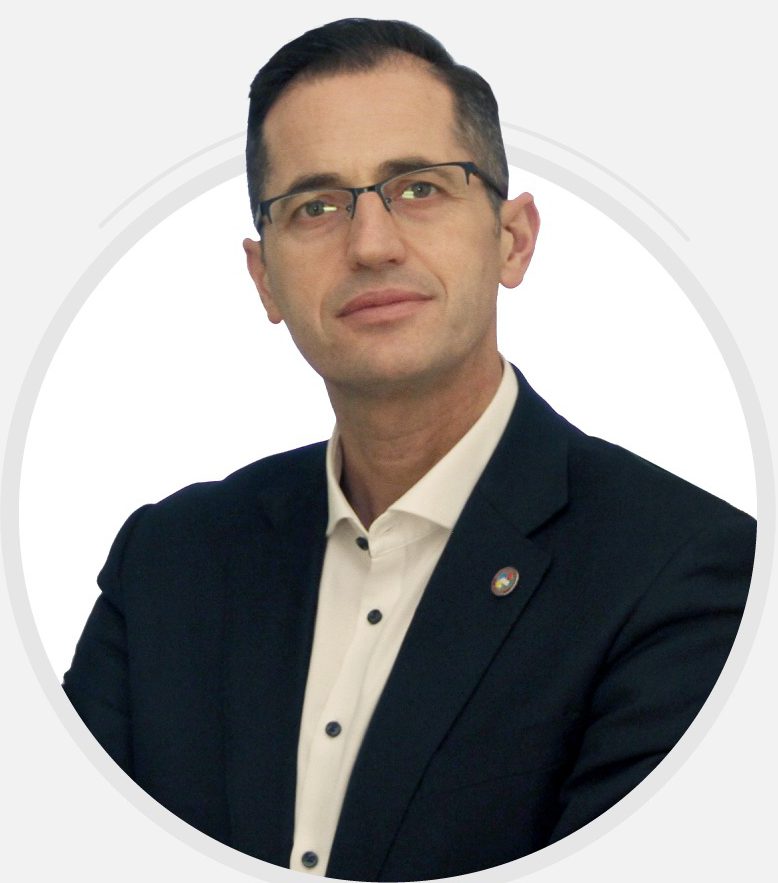
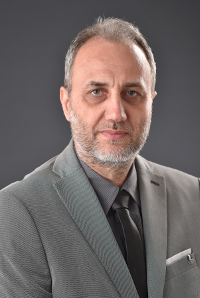
Dalibor Radovanović is a researcher at Singidunum University , affiliated with the Faculty of Business Informatics . His work spans cybersecurity, blockchain technologies, and their applications in business and IoT systems. Education: Doctoral Dissertation (2016, Singidunum University) Master's & Basic Studies (Faculty of Business Informatics) Secondary Education: ETŠ Nikola Tesla Research Interests include: Security frameworks for IoT and blockchain integration Smart card and wireless network vulnerabilities E-governance and corporate IT audit methodologies Machine learning applications in cybersecurity Environmental performance optimization in agribusiness Publication Trends reveal a focus on blockchain (2022), cybersecurity (2009-2022), and IT governance (2010-2017). His work bridges theoretical analysis with practical implementations in Serbia's digital economy. Collaborations with scholars like Marko Šarac and Saša Adamović highlight interdisciplinary approaches to securing financial systems, educational institutions, and industrial IoT applications.
Goran Avlijas serves as an Assistant Professor at Singidunum University's Faculty of Business in Belgrade, Serbia. His academic profile spans project management, operational research, and retail logistics with significant industry experience at Delta Holding, Strabag AG, and Efektus Consulting Group. His research interests focus on project management methodologies including Agile and Earned Value Management, retail operations optimization through automatic replenishment systems, and sustainable project control . Current work examines gig economy impacts on well-being and pandemic business resilience. Recent publications demonstrate strong emphasis on Quantitative project risk analysis using Monte Carlo simulation Retail inventory management and stock-out reduction Agile methodology implementation in Serbian business context Sustainable infrastructure project valuation Professional recognitions include: Project Management Professional (PMP) Professional in Business Analysis (PMI-PBA) Agile Certified Practitioner (PMI-ACP) He actively participates in Erasmus+ programs as both teacher and mentor, notably guiding Serbia's championship-winning team at the 2020 International Project Management Championships. His academic contributions include two textbooks on Project Management and Entrepreneurship, along with numerous international conference participations as scientific committee member and reviewer. Avlijas maintains strong industry-academia connections through PMI membership and consulting engagements, while contributing to higher education accreditation processes as a National Accreditation Body delegate.
Nebojša Bačanin Džakula is an academic affiliated with Singidunum University's Faculty of Mathematics, specializing in Computer Science. He earned his PhD in 2015 with a thesis on improving swarm intelligence metaheuristics for global optimization. His research focuses on AI-driven solutions for cybersecurity, energy forecasting, and optimization algorithms. He has authored/co-authored books on cloud computing and web programming. His work bridges metaheuristics with machine learning, addressing challenges in IoT security, renewable energy prediction, and healthcare diagnostics. He actively contributes to conferences like Sinteza and IEEE events, emphasizing practical applications of AI and optimization in real-world scenarios. Education: Completed doctoral studies at the Faculty of Mathematics (2009–2015). Extensive industry certifications include Microsoft, CompTIA, and Oracle credentials, enhancing his technical expertise. Research Interests: Develops hybrid models combining metaheuristics (e.g., PSO, GA) with deep learning for tasks like intrusion detection, price forecasting, and medical diagnostics. Specializes in optimizing neural networks and feature selection using advanced algorithms. His work often addresses societal challenges in sustainability, cybersecurity, and healthcare. Recent Publications: Focus on AI-driven solutions for IoT security, renewable energy prediction, and medical diagnostics (e.g., Parkinson’s detection via LSTM networks). His articles appear in prestigious journals like Engineering Applications of Artificial Intelligence and Applied Soft Computing.
Sebastian Pokutta is a Professor at Technische Universität Berlin, Vice President at the Zuse Institute Berlin (ZIB), and Chair of the Cluster of Excellence MATH+ and MODAL. His research lies at the intersection of Artificial Intelligence, Optimization, and Machine Learning, with applications in sustainability, quantum computing, and mathematical discovery. Research Interests: Development of novel optimization algorithms, particularly Frank-Wolfe and Conditional Gradient methods. Integration of machine learning with decision-making and combinatorial optimization. AI for Science (AI4Science), including applications in quantum mechanics and ecology. AI and creativity, human-AI co-creativity, and social science modeling using multi-agent LLMs. His recent publications (2025) demonstrate a strong focus on scalable optimization, interpretability, and algorithmic foundations. The work spans theoretical advances in convergence analysis, practical implementations in Julia (FrankWolfe.jl), and real-world deployments in biomass estimation and quantum certification. Scientific Awards: Gödel Prize (2023) STOC Test of Time Award (2022) Science Prize of the Association for Pediatric Orthopedics (2025) Google Research Awards (2021, 2020) NSF CAREER Award (2015) He advises a vibrant research group, with former students and postdocs securing faculty positions at institutions like Inria, Carlos III University, and James Madison University. His group has received funding from Google, DFG, and Math+, and he leads major collaborative efforts such as the Thematic Einstein Semester on Mathematical Optimization for Machine Learning. Labs and Teams: Interactive Optimization and Learning Lab at TU Berlin and ZIB. Leadership in MODAL and MATH+ research clusters, fostering interdisciplinary collaboration in mathematical optimization and AI.
Sebastian U. Stich is a tenured Professor at CISPA Helmholtz Center for Information Security and a member of the European Lab for Learning and Intelligent Systems (ELLIS). His research focuses on optimization for machine learning, collaborative learning (distributed, federated, and decentralized methods), efficient optimization techniques, adaptive stochastic methods, and privacy/security in machine learning. Recent appointments include ERC Consolidator Grant 2024 for the CollectiveMinds project. Key contributions in federated/decentralized learning, uncertainty estimation, and communication-efficient optimization. Active in workshop organization, including the Optimization for Machine Learning workshop at NeurIPS 2024. Teaching modern optimization methods at Saarland University (2023-2025). His work has been recognized with awards such as the Google Research Scholar Award (2023) and Meta Privacy-Enhancing Technologies Award (2022) . His research group includes postdocs Dr. Anton Rodomanov and Dr. Rotem Mulayoff, and PhD students Xiaowen Jiang and Yuan Gao.
Prof. Blerim Rexha is a full professor at the University of Prishtina's Faculty of Electrical and Computer Engineering, Kosovo. With a Ph.D. in Computer Engineering from Vienna University of Technology (2004), he has led research in cybersecurity, blockchain, machine learning, and electronic voting systems. His teaching portfolio includes data, computer, and internet security courses. Education : Ph.D. in Computer Engineering (Vienna), Electrical Engineer MSc (Prishtina), specialized certifications in software engineering, biometrics, and .NET programming. His research spans cybersecurity (DDoS mitigation, face authentication attacks), blockchain applications (electronic voting bridges, transaction privacy), and machine learning integration (boosted trees for intrusion detection, LSTM for vulnerability scanning). He has contributed to cloud security through novel encryption methods and AI-driven attack detection. Recent publications focus on energy efficiency in cloud vs on-premises systems, XGBoost/CatBoost/LightGBM comparisons for network security, and blockchain bridges for e-voting. His work has addressed privacy preservation in video data, SMS encryption, and eID card pseudo-profiles. Awards include the 2024 Marin Barleti Prize for academic contributions and Best Paper Awards in election security (2015) and Kosovo website vulnerabilities (2013). Honors : Marin Barleti Prize (2024) Cyber Security Ambassador (2018) ICT Academician of the Year (2016) Best Paper Awards (2015, 2013) As academic advisor to the KosovaCyberTeam , he mentors students like Korab Keqekolla and Abian Morina. His leadership extends to Kosovo's Cyber Security State Training Center curriculum development and jury roles in Albanian ICT Awards .
Zoran J. Stankovic is a Full Professor at the Faculty of Electronics, University of Niš, Serbia, in the Department of Telecommunications. He has been an integral part of the institution since earning his PhD in 2007, progressing from Assistant to Associate Professor (2020) and Full Professor (2024). He is actively involved in research, education, and academic leadership. Education: PhD in Telecommunications, Faculty of Electronics, University of Niš (2007) Master's in Telecommunications, Faculty of Electronics, University of Niš (2002) Bachelor's in Electronics and Telecommunications, Faculty of Electronics, University of Niš (1994) His research focuses on applying artificial neural networks to solve complex problems in electromagnetics and wireless systems. Key areas include antenna design optimization , direction-of-arrival (DoA) estimation , microwave cavity modeling , and smart textile antennas . His work bridges machine learning with electromagnetic theory, enabling efficient and adaptive RF system design. The analysis of his recent publications reveals a strong trend in using deep and hybrid neural networks for electromagnetic modeling and signal processing. His research emphasizes real-world applications such as wearable antennas, mobile source tracking, and intelligent antenna systems, often published in high-impact IEEE and Wiley journals. Scientific Awards: Commemorative Plaque from the Yugoslav Society for Microwave Techniques and Technologies (2005) for outstanding scientific results in microwave engineering Advising and Grants: While specific students are not listed, he has supervised numerous academic works. He has participated in 17 research projects (13 national, 4 international including DAAD, NATO, COST) and 8 educational development projects (including ERASMUS+, TEMPUS, WUS). These reflect sustained funding and academic collaboration. Labs and Teams: He is the founder and head of the Laboratory for Antennas and Propagation at the Faculty of Electronics, Niš. He is actively involved in organizing and leading the international conferences TELSIKS and ICEST , serving on their program and organizational committees, demonstrating strong leadership in the academic community.
Yannic Maus is a University Professor at the Faculty of Computer Science and Biomedical Engineering at Graz University of Technology (TU Graz), Austria, where he heads the newly founded Institute of Algorithms and Theory (established in 2025). He also serves as co-leader of one of the five fields of expertise at TU Graz (FoE Information, Communication & Computation). His academic journey includes: PhD in Computer Science from University of Freiburg, Germany (2014-2018) MSc in Mathematics from RWTH Aachen, Germany BSc in Mathematics and Computer Science from RWTH Aachen, Germany (with a year at National University of Singapore) Professor Maus specializes in theoretical computer science and algorithm design, with a particular focus on distributed computing. His research spans distributed graph algorithms, efficient algorithms, data structures, complexity theory, and geometric algorithms. He approaches problems with both theoretical rigor and practical applications in mind, seeking clean mathematical solutions to questions motivated by real-world systems. His recent publications show a strong focus on distributed and parallel algorithms, particularly in graph theory. The research trends include distributed graph coloring, symmetry breaking, vertex cover problems, and massively parallel computing models. His work often bridges theoretical computer science with practical distributed systems considerations, with applications to large-scale networks and highly parallel systems. Professor Maus has received numerous accolades for his research: 2020 Principles of Distributed Computing Doctoral Dissertation Award Wolfgang-Gentner-Nachwuchsförderpreis 2019 GI Dissertationspreis 2018 Best Paper Awards at SIROCCO 2016, DISC 2016, and DISC 2017 Professor Maus actively mentors PhD students and has secured significant research funding, including FWF grants P36280-N (2023-2027), DOC 183 (2024-2028), I6915 (2024-2028), and FFG grant No. 59263962. His research group maintains strong international collaborations with institutions across Germany, Finland, Iceland, Israel, and beyond, providing students with opportunities for international research visits. He leads the Algorithms & Complexity research group at TU Graz, which includes PhD students Manuel Jakob, Florian Schager, Malte Baumecker, and Kritika Kashyap, as well as postdoc Tijn de Vos. The group is actively involved in theoretical computer science research with a focus on distributed and parallel algorithms, particularly for large-scale networks and highly parallel systems.
Marina Milovanović is a Professor at the University of Singidunum, Faculty of Informatics and Computing, Department of Mathematics. She holds dual doctoral degrees from the Faculty of Science, University of Kragujevac (Department of Mathematics, 2014) and Faculty of Entrepreneurial Business, Union University (2008), along with Master's and Bachelor's degrees from the Faculty of Mathematics, University of Belgrade (2000-2005 and 1995-2000 respectively). Faculty of Science, University of Kragujevac, Department of Mathematics (PhD, 2014) Faculty of Entrepreneurial Business, Union University (PhD, 2008) Faculty of Mathematics, University of Belgrade (Master's, 2000-2005) Faculty of Mathematics, University of Belgrade (Bachelor's, 1995-2000) Svetozar Marković High School, science and mathematics major (1991-1995) Professor Milovanović specializes in Mathematics Education and Educational Technology, with particular expertise in interactive multimedia applications for teaching mathematics. Her research consistently bridges theoretical mathematics with practical educational technology solutions, evolving from traditional multimedia approaches to incorporating cutting-edge AI and machine learning techniques. She has authored multiple books including 'Interactive multimedia in mathematics teaching' (2015) and collections of solved mathematics problems for entrance exams. Her recent publication record through 2025 demonstrates active engagement in interdisciplinary research, particularly at the intersection of educational technology, artificial intelligence, and practical applications in fields ranging from software engineering to medical diagnostics. Her work shows a clear trajectory from foundational educational technology research toward more sophisticated AI-enhanced learning systems. Professor Milovanović has made significant contributions to semantic web applications in education, particularly through Moodle LMS enhancements, and has explored SCADA applications in industrial contexts. Her collaborative research spans multiple countries and institutions, reflecting an international scholarly network. She has extensive experience developing computer tools for engineering education and has published on diverse topics including petroleum industry processes, environmental management, and financial mathematics. Her work demonstrates consistent application of computational approaches to solve domain-specific problems across multiple disciplines.
Miloš Racković serves as a full Professor in the Department of Mathematics and Informatics at the University of Novi Sad, Serbia. He maintains active academic engagement through the Laboratory for the development of information systems, with his office located in the Information technologies and systems office (DMI&DF) on the second floor, room 49. Contact is available via telephone (485)-2868 or email rackovic@dmi.uns.ac.rs, and his personal website (http://www.is.pmf.uns.ac.rs/rackovicm/) provides additional resources. His research spans foundational and applied computer science, with seminal contributions in fuzzy database systems including PFSQL query language development and prioritized fuzzy logic for relational databases and XML. He has pioneered deep learning methodologies through innovative classification techniques using negative and missing features in convolutional neural networks. Additional expertise includes high-performance computing implementations of Lattice Boltzmann methods using OpenCL, robotics (symbolic modeling and trajectory planning), and blockchain applications for Industry 4.0 production processes. His sports analytics work applies neural networks to basketball player and referee movement analysis. Analysis of his 2012-2025 publications reveals a strategic evolution toward interdisciplinary applications, particularly in industrial transformation (blockchain-enabled traceability) and sports analytics. His work consistently bridges theoretical computer science with practical implementations, demonstrating increasing focus on real-world problem solving while maintaining strong foundations in database theory and computational methods. Professor Racković leads the Laboratory for the development of information systems, which focuses on advancing information system methodologies through formal modeling extensions (including Petri net innovations) and practical implementations for uncertainty management. The laboratory's work spans from foundational research in fuzzy logic systems to applied projects in high-performance computing and blockchain integration, fostering innovation in information technology development.
Marko Tanasković is a researcher at Singidunum University's Faculty of Informatics and Computing, specializing in control systems, robotics, and electrical engineering. He holds a PhD from ETH Zurich (2015) in Information Technology and Electrical Engineering, following degrees from University of Belgrade (BEng, 2009) and ETH Zurich (MEng, 2011). His research focuses on adaptive control systems, machine learning applications in engineering, and sensorless motor control. Key contributions include: Development of predictive algorithms for traffic systems and industrial automation Innovations in rotor orientation determination for PMSM motors Integration of AI in fraud detection and building climate control Recent work includes a 2024 study on wearable health monitoring devices and a 2022 paper on drone forensics. He has authored/co-authored over 15 peer-reviewed articles and holds patents in motor control technologies. Current affiliations include Singidunum University's Department of Electrical Engineering and Collaboration with ETH Zurich alumni networks. Active in international conferences such as Sinteza and IEEE events.
Aleksandar Jevremović is a Full Professor at the Faculty of Informatics and Computing, Singidunum University (Belgrade, Serbia), and holds multiple academic and professional roles. He is the Serbian representative at the UNESCO IFIP Technical Committee on Human-Computer Interaction since 2018. He has served as Vice-Dean of his faculty (2015–2018) and held visiting professorships at institutions like Ss. Cyril and Methodius University (North Macedonia) and Tallinn University (Estonia). His research focuses on cybersecurity, IoT, AI, and e-learning innovation. Education and Affiliations: External Researcher at the Mathematical Institute of the Serbian Academy of Sciences and Arts Visiting Scholar at Cyprus Interaction Lab (Cyprus University of Technology) Alumni/Postdoc Researcher at Tallinn University's HCI Group Member of IEEE and the Informatics Association of Serbia Research Interests: Jevremović’s work spans cybersecurity (e.g., intrusion detection, secure IoT protocols), human-computer interaction (HCI), AI-driven education tools, and neurotechnological applications like EEG-based assessment systems. He emphasizes practical solutions for digital safety, such as children’s online protection and cryptographic key generation from biometric data. Grants and Projects: Member of the External Advisory Committee for the EU-funded ONTOCHAIN project (2022–2023) Mentor for training schools like AAPELE Training School and NET4Age-Friendly initiatives Trainer in IoT, cybersecurity, and health promotion programs across Europe Labs and Teams: He collaborates with interdisciplinary teams on projects like CASPER (Children Agents for Secure and Privacy Enhanced Reaction) and led the development of WIDE, a collaborative web development education platform.
Sandra M. Đosić is an Associate Professor at the Faculty of Electronics in Niš, University of Niš, Serbia, specializing in Electronics and Embedded Systems. She has been actively contributing to research in real-time systems, fault tolerance, wireless sensor networks, and indoor localization technologies. Research Interests: Her work spans fault-tolerant real-time systems, energy-efficient computing, UWB-based indoor localization, and communication protocols for wireless sensor networks. She explores techniques such as dynamic voltage and frequency scaling (DVFS), tone-based contention resolution, and deflection routing in networks-on-chip to enhance system reliability and efficiency. Publication Trends: Her recent publications (2009–2022) demonstrate a strong focus on improving robustness and performance in embedded and distributed systems. The research integrates signal processing, network optimization, and energy-aware design, primarily applied in industrial and indoor environments. Scientific Awards: No awards are mentioned in the provided text. Advising and Grants: While no specific students are listed, she is currently participating in two national research projects, indicating active involvement in funded research. Her collaborations with researchers such as Igor Stojanovic and Milica Jovanovic suggest a strong team-based research approach. Labs and Research Teams: Although no formal lab or team name is specified, her repeated co-authorship with colleagues from the Faculty of Electronics implies active participation in a research group focused on electronics, communications, and real-time systems.
Prof. Dr. Saša Adamović is a faculty member at Singidunum University in Belgrade, Serbia, affiliated with the Faculty of Informatics and Computer Science . His academic career spans over 15 years with a focus on Cryptography, Biometrics, and IoT Security . Born October 15, 1985, in Drvar, Bosnia and Herzegovina PhD in Advanced Security Systems (2013), Master’s in Contemporary Information Technologies (2008), and Bachelor’s in Business Informatics (all from Singidunum University) His research interests include: Biometric Cryptography Blockchain for IoT Security Catalan Number Applications in Cryptography Machine Learning in Security Systems Virtualization and Energy Efficiency Steganography and Forensics Recent publications highlight trends in: IoT Healthcare Security (2022) Biometric Authentication (2021) Combinatorial Cryptography (2021) Machine Learning for Diabetes Prediction (2021) Distance Learning Security (2023) He served as one of five Serbian representatives in the Open World program (USA) for expert exchange in technology development.
Marko T. Milojkovic is a full professor at the Faculty of Electronics, University of Nis, leading the Department of Automation since 2022. He holds a PhD in Systems Management (2012), Master's in Automation (2008), and a Bachelor's in Computer Engineering & Informatics (2003), all from the same institution. His research focuses on adaptive control systems, neural networks, and dynamical systems modeling, with 27 papers in impact-factor journals. He currently heads the Laboratory for Modeling, Simulation and Systems Management and participates in 2 national and 2 international projects. Education: PhD: Systems Management (2012) MSc: Automation (2008) BSc: Computer Engineering & Informatics (2003) Research interests include neuro-fuzzy systems, MIMO system optimization, and endocrine neural networks applied to adaptive control. His publications demonstrate expertise in quasi-orthogonal filters, sliding mode control, and time-series forecasting. No scientific awards are explicitly mentioned, but his extensive project participation highlights active collaboration in control systems and automation. Prof. Milojkovic's work bridges theoretical modeling and practical applications, with recent emphasis on intelligent control systems and nonlinear dynamics. His laboratory facilitates interdisciplinary projects addressing complex system management challenges.