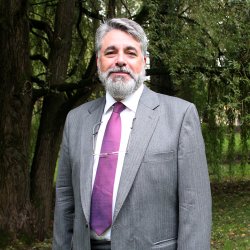
Jason R. Green is a Professor in the Department of Chemistry at the University of Massachusetts Boston. With a PhD from Purdue University (2007) and postdoctoral experience at the Universities of Chicago, Cambridge, and Northwestern University, his research bridges theoretical chemistry, physics, and data science to explore nonequilibrium systems. His work focuses on transforming chemical energy into dynamically functional materials through interdisciplinary approaches. Education: B.S., Case Western Reserve University (cum laude, 2002) Ph.D., Purdue University (2007) with NASA Graduate Fellowship NSF Postdoctoral Fellow at University of Chicago and University of Cambridge Research Interests: Theoretical chemical physics Nonequilibrium statistical mechanics Data science applications in chemical systems His recent publications analyze electrochemical material dynamics (ACS Nano 2024), chemically driven self-assembly (Chemical Science 2024), and thermodynamic speed limits across disciplines (Nature Physics 2020, Physical Review X 2022). He has received prestigious fellowships including NASA's Graduate Student Researchers Program and NSF Postdoctoral Fellowship. The Green Research Group at UMB applies theory, computation, and data science to understand energy transformation in synthetic and biological materials.
Associate Professor Zhidong Li is a prominent researcher at the Data Science Institute within the Faculty of Engineering and Information Technology at University of Technology Sydney (UTS), Australia. With over a decade of experience in data science and machine learning, he leads impactful research bridging theoretical advancements with practical applications across multiple critical infrastructure domains. Dr. Li earned his PhD from the University of New South Wales, Sydney, Australia, and previously served as a senior engineer at Data61, CSIRO (Commonwealth Scientific and Industrial Research Organisation), Australia's federal government agency for scientific research. His research spans machine learning, data mining, pattern recognition, image processing, and human-computer interaction with applications in water, gas, traffic, urbanization, visitor economy, agriculture, environment, finance, property market, railway, law, electric and health sectors. His work particularly focuses on developing interpretable AI models, temporal point processes, and practical applications for smart infrastructure management. His extensive publication record reveals strong thematic consistency in applying advanced machine learning techniques to infrastructure management problems, with particular emphasis on water systems. His research demonstrates progression from fundamental algorithm development toward increasingly sophisticated applications with real-world impact, especially in temporal modeling, graph neural networks, and fairness in AI systems. Scientific Awards 2022 R&D Excellence Award NSW Water Award 2021 UTS Medal for Research Impact for the Vice-Chancellor's Awards for Research Excellence 2018 Australian Museum Eureka Prize for Excellence in Data Science 2019 Victorian iAwards - Industrial & Primary Industries Merit for 'Predictive Analytics for Water Pipe Maintenance' Multiple AWA research innovation awards (NSW, National, QLD) Dr. Li actively supervises Masters and PhD students and leads numerous funded research projects across diverse sectors. His collaborative approach is evident through partnerships with water utilities, transport agencies, and various CRC projects focusing on Food Agility, Digital Finance, and Smartcrete. His work on the world's first independently-audited ethical talent AI in partnership with Reejig demonstrates his commitment to translating research into real-world solutions that address societal challenges while maintaining ethical standards.
Univ.-Prof. Christos N. Likos is a world-leading researcher at the University of Vienna , holding the chair in Multiscale Computational Physics since 2010. Affiliated with the Faculty of Physics and directing the Computational and Soft Matter Physics group, he bridges scales from microscopic to macroscopic in soft matter systems. Education: Dipl.-Ing. in Electrical Engineering (NTUA Athens), M.Sc. & Ph.D. in Physics (Cornell University) Honors: Fellow of the Royal Society of Chemistry (2013), University of Vienna Teaching Award (2025), Outstanding Referee Award (2009) His research in Soft Condensed Matter focuses on polymers, colloids, and biomolecular systems through coarse-graining , density functional theory , and Monte Carlo simulations . Key collaborations include institutions in Rome, Heraklion, San Sebastian, and Princeton. His work reveals principles of self-organization, non-equilibrium phenomena, and responsive material design with applications in cosmetics, nanotechnology, and biophysics. Recent publications highlight active matter , topological polymers , and electric field-responsive microgels . The group trains 18 current students (Ph.D., M.Sc., B.Sc.) and maintains partnerships with experimental teams across Europe. As Associate Editor of Soft Matter and member of Journal of Colloid and Interface Science Open editorial board, he shapes scientific discourse in his field. Teaching excellence is a hallmark, with courses on Advanced Statistical Physics and Soft Matter Principles . His group website details ongoing projects, while lab facilities in Vienna's Kolingasse campus enable interdisciplinary research.
Prof. Wojciech Sobieski is a faculty member at the Department of Mechanics and Fundamentals of Machine Design within the Faculty of Technical Sciences at the University of Warmia and Mazury in Olsztyn . His research focuses on fluid mechanics, numerical modeling, and porous media analysis, with applications in environmental engineering, hydraulic systems, and 3D printing. Academic Rank: Professor Scientific Discipline: Mechanical Engineering Key Research Areas: Tortuosity Analysis, Multiphase Flow, DEM Simulations His recent publications highlight advancements in computational methods for granular porous media, fluid flow modeling, and thermodynamic applications. Notable trends include the use of the Waterfall Algorithm for geometric analysis and sensitivity studies of numerical models like the Eulerian multiphase approach. He has contributed to understanding Forchheimer's laws and cavitation phenomena in hydraulic systems. Prof. Sobieski oversees the PathFinder Project , a research initiative focused on numerical modeling of porous media. His laboratory maintains infrastructure for multiphase flow simulations and particle-scale modeling. He has supervised 2 doctoral students to completion but currently has no active advisees.
Daniela Margareta Chiorean serves as University Professor in the Graphics Department at the University of Art and Design Cluj-Napoca, where she has held academic positions since 2000 and currently serves as Prorector responsible for quality assurance (2023-2024). She previously served as Dean of the Faculty of Plastic Arts (2012-2015) and Department Director for Graphics (2015-2023). Concurrently, she maintains an active legal practice as an attorney specializing in civil law and intellectual property at the Cluj Bar Association since 2007. Her educational background includes a PhD in Visual Arts (2007) from UAD Cluj-Napoca with thesis 'Man - Media. Traditional and new media in graphics,' a Master's in Civil Law (2005-2007), Law degree (2001-2005), and dual Master's degrees in Visual Arts (2001-2003). She completed specialized training in intellectual property at WIPO (2002) and cultural management/multimedia in Germany (2002-2003). Chiorean's research bridges graphic design, digital media, and intellectual property law, examining how traditional media interacts with contemporary digital environments. Her work explores symbolic dynamics in advertising, the evolution of typography from Gutenberg to virtual publications, and the legal frameworks governing creative works in digital spaces. She investigates how new technologies transform artistic practices while maintaining connections to historical techniques, with particular focus on remix culture and copyright issues in visual communication. Her publication trends reveal consistent exploration of media transitions, with recent work analyzing digital image processing, urban-nature representations in artificial environments, and comparative studies of display versus print media. These publications demonstrate her interdisciplinary approach connecting artistic practice with scholarly inquiry into media evolution. Premiul UAP România pentru grafică - tineret (2002) Premiul Vespasian Lungu pentru grafică (1997) As a researcher, she has led multiple nationally-funded projects including 'Vector – Design and Book Illustration' (2012) through the National Cultural Fund and 'Center for Promoting Entrepreneurship in Sustainable Development' (2010-2013). She coordinates international collaborations through Erasmus+ and Leonardo da Vinci programs, organizing workshops on infographics, bookbinding, and digital media. Her professional activities span academic leadership, legal practice in intellectual property, and active participation in national and international artistic communities as both creator and evaluator. She coordinates specialized workshops in infographics and bookbinding techniques, and participates annually in the Brâncuși International Workshops for sculpture, painting, and graphics. Her collaborative network extends across European institutions through multiple international partnerships, with recent involvement in Korea's 'O întâlnire și o altă călătorie începe' exhibition (2024).
Hans-Joachim Hof is a Professor and Vice President for Teaching and Students at Technische Hochschule Ingolstadt (THI), where he has been employed since 2016. He serves as Head of Bachelor Cybersecurity (since 2022), Project Manager for THIsuccessAI (since 2021), and Head of the Research Group 'Security in Mobility' at the CARISSMA Institute of Electric, Connected and Secure Mobility. Additionally, he chairs the Scientific Board of the Center of Entrepreneurship and serves on the Supervisory Board of AININ. Professor, Head of INSecurity - Ingolstadt Applied IT Security Research Group (since WS 2016) Professor of Secure Software Systems, Head of MuSe - Munich IT Security Research Group at HAW Munich (2011-2016) Research Scientist at University of Karlsruhe (2008-2011) Research Assistant at Institute for Telematics, University of Karlsruhe (TH) (2003-2007) Professor Hof holds a doctorate in engineering and completed studies in computer science with a specialization in telematics and reliability architectures of systems, with a minor in law. His research spans automotive security, network security, and IT security, with recent focus on security in the Internet of Things, development processes for Secure Automotive Software, Automotive Blockchains, and Future Automotive Security Architectures. His work bridges theoretical security frameworks with practical automotive applications, particularly in electric vehicle security and battery management systems. Hof's recent publications reveal a strong trend toward automotive cybersecurity, with particular emphasis on electric vehicle infrastructure security, battery management systems, and vehicle security operations centers. His research increasingly addresses the security challenges of connected and autonomous vehicles, with growing attention to trust management systems and the security implications of AI in automotive contexts. The interdisciplinary nature of his work connects computer security with automotive engineering, energy systems, and digital forensics. Professor Hof has received numerous prestigious awards for his research contributions: Multiple Best Paper Awards at SECURWARE (2015, 2016, 2017) Best Paper Awards at CENTRIC (2010, 2012) Best Speaker Award at ESE Congress 2015 IARIA Fellow recognition Best Paper Award at ICIW 2010 As Editor-in-Chief of the International Journal on Advances in Security and Chairman of the German Chapter of the ACM, Hof plays a significant role in shaping security research discourse. His leadership extends to the German Informatics Society where he serves on the Executive Board. His research group INSicherheit (http://insi.science) actively collaborates with industry partners on real-world security challenges. Professor Hof leads the INSecurity research group at THI, which focuses on applied IT security with particular expertise in automotive contexts. The group maintains strong industry connections and operates within the CARISSMA research institute, which specializes in electric, connected, and secure mobility. Their work includes practical security testing, development of security architectures, and analysis of emerging threats in automotive systems, with notable contributions to EV charging security, battery management systems, and vehicle forensics.
Matthias C. Kettemann is Professor and Chair for Innovation, Theory, and Philosophy of Law at the Institute for Theory and Future of Law, University of Innsbruck. He simultaneously leads the research group 'Global Constitutionalism and the Internet' at the Humboldt Institute for Internet and Society (HIIG) and directs the research programme 'Regulatory Structures and the Emergence of Rules in Online Spaces' at the Leibniz Institute for Media Research | Hans Bredow Institute. Additionally, he heads the Innsbruck Quantum Ethics Lab and serves as a board member and research group leader for 'Platform and Content Governance' at the Sustainable Computing Lab, Vienna University of Economics and Business. Prof. Kettemann's research focuses on the legal foundations of digital societies, examining regulatory mechanisms for digital platforms and the interaction between states and private actors. His work spans internet governance, platform regulation, digital rights, and the ethical implications of emerging technologies including AI and quantum computing. He has published extensively on the normative order of the internet, with his 2020 monograph 'The Normative Order of the Internet: A Theory of Online Rule and Regulation' establishing him as a leading scholar in the field. His recent publications reveal a clear trajectory toward examining the intersection of law, technology, and democratic governance. The articles demonstrate particular attention to the Digital Services Act implementation, human-in-the-loop systems for AI governance, and the relationship between cybersecurity and privacy. His work consistently addresses how legal frameworks can protect democratic values while accommodating technological innovation, with increasing focus on quantum technology ethics and international dimensions of digital governance. Prof. Kettemann has advised numerous international organizations including the Council of Europe, UNESCO, OSCE, and various national ministries. His current research projects include the 'DSA research network,' 'Human in the Loop,' 'Cybersecurity,' and 'The Public International Law of the Internet,' reflecting his commitment to addressing pressing challenges in digital governance through interdisciplinary research and practical policy engagement. He is actively involved in multiple research teams and labs, particularly the Innsbruck Quantum Ethics Lab which explores ethical dimensions of quantum technologies, and contributes to shaping global digital governance through participation in international expert groups and advisory roles with governmental bodies across Europe.
Laura State serves as a Research Fellow at the Humboldt Institute for Internet and Society (HIIG) in Berlin, Germany, where she contributes to the AI & Society Lab's Impact AI project. This initiative develops transdisciplinary auditing methodologies to evaluate artificial intelligence systems' contributions to societal transformation and ecological sustainability through rigorous impact assessment frameworks. Her academic credentials include: PhD in Data Science from Scuola Normale Superiore, Pisa, Italy (Advised by Salvatore Ruggieri and Franco Turini) MSc in Neural Information Processing from the University of Tübingen BSc in Physics from the University of Rostock State's research synthesizes hard sciences with social perspectives to investigate AI's societal and planetary implications. She specializes in transparency and accountability mechanisms for non-interpretable machine learning models, developing assessment methodologies to determine how AI can foster sustainable futures. Her interdisciplinary approach integrates technical AI development with regulatory frameworks and ecological impact analysis, emphasizing real-world applicability through industry-academia collaboration. Her 2023-2025 publications reveal a cohesive research trajectory centered on explainable AI and regulatory compliance, particularly regarding GDPR requirements. Key themes include legal-technical alignment for explanation systems, bias/fairness policy frameworks, and innovative evaluation tools like REASONX. The work consistently bridges machine learning theory with societal accountability, demonstrating methodological rigor in translating technical capabilities into public-interest applications. As a core member of HIIG's AI & Society Lab, State collaborates on transdisciplinary teams examining AI's role in sustainability transitions. The Impact AI project coordinates researchers from computer science, law, and social sciences to develop evaluation frameworks that measure AI's contribution to UN Sustainable Development Goals, with active engagement in policy dialogues and public science initiatives like Lange Nacht der Wissenschaften.
Yao Li is an Associate Professor in the Department of Mathematics and Statistics at the University of Massachusetts Amherst. He holds a Ph.D. in Mathematics from Georgia Institute of Technology (2012) and previously served as a Courant Instructor at New York University’s Courant Institute. His research focuses on applied probability, dynamical systems, numerical analysis, and their intersections with machine learning, neuroscience, and statistical mechanics. He has contributed to understanding stochastic dynamics, invariant measures, and the mathematical foundations of machine learning. His work bridges theoretical mathematics with interdisciplinary applications in biology, physics, and engineering. Education : Ph.D. in Mathematics, Georgia Institute of Technology, 2012 Courant Instructor, Courant Institute of Mathematical Sciences, New York University Research Interests : Dr. Li’s research spans applied probability, dynamical systems, and numerical analysis. Key areas include: Machine learning and data-driven computational methods Neuroscience modeling (spiking neural networks, cortical processing) Nonequilibrium statistical mechanics (thermodynamic laws, energy exchange models) Stochastic processes and their ergodic properties His work emphasizes rigorous mathematical analysis combined with numerical simulations, addressing challenges in high-dimensional stochastic systems. Teaching & Advising : He teaches advanced courses such as Numerical Analysis, Applied Math Project Seminar, and Statistics. While specific student advisees are not listed, his research group likely engages graduate students in interdisciplinary projects. His courses integrate theoretical concepts with real-world applications, reflecting his research focus on computational and applied methods. Labs/Teams : Dr. Li’s research is conducted within the Department of Mathematics and Statistics at UMass Amherst, collaborating with institutions like the Courant Institute and Georgia Tech. His work often involves interdisciplinary teams addressing problems at the intersection of mathematics, physics, and biology.
Brian Nussbaum is an Assistant Professor in the College of Emergency Preparedness, Homeland Security and Cybersecurity (CEHC) at the University at Albany. He is concurrently a Fellow of the Cybersecurity Initiative at New America and an Affiliate Scholar at Stanford Law School's Center for Internet and Society (CIS). Previously, he served as a Senior Intelligence Analyst at the New York State Office of Counter Terrorism (OCT), where he established the Cyber Analysis Unit (CAU) at the New York State Intelligence Center (NYSIC). Education: Ph.D. in Political Science, University at Albany, 2009 M.A. in Political Science, University at Albany, 2007 B.A. in Political Science, Binghamton University, 2002 Nussbaum's research examines cybersecurity governance with emphasis on state/local capabilities, critical infrastructure protection, and intelligence communication. His core interests include: Policy frameworks for municipal cybersecurity resilience Threat assessment methodologies for emerging technologies Cross-jurisdictional information sharing architectures Operational challenges in smart city security His recent publications (2020-2024) demonstrate multidisciplinary analysis of cyber-physical threats, with recurring themes in: Critical infrastructure vulnerability and crisis management Evolution of financial cybercrime and regulatory responses Attribution challenges in cyber incidents Intersections of disinformation, surveillance, and democratic processes Nussbaum contributes to field-building through affiliations with New America and Stanford CIS, extending his impact beyond academia into national policy discourse. His prior operational experience at NYSIC informs applied research on public-sector cybersecurity capacity.
Dr. Gerald Wang is an Assistant Professor in Civil and Environmental Engineering at Carnegie Mellon University with courtesy appointments in Chemical Engineering and Mechanical Engineering. He leads the M5 Lab (Mechanics of Materials via Molecular and Multiscale Methods), focusing on nanoscale mechanics using computational approaches to solve civil engineering challenges related to water-energy systems, material resilience, and sustainable polymers. Education: Ph.D. in Mechanical Engineering and Computation, MIT (2019) S.M. in Mechanical Engineering, MIT (2015) B.S. in Mechanical Engineering, Mathematics & Physics, Yale University (2013) His research integrates statistical physics, fluid mechanics, and high-performance computing to investigate nanoscale structural and transport phenomena. Key areas include climate-resilient infrastructure, energy-water nexus solutions, and nanoscale thermal transport in materials. Recent work explores molecular-scale separation processes and recyclable polymer design using advanced simulation techniques. Publication trends demonstrate consistent focus on nanoscale transport mechanisms, computational method development, and interdisciplinary applications from materials science to urban systems. Articles frequently bridge molecular dynamics with macro-scale engineering problems. Awards: Scott Institute Seed Grant for clean energy research CMU Celebration of Education Award for teaching excellence Current projects include NSF-funded work on nanoscale slip phenomena and polymer upcycling collaborations. The M5 Lab develops open-source simulation tools and maintains active industry partnerships in advanced materials.
Cindy Grimm is a Professor and Graduate Program Director in the School of Mechanical, Industrial, and Manufacturing Engineering at Oregon State University (OSU), part of the College of Engineering. She is affiliated with the Robotics group, Human-Centered Computing, and Graphics and Visualization. Her research focuses on robotic grasping and manipulation for agricultural applications, ethics in robotics, and interdisciplinary projects such as 3D modeling, medical imaging segmentation, and bio-inspired sensor design. Education: Ph.D. in Computer Science, Brown University, 1996 M.S. in Computer Science, Brown University, 1992 B.A. in Computer Science and Art, University of California, Berkeley, 1990 Research Interests: Dr. Grimm’s work bridges computer science and robotics, emphasizing practical applications in agriculture and ethics. Key areas include robotic fruit harvesting systems, human-robot interaction, and the development of perception-driven algorithms for complex tasks like tree pruning and object manipulation. Her earlier projects explored surface modeling, bat sonar patterns, and 3D sketching interfaces. Publications: Her recent work addresses challenges in autonomous orchard management, robotic gripper design, and public understanding of service robots. Themes include precision agriculture, grasp planning, and sociotechnical aspects of robotics adoption. Awards: Recipient of the NSF CAREER Award, recognizing her contributions to robotics and interdisciplinary research. Service: Leads the Robotics graduate program at OSU, emphasizing ethical and technical training. Collaborates with the Collaborative Robotics and Intelligent Systems Institute (CoRIS) to advance robotics applications. Labs/Teams: Active in the CoRIS Institute, focusing on collaborative robotics and real-world robotic systems. Her lab develops hardware-software solutions for agricultural robotics and human-centered robotic interfaces.
Dr. Markus Ellmer is affiliated with the University of Salzburg's Faculty of Law, Business and Economics, within the Department of Business (Human Resource Management). As a Lecturer, his work bridges academic research and practical applications in digital HRM tools and user research at TeamEcho. His teaching focuses on qualitative research methods and digital HRM, including courses like 'Basics and Methods of Empirical Research' (since 2018) and 'HRM and Digital Technology' (since 2021). His research explores socio-technical dynamics of digital HR platforms, platform worker voice mechanisms, and the impact of data-driven HR analytics on organizational credibility. Key themes include digital participation, epistemic alignment in HR practices, and global mobility in multinational employer branding. Notable research contributions address platform labor policies in Europe, affordance-based analyses of e-HRM systems, and the governance of human computation labor on platforms like Amazon Mechanical Turk. His work critically examines the interplay between technology design, organizational performance, and worker welfare in digital labor markets. Ellmer has published extensively on crowdwork, HR analytics credibility, and digital voice mechanisms, with a focus on socio-technical systems and epistemological dimensions of digital HR practices. He actively contributes to debates on improving platform work conditions and rethinking traditional HRM frameworks in the digital era.
Professor Henry Prakken is a leading researcher in Artificial Intelligence and Law at Utrecht University's Department of Computer Science. He holds a prominent position in the Responsible AI research group and has been instrumental in advancing computational models of legal argumentation. With an extensive publication record spanning over three decades, Prakken has established himself as a central figure in the intersection of law and artificial intelligence. Prakken's research interests focus on computational models of argumentation, legal reasoning systems, and the application of AI to legal domains. His work bridges theoretical foundations with practical applications, particularly in case-based reasoning, Bayesian networks for legal evidence, and formal argumentation frameworks. He has made significant contributions to understanding how computational models can represent and analyze legal reasoning processes, with particular attention to precedent-based reasoning and argument strength. His publication record demonstrates consistent research productivity with numerous high-impact papers in venues like Artificial Intelligence, Artificial Intelligence and Law, and proceedings of major conferences including ICAIL and COMMA. Recent work has expanded into evaluating generative AI's legal reasoning capabilities and developing more sophisticated models of argument strength and acceptability. Past president of the International Association for AI & Law (IAAIL) Past president of the JURIX Foundation for Legal Knowledge-Based Systems Past president of the steering committee of the COMMA conferences on Computational Models of Argument Editorial board member of Artificial Intelligence and Law Associate editor of Artificial Intelligence (2017-2022) Prakken has played a significant role in mentoring and shaping the field through his leadership positions and editorial work. His research has influenced both theoretical developments in computational argumentation and practical applications in legal technology, contributing to the growing field of responsible AI in legal contexts.
Professor Alan Woodward is a renowned computer security expert at the University of Surrey, affiliated with the Surrey Centre for Cyber Security and Computer Science Research Centre. His career spans academia, government service, and private sector leadership, including pivotal roles in IT businesses like Charteris plc. He holds fellowships and chartered status across multiple prestigious institutions and actively advises governmental bodies such as Europol. Education: Undergraduate studies in Physics & Astronomy Postgraduate research in adaptive filtering and signal recovery at the University of Southampton's Institute of Sound and Vibration Research Research Focus: Woodward's interdisciplinary work bridges cybersecurity, digital forensics, and signal processing. His expertise includes cryptographic methods, steganography for covert communications, digital watermarking for data protection, and novel approaches to forensic computing. Current projects explore quantum computing threats and real-world cybercrime mitigation. Publication Trends: His recent articles demonstrate a strong focus on emerging cyber threats across societal and technical domains. Key themes include quantum cryptography vulnerabilities, organized cybercrime patterns, critical infrastructure risks, mobile/cloud security challenges, and public cybersecurity education with practical guidance for digital safety. Honors & Credentials: Fellow: Institute of Physics, British Computer Society, Royal Statistical Society Chartered Status: Engineer (CEng), IT Practitioner (CITP), Physicist (CPhys) Eur Ing (European Engineer) Leadership & Outreach: Beyond academic research, Woodward directs technology enterprises and leads public STEM engagement. He frequently contributes to international media (BBC, The Times, The Telegraph) as a cybersecurity commentator. His Surrey research teams collaborate with law enforcement and industry partners on threat intelligence initiatives.