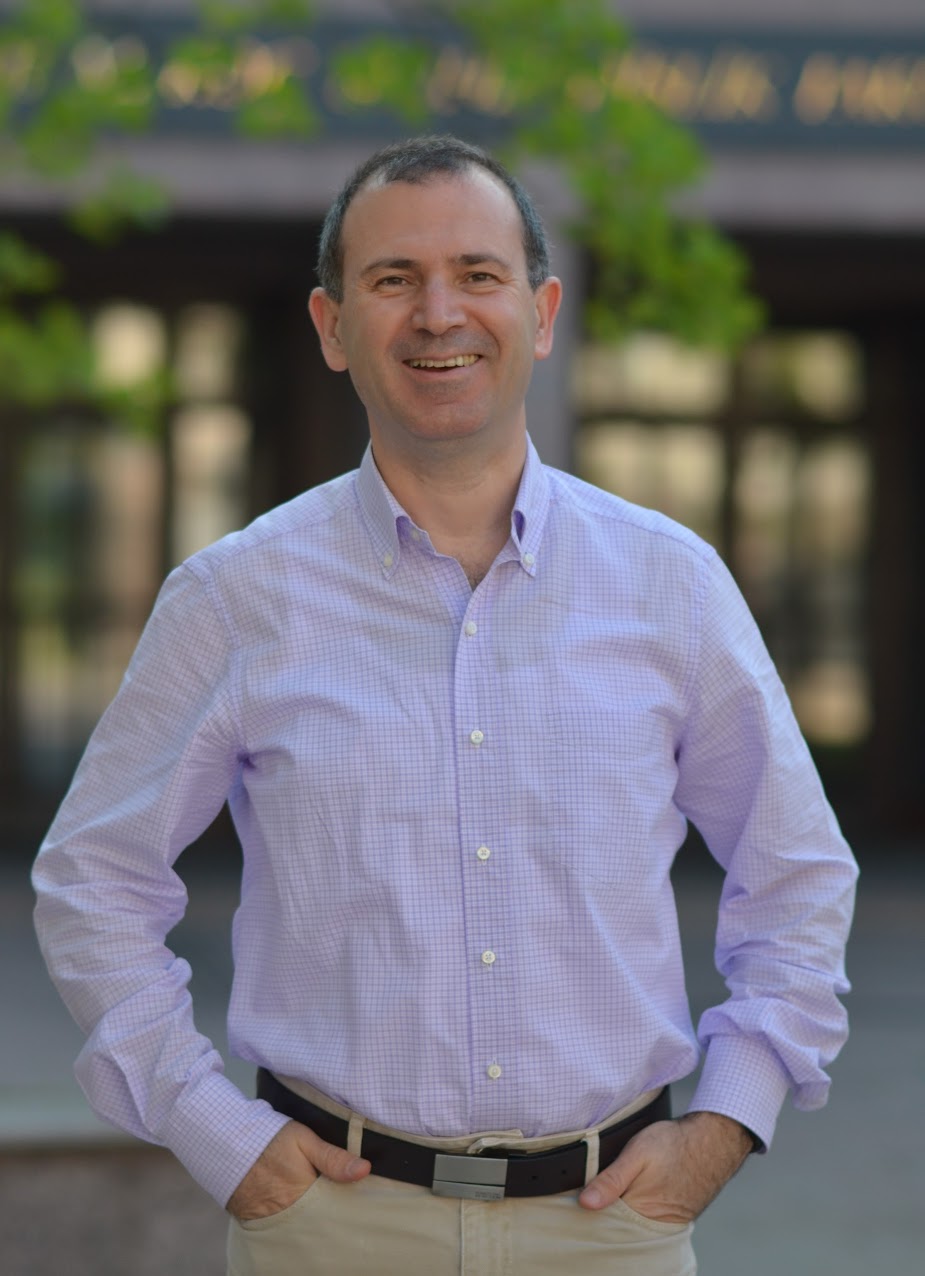
Aykut Erdem is an Associate Professor of Computer Engineering at Koç University, affiliated with the KUIS AI Center. He earned his PhD, MSc, and BSc in Computer Engineering from Middle East Technical University (METU), with visiting researcher experiences at Virginia Tech (2004) and MIT (2007). His research focuses on learning-based approaches for visual data understanding, including image editing, visual saliency estimation, and vision-language integration. Research Interests: Vision and Graphics, Machine Learning, Artificial Intelligence, Computer Vision, Natural Language Processing, Generative Artificial Intelligence. Recent work includes text-guided image/video editing, diffusion models for object removal, and GAN-based frameworks for domain adaptation. Scientific Awards: Young Scientist Award (BAGEP 2021) by Science Academy in Computer Engineering Best Paper Award at 5th Multimodal Learning and Applications Workshop (2022) Collaborations and Funding: Principal investigator for TUBITAK 1001 project on generative AI for visual data (2021-2024), Adobe Research Gift (2023), and co-investigator for multiple TUBITAK grants. Serves as Associate Editor for IEEE Transactions on Image Processing (2022-present).
Erkut Erdem is a Professor in the Department of Computer Engineering at Hacettepe University, where he leads the Computer Vision Laboratory (HUCVL). His research focuses on computer vision and machine learning, particularly on incorporating different kinds of context (spatial, temporal and cross-modal) into visual processing across all levels from low to high-level vision. He received his Ph.D. (2008), M.Sc. (2003), and B.Sc. (2001) from Middle East Technical University. Prior to joining Hacettepe University in 2010, he completed a post-doctoral fellowship at Ecole Nationale Supérieure des Télécommunications (2009-2010) and held visiting researcher positions at UCLA (2007) and Virginia Tech (2004). His current research interests include Visual Saliency Prediction, Automatic Image Description, Video/Photoset Summarization, Image Filtering, and Image Editing. Recent work has focused on multimodal learning with video-language models, diffusion-based image editing, and event-based vision for low-light conditions. His research has been published in top venues including NeurIPS, ICLR, ICCV, SIGGRAPH, and ACL. He has received significant recognition including The Young Researcher Award from Turkish Academy of Sciences and being named a 2022 Outstanding Associate Editor of IEEE Transactions on Multimedia. He has secured multiple research projects funded by TUBITAK and received gift funds from Adobe Research for text-guided image synthesis work. Current Teaching: BBM202: Algorithms, AIN434/BBM444: Fundamentals of Computational Photography Graduate Supervision: 6 current Ph.D. students, numerous recent graduates including Burak Ercan (2024) and Aysun Kocak (2023) Professional Affiliations: Co-affiliated with Koç University and İş Bank AI Center (KUIS AI)
Prof. Dr. Ahmet ÖZMEN is a Professor at Sakarya University's Faculty of Computer and Information Sciences, Department of Software Engineering. He has held various administrative positions including Head of the Software Engineering Department (2019-2028) and Director of the Computer Research and Application Center (2019-2022). With extensive experience in academia since 1991, he has made significant contributions to computer vision, traffic monitoring systems, and sensor technologies. Sakarya University: Professor (2019-present), Associate Professor (2011-2019) Dumlupınar University: Assistant Professor (2001-2011), Research Assistant (2000-2001, 1993-1998) Istanbul Technical University: Research Assistant (1991-1993) Prof. ÖZMEN's research spans computer vision applications for traffic monitoring, indoor air quality systems, parallel computing, and sensor technologies. His work bridges theoretical computer science with practical engineering applications, particularly in developing vision-based systems for nighttime vehicle detection, traffic flow monitoring, and environmental sensing. His interdisciplinary approach combines machine learning, image processing, and embedded systems to solve real-world problems in transportation and environmental monitoring. His publication record shows a clear evolution from parallel and distributed systems in his early career to computer vision and sensor applications in recent years. The majority of his recent work focuses on traffic monitoring systems using computer vision techniques, particularly for nighttime conditions, and indoor air quality monitoring systems using sensor networks. His research demonstrates strong industry and societal relevance, with applications in smart transportation, environmental protection, and educational technology. TÜBİTAK Publication Awards (2006, 2008, 2009, 2010) Physical implementation award from TÜBİDER (2008) Microsoft Certified Professional Certificate (2005) YÖK overseas study scholarships (1993, 1998) Elginkan graduate scholarships (1990, 1991) Prof. ÖZMEN has supervised numerous graduate students across multiple institutions, with a focus on practical engineering problems. His research has been supported by various projects including TÜBİTAK projects, institutional research grants, and industry collaborations. He has led significant research initiatives in traffic monitoring systems, indoor air quality monitoring, and educational technology platforms. His administrative leadership has included directing research centers and shaping curriculum development in software engineering. His work has involved establishing research teams focused on computer vision applications, sensor network development, and educational technology. These teams have produced numerous publications, developed practical systems, and trained the next generation of computer engineers. Current research directions include advanced traffic monitoring systems using deep learning and multi-camera setups for urban planning applications.
Prof. Dr. Özlem İlk Dağ is a Professor of Statistics at the Middle East Technical University (METU), Ankara, Turkey. She holds the position of Department Head of Statistics and serves on advisory boards for TUBITAK and the Journal of Biostatistics. Her academic journey includes roles from Research Assistant (1997) to Professor (2018), with affiliations in Actuarial Sciences and Biostatistics. Education: Ph.D. in Statistics (Iowa State University, 2004), M.S. and B.S. from METU. Research focuses on longitudinal data analysis, multilevel modeling, Bayesian methods, and biostatistics. She authored three editions of R Yazilimina Giris and a foundational book on multivariate longitudinal data analysis. Key contributions include developing marginalized transition random effects models (MTREM) and R packages like 'mmm'. Awards include METU's 20-year service recognition and teaching excellence. She has supervised numerous research projects and co-authored over 50 peer-reviewed articles across biostatistics, genomics, and statistical computing. Her work bridges statistical theory and application, with notable contributions to gene expression clustering, maternal antibody studies in veterinary science, and computational methods for longitudinal data. She maintains active collaborations in genomics and biostatistics, and her lab focuses on integrating statistical computing with biomedical research.
Mehmet Uğur KAHRAMAN is an Assistant Professor at the Department of Interior Architecture and Environmental Design at Antalya Bilim University, where he has served since 2017. Previously, he held a faculty position at Kayseri Nuh Naci Yazgan University (2015–2017). His academic journey includes a Doctorate from Hacettepe University (Interior Architecture and Environmental Design), a Master of Design (Interior Design) from Swinburne University of Technology (Australia), and a Bachelor’s degree from Hacettepe University’s Department of Interior Architecture and Environmental Design. Before academia, he worked as a construction site manager at KG Architecture in Istanbul, co-founded the food and beverage brand 'Shot&Bite' in Ankara, and later served as a designer at QUBİ Design Office. His research focuses on integrating artificial intelligence into design education, neurocognitive aspects of spatial design, sustainable materials, and pedagogical innovations in interior architecture education. He has authored over 20 peer-reviewed articles on topics ranging from AI-driven furniture design to multisensory hospitality spaces. His work bridges theoretical research with practical applications, such as developing curriculum models for design studios and exploring waste-to-art construction techniques. KAHRAMAN’s studies also address health impacts of building materials and the psychological dimensions of housing during crises like the COVID-19 pandemic. He maintains active research collaborations, particularly in Turkey and Australia, and has contributed to public infrastructure projects involving material conservation and adaptive reuse. His educational philosophy emphasizes student-centered learning, interdisciplinary approaches, and leveraging digital tools for contemporary design challenges.
Engin Erzin is a Professor at Koç University's College of Engineering, leading the KUIS AI Lab and Multimedia, Vision and Graphics Lab . His research focuses on AI-driven human-centric systems, affective computing, and multimodal interaction analysis. He has contributed extensively to robotics, speech processing, and human-robot interaction through over 70 peer-reviewed publications since 2008. Research interests include: Affective computing and emotion recognition from speech/gestures Human-robot interaction and socially engaging agents Speech-driven animation and gesture synthesis Multimodal data fusion for interaction analysis Deep learning applications in robotics and biomedical engineering Recent work emphasizes: Developing adaptive pHRI controllers for manufacturing tasks Creating engagement measurement frameworks for human-machine interfaces Advancing Turkish speech recognition through self-supervised learning Designing multimodal databases for interaction studies Labs: KUIS AI Lab : Focuses on AI applications in robotics and human-computer interaction Multimedia Lab : Specializes in vision, graphics, and audiovisual analysis
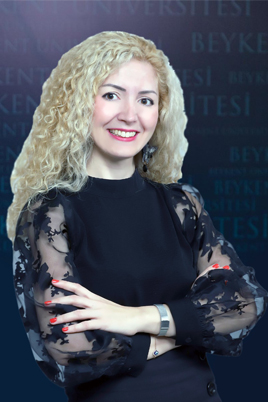
Sevgi AYDIN serves as an Assistant Professor in Logistics Management at Beykent University's Faculty of Business. Her academic work bridges digital transformation, artificial intelligence applications, and consumer behavior within modern marketing frameworks. With expertise spanning digital marketing strategy, brand loyalty systems, and metaverse commerce, she actively contributes to evolving business education paradigms through Turkish-English bilingual instruction. Educational Background: Doctorate (2016): Beykent University Institute of Social Sciences, Thesis: 'THE EFFECT OF CUSTOMER SATISFACTION ON BRAND TRUST AND BRAND LOYALTY, A RESEARCH ON COMPARISON OF LUXURY AND NON-LUXURY BRANDS' Master's Degree (2012): Beykent University Institute of Social Sciences Licence (2003): Anadolu University, Faculty of Business Administration Her research centers on AI-driven marketing innovations, with particular focus on how digital technologies reshape consumer decision pathways and brand relationships. Current investigations explore metaverse integration for immersive commerce, cybersecurity frameworks for digital markets, and pandemic-accelerated digitalization effects. Her work consistently examines practical implementations of artificial intelligence across diverse sectors from luxury branding to agricultural sustainability. Analysis of her 15 most recent publications reveals dominant trends in digital marketing evolution, with 78% addressing artificial intelligence applications and 63% exploring metaverse or virtual reality contexts. Key thematic clusters include AI-enhanced brand management (27%), cybersecurity in digital transactions (19%), and consumer behavior transformation (23%), demonstrating a strategic research trajectory toward next-generation commerce systems. Academic Supervision: SEVİL AYDIN (2024): 'THE USE OF SOCIAL MEDIA IN HOSPITAL CHOICE AND THE EFFECT OF WORD-OF-MOUTH MARKETING ON BRAND LOYALTY' RUKEN BAYONET (2021): 'The role of the food engineer in ensuring occupational health and safety management in food businesses producing hot meals' MERYEM BALTACI (2023): 'The Future of Graphic Design and the Impact of Artificial Intelligence on Graphic Design: Maw Agency Client Applications'
Dr. Burak Çeber is an Assistant Professor at Uskudar University's Faculty of Communication, Department of Advertising. His academic background includes a BSc (2016), MSc (2018), and PhD (2022) from Kocaeli University (Advertising), Kocaeli University (Visual Communication Design and Advertising), and Marmara University (Public Relations) respectively. He supervises graduate theses on AI applications in public relations and teaches courses ranging from digital advertising to integrated marketing communication. PhD in Public Relations (Marmara University, 2022) Current research focuses on AI ethics, generative AI in advertising, and digital transformation His scholarly output includes books like Yapay Zekâyı Sorgulamak: Veri Etiği ve Dijital Reklamcılığın Kesişimi (Nobel Bilimsel, 2024) and applied research on AI-human collaboration in public relations. He leads the university's Digital Education Committee and Web Commission, while coordinating accreditation efforts for academic programs. Recent publications examine: AI's impact on advertising creativity (2025) AI ethics frameworks (2024) Digital PR applications (2024) Generative AI in consumer campaigns (2025) As Laboratory Supervisor (since 2022), he oversees technical implementation of digital tools in academic settings. His teaching portfolio includes specialized courses like Halkla İlişkilerde Yapay Zeka Uygulamaları for undergraduates and Dijital Halkla İlişkiler Uygulamaları for master's students.
Lecturer ÖNDER DÜZ is affiliated with Uşak University , currently serving at the EŞME VOCATIONAL SCHOOL, Department of Handicrafts . Previously, he held lecturer positions at Banaz Vocational School (2013-2023) and Eşme Vocational School (2010-2013). His academic journey includes a Master’s degree in Traditional Turkish Arts from Sakarya University (2007-2019) and an undergraduate diploma from the same institution (2000-2004). Research Focus: Traditional Turkish Handicrafts, Ancient Tile Repair, Computer Graphics, and Interior Architecture. Projects: Led educational infrastructure development in vocational schools and participated in cultural heritage initiatives like "Seljuk Tiles with Modern Reflections" and "Pattern and design features of Karatay Madrasa decorations". Training: Completed certifications in IT (Adobe Acrobat Pro, Autodesk 3D StudioMAX), Sustainable Energy, Water Efficiency, and Human Rights/Good Governance. Artistic Contributions: Active in international art competitions, exhibitions, and symposiums, including the "5th International Young Ceramicists Tile Competition" and "Cumhuriyetimizin 100. Yılı Anı Duvarı Projesi". Leadership: Served as Head of Department (2017-2020) and Assistant Director of Vocational Schools.
Mustafa Sert , currently serving as Associate Professor at Başkent University's Department of Computer Engineering and as Vice Dean of the Faculty of Engineering, has made significant contributions to audio signal processing, machine learning, and semantic multimedia. He earned his PhD (2006), MSc (2001), and BSc (1997) in Computer Engineering from Gazi University, supervised by prominent academics. PhD: Gazi University (2006) MSc: Gazi University (2001) BSc: Gazi University (1997) His research focuses on audio-visual content analysis , multimodal information fusion , and machine learning applications in semantic multimedia systems. He leads projects at the intersection of deep learning , speech processing , and acoustic pattern recognition , with work appearing in venues like IEEE Access, ACM Multimedia conferences, and Signal Processing and Communications Applications Conference (SIU). Recent publications demonstrate trends in automated audio captioning , medical speech analysis , and educational data mining , with applications spanning mental health detection, chatbot development, and reviewer selection systems. His work integrates transformer architectures , convolutional networks , and fuzzy decision-making models . Scientific Recognitions: Best Paper Award (7th Eurasian Congress on Emergency Medicine 2021) Outstanding Reviewer Awards (IEEE ICME 2020, 2021) Outstanding Area Chair Award (ACM Multimedia 2024) Academic Leadership includes roles as Senior IEEE Member, technical committee board positions in IEEE CTSoc divisions, and ACM membership. He supervises over 20 graduate students in topics ranging from depression detection through speech to geothermal permeability estimation , while maintaining active involvement in conference organization and journal reviewing for top-tier publications.
Baybora Temel is an Associate Professor at Trakya University Faculty of Fine Arts , with a PhD in Computer Science from Marmara University (2009). His research merges Artificial Intelligence and Digital Art Analysis , focusing on Art Authentication via wavelet transforms and neural networks. Specializes in Painting Style Classification and Digital Art Forensics Recipient of Nuri Iyem Painting Competition Exhibition (2015) and Australian Embassy Painting Award (2009) Active in International Art Symposia (Odessa, Patras) and National Exhibitions His 15 most recent publications span Art Authentication (2008-2022) and Digital Art Analysis , employing Machine Learning for Cubist Painting Discrimination and Figurative Art Studies . He has curated exhibitions like Art Suites 26th International Art Workshop (2018) and participated in Balkan Exhibitions IV (2023).
Prof. Dr. Hacı Ömer Beydoğan is a faculty member at the Faculty of Education , Department of Educational Sciences , Ahi Evran University , Turkey. Holding a PhD in Curriculum and Instruction from Atatürk University (1993), a Master’s in Classroom Education from Gazi University (1988), and a BA in Educational Sciences (1985), he has dedicated his career to teacher education and curriculum design. Key Roles : Professor (2013–present, Ahi Evran University) Chair of Department of Educational Sciences (2018–2021) Department Head (2004–2007) Research Interests : His work focuses on Curriculum and Instruction , Measurement and Evaluation in Education , and Educational Technologies . Notably, he has explored multimedia-based learning , peer assessment , and feedback mechanisms in teacher training. Publication Trends : Recent articles address scale development for educational assessment (2024), non-digital computer science education (2023), and drama-based language instruction (2022). Earlier works examine multimedia learning (2015), self-regulated learning (2015), and concept map applications (2010). Advising and Projects : He has supervised over 13 theses, including Lokman Çavdar’s 2025 PhD on teacher technology integration and Davut Yıldırım’s 2019 Master’s on augmented reality in preschool education . Active in projects like Development of the Student University Image Scale (2016) and Analysis of 5th Grade English Curricula (2019), his research bridges theory and practice in educational quality.
Dr. Muhammed Akif YENİKAYA is an Assistant Professor (Dr. Öğretim Üyesi) at Kafkas University's Faculty of Economics and Administrative Sciences, Department of Management Information Systems. Since 2020, he has held roles including Research Assistant (2020-present), Assistant Director of the Research and Application Center (2022-2024), and Director of the Research and Application Center (2024-present). He advises the Kafkas University Techno Informatics Club. Education PhD in Computer Engineering, Maltepe University (2019-2022) MSc in Computer Engineering, İzmir University of Economics (2016-2018) MSc in Occupational Health and Safety, Kafkas University (2024) Bachelor's in Management Information Systems, Anadolu University (2019-2022) Bachelor's in Western Languages and Literatures, Kafkas University (2022) Associate Degree in Graphic Design, Istanbul University (2022) Research Focus Yenikaya's research integrates artificial intelligence with practical applications across healthcare, agriculture, energy, and management. His work emphasizes deep learning models for medical diagnostics (e.g., retinal and X-ray analysis), sustainable agriculture via IoT-based hydroponic systems, and AI-driven waste management. He also explores organizational digital transformation, technology adoption, and digital leadership strategies in business contexts. Publications Overview His 24 publications demonstrate a strong focus on AI/ML applications in healthcare (e.g., diabetic retinopathy detection, skin cancer diagnosis), sustainable technology (hydroponics, energy efficiency), and digital leadership. Recent work shows increased emphasis on convolutional neural networks and cross-disciplinary solutions for environmental and industrial challenges. Awards and Grants UBYT-2024 Award from TÜBİTAK (2024) Project: Hydroponic Home Agricultural Production System (2023-2025, Project Lead) Project: Digital Content and AR Applications for Climate Change Education (2024, Trainer) Teaching and Advising Teaches courses including Artificial Intelligence , Database Systems , and Mobile Programming at undergraduate/graduate levels. Advises MSc student Rafet Doğrukartal on a QR-code-based inventory management system (2025).
Mehmet Türkan serves as an Associate Professor in the Department of Electrical and Electronics Engineering at the Faculty of Engineering, Izmir University of Economics, Turkey, where he has held academic positions since 2015 including promotion from Assistant to Associate Professor. His academic credentials include: PhD in Computer Science from Université Rennes I, France (2011) MSc in Electrical and Electronics Engineering from Bilkent University, Turkey (2007) BSc in Electrical and Electronics Engineering from Eskişehir Osmangazi University, Turkey (2004) Dr. Türkan's research centers on digital signal/image processing, computer vision, and machine learning with emphasis on sparse representations, linear embeddings, and deep learning applications. His work bridges theoretical algorithm development with practical implementations in biomedical imaging and multimedia systems, particularly advancing techniques for image fusion, quality assessment, and medical diagnostics. Analysis of his 2020-2024 publications reveals a strong trajectory toward biomedical applications—especially melanoma detection and fluorescence microscopy—while maintaining core contributions to image processing fundamentals. This period shows increasing integration of deep learning with traditional signal processing methods, reflecting broader field trends. His scientific recognition includes: Best Student Paper Award at IEEE ICIP 2010 Dr. Türkan has secured research funding through European Commission initiatives including MUSCLE-NoE, 3-DTV-NoE, and UltraHD-4U projects. His collaborative work spans international teams at Technicolor Research & Innovation Center (2011-2015) and current academic partnerships. He maintains active leadership in image processing research through ongoing publications and supervision of graduate projects at Izmir University of Economics, with recent work focusing on spatio-temporal information preservation and medical image analysis.
Doç. Dr. Çağrı Barış Kasap is an academic in the Department of Graphic Design at Dogus University's Faculty of Art and Design . He teaches courses such as Interface Design , Motion Design , Web Design and Development , and Design Coding . Holding a PhD from State University of New York at Binghamton (2011) , he has held academic positions at İstinye University , Kadir Has University , İstanbul Gelişim University , Okan University , Yeni Yüzyıl University , and Maltepe University before joining Dogus University in 2019. In 2023, he was promoted to Associate Professor. Education : Bilkent University (BS/MS in Communication and Design), SUNY Binghamton (PhD in 2011) Research Interests : Dr. Kasap’s work bridges design theory , semiotics , and political economy , with a focus on critical analysis of pedagogy , digital media , and visual communication . His studies explore themes like micro-fascism in education , photographic design , and metaphorical experiences in film . Article Trends : His publications span design education assessment , political communication , 21st-century design practices , and philosophical critiques of media . He frequently analyzes intersections between art pedagogy , poststructuralist theory , and digital culture .



.jpeg)