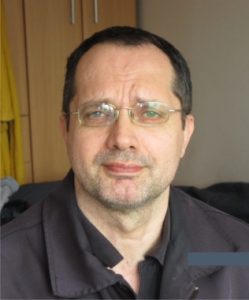
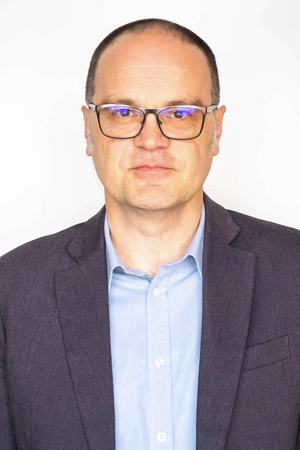
Prof. Igor Dejanović is a Regular Professor at the Department of Informatics, Faculty of Technical Sciences, University of Novi Sad. He holds a BSc (2000) and MSc (2008) in Computer Science from the same institution, followed by a PhD in 2012 with a thesis on 'Contributions to Methods of Rapid Software Development Based on Extensible Domain-Specific Specifications'. Positions Held: 2000–2004: Technical Associate at Faculty Computing Center 2004: Selected as Assistant Professor 2008: Promoted to Assistant Professor 2012: Promoted to Associate Professor 2017: Promoted to Full Professor Research focuses on domain-specific languages, software patterns, model-driven development, and software configuration management. He has contributed extensively to software engineering methodologies and education in technical informatics.
Dragan Ivanović is a Regular Professor at the University of Novi Sad's Faculty of Technical Sciences, Department of Informatics. He completed his BSc in 2006 with a thesis titled 'E-Learning System Based on IEEE LOM Standard,' earning the Milena Maric-Ainstein Award. He earned his PhD in 2010 with a thesis on scientific content storage systems, later published as a monograph. His academic journey includes scholarships from Serbian governmental and educational bodies. Bachelor's in Computer Science and Informatics (2006) Master's in Computer Science and Informatics (2006) PhD in Informatics (2010) His research focuses on digital archives, e-learning systems, and multimedia technologies. He has published 25 scientific papers, including 8 in SCI-indexed journals. He teaches courses such as Computer Basics, Multimedia, and Digital Archives, and conducts exercises in programming and web development. Awards include the 2011 Serbian Informatics Society Award for Best Scientific Work. He has collaborated with industry, including Levi9 Global Sourcing (2005), and has held academic roles since 2007.
Бранко Маркоски is a Professor at the Department of Informatics , Faculty of Technical Sciences , University of Novi Sad. He holds a PhD in Computer Science with a dissertation titled 'Resolvent Method for One-Pass Symbolic Testing of Partitioned Program Structures' (2007). His academic journey includes a Master's in Computer Science (2000) focusing on 'Program Testing and Deductive Verification of Correctness', and a Diploma in Automation and Computer Technology (1994). Education : Bachelor's in Automation and Computer Technology, Faculty of Technical Sciences (1987–1994) Master's in Computer Science, Faculty of Technical Sciences (1994–2000) PhD in Computer Science, Faculty of Technical Sciences (2007) Research Interests : Focus on software testing methodologies, formal verification, and program correctness. His work emphasizes symbolic testing techniques and automated approaches to software validation. Awards : Recipient of Spartak Diplomas for academic excellence Winner of multiple competitions in Mathematics and Physics during secondary school Additional Expertise : Fluent in English, active involvement in sports as a basketball delegate.
Гордана Милосављевић is a Full Professor at the Department of Informatics, Faculty of Technical Sciences, University of Novi Sad. She holds a BSc in Computer Science (1995), MSc in Software Development (2001), and PhD in Information Systems (2010). Her career includes roles as Research Assistant (1998-2002), Associate Professor (2010), and Full Professor (2015). Research Focus: Specializes in model-driven software development, agile methodologies, and complex business system modeling. Her work emphasizes rapid development of adaptive business information systems. Affiliations: Member of the Computer Science and Informatics Department, affiliated with the University of Novi Sad. Active in academic governance and curriculum development in technical sciences.
Stefan Ćirković is a Teaching Associate in the Department of Information Technologies at the Faculty of Technical Sciences in Čačak, University of Kragujevac. His office is located at Saint Sava 65, 32102 Čačak, Serbia. He is currently pursuing doctoral studies in Information Technology (2023–present) at the same institution. Education: Doctoral Academic Studies – Information Technology, University of Kragujevac (2023–present) Master of Academic Studies – Information Technology, University of Kragujevac (2022–2023) Basic Academic Studies – Information Technology, University of Kragujevac (2018–2022) Specialized Program – Cybersecurity, University of Kragujevac (2024) Research Focus: Ćirković specializes in applied artificial intelligence with significant work in cybersecurity, medical imaging, and network systems. His research demonstrates strong emphasis on practical AI implementations including real-time object detection (YOLO algorithm), anomaly detection in networks, federated learning for healthcare applications, and cybersecurity techniques using large language models. His work frequently intersects with medical informatics, particularly in diagnostic applications. Publication Trends: Recent publications (2024–2025) show predominant focus on AI/ML applications across multiple domains. Cybersecurity remains a core theme with novel approaches to web application security and network anomaly detection. Medical applications feature prominently, especially in diagnostic imaging (kidney stones, skin cancer) and hemodialysis optimization. Methodologically, there's consistent exploration of deep learning architectures and real-time systems. Laboratory Affiliations: Associated with the Computer Science Laboratory at the Faculty of Technical Sciences in Čačak. Utilizes institutional resources including the Moodle e-learning platform and Microsoft 365/Teams infrastructure for academic activities.
Dr. Anđelija Mitrović is an Assistant Professor at the Department of Mechatronics, Faculty of Technical Sciences in Čačak, University of Kragujevac. She holds a PhD in Technical Sciences (Mechanical Engineering) from 2016 and Master of Science in Information Technology from 2010. Her academic career spans multiple institutions including College of Technical Vocational Studies Čačak (2006-2011) and Faculty of Technical Sciences Čačak (2020-present). BSc in Hydropower Engineering, Mechanical Engineering Faculty Belgrade (1996) Profesor in Engineering and Informatics, Technology Faculty Čačak (2006) MSc in Information Technology, Technology Faculty Čačak (2010) PhD in Technical Sciences, Faculty of Technical Sciences Novi Sad (2016) Her research focuses on Production Technologies with emphasis on metal cutting thermal analysis, CAD/CAM systems, and educational technology innovations. Key research trends include: Thermal modeling in conventional and unconventional machining 3D virtual environment applications for engineering education Finite element analysis of milling processes Software-based cutting parameter optimization Integration of immersive learning platforms Publications demonstrate expertise in Thermal Analysis , Manufacturing Simulation , and Virtual Learning Environments . While no formal awards are listed, her work appears in reputable journals and international conference proceedings.
Lena Tica is an Assistant Professor at the Department of Social and Human Sciences within the Faculty of Technical Sciences in Čačak, University of Kragujevac. She holds a PhD in Philological Sciences (English Language) from the University of Kragujevac (2022), alongside MA and BA degrees in English Language and Literature from the University of Belgrade (2011 and 2009). Her academic career at FTS Čačak began in 2009, advancing to her current position in 2023. Born: October 31, 1985 in Čačak Education: University of Belgrade (BA/MA), University of Kragujevac (PhD) Current Role: Assistant Professor (English Language) Her research spans English Language Teaching (ESL/ESP) , Anglo-American Literature , and Digital Education . Key areas include: postmodern literary analysis, AI integration in language instruction, and technology-driven pedagogical frameworks. Recent publications examine ChatGPT's impact on writing skills and social media's role in language acquisition. Notable collaborations include co-authors Lidija Palurović and Ivana Krsmanović across 12 international conference papers and journal articles since 2014. She actively participates in Erasmus+ projects, serving as coordinator since 2019, and contributes to conferences like ELALT and TIE. Her methodological innovations combine Community of Inquiry (COI) frameworks and Blended Intensive Programmes for engineering students.
Srđan Divac is a Teaching Assistant at the Department of General Electrical Engineering and Electronics within the Faculty of Technical Sciences, University of Kragujevac . He earned his PhD in 2025 (average grade: 9.88) after completing his master's (2018, grade: 10) and bachelor's (2017, grade: 9.67) studies at the same institution. His research focuses on: Numerical methods in electromagnetics Measurement uncertainty analysis for electrical machines Dynamic hysteresis modeling in ferromagnetic materials Harmonic interpolation techniques for nonlinear circuits Instantaneous magnetisation power analysis Equivalent circuit parameter estimation Key article trends include simulation of magnetic hysteresis loops, electromagnetic computation for power systems, and advanced modeling of ferromagnetic and permalloy materials under varying excitation frequencies. His work appears in journals like Applied Sciences and Energies , as well as conferences such as IcETRAN and PES .
Milan Marjanović is an Assistant Professor at the Department of Mechanical Engineering, Faculty of Technical Sciences in Čačak, University of Kragujevac. Holding an M.Sc. in Mechanical Engineering, he teaches Thermodynamics, Applied Thermodynamics, Renewable Energy Sources, and Machine Elements. His research focuses on Thermal Engineering, Thermoenergetics, and Renewable Energy systems. Born 1990 in Užice Completed primary/secondary education in Požega Faculty of Mechanical Engineering and Civil Engineering, Kraljevo (2012) Master's in Energy Engineering (2014) Research spans biomass combustion optimization, solar energy systems, and hydraulic simulation tools. Active in academic projects like the national PRIZMA 2023 initiative for Active Condensation Hybrid Systems. Key publications include work on: Biomass-fired district heating efficiency AI-driven solar energy prediction models Hybrid photovoltaic-thermal collector testing Industry 4.0 curriculum development for Mechatronics Scientific contributions appear in journals like Case Studies in Thermal Engineering and conferences including COAST 2024. Awards include Ministry scholarships and 'Mašinijada' competition victories. Collaborates with industry partners on mechanical testing equipment development.
Dijana Stojić is an Assistant at the Department of Computer and Software Engineering, Faculty of Technical Sciences in Čačak, University of Kragujevac. She has held this position since January 2018 while pursuing her doctoral studies in Electrical and Computer Engineering with a specialization in Computer Engineering, which she began in 2021. Her academic journey began with excellent results at the 'Vuk Karadžić' elementary school in Čačak, followed by the Technical School in Čačak where she majored in computer electrical engineering. She earned her Bachelor's degree in Computer Engineering in 2011 (average grade 9.37) and Master's degree in 2012 (perfect average grade 10.00) from the Faculty of Technology in Čačak. Her Master's thesis, 'Software Support for Active RFID Localization,' was supervised by Prof. Dr. Siniša Ranđić. Dijana's research spans multiple domains within computer engineering, with recent publications focusing on practical applications of technology in diverse fields. Her work demonstrates strong expertise in IoT systems, machine learning applications, blockchain technology, and human-computer interaction. She has published extensively on topics including earthquake detection using mobile phones, predictive models for identifying students with difficulties in online learning, medical applications like ECG monitoring with Arduino, agricultural engineering applications, and infrastructure monitoring systems. Award for best first-year student at Faculty of Technology in Čačak Award for best second-year student at Faculty of Technology in Čačak Her professional activities include serving as Student Vice-Dean at the Technical Faculty in Čačak from December 2010 to September 2012, participating in the TEMPUS SIGMUS project, and completing an internship at D.O.O. DOCUS from June 2013 to June 2014. She was a scholarship holder of the Ministry of Education, Science and Technological Development from April 2013 to March 2017 and has been involved in significant research projects including 'Development and modeling of energy efficient, adaptable, multiprocessor and multisensory electronic low-power systems' (TR 32043) and the 'German-Serbian Collocation Dictionary for German Language and Teaching' (DeSKoll).
Sreten Mastilovic is a Research Professor at the Department of Materials Science, Institute for Multidisciplinary Research, University of Belgrade. He holds a PhD in Technical Sciences from Arizona State University (1997) and has spent over 25 years in academic and research institutions. Education: PhD (1997), MSc (1994), and BSc (1989) from University of Belgrade and Arizona State University His research focuses on Mechanics of Materials , particularly damage and fracture mechanics, micromechanics, constitutive modeling, and dynamic material behavior. He also works on Finite Element Analysis for structural and penetration mechanics, and Wind/Solar Energy Analysis for renewable energy projects. His recent publications highlight size effects in fracture mechanics, scaling behaviors in fragmentation, and computational modeling of material failure. He has led projects like SEEWIND (European Commission FP6) and SYNENERGY (Hellenic Aid), and contributed to national grants including OI 174010 (2011–2019) and TR 14067 (2008–2011).
Ivan Miletić is an Associate Professor at the Faculty of Engineering Sciences, University of Kragujevac, specializing in Machine Structures and Mechanization. His academic career at the university includes significant contributions to mechanical engineering research and education within the Department of mechanical structures and mechanization. His research interests span across several key areas in mechanical engineering, with a strong focus on machine design, structural analysis, and materials science. Professor Miletić has made substantial contributions to the understanding of cycloid reducers, gear design, and the mechanical properties of advanced materials. His work bridges theoretical analysis with practical applications in automotive, aerospace, and industrial machinery sectors. Professor Miletić's publication record demonstrates a strong focus on mechanical design optimization and structural analysis. His recent work has particularly emphasized the development and analysis of cycloid reducers, gear systems, and advanced composites. He has also contributed significantly to design automation methodologies and structural optimization techniques, applying advanced computational approaches to solve complex engineering problems across multiple disciplines. His scholarly contributions have practical applications in diverse fields including automotive engineering, aerospace technology, and industrial machinery design. Professor Miletić maintains an active research profile with publications spanning from 2020 to 2025, indicating ongoing scholarly productivity in mechanical engineering disciplines. As an educator, Professor Miletić has been instrumental in developing curriculum and mentoring students in mechanical engineering disciplines. His election to the position of Associate Professor in 2021 reflects his significant contributions to both research and teaching at the Faculty of Engineering Sciences.
Dragan Adamović is a Professor at the Department of Production Engineering, Faculty of Engineering, University of Kragujevac. His work focuses on manufacturing processes, materials science, tribology, and biomaterials. He has extensive experience in numerical modeling of metal forming processes like ironing and deep drawing, with a strong emphasis on optimizing mechanical properties through thermal treatments and surface treatments such as shot peening. His research integrates computational methods (e.g., FEA) with experimental validation, addressing challenges in automotive engineering, biomedical applications, and industrial safety. Notable contributions include studies on friction coefficient determination in forming processes, wear behavior of alloyed steels, and the development of biodegradable metallic implants. He also investigates occupational safety in industries like concrete production and bakery environments. Adamović has authored over 50 peer-reviewed articles since 2003, covering topics from welding technologies to additive manufacturing applications. His work bridges theoretical material science with practical industrial solutions, emphasizing sustainability and process efficiency in modern production systems.
Dušan Gordić is a Professor in the Department of Energy and Process Engineering at the Faculty of Engineering, University of Kragujevac. His research focuses on energy efficiency, waste heat utilization, and sustainable industrial processes, with a particular emphasis on public infrastructure and food production systems. He holds a professorial position since 2012 and contributes to academic leadership through his chair in energy systems. His research interests span energy engineering, environmental impact assessment, and emerging technologies like AI-driven energy management. He has conducted case studies on kindergarten energy performance, industrial decarbonization, and 3D printing applications in education. His work integrates both theoretical and applied approaches, addressing challenges in renewable energy adoption and public building optimization. Key research themes: Energy systems, HVAC efficiency, sustainable manufacturing, and waste-to-energy solutions. Notable projects: Rooftop photovoltaic integration for food facilities, waste heat recovery in industrial compressors, and GPT applications in public building management. Dr. Gordić collaborates with municipalities and industries to develop practical solutions for energy efficiency, including thermal insulation strategies and carbon footprint reduction in urban settings. His publications frequently explore Balkan case studies, emphasizing regional sustainability challenges.
Milan R. Dincic is an Associate Professor at the University of Niš, Faculty of Electronic Engineering, Department of Telecommunications. He holds a PhD in Metrology and Measurement Technology (2017) and a Master’s degree in Telecommunications (2012), both from the same institution. His academic career includes research on quantization techniques, signal processing, and metrology applications. Dr. Dincic’s research focuses on optimizing quantizers for measurement signals, including Gaussian and Laplacian distributions. He has contributed to adaptive quantization, lossless coding algorithms, and hybrid systems integrating codecs like ITU-T G.711. His work bridges theoretical signal processing with practical applications in telecommunications and sensor systems. His publications (26 journal articles) emphasize quantizer design, image sampling, and compression techniques. He co-authored the textbook "Sensors in Vehicles" (2014). Current projects include national/international collaborations in metrology and measurement technology. His lab focuses on advancing signal processing methodologies for precision measurement systems.