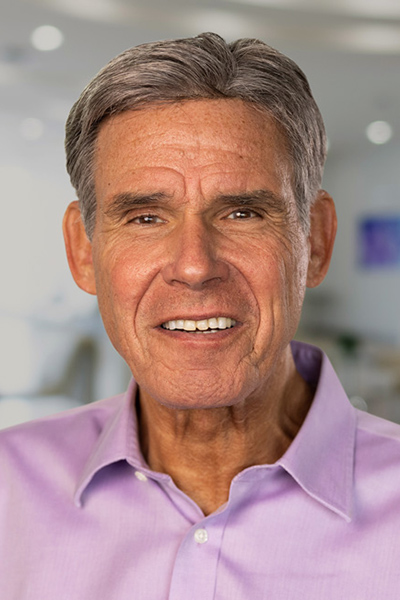
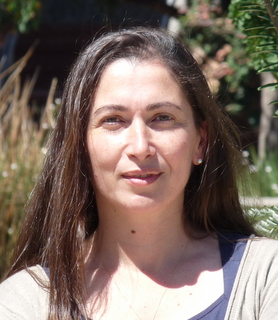
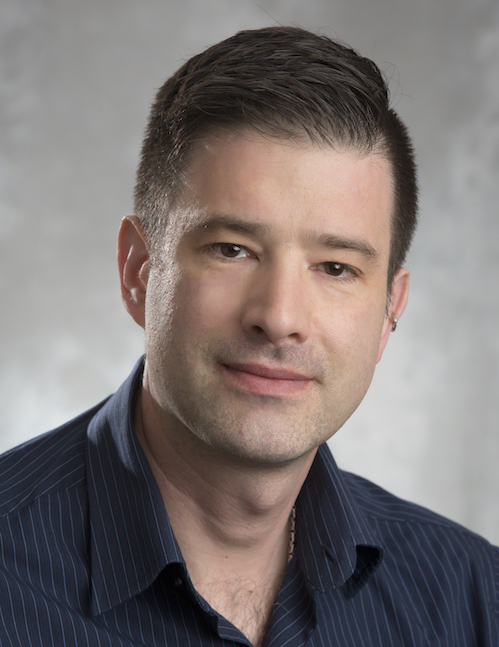
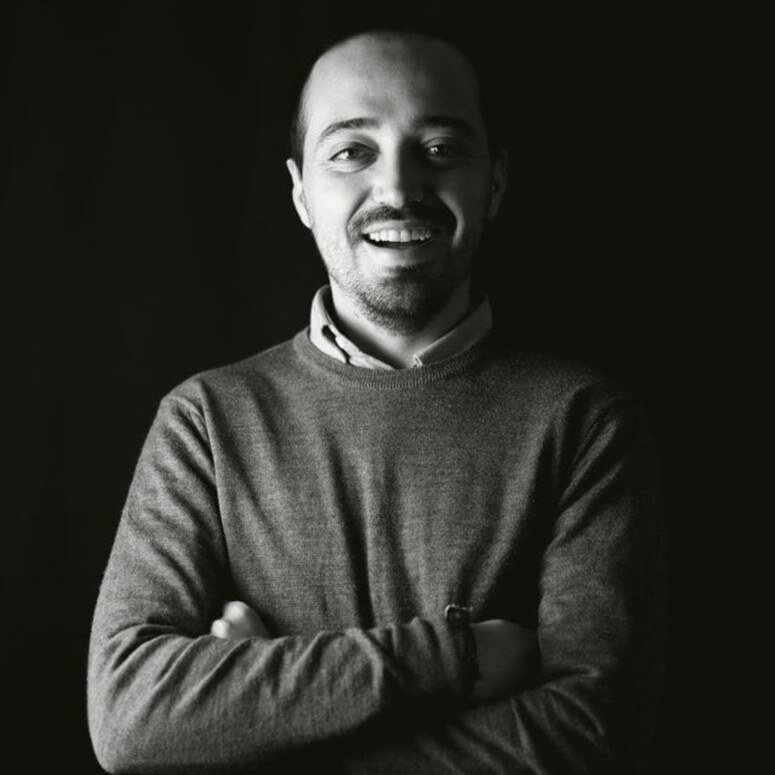
Eric Topol is Founder and Director of Scripps Research Translational Institute, Executive Vice President at Scripps Research, and holds the Gary and Mary West Endowed Chair of Innovative Medicine. A National Academy of Medicine member and top-cited researcher, he focuses on individualized medicine using genomic, digital and AI technologies. His research spans AI applications in healthcare, digital medicine, genomics, and translational science. Recent publications explore AI's role in clinical reasoning, medical imaging, and epidemic modeling, plus innovations in cardiology and Alzheimer's research. Topol leads major NIH initiatives including the All of Us Research Program and has authored influential books on medicine's digital future.
Diem M Nguyen is an Associate Professor in the Department of Mathematics and Statistics at Bowling Green State University (BGSU), part of the College of Arts and Sciences. His research focuses on integrating online technology into mathematics education and assessment, alongside number theory and mathematical reasoning. He holds a Ph.D. in Mathematics Education from Texas A&M University (2002) and an M.S. in Mathematics from the same institution (1999). His research explores web-based tools for mathematics learning, including automated assessment systems like WebMA and online placement exams. Key contributions include studies on statistical distributions (e.g., skew-normal and multinomial) and pedagogical strategies to address student misconceptions in algebra. Nguyen has authored/co-authored over a dozen peer-reviewed publications since 2004, emphasizing technology-enhanced learning and statistical methodologies. Nguyen’s work bridges theoretical mathematics with practical educational applications, aiming to improve student engagement and achievement through innovative digital tools. He is actively involved in curriculum development and has presented at international conferences on technology in mathematics education.
Maria Garcia de la Banda is a distinguished Professor at Monash University's Faculty of Information Technology, where she serves in the Department of Data Science and Artificial Intelligence (DSAI). With over 25 years of academic experience, she has held significant leadership roles including Deputy Dean (Research) until July 2022, overall Deputy Dean of the Faculty (2013-2016), and Head of the Caulfield School of Information Technology (2009-2011). She is currently a member of the ARC College of Experts and Co-Chair of the Monash-Woodside FutureLab. Her educational background includes a Doctor of Philosophy in Computer Science from the Universidad Politecnica de Madrid (awarded July 7, 1994) and an Ingeniero Informatico degree from the same institution (awarded March 1, 1992). Her PhD received the university's Best PhD Award. Garcia de la Banda's research spans multiple disciplines with a strong focus on constraint programming, combinatorial optimization, program analysis, and bioinformatics. She leads the Optimization research group within DSAI and has made significant contributions to declarative programming languages, parallelism, and automatic parallelization. Her interdisciplinary work bridges computer science with biological applications, particularly in protein structure analysis and computational drug design. Her publication record shows consistent contributions across constraint programming, optimization, and bioinformatics. Recent work demonstrates increasing interdisciplinary collaboration, with a notable expansion into bioinformatics applications alongside her core constraint programming research. She has maintained a strong presence at major conferences like CP (International Conference on Principles and Practice of Constraint Programming) while also building impactful industry collaborations. Her scientific recognition includes: Logan Fellowship (1997) - the first and only prestigious award of its kind in the Faculty of IT International Constraint Modelling Challenge winner (2005, with Peter Stuckey) Universidad Politecnica de Madrid's Best PhD Award (1994) Induction into the Monash Honour Roll (2021) Vice-Chancellor's Diversity and Inclusion Award (2020) As a research leader, Garcia de la Banda has secured over $20M in industry funding and $14M in nationally competitive funding, including $8M as Chief Investigator in 11 ARC grants (5 as lead). She has served as Area Editor of the Journal of Theory and Practice of Logic Programming since 2010 and on the Editorial Board of the Constraints journal since 2019. Her leadership extends to professional organizations, having served on the Executive Committees of both the Association of Logic Programming (2005-2008) and the Association of Constraint Programming (2017-2020), where she was President (2019-2020). She leads the Optimization research group within DSAI and collaborates extensively across Monash University and with industry partners. Her current major projects include HARNESS (Hierarchical Abstractions and Reasoning for Neuro-Symbolic Systems), the ARC Training Centre in Optimisation Technologies, and the Building 4.0 CRC project focused on better buildings through technology. These initiatives demonstrate her commitment to translating theoretical research into practical applications with real-world impact.
Ziwei Huang is an Assistant Professor at Southeast University's School of Information Science and Engineering, Department of Communication Engineering. With a prolific publication record from 2019-2025, Huang has established expertise in wireless communications, particularly in 5G/6G channel modeling, UAV communications, and vehicular networks. Recent work demonstrates a strategic expansion into AI/ML applications, computer vision, and large language models, showing interdisciplinary research growth. Huang's research interests focus on wireless communications channel modeling with particular emphasis on non-stationary characteristics, spatial consistency, and trajectory modeling for next-generation communication systems. Key areas include UAV communications , vehicular networks , intelligent sensing-communication integration , and multi-modal data fusion . Recent work has expanded into fundus image processing , text-to-image synthesis , and hallucination mitigation in vision-language models , demonstrating a strategic expansion into AI applications while maintaining core expertise in communications. The publication trends reveal a clear evolution from traditional wireless channel modeling (2019-2021) toward more integrated sensing-communication systems (2022-2023), with a significant pivot toward AI/ML applications in 2024-2025. Huang's work spans both theoretical channel modeling and practical implementation, with increasing emphasis on cross-disciplinary applications. The research shows strong collaboration patterns with Xiang Cheng and Lu Bai, suggesting membership in a well-established research group at Southeast University. Huang has contributed to numerous high-impact publications in IEEE journals including IEEE Transactions on Wireless Communications, IEEE Transactions on Vehicular Technology, and IEEE Communications Surveys & Tutorials, as well as top conferences like AAAI and ACL. The research demonstrates consistent funding support through collaborative projects focused on next-generation wireless communication systems. The work spans multiple laboratories and research teams, including wireless communications research groups at Southeast University, collaborations with medical imaging researchers for fundus analysis, and partnerships with AI research teams working on vision-language models. Recent publications suggest active participation in interdisciplinary research initiatives bridging communications engineering with artificial intelligence.
Arie Gurfinkel is a Professor at the University of Waterloo, holding a joint appointment in the Department of Electrical and Computer Engineering and the Cheriton School of Computer Science. His research focuses on automated program analysis, software model checking, automated reasoning, and abstract interpretation. He develops tools like SeaHorn, Avy, and others to enhance the verification and testing of complex computer systems. His work emphasizes formal methods, machine learning integration, and hardware/software verification. Recent publications highlight advancements in interpolation-based model checking, constrained Horn clauses, and algorithm selection for hardware verification. Gurfinkel's contributions include open-source tools and frameworks widely used in academic and industrial verification efforts. He actively seeks motivated graduate students interested in logic, automated reasoning, and formal methods. His research has been presented in top-tier conferences and journals, reflecting his expertise in formal verification and software engineering.
Francesco De Pace is a PostDoc Researcher at the Institute of Visual Computing and Human-Centered Technology within the Faculty of Informatics at Vienna University of Technology (TU Wien). His research focuses on the intersection of augmented reality, virtual reality, and human-robot interaction, with particular emphasis on developing innovative interfaces for industrial applications. Dr. De Pace's research spans several key areas in immersive technologies and human-computer interaction. His primary interests include Augmented Reality (AR) and Virtual Reality (VR) systems, Human-Robot Interaction (HRI), Brain-Computer Interfaces (BCIs), and advanced tracking and localization techniques. He has made significant contributions to the development of AR/VR interfaces for industrial robots, outdoor tracking with Real-Time Kinematic GPS, and SLAM (Simultaneous Localization and Mapping) systems. His work bridges theoretical research with practical industrial applications, focusing on creating more intuitive and effective human-machine interfaces. Dr. De Pace's recent publications demonstrate a clear trajectory toward enhancing human-robot collaboration through immersive technologies. His research shows increasing sophistication in integrating multiple modalities (visual, spatial, and neural) to create more natural interaction paradigms. A notable trend is the application of AR/VR to industrial settings, particularly for assembly tasks, path planning, and training scenarios. His systematic evaluation of RTK-GPS for wearable AR represents important foundational work for outdoor AR applications, addressing critical challenges in positional accuracy across different environmental conditions. While specific awards are not prominently documented in the available information, Dr. De Pace's research has been supported by significant funding mechanisms, including grants from the Austrian Research Promotion Agency (FFG) under Grant Agreement No FO999886342 KIRAS MRespond, indicating recognition of the importance and potential impact of his work. Dr. De Pace appears to be actively involved in multiple research projects, including PostDisaster and MRespond as indicated in his profile. His collaborative approach is evident through his extensive co-authorship with researchers across institutions. While specific student advising information isn't detailed in the available materials, his role as a PostDoc Researcher likely involves mentoring junior researchers and contributing to the academic development of students working on related projects. Dr. De Pace is associated with the Mixed Reality Lab at TU Wien, as indicated in the website navigation. His research appears to be conducted within collaborative frameworks that include both academic and industry partners. His work on the MRespond project suggests engagement with emergency response applications of mixed reality technologies, indicating interdisciplinary team involvement spanning computer science, engineering, and potentially public safety domains.
Beatrix Buhl is a Visiting Professor at TU Wien's Faculty of Informatics, specializing in Formal Methods in Systems Engineering (Department E192-04). Her research focuses on automated reasoning, software verification, and theorem proving, supported by EU-funded projects such as LEARN (2025–2026) and 'Automated Reasoning with Theories and Induction for Software Technologies' (2021–2026). Office: Favoritenstrasse 9, Room HD0319 Contact: +43-1-58801-18404 Her work bridges formal methods with practical software engineering challenges, emphasizing scalable verification techniques and automated reasoning frameworks. Current projects explore learning-based approaches to efficient automated reasoning and induction-based methods for software technologies.
Marton Hajdu is a PostDoc Researcher at the Vienna University of Technology , affiliated with the Systems Engineering department under the Formal Methods in Systems Engineering group (E192-04). His research focuses on formal methods , automated reasoning , and inductive logic . He actively contributes to projects such as ARTIST (2021–2026) , ForSmart (2023–2027) , and SFB SPyCoDe (2023–2026) , which explore recursive programming, saturation-based reasoning, and inductive benchmarks. His work intersects superposition calculus , term rewriting , and formal verification . His recent publications highlight advancements in inductive reasoning , recursive program synthesis , and constraint solving using saturation techniques. These contributions align with broader trends in automated deduction and logic programming for computer-aided verification. Marton Hajdu holds a Diploma Thesis from TU Wien (2020) titled Automating inductive reasoning with recursive functions , establishing his expertise in formal methods and recursive logic. He collaborates with researchers like Laura Kovács and Andrei Voronkov , and his work is supported by projects spanning formal reasoning, smart systems, and theoretical computer science.
Pascal Schreck is a Professor of Computer Science at the University of Strasbourg, affiliated with the Department of Computer Science within the UFR of Mathematics and Computer Science. He is a researcher at the ICube laboratory and has held administrative roles, including Director of the Computer Science Department (2008–2011) and course coordinator for specialized programs. His research focuses on geometric computing, formal methods in geometry, automated deduction, and geometric constraint solving, with contributions to theorem proving, computational geometry, and CAD applications. His work integrates algebraic and geometric approaches to solve problems like constructibility in geometric constructions, incidence geometry, and constraint systems. He has developed methods using Coq proof assistants for formal verification and explored topics such as homotopy-based solutions for geometric constraints. His contributions span theoretical advancements and practical applications in areas like 3D modeling and medical trajectory planning. Key research trends include leveraging formal systems (e.g., Coq) for mechanized proofs, analyzing geometric constructs' feasibility, and improving algorithms for constraint resolution. His publications address foundational geometry theorems (e.g., Dandelin-Gallucci), combinatorial geometry, and automated construction verification. He has also contributed to international workshops and conference proceedings on automated deduction in geometry. As a member of the ICube laboratory and the IGG Team (Geometric and Graphical Computing), Schreck collaborates on interdisciplinary projects, bridging mathematics, computer science, and engineering. His work emphasizes rigorous formalization, algorithm optimization, and practical implementation in geometric problem-solving domains.
Dr. Sebastian Stein is a Research Fellow in the School of Computing Science at the University of Glasgow, working within the Inference, Dynamics and Interaction Research Group. His current research focuses on the EPSRC-funded project 'Closed-Loop Data Science for Complex, Computationally- and Data-Intensive Analytics' under Professor Roderick Murray-Smith. With a background spanning human-computer interaction, ubiquitous computing, and machine learning, his research integrates computer vision, action recognition, and intelligent interactive systems. He holds a PhD in Computing from the University of Dundee and a Diplom in Computer Science and Electrical Engineering from TU Dortmund. Stein's publications demonstrate expertise in multimodal sensing systems, rehabilitation engineering, probabilistic modeling interfaces, and intelligent transportation solutions. Recent work includes EEG-based pain biomarkers, interactive Bayesian models, and COVID-19 containment strategies through control theory. His technical contributions span healthcare applications like spinal cord injury rehabilitation, neuroprosthetics development, and urban computing platforms for built environment analysis.
Zoey Zhiyu Chen is an Assistant Professor in the Department of Computer Science at the Erik Jonsson School of Engineering and Computer Science, University of Texas at Dallas. Her research focuses on advancing artificial intelligence, particularly in natural language processing (NLP), healthcare technology, financial technology, and dialogue systems. She explores the application of large language models (LLMs) in critical domains such as mental health therapy, cognitive behavior therapy (CBT), and finance, emphasizing robustness and ethical considerations. Key research areas include hypothesis discovery, rule learning, patient simulation for mental health training, and improving medical predictions through multimodal data analysis. Her work also addresses challenges in retrieval-augmented models, agentic search optimization, and zero-shot dialogue state tracking. Chen’s contributions span theoretical advancements in AI reasoning and practical applications in societal domains like law and healthcare. Her articles highlight trends in leveraging LLMs for clinical support, financial analysis, and improving human-AI interaction through preference learning and function calling mechanisms. She advocates for responsible AI development, as seen in studies on energy efficiency benchmarks (Hulk) and domain-specific robustness (RobustFin).
Anders Læsø Madsen is a Professor at the Department of Computer Science , part of The Technical Faculty of IT and Design at Aalborg University . His research focuses on probabilistic graphical models, with a particular emphasis on Bayesian networks and their applications in industrial and environmental domains. Current affiliation: Aalborg University Research areas: Bayesian networks, probabilistic inference, decision support systems, data stream modeling His recent work spans control room engineering , where AI systems aid human operators, and environmental risk assessment using probabilistic models of pharmaceutical impacts. He also contributes to artificial intelligence in power grid monitoring , addressing anomaly detection through Bayesian reasoning. Publications from 2024-2025 demonstrate interdisciplinary applications, including electricity grid data validation , explainable AI frameworks , and pharmaceutical risk modeling . These works integrate probabilistic methods with domain-specific challenges in energy systems, industrial automation, and environmental science.
Moshe Y. Vardi is a University Professor and the Karen Ostrum George Distinguished Service Professor in Computational Engineering at Rice University . He also serves as a Fellow for Science and Technology Policy at the Baker Institute for Public Policy and is a Senior Editor of the Communications of the ACM . Vardi has held significant roles such as Department Chair at Rice (1994-2002) and leadership positions at IBM and Stanford. Education : Ph.D. in Computer Science (1981), Hebrew University, Jerusalem, Israel. Research Interests : Vardi's work spans automated reasoning , a field with applications in machine learning , database theory , computational-complexity theory , knowledge in multi-agent systems , and computer-aided verification . His research emphasizes the unusual effectiveness of logic in computer science and societal implications of technology. Scientific Awards : Vardi has received numerous accolades, including the Gödel Prize , Knuth Prize , Blaise Pascal Medal , ACM SIGMOD Codd Award , and multiple IBM Outstanding Innovation Awards . He is a fellow of over 10 prestigious societies, including the IEEE , ACM , American Academy of Arts and Sciences , and National Academy of Sciences . Advising and Leadership : Vardi has advised notable students like Kuldeep S. Meel , who won awards under his guidance. He has led initiatives such as the Technology, Culture, and Society program at Rice and served as Editor-in-Chief of Communications of the ACM .
Marcello Balduccini is the Department Chair and Associate Professor of Decision and System Sciences at Saint Joseph's University's Erivan K. Haub School of Business. His research focuses on knowledge representation & reasoning, ontologies, agent architectures, and cybersecurity applications in cyber-physical systems (IoT) and cognitive robotics. He previously held roles as an Assistant Research Professor at Drexel University and Principal Research Scientist at Kodak Research Labs. Research Interests: Knowledge Representation & Reasoning Cyber-Security and Cyber-Analytics Ontology-Based Systems Natural Language Understanding Constraint Satisfaction Problems Trustworthiness in AI/Robotics Recent work emphasizes explainable AI (XAI) systems for Answer Set Programming (ASP), cybersecurity frameworks, and formal methods for cyber-physical systems. His over 100 publications span conferences like LPNMR and ICLP, addressing topics from actual causation to autonomous UAV mission planning. Dr. Balduccini has organized international conferences and received grants supporting AI research, including travel grants for knowledge representation conferences. His work bridges theoretical advancements with practical applications in smart grids, supply chain management, and SDG-aligned AI systems.
Maria Fahlgren is an Associate Professor in Mathematics Education at Karlstad University, specializing in the integration of digital technologies into mathematics teaching and learning. She focuses on task design, particularly at the upper secondary and tertiary levels, using dynamic software such as GeoGebra and Desmos. Her work emphasizes student exploration, experimentation, and reasoning through technology-enhanced environments. Collaborations include the National Centre for Mathematics Education (NCM) for professional development modules and the Nordplus Higher Education network (METT) for teacher training exchanges. Her research spans design-based research methodologies, formative feedback systems in engineering education, and cross-European projects under Erasmus+. Key themes include real-time classroom monitoring, hybrid assessment systems combining dynamic software with computer-aided tools, and fostering mathematical reasoning through technology. Publications highlight innovations in task design, adaptive assessment systems, and the role of programming as a mathematical instrument. Her work bridges pedagogical theory with practical classroom applications, aiming to enhance both student learning and teacher capacity through technology integration. Current initiatives include developing digital solutions for formative feedback, orchestrating technology-mediated classroom discussions, and advancing teacher training programs via collaborative networks across universities in Sweden, Estonia, Norway, Iceland, and beyond.