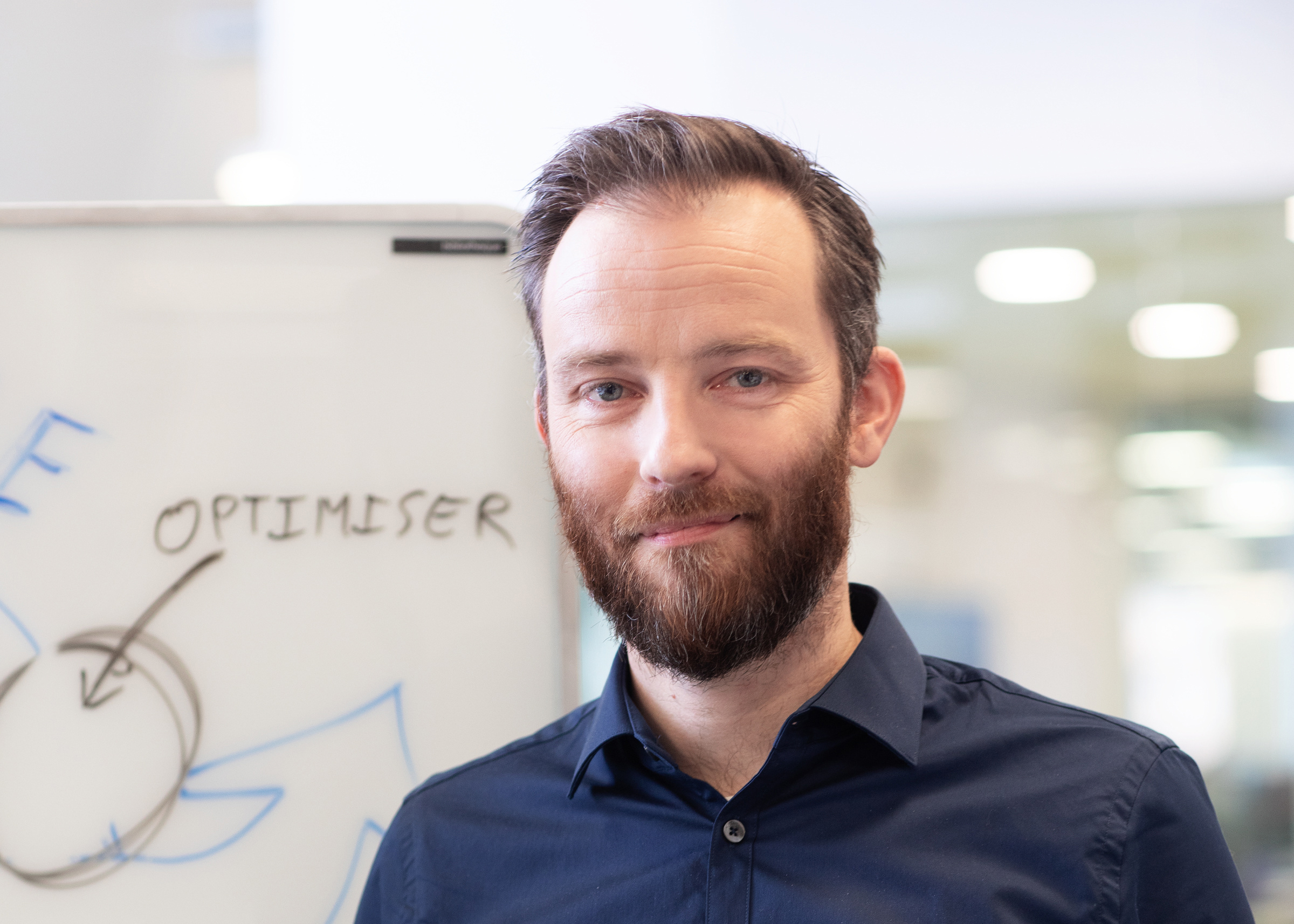
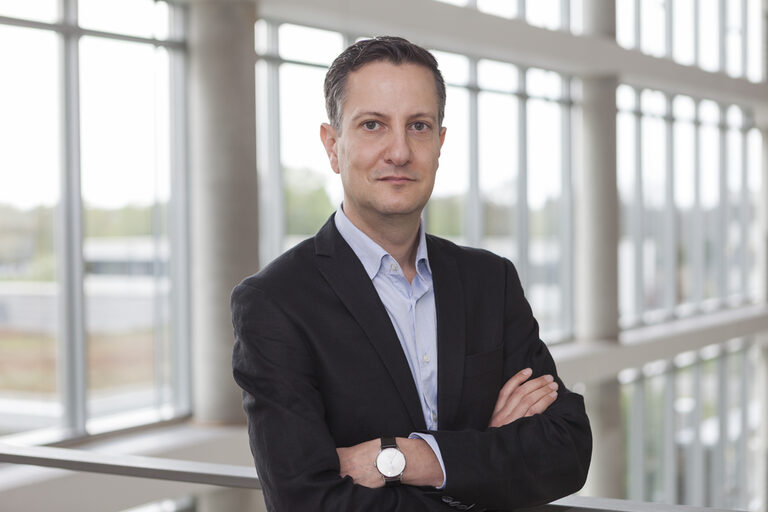
Efstratios Ioannidis is an Associate Professor at the Department of Industrial Engineering, School of Industrial Engineering, Technical University of Crete. He holds a Diploma in Production and Management Engineering (1995), a Postgraduate Diploma (1997), and a PhD (2004) from the Technical University of Crete’s Department of Industrial Engineering. From 2004–2009, he held contract positions as a lecturer at multiple institutions, including the Technical University of Crete and Democritus University of Thrace. In 2005, he served as a Lecturer at the University of the Aegean’s Department of Mathematics. He was a Visiting Researcher at École Centrale Paris’s LGI lab (2009) and became an Assistant Professor at his current institution in 2010, advancing to Associate Professor thereafter. His research focuses on production networks analysis , AI applications in production systems , and stochastic systems . He leads the Production Systems Laboratory and collaborates with the Computer Aided Manufacturing (CAM) Collaboration initiative. His work bridges theoretical optimization with practical industrial challenges.
Professor Kenneth Morgan is a faculty member in the School of Aerospace, Civil, Electrical and Mechanical Engineering at Swansea University, specializing in Civil Engineering. He holds the rank of Professor and is actively involved in research and postgraduate supervision. His research focuses on computational fluid dynamics, computational electromagnetics, mesh generation, and wave propagation. Education and Affiliations: While specific educational details are not provided, his academic position and research output indicate advanced training in engineering and applied mathematics. He is affiliated with the Morgan Advanced Studies Institute (MASI) as an academic leader and collaborator. Research Interests: Professor Morgan’s work spans advanced numerical methods for engineering simulations, including finite element and volume techniques, mesh optimization, and applications in aerodynamics, electromagnetics, and fluid dynamics. His recent projects include developing neural network-based aerodynamic design tools and high-fidelity simulations for complex geometries. Publications and Awards: He has authored numerous peer-reviewed articles, with recent contributions on NURBS-enhanced FEM, solar absorber design, and aerodynamic analysis of supersonic vehicles. His accolades include fellowships from the Royal Academy of Engineering and the Learned Society of Wales. Grants and Collaborations: He has led or contributed to major grants such as the Platform Grant for mesh generation (EPSRC, 2006–2011) and the FLAVIIR aeronautics initiative (EPSRC/BAE Systems, 2004–2007). His work bridges academia and industry, addressing challenges in aerospace, energy, and computational methods. Labs and Teams: As part of MASI, he collaborates in interdisciplinary teams tackling global challenges like sustainable engineering and advanced material systems.
O.R. Tutunea-Fatan is a Professor in the Department of Mechanical and Materials Engineering at Western University, Canada. His academic roles include serving as Associate Chair for Graduate Research Programs (2025-2027) and Acting Associate Dean for Undergraduate Studies (2023-2024). He holds a Ph.D. from Western University and degrees from Transilvania University, Romania. Tutunea-Fatan’s research focuses on precision manufacturing, CAD/CAM integration, laser-based surface engineering, and biomedical applications such as computer-aided orthopaedic surgery. He has supervised over 40 graduate students and holds multiple teaching awards including the Edward G. Pleva Award (2023), Western’s highest teaching honor. Key Research: Laser polishing, ultraprecise cutting, composite materials, functional surface design Industry Collaborations: General Motors, DuPont, Dieffenbacher, Scisense Inc. His work bridges advanced manufacturing with biomedical innovation, emphasizing real-world applications in aerospace, automotive, and medical sectors. Recent projects include drag-reduction riblet surfaces and AI-driven process monitoring.
Vassilis Kouikoglou is a Professor at the School of Production Engineering and Management, Technical University of Crete, where he directs the Computer Aided Manufacturing (CAM) laboratory and previously served as chairman. His academic journey includes a PhD in Production Engineering (1989) and a diploma in Electrical Engineering from the National Technical University of Athens (1985). He specializes in modeling and optimizing production networks and environmental systems, with a focus on sustainability assessment frameworks. Education: PhD in Production Engineering and Management, Technical University of Crete (1989) Diploma in Electrical Engineering, National Technical University of Athens (1985) Research interests revolve around production networks, environmental systems, and sustainability assessment , leveraging fuzzy logic and mathematical models to address complex systems. Recent work emphasizes sustainability rankings of nations, energy policies, and climate security. His lab, CAM, focuses on advanced manufacturing and systems engineering. Key contributions include the SAFE framework for sustainability evaluation, climate action urgency studies, and optimization of healthcare and production systems. Though no awards are listed, his extensive publications reflect significant academic impact. His advising and grants history is not explicitly detailed, but his work spans interdisciplinary collaborations in manufacturing, environmental science, and public health. The CAM Laboratory serves as a hub for applied research in sustainable systems and advanced production technologies.
Przemyslaw Musialski is an Associate Professor of Computer Science at New Jersey Institute of Technology (NJIT), USA. His research focuses on geometric design, computer graphics, digital fabrication, and machine learning, aiming to develop algorithmic solutions for computational design and fabrication processes. Previously, he led the Computational Fabrication group at TU Wien's Center for Geometry and Computational Design (GCD), serving as an assistant professor there. He holds a PhD in Computer Science from TU Wien (2010) and an MSc in Media Sciences from Bauhaus University Weimar (2007). His academic journey includes roles at VRVis Research Center, Arizona State University as a postdoc, and KAUST as a visiting researcher. His work bridges computational geometry, fabrication-aware design, and AI applications in architecture and engineering. Notable contributions include methods for procedural facade generation, elastic geodesic grid structures, and neural surface reconstruction techniques. He actively contributes to international conferences and journals in computer graphics and geometric design. Research interests emphasize geometric algorithms, digital fabrication workflows, and integrating machine learning to enhance design automation. His lab explores applications in architectural design, 3D printing, and interactive modeling tools.
Leah Buechley is an Associate Professor in the Department of Computer Science at the University of New Mexico, College of Engineering. She previously served as an associate professor at the MIT Media Lab, where she founded and directed the High-Low Tech group. Her work lies at the intersection of computer science, art, design, and education, with a mission to broaden participation in technology creation. Education: PhD in Computer Science, University of Colorado at Boulder, 2007 MS in Computer Science, University of Colorado at Boulder, 2003 BA in Physics, Skidmore College, 1997 Her research focuses on developing accessible technologies for learning and creative expression. She is renowned for inventing the LilyPad Arduino, a sewable electronics platform that has revolutionized educational approaches to physical computing. Her interests include computational design and fabrication, human-computer interaction, computer science education (especially CS4All), ubiquitous computing, and strategies to increase diversity in STEM fields. The recent research projects reflect a strong trend toward sustainable, material-driven innovation in digital fabrication. Themes include biodegradable and waste-based materials (eggshell, clay), open-source software for 3D printing (slicers), speculative design, and the integration of art, mathematics, and computation in ceramics and public installations. Scientific Awards: NSF CAREER Award 2017 Edith Ackerman Award for Interaction Design and Children Leah Buechley has advised numerous students through her research groups at MIT and UNM, though specific names are not listed. Her work has been supported by significant grants, including the NSF CAREER award, which funds her efforts in inclusive technology education. She leads interdisciplinary research involving engineers, artists, and educators. Her current lab at UNM explores computational materials and fabrication, continuing the legacy of the High-Low Tech group. Projects like ColdGlass, CeraMetal, and WeaveSlicer demonstrate a focus on expanding the material possibilities of desktop 3D printing, while PAHTIA and Directions for Degradation highlight her engagement with interactive art and ecological thinking.
Dr. Lucas Hof is a Professor at the Department of Mechanical Engineering , École de technologie supérieure (ÉTS), University of Québec . He holds a B.Sc. , M.Sc. from Delft University of Technology and a Ph.D. from Concordia University. Research Axes: Aeronautics/Aerospace, Sustainable Development & Circular Economy, Innovative Materials, Intelligent Systems Labs: NUMERIX (Organizational Engineering), DYNAMO (Machine Dynamics), CIRODD (Sustainable Development), LFIC (Smart Manufacturing) His research focuses on advanced manufacturing (SACE micromachining, additive manufacturing), smart corrosion monitoring in bolted joints, industry 4.0/5.0 integration , and circular economy strategies for materials like eggshells and titanium alloys. Recent work explores neural networks for powder coating optimization and electrochemical post-processing of 3D-printed parts. Key publications span glass machining ( Manufacturing Letters ), smart maintenance systems ( IFAC-PapersOnLine ), and circular supply chains ( Journal of Cleaner Production ). He co-supervises numerous PhD/MSc students in topics including solar panel design, medical mask recycling, and metamaterial applications.
Andriy Valentynovich Parkhomenko is an Associate Professor at the Department of Mechanical Engineering, National University "Zaporizhzhia Polytechnic". He serves as Head of the Educational and Methodological Department and has been with the university since 1995. With a Candidate of Technical Sciences degree, he specializes in modern casting technologies, economical alloy steels, embedded systems design, and CAD/CAM/CAE systems in foundry production. Education: Zaporizhzhia Machine-Building Institute named after V.Ya. Chubar (1991) - "Foundry of ferrous and non-ferrous metals", qualification "metallurgical engineer" Research Interests: Professor Parkhomenko's research focuses on modern casting technologies and the development of economical alloy steels for industrial applications. His work in embedded systems design methodologies has contributed significantly to the field of IoT education and remote laboratory development. He has pioneered approaches for integrating CAD/CAM/CAE systems into foundry production, enhancing efficiency and precision in manufacturing processes. His recent research extends into biomedical applications, particularly in the prototyping of spinal implants and other medical devices. Research Trends: Professor Parkhomenko's recent publications demonstrate a clear evolution from traditional mechanical engineering and foundry technologies toward more advanced applications in biomedical engineering, smart home systems, and IoT technologies. His work shows a strong emphasis on remote experimentation and virtual laboratories as tools for inclusive engineering education. There's a noticeable trend toward interdisciplinary research, particularly at the intersection of mechanical engineering, computer science, and biomedical applications. Scientific Awards: Honorary badge "Excellence in Education" Honorary badge "For Scientific and Educational Achievements" Honorary badge "For Impeccable Work" III degree Certificate of Honor from the Ministry of Education and Science of Ukraine Certificate of Honor from the Department of Education and Science of Zaporizhzhia Regional State Administration Professional Activities: As Head of the Educational and Methodological Department, Professor Parkhomenko oversees curriculum development and educational standards. He has participated in numerous international conferences and has completed international internships in Germany and Spain through ERASMUS+ programs. His work on remote laboratories has significantly contributed to inclusive engineering education, particularly for students with disabilities. Research Infrastructure: Professor Parkhomenko has been instrumental in developing integrated complexes for IoT technologies study and remote laboratory systems. His work has established infrastructure for smart home system research, biomedical device prototyping, and energy consumption control systems. These facilities support both educational and research activities at Zaporizhzhia Polytechnic University.
Vojislav Vujičić serves as an Assistant Professor at the Department of Mechanical Engineering , Faculty of Technical Sciences , University of Kragujevac . His work bridges Mechatronic Systems and Industrial Automation , with a focus on Robotics and Simulation tools like MATLAB/Simulink. He teaches courses such as PLC programming and CAD/CAE design. Research Interests include mechatronic process modeling, industrial robot programming, and renewable energy systems. His recent publications (2024) highlight advancements in ABB IRB 120 robot simulation , CNC feed systems , and project-based learning in engineering education. Earlier works (2022–2015) cover photovoltaic-thermal systems, hydraulic modeling, and educational laboratory setups. Publication Trends show a strong emphasis on robotics , simulation , and education technology , often integrating MATLAB and ABB RobotStudio . Collaborations with researchers like Ivan Milićević and Nedeljko Dučić are frequent, spanning topics from 3D printing optimization to control systems .
Sven Ekered is a Senior Research Engineer at the Department of Production Systems , Chalmers University of Technology. He serves as an instructor and head of the production laboratory at IMS Lindholmen, teaching CAD/CAM, automation technology, and CNC-technology . Research Focus: Automation engineering, robotics, digital twins, IoT, and sustainable manufacturing. Projects: ShiftBeds (2023–2026), DIH World (2020–2023), MOTION (2015–2016). Collaborations: VINNOVA, European Commission, and industry partners. Publication Trends: His work over 17 years explores robotic automation, interoperability in assembly, digital twins for IoT/VR, and MQL drilling. Recent studies emphasize real-time connectivity and AI-driven vision systems.
Prof. Joachim Friedhoff is a Professor at the Department of Mechanical Engineering, Ruhr West University of Applied Sciences. His teaching focuses on CAX-Technologien (Computer-Aided Technologies). Contact: Email or office hours via eLearning platform . Research interests center on advanced CAX technologies, including CAD/CAE/CAM integration, simulation-driven design, and automation in mechanical engineering workflows. His work emphasizes practical applications in manufacturing and design optimization. No scientific awards, recent publications, or grant activities are explicitly listed in the provided text.
Nikolaos Sapidis is a Professor at the Department of Mechanical Engineering, University of Western Macedonia, Greece, leading the 'Division of Constructions and Materials'. His career spans over three decades with previous roles at the University of the Aegean and multiple academic/research institutions including the National Technical University of Athens and Technical University of Catalonia. He earned a Ph.D. in Mechanical and Aerospace Sciences from the University of Rochester, USA, and holds degrees in Applied Mathematics (University of Utah) and Naval Architecture (National Technical University of Athens). His research focuses on Computational Design and Analysis , including CAD/CAE integration, geometric modeling of curves/surfaces, virtual engineering, and finite-element methodologies. Notable areas include solid modeling, point-cloud-based CAD, reverse engineering, and virtual reality applications in mechanical systems. He has authored over 80 publications and actively contributes to editorial boards of journals like Computer-Aided Design and Computer-Aided Design and Applications . His work emphasizes practical industrial applications, with research implemented in systems by companies like General Motors and Mercedes-Benz. Key contributions include algorithms for shape preservation in curves/surfaces, automated assembly design frameworks, and finite-element model optimization for large-scale systems. He directs the Laboratory of Mechanical Systems , advancing interdisciplinary research in mechanical design and virtual engineering.
Emmanouil Varitis is an Associate Professor in the Department of Mechanical Engineering at the University of Western Macedonia, within the Polytechnic School. Born in Thessaloniki in 1980, he holds a PhD in Reverse Engineering and Rapid Prototyping (2009) and a Mechanical Engineering degree (2004). He joined the University of Western Macedonia in 2010 as a Research Assistant and was promoted to Associate Professor in 2017. His research focuses on CAD/CAM, design automation, additive manufacturing, and reverse engineering, with applications in biomedical engineering and archaeological 3D reconstruction. Education: 2009: PhD in Reverse Engineering and Rapid Prototyping 2004: Mechanical Engineer Research interests span computational mechanics, biomaterials, and manufacturing processes. Notable work includes finite element modeling of lumbar stability, laser scanning of archaeological artifacts (e.g., Parthenon friezes), and optimization of industrial productivity through model-based definition systems. He has authored over 20 peer-reviewed publications and contributed to more than 10 research projects. Laboratory: Laboratory for Biomaterials and Computational Mechanics . Courses taught include Machine Elements I and II.
Professor Kuang-Hua Chang is a David Ross Boyd Professor and Williams Companies Foundation Presidential Professor at the University of Oklahoma's Department of Aerospace & Mechanical Engineering. He specializes in computational mechanics, material design, and bioengineering applications. His research focuses on multi-scale modeling, structural fatigue/fracture analysis, and innovative design projects like green tricycle development and 3D-printed bioengineering solutions. Education: PhD (1990), MS (1987), and BS (1980) in Mechanical Engineering from The University of Iowa and Taipei Institute of Technology. Research interests include CAD/CAM integration, reverse engineering, assistive device design, and concurrent engineering. He has pioneered methods like bridging scale decomposition for multiscale simulations and developed design tools using software such as Creo, SOLIDWORKS, and CAMWorks. Award highlights: David Ross Boyd Professorship (2013), multiple OU Alumni Teaching Awards, and the Don Davis Award for disability advocacy. He serves on editorial boards for journals like Computer-Aided Design and Applications . Teaching spans courses on CAD/CAE, mechanism design, and structural optimization. His work integrates education and innovation, emphasizing experiential learning and entrepreneurship through projects like the Green Tricycle initiative.
Prof. Volker Helm is a Professor for Digital Methods in Architecture at Dortmund University of Applied Sciences since 2017. His academic journey includes a doctorate from the Cologne Academy of Media Arts (Department of Experimental Computer Science) and ETH Zurich, under Professors Georg Trogemann and Matthias Kohler. Previously, he worked at Herzog & de Meuron (2004–2010), focusing on complex geometries and computer-controlled manufacturing, notably contributing to the Beijing National Stadium. He also served as a research associate and operational director at ETH Zurich’s Chair of Architecture and Digital Fabrication (2010–2017), specializing in algorithmic component design and robotic production. His teaching spans courses like Digital Methods/Fundamentals, Design, and Special Areas, emphasizing parametric design and digital fabrication. He leads the DMA Innovation Lab and collaborates on projects blending computational tools with architectural practice. Helm’s research integrates digital technologies into architectural workflows, advocating for their role as cohesive design processes. His work bridges academic research, industry applications, and pedagogy, fostering innovation in architectural creation and construction.