Nigar Kantarci Çarşibasi is an Assistant Professor at Üsküdar University, Faculty of Engineering and Natural Sciences, Department of Chemical Engineering . Her research focuses on bioinformatics, protein modeling, protein-protein interactions, computer-aided drug design , and molecular dynamics simulations . B.Sc. (2001), M.Sc. (2003), and Ph.D. (2009) in Chemical Engineering from Boğaziçi University. Academic career: Assistant Professor at Üsküdar University (2019–present), Research Assistant at Boğaziçi University (2003–2009). Her work integrates computational biology and chemical engineering , targeting Alzheimer's disease and cancer therapeutics . She employs molecular dynamics simulations , elastic network models , and pharmacophore modeling to study protein conformational changes and drug interactions. Recent publications analyze heat transfer in electrolyte solutions , multi-target drugs for Alzheimer's , and MDM2 protein inhibition for cancer. Her 14 peer-reviewed articles (Scopus and other indices) explore interdisciplinary themes linking chemistry, biology, and engineering . She supervises research projects on Alzheimer's and cancer funded by BAP and TÜBİTAK . Current projects include in silico formulation optimization for nutraceuticals and neuroprotective agent development .
Dr. Marcella Bassetto is an Honorary Senior Lecturer in the Department of Chemistry within the Faculty of Science and Engineering at Swansea University. She joined Swansea University in September 2019 as a Lecturer in Chemistry, following a Sêr Cymru II Individual Research Fellowship at Cardiff University where she focused on computer-aided design and synthesis of new antiviral agents. Her expertise spans molecular modeling, computer-aided drug design, medicinal chemistry, synthetic organic chemistry, and antiviral research. Dr. Bassetto earned her degree in Medicinal Chemistry and Technology from the University of Padova, Italy, in 2010, and completed her PhD in Medicinal Chemistry from Cardiff University in 2013. Her doctoral research focused on computer-aided design and synthesis of potential antiviral agents against HCV. After her PhD, she worked as a Post-Doctoral Research Associate at Cardiff University developing fluorinated anticancer agents for prostate cancer treatment, followed by a brief stint at a pharmaceutical company in Rome as a synthetic chemist. Her research interests center on computer-aided drug design and synthesis of novel therapeutic agents, with particular focus on antiviral compounds targeting viruses such as norovirus, chikungunya, Zika, and SARS-CoV-2. She employs molecular modeling and structure-based approaches to design novel compounds that can inhibit viral replication or correct protein misfolding in retinal diseases. Her work bridges computational chemistry with synthetic organic chemistry to develop potential therapeutics for various diseases. Analysis of her recent publications reveals a strong trend in antiviral drug discovery, with significant focus on structure-based and ligand-based design approaches. Her research spans multiple viral targets including norovirus polymerase, EV71, chikungunya virus, and SARS-CoV-2. She has also made contributions to research on chemical chaperones for retinal diseases and anticancer agents targeting leukemia and prostate cancer. Sêr Cymru II Individual Research Fellowship (2016) Dr. Bassetto is actively involved in postgraduate supervision, having supervised PhD projects on topics including antiviral agent development and novel materials for gas separation. She has secured research funding for projects targeting schistosomiasis, retinal blinding diseases, norovirus treatments, and antiviral compounds against vector-borne diseases like chikungunya and Zika. Her teaching focuses on organic and biological chemistry for undergraduate chemistry students, with emphasis on medicinal chemistry and drug design principles. Her research involves collaboration with multiple laboratories and institutions, particularly with Professor Brancale's group at Cardiff University. She maintains an active research program with ongoing projects targeting viral diseases and protein misfolding disorders, utilizing both computational and experimental approaches in her drug discovery pipeline.
Jürgen Ziegler is a Senior Full Professor at the Department of Computer Science and Applied Cognitive Science within the Faculty of Computer Science at the University of Duisburg-Essen. He leads the Interactive Intelligent Systems Group, focusing on human-computer interaction, recommender systems, and explainable AI. His work emphasizes transparency, user control, and interdisciplinary collaboration with industry partners. He earned his doctoral degree from the University of Stuttgart, specializing in formal user interface design methodology. Prior to his current role, he headed the Competence Center for Software Technology and Interactive Systems at the Fraunhofer Institute for Industrial Engineering (IAO) in Stuttgart. He also served as Editor-in-Chief of the journal i-com - Journal of Interactive Media from 2001 to 2021. Ziegler’s research bridges academic and industrial domains, with applications in e-commerce, health, social media, and automotive systems. He investigates how to make intelligent technologies more transparent and user-controllable, particularly in conversational recommender systems, personalized interfaces, and social media analytics. His work integrates visualization techniques and semantic data models to enhance user experience. His recent publications focus on multistakeholder evaluation frameworks, explainable AI, and the integration of conversational agents with traditional interfaces. These studies explore domains like health promotion, smart environments, and education, using methods such as knowledge graphs, generative AI, and interactive sliders for feature dependency visualization. Ziegler founded and co-chairs the German Special Interest Group on User-Centred Artificial Intelligence. He has contributed to funded projects like SPIDER, FairWays, and PAnalytics, which address polarization in social networks, interactive recommendation, and health support systems. His leadership roles include organizing international workshops on explainable user models and user-centered AI. He supervises PhD students and advises on projects related to recommender systems, mental models, and user interaction preferences. His team collaborates on multi-method approaches for transparent decision support and the development of tools for measuring user perception of recommendation transparency. Labs and teams under his direction include the Interactive Intelligent Systems Group, which develops demonstrators like AR-based shopping advisors and hybrid recommendation frameworks. His work emphasizes both theoretical advancements and practical implementations across diverse application scenarios.
Mirsad Trobradović is an Associate Professor at the Faculty of Mechanical Engineering , University of Sarajevo , Bosnia and Herzegovina, where he conducts research and teaches in the broad domain of mechanical and automotive engineering. His office is located in room 523, and he welcomes consultations every working day by appointment. Education & Academic Standing: While the page does not detail his prior degrees, his current academic rank of docent (equivalent to Associate Professor) and the title doc. dr. indicate completion of a doctoral degree and fulfilment of all requirements for tenure-track advancement at the University of Sarajevo. Research Interests: Trobradović’s work centres on automotive engineering , electric mobility , additive manufacturing , polymer materials , 3D scanning technologies , and finite element analysis . He explores how electrification of transport affects national energy demands, investigates durability and failure mechanisms of 3D-printed polymer gears, and integrates advanced scanning techniques into furniture manufacturing processes. Additional interests include the biomechanical performance of medical fixation devices, emission reduction in diesel engines, and the mathematical modelling of dynamic systems. Publication Trends: Across more than 15 peer-reviewed articles and book chapters since 2005, Trobradović demonstrates a clear trajectory from foundational vehicle dynamics and alternative fuels toward cutting-edge topics such as electric-vehicle energy regeneration, 3D-printed component reliability, and digital transformation of manufacturing. His most recent 2025 contributions focus on quantifying the electrical-energy impact of vehicle electrification in Bosnia and Herzegovina and on assessing service life of additively manufactured polymer gears. Scientific Awards: No specific awards or distinctions are listed on the University of Sarajevo page. Advising & Projects: Although individual student names are not disclosed, Trobradović collaborates extensively with colleagues such as Adis Muminović, Nedim Pervan, and Vahidin Hadžiabdić, indicating active supervision of graduate researchers and participation in multi-institutional projects. Detailed project listings are absent, yet the breadth of co-authored works suggests ongoing grant activity. Laboratory & Teams: He carries out his investigations within the research environment of the Faculty of Mechanical Engineering, leveraging laboratories for automotive testing, additive manufacturing, and computer-aided engineering simulation.
Francisco Ismael Diaz Moreno is an Associate Professor of Chemical Engineering at the Escuela Técnica Superior de Ingenieros Industriales, Universidad Politécnica de Madrid (UPM). He serves as the academic head of the Master's degree in Chemical Engineering and is currently the Subdirector of the Department of Chemical Engineering and Environmental Engineering since September 2024. His academic journey began with a bachelor's in Chemical Engineering in 2006, followed by a Master in Industrial Process Engineering in 2007, and culminated with a PhD (cum laude) from Universidad Complutense de Madrid in 2010, funded by a Spanish Government FPU competitive grant. Dr. Diaz's primary research focuses on Process System Engineering for sustainable chemical industry solutions and advanced applied thermodynamics models in separation processes. His work prominently features the application of machine learning models in chemical engineering, clean energy technologies, and sustainable solvents including ionic liquids and eutectic solvents. His recent publications demonstrate a strong emphasis on green extraction processes, biorefineries, and educational innovation in chemical engineering. His publication trend reveals a consistent focus on sustainable chemical processes with increasing integration of computational methods like COSMO-RS modeling, Aspen Plus simulation, and machine learning applications. His research spans diverse areas including biomass conversion, solvent extraction for natural compounds, process optimization, and carbon capture technologies, with significant attention to environmental impact assessment. FPU competitive grant for PhD research Dr. Diaz has supervised over 50 bachelor's and master's theses and taught more than 1,700 hours of theoretical and practical lessons. He has led three educational innovation projects funded by UPM and contributed to 14 others as a team member. His research is conducted within the AsLab - Autonomous Systems Laboratory, where he collaborates with various engineering experts, and he is also an active member of the EIChE - Educational Innovation on Chemical Engineering group. He maintains strong international research connections, having worked as an invited researcher at the University of Nottingham, Aristotle University of Thessaloniki, and Imperial College London. His research group focuses on developing sustainable processes for the chemical industry, particularly through computer-aided process engineering approaches.
Professor Ali Tolga Bozdana is a faculty member at Gaziantep University, Faculty of Engineering, Department of Mechanical Engineering. He has served as Professor since 2022, following positions as Associate Professor (2017-2022), Doctor Lecturer (2008-2017), and Research Assistant (2006-2008) at the same institution. His academic career also includes research assistant positions at the University of Nottingham (2001-2006) and Gaziantep University (1997-2001). Professor Bozdana earned his Doctorate from the University of Nottingham (2001-2006), Master's degree from Gaziantep University (1997-1999), and Bachelor's degree from Gaziantep University (1992-1997), all in Mechanical Engineering. He has also served as Dean Assistant (2018-present) and Department Vice Chair (2010-2013) at Gaziantep University. His research focuses on advanced manufacturing processes, particularly deep drawing technologies, electrical discharge machining, and servo press systems. Professor Bozdana has made significant contributions to ultrasonic-assisted manufacturing processes, developing novel techniques to improve forming quality and efficiency. His work bridges theoretical modeling with practical applications in aerospace and industrial manufacturing, with particular emphasis on precision manufacturing technologies for difficult-to-machine materials. Professor Bozdana's publication record shows consistent focus on precision manufacturing technologies, with recent work emphasizing ultrasonic-assisted deep drawing, servo press applications, and advanced electrical discharge machining techniques. His research demonstrates progression from fundamental process understanding to innovative system design and implementation, with strong emphasis on both numerical simulation and experimental validation. Kamu Yayın Teşvik Ödülü (TÜBİTAK) in 2018 (twice), 2017, 2016, and 2014 En İyi Sanayi İşbirliği Bildirisi Ödülü Finalisti (2015) Emerald Literati Network Awards for Excellence (2005) Türk Plastik Sanayicileri Araştırma, Geliştirme ve Eğitim Vakfı (PAGEV) Mansiyon Ödülü (2005) PhD Studentship Bursary from Rolls-Royce University Technology Centre (2001) Public Overseas Research Scholarship (2001) Professor Bozdana has supervised numerous graduate students including PhD candidates Sadik Olguner, Abdullah Gazi Firat, and Nazar Kais Al Karkhi. He has led significant research projects including a TÜBİTAK 3001 project on 'Servo Krank Pres ile Ultrasonik Destekli Derin Çekme İşlemi' (2016-2018) and a TÜBİTAK 1001 project on electrical discharge drilling of aerospace alloys (2008-2010). His work has resulted in a national patent for an ultrasonic-assisted deep drawing system. Professor Bozdana's laboratory work focuses on advanced manufacturing systems, particularly servo press technology and ultrasonic-assisted manufacturing processes. His team has developed experimental setups for implementing ultrasonic vibrations in deep drawing processes and created novel die systems for improved manufacturing quality. His research group maintains strong industry connections, particularly in aerospace manufacturing applications.
Robert E. Parkin is a Professor in the Department of Mechanical and Industrial Engineering, Robotics at the Francis College of Engineering, University of Massachusetts Lowell. His research spans Solar Energy, Robotics, and Manufacturing. Education: D.I.C (1965), Imperial College, University of London Ph.D. (1965), Imperial College, University of London B.S. in Engineering (1962), University of London Dr. Parkin's research interests include Robotics, Control, and Manufacturing. He has developed simple, robust, and efficient sorting algorithms in group technology for factory applications. His work in solar energy focuses on solar angles and optical properties of materials for solar systems. His publications show a progression from robotics in the 1980s to manufacturing systems in the 1990s and 2000s, and more recently solar energy. The solar energy papers address geometric and material aspects, while the manufacturing work centers on algorithmic improvements in group technology. Awards and Honors: Plymouth Major Award National Research council award (2000) University Scholar (1985) Keynote speaker (1985) - Combustion Engineering, Alexandria, VA Information regarding student advising and research grants was not mentioned in the source material. Dr. Parkin is affiliated with the Center for Energy Innovation at UMass Lowell.
Theodore J. Ganley, M.D. serves as Professor of Orthopaedic Surgery at the Children's Hospital of Philadelphia (CHOP) with primary affiliation through the Perelman School of Medicine at the University of Pennsylvania. He practices within CHOP's Division of Orthopaedic Surgery, specializing in pediatric musculoskeletal conditions at the hospital's Philadelphia campus. Education B.S. from University of Notre Dame (1986) M.D. from Hahnemann University School of Medicine (1990) Dr. Ganley's clinical practice centers on Pediatric Sports Medicine, treating athletic injuries across developmental stages with emphasis on growth plate considerations and return-to-sport protocols. His research program in Pediatric Sports investigates biomechanical factors in youth sports injuries, long-term outcomes of cartilage disorders, and prevention strategies for common conditions like osteochondritis dissecans. Specialized expertise includes complex elbow pathology in throwers and soccer-related knee trauma in adolescents. Analysis of his 2000-2001 publications reveals concentrated research in pediatric orthopedic trauma and sports medicine, with recurring themes in joint preservation techniques, imaging-guided fracture management, and congenital anomaly interventions. The work demonstrates strong collaboration within CHOP's orthopedic division and consistent focus on translating clinical observations into practical treatment frameworks for developing musculoskeletal systems. Scientific Awards No awards documented in source material While specific mentorship details are unrecorded, Dr. Ganley's professorial rank indicates active involvement in surgical training programs. His publication record suggests experience securing institutional support for clinical research, particularly in sports injury epidemiology and outcomes assessment within pediatric populations. He operates within CHOP's Division of Orthopaedic Surgery, a comprehensive program providing specialized care for musculoskeletal conditions from infancy through adolescence, with integrated research initiatives focused on improving functional outcomes in growing patients.
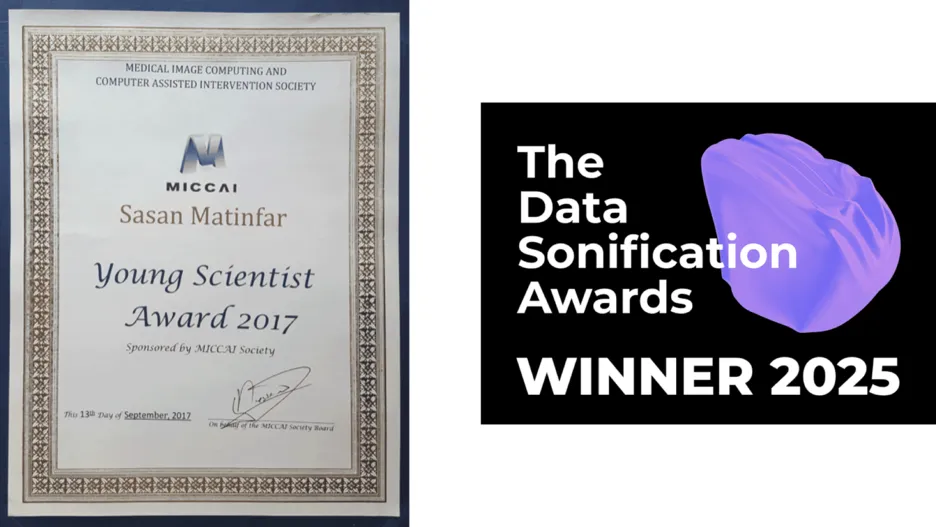
Sasan Matinfar is a research scientist at the Technical University of Munich (TUM), affiliated with the Chair of Computer Aided Medical Procedures (Prof. Navab) and the Munich Center for Machine Learning (MCML). He serves as scientific staff at Rechts der Isar Hospital, developing XR and sonification systems for surgical environments since 2020. His educational background includes: Master’s and Bachelor’s in Computer Science, Ludwig Maximilian University of Munich (LMU) Musicology, Franz Liszt University of Music, Weimar Piano Interpretation, Art University of Tehran Matinfar pioneers medical sonification and multisensory XR, creating auditory interfaces that convert tissue properties into sound for surgical guidance. His work in user-centered design produces clinically viable tools like the Ocular Stethoscope for retinal procedures and physics-based BioSonix frameworks, merging computer vision with perceptual audio engineering to enhance intraoperative precision without visual overload. Analysis of his 12 recent publications (2017-2025) reveals an evolving research arc from foundational surgical soundtracks to sophisticated context-aware sonification. Current work integrates generative AI with real-time tissue deformation modeling, focusing on multimodal frameworks where auditory feedback complements visual navigation in complex surgeries like cardiac interventions and retinal peeling. Key recognitions include: The Data Sonification Award (2025) MICCAI 2023 Best Paper Nominee (top 3% of submissions) MICCAI Young Scientist Award (2017, top 2% of papers) As an educator, Matinfar mentors students through TUM courses including Medical Augmented Reality (WS 2025/26) and Surgical Robotics, while co-organizing the Medical Augmented Reality Summer School and IEEE ISMAR 2025’s MIX Workshop. His patented technologies emerge from collaborations with Politecnico di Milano, TU Dresden’s CeTI, and Balgrist Hospital Zurich, securing interdisciplinary grants in surgical data science. Matinfar operates within TUM’s NARVIS Lab for medical image analysis and RobUSt for robotics-ultrasound integration, leveraging the German Heart Center Munich (DHM) infrastructure to validate XR systems in live surgical workflows and advance vision-language models for intraoperative decision support.
Dr. Abolghasem Sadeghi-Niaraki is an Associate Professor in the Department of Computer Science and Engineering at Sejong University's College of Engineering, where he has served since 2017. He leads the eXtended Reality (XR) Research Center and holds a Research Professor position at the Super-Realistic XR Technology Research Center (2022-2030). Previously, he was an Assistant Professor at INHA University's Department of Geo-Informatics Engineering (2009-2017). Recently appointed as a Fellow at Harvard University's Spatial Data Lab (SDL), he conducts collaborative research in spatiotemporal data analytics and geo-AI. Dr. Sadeghi-Niaraki's research spans Geo-AI, XR technologies, Machine Learning, Metaverse applications, and IoT. His work focuses on applying AI to geospatial problems, developing immersive technologies for education and cultural heritage, and creating predictive models for natural hazards. He has secured significant funding for XR Metaverse research from the Ministry of Science and ICT, focusing on Real-Virtual integration. His interdisciplinary approach combines computer science with environmental science, urban planning, healthcare, and education. His research portfolio demonstrates strong trends in geospatial AI applications for environmental monitoring, particularly in natural hazard prediction (floods, wildfires, earthquakes), as well as innovative educational applications of VR/AR. Recent work shows increasing integration of large language models with immersive technologies and a growing focus on healthcare applications within virtual environments. Dr. Sadeghi-Niaraki has received significant recognition including: Top 2% Scientist Worldwide (Stanford-Elsevier 2024) Fellow at Harvard SDL, Center for Geographic Analysis Australian Endeavour Fellowship Recipient Member of IEEE & AAG (American Association of Geographers) He has led over $9.3 million in research funding, supervised 40+ Master's and 6+ Ph.D. students, and collaborated with 14 universities across 8 countries in immersive technology development. His laboratory work centers on the eXtended Reality Research Center at Sejong University, where his team develops patented methods for context-aware AR/VR systems applied to tourism, cultural heritage, and smart city planning.
Orlando Manuel Oliveira Belo is an Associate Professor with Habilitation at the School of Engineering, University of Minho, Portugal, where he has been a member of the Department of Informatics since 1986. He is also a Senior Researcher at the ALGORITMI R&D Centre, and a member of both the CST R&D Group and ISLab R&D Lab. His academic career spans over three decades, with significant contributions to the fields of Business Intelligence, Data Warehousing, and Data Mining. His educational background includes: 5-year degree in Systems and Informatics Engineering (1986) "Provas de Aptidão Pedagógica e Capacidade Científica" (MSc equivalent) in Expert Systems (1991) Ph.D. in Multi-Agent Systems (1998) Habilitation (2013) Professor Belo's research primarily focuses on Business Intelligence and related areas including Data Warehousing Systems, OLAP, Dashboarding, and Data Mining. His work has significant practical applications in fraud detection and control in telecommunication systems, data quality evaluation, and ETL systems for industrial data warehousing. In recent years, his research has expanded into Ontology Learning and Sentiment Analysis, with applications in healthcare analytics, particularly in cardiovascular health monitoring and dermatology. His interdisciplinary approach bridges computer science with practical business and healthcare applications, demonstrating the versatility of data analytics across different domains. His recent publications (2023-2025) show a clear trend toward integrating advanced machine learning techniques with domain-specific knowledge, particularly in healthcare applications. He has published extensively on sentiment analysis, ontologies, and data warehousing, with a growing emphasis on medical applications including atopic dermatitis and cardiovascular health. His work demonstrates a progression from foundational data warehousing and ETL research to more specialized applications in precision medicine and well-being analytics, reflecting the evolving landscape of data science applications. Professor Belo has an impressive publication record with 181 publications, including 26 in Q1/Q2 journals, and has accumulated 468 citations, resulting in an h-index of 11. His editorial contributions further demonstrate his standing in the academic community. As a dedicated researcher and educator, Professor Belo has been instrumental in developing computational platforms for specific applications and has contributed significantly to the advancement of Business Intelligence methodologies. His work with the ALGORITMI R&D Centre has fostered numerous collaborative projects and has positioned him as a key figure in data analytics research at the University of Minho. His laboratory affiliations include the CST R&D Group and ISLab R&D Lab, where he continues to lead research initiatives in Business Intelligence, Data Mining, and their applications across various domains including healthcare, telecommunications, and business analytics.
He David Zhang is an Assistant Professor of Computer Science at Governors State University and a Postdoctoral Associate at Virginia Commonwealth University (VCU) Robotics Lab. His research focuses on computer vision, robotics, and assistive technologies for visually impaired individuals. Ph.D. in Electrical & Computer Engineering, University of Arkansas at Little Rock (2018) B.S. in Computer Science & Technology, Chinese University of Mining and Technology at Beijing (2009) Study Certificate in Computer Architecture, University of Chinese Academy of Sciences (2010) Dr. Zhang's research integrates vision-based algorithms with inertial sensors to create robust systems for indoor localization, 3D mapping, and human-robot interaction. Key projects include Smart Cane, CoRobotic Cane (CRC), Wearable Robotic Object Manipulation Aid (W-ROMA), and Quadrupedal Human-Assistive Robotic Platform (Q-HARP), which aim to enhance mobility for the visually impaired and elderly populations. His recent publications emphasize improving Visual-Inertial Odometry (VIO) accuracy through depth uncertainty modeling and hybrid perspective-n-point methods. He has contributed to benchmark datasets like VCU-RVI and explored SLAM applications in real-time assistive robotics. Awards include Best Conference Paper honors and competitive recognitions in IROS and 3MT competitions. Best Conference Paper Award, IEEE HSI 2019 2nd Place, IROS 2020 UZH-FPV VIO Competition System Engineering Award for Excellent Ph.D. Student, UA Little Rock (2018)
Takeshi Hagiwara is a Professor at the Art and Architecture School and the School of Creative Science and Engineering . He holds a Master's degree in Civil Engineering from Waseda University's Graduate School of Science and Engineering (1985) and has over 30 years of academic and professional experience. Education: MS in Civil Engineering, Waseda University (1985) Academic Career: 1988-1990 Research Associate at Nagoya University, 1990-2000 Lecturer at Waseda University, 2000-Present Professor His research focuses on architectural history and design , particularly the interplay between structural systems, material expression, and environmental integration. He explores tactile qualities in architecture, multilayered spatial concepts, and the philosophical relationship between the body and built environments. Publication trends show a consistent focus on material innovation (steel, PC panels), structural aesthetics, and environmental responsiveness across 15+ years. Key themes include urban thickness, metaphorical design, and historical reinterpretation in contemporary practice. 2009 Union of Japanese Architects Award (Encouragement Prize) 2008 International Competition Winner for Miaoli Hakka Cultural Park 2007 Winner of National Kaohsiung Performing Arts Center Competition 2006 Excellent Paper Prize, Japan Institute of Architects As an educator, he leads Graduation Projects , Bachelor's and Master's Theses , and advanced seminars in architectural design. His work bridges academic research and practical implementation through projects like Tokyo Sankei Building and GYOSEI INTERNATIONAL GYM.
Devarajan Ramanujan is an Associate Professor in the Department of Mechanical and Production Engineering at Aarhus University, Denmark, under the school of AU Engineering. He leads the Design and Manufacturing Section and directs the Life Cycle Design and Manufacturing Research Group, focusing on sustainability and circular economy integration in engineering systems. He joined Aarhus University in 2017 after completing a postdoctoral fellowship at MIT and earning his PhD from Purdue University. Research Interests: His work centers on sustainable design, sustainable manufacturing, circular economy, life cycle assessment, and digital twins. He develops computer-aided tools to embed environmental and circularity assessments early in product and process design. The research is practice-oriented and conducted in collaboration with manufacturing industries, standards bodies, and innovation clusters. Publication Trends: His recent publications (2017–2024) show a consistent focus on integrating sustainability into engineering design and manufacturing. Key themes include life cycle assessment visualization on CAD models, circular disassembly frameworks, digital threads for circular economy, and multiregional analysis of critical material supply chains (e.g., dysprosium). The work spans environmental engineering, industrial systems, and digital manufacturing. Scientific Awards: Award from the American Society of Mechanical Engineering (ASME) Award from the Association of EcoDesign Societies in Japan Award from Aarhus University Award from Purdue University Advising and Grants: While specific student advisees are not listed, he leads a research group and has secured multiple competitive research grants. His funded projects include ACCURATE (2024–2026), Building the Digital Thread (2021–2025), and Realizing Circular Production (2022–2024), among others, indicating active mentorship and project leadership. These projects are supported by national and international funding bodies, though specific agencies are not named. Labs and Teams: He leads the Life Cycle Design and Manufacturing Research Group, which develops computational methods for sustainable engineering. The group emphasizes collaboration with industry and real-world implementation, suggesting strong industrial linkages and applied research focus.
Professor Tughrul Arslan holds the Chair of Integrated Electronic Systems at the School of Engineering, University of Edinburgh . He leads the Embedded Wireless and Wearable Sensor Systems (EWireless) Group and co-founded sensewhere Ltd. and Sofant Technologies . His research spans reconfigurable architectures, low-power wireless systems, and biomedical RF sensing. Academic Background: BEng and PhD in Electronics Professional Affiliations: Senior Member IEEE, Fellow IET, Chartered Engineer His work focuses on smart wearable devices , indoor positioning systems , and AI-driven healthcare monitoring . Recent publications emphasize microwave imaging for dementia detection , edge AI accelerators , and non-invasive tremor monitoring . Key contributions include patented technologies like the Reconfigurable Instruction Cell Architecture (RICA) . Award-winning academic, he has supervised over 40 PhD students and authored 400+ peer-reviewed papers. His external roles include Chief Technology Officer at sensewhere , driving commercialization of indoor navigation solutions.