Varvara G. Kouznetsova is an Associate Professor in Multi-scale Mechanics of Solids at the Department of Mechanical Engineering of Eindhoven University of Technology (TU/e). Her roles include leading the Mechanics of Materials group and teaching courses such as Advanced Computational Continuum Mechanics and Material Models. She holds a PhD in Mechanical Engineering from TU/e and a degree in Applied Mathematics from Perm State Technical University, Russia. Prior to her current position, she was a Research Fellow at NIMR and M2i institutes and an Assistant Professor at TU/e from 2006 to 2018. Her research focuses on developing multi-scale techniques for materials ranging from advanced steels to metamaterials, emphasizing emergent phenomena across scales. Key interests include computational homogenization, wave propagation, and fracture mechanics. She has supervised 54 academic works and contributed to 160+ research outputs, including influential studies on metamaterials and multiscale analysis. Her recent articles explore topics like reduced-order modeling for elastomeric metamaterials, multiscale FEM-MD coupling for nanocrystalline metals, and acoustic metamaterial transient analysis. She collaborates internationally and maintains datasets on platforms like 4TU.Centre for Research Data. Courses taught include Computer-Aided Engineering and Composite Materials Design.
Dr. Muhammad Shahid Javaid is a postdoctoral research fellow in the Department of Neuroscience at the School of Translational Medicine, Monash University. He completed his PhD from Monash University and has presented his research on national and international platforms. His research focuses on: Development of precision medicines using human stem cell-based in vitro epilepsy models Biological reprogramming of patients' blood cells into stem cells Converting stem cells into brain cells, neurons, and 3D brain organoids Creating personalized 'disease-in-a-dish' models for patients with medically intractable epilepsy Bioinformatics-based computer-aided medicine design His recent publications demonstrate expertise in integrating in vitro human iPSCs-derived neuron and in vivo animal approaches for anti-seizure compound screening, developing human in vitro models of epilepsy using stem cells, conducting molecular docking studies for redox balance regulation in epilepsy, analyzing sex differences in adverse drug reactions from antiseizure medications, and performing in silico analysis of stem cell differentiation mechanisms. His awards include: Gold Medal (2016) Monash Graduate Scholarship (MGS) (2018) Monash International Tuition Scholarship (MITS) (2018) Dr. Javaid has been actively involved in research projects related to patient-specific disease models for Homer1 gene mutations, pre-clinical evaluation of adenosine A1 receptor modulators for drug-resistant epilepsy, intracerebral delivery of Neuropeptide Y for epilepsy treatment, and drug screening using patient-specific iPSCs-derived neurons. He also served as an Authorised Officer and Public Health Officer at the Department of Health (Victoria) from February 2021 to June 2022, demonstrating his commitment to public health applications of his research.
Jacob K. White is the Cecil H. Green Professor of Electrical Engineering and Computer Science at the Massachusetts Institute of Technology (MIT). He is a principal investigator at the Research Laboratory of Electronics (RLE) and served as its Associate Director since 2001. His academic journey includes positions as an assistant professor (1987), associate professor (1991), and full professor (1996) at MIT. Education: Bachelor's degree in Electrical Engineering and Computer Science from MIT (1980) Master's degree from the University of California, Berkeley (1983) Doctorate from UC Berkeley (1985) Research Interests: Computer-aided design and computational prototyping Numerical algorithms and simulation techniques Optimization of integrated circuits and MEMS devices BioMEMS and biomolecule design Systems biology and fluidic analysis of sensors/actuators Scientific Awards: 2008 IEEE Fellow Major Award at the 50th Design Automation Conference (DAC) Advising and Grants: No student advisees listed. Details on grants are not provided in the text. Labs/Teams: Principal Investigator at the Research Laboratory of Electronics (RLE) and leads the Computational Prototyping Group.
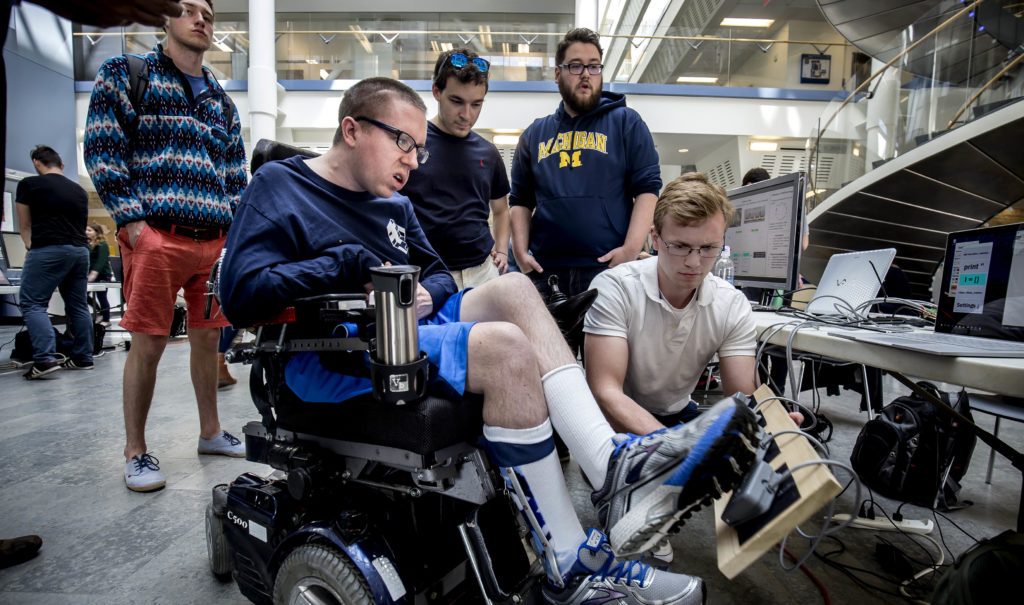
David Chesney is the Toby Teorey Collegiate Lecturer in Computer Science and Engineering at the University of Michigan, College of Engineering. He specializes in project-based courses focusing on accessible software systems and gaming for social impact. His teaching emphasizes context-driven learning, integrating real-world challenges such as disabilities and healthcare needs into course projects. He teaches ENG100 Gaming for the Greater Good and EECS495 Accessible Software Systems Design, collaborating with institutions like C.S. Mott Children’s Hospital and tech companies including Microsoft and IBM. His work involves creating assistive technologies for individuals with disabilities, highlighted in projects like Engineering for Grace and the IBM Watson social needs initiative. Research interests include assistive technology development, inclusive design principles, and leveraging emerging technologies (e.g., HoloLens, Kinect) for accessibility. He has been recognized with the 2018 James T. Neubacher Award for his contributions to engineering education and community impact. Notable collaborations: Prof. Sean Ahlquist (Architecture), C.S. Mott Children’s Hospital, IBM Watson Media features: U-M Engineering articles, TEDxUofM, WDIV News Advising and grants involve translating student projects into commercializable products, with corporate partnerships supporting advanced tool provision. His lab focuses on tangible outcomes bridging academic research and real-world applications.
Beth Trushkowsky is an Associate Professor in the Computer Science Department at Harvey Mudd College. Her research focuses on integrating human computation into database systems, with a particular emphasis on adaptive query processing and scalable data management. She leads an NSF-funded project on Adaptive Query Processing for Crowd-Powered Database Systems , exploring how human computation can enhance query execution efficiency in hybrid systems. Her research interests include crowdsourcing, scalable databases, and cloud computing. Notable work includes the Dynamic Filter algorithm (HCOMP 2017), which uses adaptive scheduling to optimize crowd-powered query processing. She has also contributed to systems like CrowdQ for crowdsourced query understanding and SCADS for distributed storage scalability. Dr. Trushkowsky teaches courses such as Database Systems (CS 133) and Computer Systems (CS 105) . She has advised numerous undergraduate researchers, including Harry Aung, Flora Gallina-Jones, and Cienn Givens, through NSF-funded projects and campus initiatives. Her work has been recognized with a Best Paper Award at ICDE 2013 . Key collaborations include projects with Tim Kraska, Michael J. Franklin, and Purnamrita Sarkar on crowdsourcing enumeration queries. Her lab’s research has been presented at venues like the AAAI Conference on Human Computation and the Tapia Diversity in Computing conference.
Prof. Christoph Kinkeldey is a Lecturer at Hamburg University of Applied Sciences, affiliated with the Department of Information, Media and Communication within the Faculty of Design, Media and Information. He holds a doctorate in Geoinformatics from HafenCity University Hamburg (2015) and has conducted research globally, including at PennState University, University of Melbourne, and Inria. His work focuses on data visualization, visual analytics, and uncertainty visualization, emphasizing how visual tools aid decision-making in complex data environments. Education: PhD in Geoinformatics, HafenCity University Hamburg (2015) Research Interests: Interactive visual data analysis Uncertainty communication in visualizations Blockchain data exploration (e.g., Bitcoin network analysis) Evaluation of visualization techniques His research bridges cartography, computer science, and human-centered design to empower diverse stakeholders in understanding complex information. Publications: Recent work emphasizes uncertainty visualization for data analysts, machine learning interpretability, and blockchain analytics. Key contributions include the BitConduite tool for Bitcoin network analysis and participatory design methods for non-technical users. Awards: 2016 VAST Mini Challenge 2: Honorable Mention for Clear Analysis Strategy Advising & Collaboration: Currently on parental leave until August 2024, he collaborates with the gicentre (City, University of London) and Monash University’s Department of Human-Centered Computing. His research teams focus on interdisciplinary projects merging visualization theory with practical applications. Labs/Teams: Active in the gicentre’s visualization initiatives and Monash’s Human-Centered Computing group, contributing to open-source tools and international research networks.
Stavros Papathanasiou is a Professor at the National Technical University of Athens (NTUA), affiliated with the School of Electrical and Computer Engineering and the Department of Electric Power. His academic career includes a PhD (1997) and Diploma (1991) in Electrical Engineering from NTUA. He specializes in renewable energy systems, power electronics, grid integration of renewables, energy storage, and autonomous power systems. His research focuses on optimizing energy systems with high renewable penetration, microgrids, and grid stability in isolated/islanded grids. Prof. Papathanasiou has led over 100 projects addressing regulatory frameworks for RES and storage, grid codes, interconnections, and energy policy. He collaborates internationally with utilities like TEPCO, KEPCO, and TERNA. His work emphasizes technical solutions for integrating renewables, managing grid stability, and enhancing energy resilience in non-interconnected systems. Key research areas include wind energy systems, photovoltaic technologies, battery storage optimization, and hydrogen storage applications. He has published extensively (>170 papers) in journals like IEEE Transactions on Energy Conversion and Renewable Energy, focusing on technical challenges in renewable integration, power quality, and system dynamics. His lab, the Electric Machines and Power Electronics Laboratory, develops innovative solutions for distributed energy systems. Prof. Papathanasiou advises on national and EU energy policies, contributing to the design of state aid frameworks for renewable projects and grid infrastructure. He has advised governments on island decarbonization strategies and participated in international initiatives like the MERGE project on EV-grid interactions.
Dr. Monica Ward is a Teaching Professor at Dublin City University, currently serving as the Dean of Teaching and Learning within the Office of the Vice-President for Academic Affairs. Her work bridges technology and pedagogy, focusing on innovative educational tools. Office of the Vice-President for Academic Affairs Glasnevin Campus, Room D114 Monica's research interests revolve around Computer-Assisted Language Learning (CALL) , educational technology , and game-based learning . She has contributed significantly to inclusive education, language revitalization (e.g., Irish and Nawat), and formative assessment in both language learning and introductory programming. Her projects often leverage Artificial Intelligence , Virtual Reality , and gamification to create engaging, accessible learning environments. Her recent publications highlight trends in adaptive learning technologies , socio-cultural immersion , and student-centered CALL design . Notable works include studies on educational robotics for dyslexic learners, AI-driven text analysis in game-based language learning, and the impact of interactive oral assessments. Monica has developed educational games like Cipher: Faoi Gheasa and Cipher VR , which integrate mythology and technology to enhance language reconnection. She also explores peer observation, collaborative modules, and green approaches in educational app development, reflecting her commitment to sustainable and culturally relevant teaching strategies.
Giancarlo Crocetti is an Assistant Professor in the Department of Computer Science, Mathematics and Science at the Collins College of Professional Studies, St. John's University. His teaching focuses on data science, distributed analytics, and web data mining. He holds a Doctor of Professional Studies (D.P.S.) in Applied Computing from Pace University, along with Master's degrees in Data Mining (Central Connecticut State University) and Computer Science (La Sapienza University, Rome). Education: D.P.S., Applied Computing, Pace University M.S., Data Mining, Central Connecticut State University M.S., Computer Science, La Sapienza University - Rome His research interests span cognitive science and semantic representation of knowledge. Crocetti actively contributes to cutting-edge fields like telemedicine analytics, biomarker development for Parkinson's disease, and ensemble models in histological examination. His work bridges computer science with healthcare applications through innovative data mining techniques. Notable research includes developing algorithms for social conversation analysis in NSCLC patients and creating a think tank simulator for virtual expert consultations. His publications demonstrate expertise in both foundational computer science and applied biomedical informatics.
Madeleine EL ZAHER is a Researcher-Lecturer at CESI, affiliated with the Engineering and Numerical Tools research team. Her work focuses on Artificial Intelligence, Collaborative Robotics, Human-Machine Interaction, and Multi-Agent Systems. She holds a PhD in Computer Sciences from the University of Technology of Belfort-Montbéliard (2013) and a Master’s degree in Computer Sciences and Telecommunications from Paul Sabatier University (2010). Teaching responsibilities include Computer Sciences and Electronics at the Engineering program level, emphasizing project-based learning and training through research. She co-supervises PhD students in industrial robotics and cyber-physical systems, including Abdessalem ACHOUR (defending in 2024) and Badra Souhila GUENDOUZI (defending in 2025). Her research spans semantic mapping in mobile robotics, federated learning for industrial systems, and platooning algorithms for autonomous vehicles. Notable publications include work on semantic mapping with 3D models (2024), federated learning frameworks using genetic algorithms (2023), and verification of platooning systems (2012–2015). No scientific awards are explicitly listed, but her contributions reflect impactful work in autonomous systems and robotics. Grants and lab affiliations are not detailed in the provided text, though her team’s research aligns with CESI’s focus on engineering and numerical tools.
Robert Manderson is a Senior Lecturer in the University of Roehampton Business School, specializing in information systems, project management, and business research. He holds a B.Sc., Dip.Sc., M.Sc., and is a Fellow of the Higher Education Academy and PRINCE2 Registered Practitioner. His career spans software engineering at BAE Systems and academic research roles at Lancaster University and Manchester University, funded by EPSRC and BT Plc. External Examiner roles at York Business School (2020–2024), Glyndwr University (2013–2016), and University of West London (2011–2015) Member of British Academy of Management and IEEE Research interests focus on ICT in business, Cloud computing, Big Data, education technology, and employability. He contributes to textbooks on Management Information Systems and regularly reviews conference papers. Current projects explore Fintech regulation, aerospace IT innovation, and social media's role in student employability. Key awards: Fellow of HEA, PRINCE2 Certifications Teaching areas include data analytics, PRINCE2/Agile methodologies, and Adobe Creative Cloud. He has advised on modules across computing and business programs, emphasizing ICT's role in organizational success.
Ansaf Salleb-Aouissi is a Senior Lecturer in the Department of Computer Science at Columbia University’s Fu Foundation School of Engineering and Applied Science. She holds affiliations with the Foundations of Data Science and Health Analytics centers. With a PhD from the University of Orleans, France (2003), she pursued postdoctoral training at INRIA Rennes before joining Columbia as an Associate Research Scientist in 2006. She transitioned to her current role in 2015 after serving as an adjunct professor in Computer Science and Data Science from 2014–2015. Her research focuses on machine learning applications in healthcare, education, and infrastructure systems. Key areas include medical informatics (e.g., preeclampsia prediction, genetic associations in pregnancy), educational data mining (intelligent tutoring systems, bootcamp design), and power grid reliability. Notable achievements include winning the NIH Maternal Morbidity Data Challenge and developing tools like LogicLearner for logic education. She has contributed to projects such as analyzing CDC pregnancy data and optimizing the New York City power grid. Her work bridges theoretical machine learning with real-world applications, emphasizing interpretability, bias mitigation, and collaboration across disciplines. She has published extensively in venues like JMLR, TPAMI, and ECML, addressing topics from counterfactual explanations to ensemble learning with missing data.
Sai Manoj Pudukotai Dinakarrao is an Assistant Professor in the Department of Electrical and Computer Engineering at George Mason University's College of Engineering and Computing. He leads the HArt (Hardware and AI Research) Group, focusing on cutting-edge research at the intersection of hardware security and artificial intelligence. His educational journey includes a BTech in Electronics and Communication Engineering from Jawaharlal Nehru Technological University (2010), an MTech in Information Technology from International Institute of Information Technology Bangalore (2012), and a PhD in Electrical Engineering from Nanyang Technological University, Singapore (2015). Following his doctoral studies, he completed post-doctoral research at TU Wien, Vienna (2015-2017) and George Mason University (2017-2018). Dr. Dinakarrao's research spans hardware security, adversarial machine learning, IoT networks, and deep learning in resource-constrained environments. His work integrates hardware design with AI techniques to address security challenges in computing systems, with particular focus on side-channel attack detection, malware detection in IoT networks, on-chip security, and hardware accelerator design for machine learning applications. His research has resulted in numerous publications in top-tier conferences and journals including IEEE Transactions, ACM conferences, and Design Automation Conference. Analysis of his recent publications reveals a strong trend toward hardware security solutions using machine learning techniques. His work increasingly focuses on Processing-in-Memory architectures, energy-efficient security solutions for IoT devices, and innovative approaches to hardware Trojan detection. Many publications demonstrate interdisciplinary collaboration across electrical engineering, computer science, and cybersecurity domains. Young Research Fellow Award at Design Automation Conference (DAC) 2013 Best paper award at International Conference on Data Mining (ICDM) 2019 Best paper award at International Conference on Consumer Electronics (ICCE) 2020 Best paper nomination at International Conference on Computer-Aided Design (ICCAD) 2019 Best paper nomination at Design Automation and Test in Europe (DATE) 2018 Dr. Dinakarrao has successfully mentored numerous PhD and MS students, with alumni securing positions at AMD-Xilinx, US Government agencies, and academic institutions. His research has been supported by significant grants from NSF, DARPA, and Virginia Commonwealth Cyber Initiative. Current projects include securing supply chains with UVA, developing novel architectures for machine learning acceleration, and creating energy-preserving cryptography protocols. The HArt Group maintains active collaborations with industry partners including AMD-Xilinx and government agencies. The lab focuses on practical implementations of theoretical security concepts, with particular emphasis on creating deployable security solutions for real-world hardware systems. Current research directions include intermittent computing with energy harvesting, hardware fuzzing techniques, and robust machine learning models resistant to adversarial attacks.
Kazuyuki Iwase serves as Associate Professor at Tohoku University's Institute of Multidisciplinary Research for Advanced Materials since April 2025, following progressive appointments as Senior Assistant Professor (2023-2025) and Assistant Professor (2019-2023). His academic journey includes postdoctoral research at Paul Scherrer Institute (Switzerland) and multiple JSPS Research Fellowships. He maintains active collaborations with prominent researchers including Prof. Itaru Honma and Prof. Takaaki Tomai. Dr. Iwase's research focuses on electrocatalysis for sustainable energy conversion, specializing in carbon dioxide reduction reaction (CO2RR) and oxygen evolution reaction (OER) systems. His work spans nanomaterials engineering, electrocatalyst design, and device integration for renewable energy applications. Key methodologies include supercritical hydrothermal processing, mechanical alloying, and machine learning optimization of electrochemical systems. His publication record demonstrates consistent high-impact output with 36 accepted articles through 2025, featuring 11 as corresponding author and 15 as first/equal-first author. Recent work explores manganese nanospinels for OER, Ag-Sn intermetallics for CO2RR, and machine learning approaches for reaction optimization, showing strong interdisciplinary connections between materials science, electrochemistry, and sustainable engineering. The 5th Symposium for The Core Research Clusters for Materials Science and Spintronics Poster Award (2021) Student Presentation Award, Chemical Society of Japan (2016) International Exchange Support Award, Electrochemical Society of Japan (2016) SIEMME Best Oral Presentation Award (2014) Dr. Iwase has secured significant research funding as Principal Investigator, including a JST PRESTO grant (¥40,000,000) for CO2 conversion research and multiple JSPS Grants-in-Aid totaling over ¥59,000,000. His academic service includes peer review for prestigious journals including Angewandte Chemie and Nature Sustainability. He maintains active international engagement through invited lectures in Japan, India, and Switzerland, focusing on nanomaterials for electrocatalysis.
Georges G.E. Gielen is a Full Professor in the Department of Electrical Engineering (ESAT) at KU Leuven (Belgium), where he has been faculty since 1993. He also serves as scientific research advisor at imec (10% appointment). Previously, he held leadership roles including Vice-Rector for Science, Engineering & Technology (2013-2017), Chair of Electrical Engineering Department (2012-2013, 2020-2024), Head of MICAS research group, and PI coordinator of Leuven CHIPS Center of Excellence. He received MSc (1986) and PhD (1990) degrees in Electrical Engineering from KU Leuven. His research focuses on analog/mixed-signal IC design and CAD tools, including design automation, modeling, simulation, optimization, synthesis, and testing. Key areas include data converters, sensor interfaces, low-power design, and EDA tools. He has supervised over 55 PhD graduates and coordinates multiple research projects, including an ERC Advanced Grant (AnalogCreate). Professor Gielen has authored 14 books and over 800 publications, with works spanning circuit design, CAD methodologies, testing techniques, and microelectronics. His publications consistently address emerging challenges in analog/digital integration and design automation. IEEE Fellow (2002) Royal Flemish Academy of Belgium (Technical Sciences) Academia Europaea (Engineering) IEEE CAS Mac Van Valkenburg Award (2015) IEEE CAS Charles Desoer Award (2020) EDAA Achievement Award (2021) 14 additional awards including 4 best paper prizes He leads the MICAS research group focusing on microelectronics and sensors, and has chaired the Leuven ICT research center. He regularly serves on editorial boards of IEEE Transactions and organizes major conferences (General Chair for DATE 2006, ICCAD 2007, ESSCIRC 2017, ETS 2021).