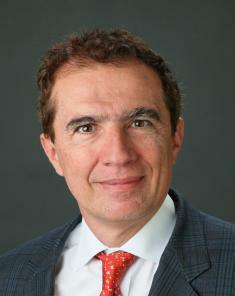
Giovanni De Micheli is a Professor of Electrical Engineering and Computer Science at EPF Lausanne, Switzerland. He also serves as Director of the Integrated Systems Centre and the Institute of Electrical Engineering at EPFL, and chairs the Scientific Committee of CSEM in Neuchatel. Previously, he held academic roles at Stanford University for 18 years, including Full Professor, Associate Professor, and Assistant Professor in the Department of Electrical Engineering. His research spans synthesis of digital circuits, hardware/software co-design, low-power design, and Networks on Chip (NoC) technology. 2003: IEEE Emanuel Piore Award 2000: Golden Jubilee Medal of the IEEE CAS Society 2000: ACM Fellow 1994: IEEE Fellow 1990: IEEE/CS Distinguished Service Award 1988: NSF Presidential Young Investigator Award His seminal contributions include pioneering C-based synthesis and Boolean matching algorithms for digital circuits, foundational work in dynamic power management using stochastic control, and the development of Network-on-Chip (NoC) technology. His publications, such as "Networks on Chips: A New SoC Paradigm" and "Dynamic Power Management for Portable Systems" , have shaped modern SoC design practices. With over 400 technical articles, 9 books, and an H-index of 56, his work remains highly influential.
Georges Gielen is Full Professor in the Department of Electrical Engineering (ESAT) at KU Leuven, Belgium, and part-time Research Director at imec. He has held multiple leadership roles including Chair of ESAT Department (2012-2013, 2020-2024) and Vice-Rector for Science, Engineering & Technology (2013-2017). His academic career spans over 30 years at KU Leuven, progressing from Assistant to Full Professor. His research focuses on analog and mixed-signal integrated circuit design automation , with expertise in CAD tools, design optimization, sensor interfaces, and neuromorphic systems. His work bridges hardware design with machine learning, particularly in hardware-efficient AI implementations and biomedical applications. He has pioneered techniques for automated analog circuit sizing, topology synthesis, and reliability-aware design in nanometer CMOS. Gielen has received numerous accolades including the IEEE CAS Mac Van Valkenburg Award (2015), IEEE CAS Charles Desoer Award (2020), and EDAA Achievement Award (2021). He holds an ERC Advanced Grant AnalogCreate and is an IEEE Fellow since 2002. As a prolific scholar, he has chaired major conferences including DATE (2006), ICCAD (2007), and ESSCIRC (2017). He has graduated over 55 PhD students through the MICAS research group at KU Leuven, currently supervising 13 doctoral candidates. His research team collaborates extensively with imec and industry partners on cutting-edge projects in carbon-aware AI accelerators, uncertainty-aware design, and neuromorphic sensor interfaces.
Hannes Hick is a Professor at Graz University of Technology , affiliated with the Institute of Machine Elements and Development Methodology . His research focuses on mechanical development, tribology, and systems engineering for automotive and industrial applications. He actively contributes to engineering education and methodology standardization. Research Interests Hydrogen internal combustion engines System modeling and digital twins Tribology in electric drivetrains Sustainable engineering practices MBSE (Model-Based Systems Engineering) Friction and wear analysis Article Trends His recent work emphasizes hydrogen propulsion systems, model-based approaches for interdisciplinary engineering challenges, tribological optimization for sustainable mobility, and integrating AI with mechanical design workflows. Labs and Teams He leads research at the Institute of Machine Elements, focusing on mechanical validation and development methodologies for advanced powertrain systems.
Luca Benini is a Full Professor of Electronics at the University of Bologna's Department of Electrical, Computer and Systems Engineering. He also holds a Visiting Faculty Position at the Ecole Polytechnique Federale de Lausanne (EPFL) and serves as Chief Architect of the Platform 2012 project at STMicroelectronics in Grenoble, France. His educational background includes academic positions progressing from Assistant Professor (1998) to Associate Professor (2001) and finally Full Professor (2006) at the University of Bologna. He has held significant industry positions including IC Architecture and CAD Engineer at Integrated Information Technology Inc. (1994), Senior Member of R&D Staff at Synopsys Inc. (1996), and Visiting Researcher at Hewlett Packard Laboratories (1997-2004). Professor Benini's research focuses on designing systems for ambient intelligence, spanning multi-processor systems-on-chip, networks on chip, and energy-efficient smart sensors and sensor networks. His work has expanded into biochips for biological molecule recognition, bioinformatics, and advanced algorithms for in-silico biology. His expertise in low-power design of integrated circuits and systems earned him IEEE Fellow status in 2007. He has received multiple honors including best paper awards at IEEE GLS-VLSI and the European Wireless Sensor Networks Conference (both 2008), with three of his papers featured in 'Design Automation and Test in Europe - The Most Influential Papers of 10 Years' (Springer 2008). IEEE Fellow (2007) for contributions to design technologies for low power design Member of ARTEMISIA Steering Board (elected twice) Member of European Design and Automation Association Main Board Member of MEDEA+ EDA roadmap committee Member of EC Advisory group on Computing Systems Benini has held significant leadership roles in the academic community, serving as General Chair of the IEEE/ACM Design Automation and Test in Europe Conference (2009), DATE Program Chair (2005), and Program Chair for multiple specialized symposia. He serves as associate editor for several prestigious journals including IEEE Transactions on Computer-Aided Design and ACM Transactions on Embedded Computing Systems, and has organized influential workshops like the Dagstuhl Seminar on Power-Aware Computing Systems.
Univ.Prof. Michael Wimmer is a Professor in the Department of Computer Graphics and Visualization at TU Wien's Faculty of Informatics. His research focuses on real-time rendering, point cloud processing, GPU computing, and computational design. He leads projects involving architectural visualization, thermal simulation, and integrative design frameworks combining 4D sketching with material modeling. His work bridges computer graphics with applications in architecture and engineering. ORCID: 0000-0002-9370-2663 Research Group: Network Lab Recent research emphasizes GPU-accelerated algorithms (e.g., LOD generation for 2 billion points), real-time rendering techniques, and deep learning approaches for surface reconstruction. Collaborations span thermal simulation with civil engineers and 4D design tools for architects. Notable contributions include: Developing PPSurf for detailed surface reconstruction using point convolutions Advancing Vulkan-based rendering pipelines in academic settings Integrating light polarization for HDR imaging His lab explores applications in architectural design metaphors, computational material assessment via GeoRadar, and thermal simulation using precomputed radiative transport. Students under his supervision focus on GPU optimization, 3D reconstruction, and VR ergonomics.
Georges G.E. Gielen is a Full Professor in the Department of Electrical Engineering (ESAT) at KU Leuven (Belgium), where he has been faculty since 1993. He also serves as scientific research advisor at imec (10% appointment). Previously, he held leadership roles including Vice-Rector for Science, Engineering & Technology (2013-2017), Chair of Electrical Engineering Department (2012-2013, 2020-2024), Head of MICAS research group, and PI coordinator of Leuven CHIPS Center of Excellence. He received MSc (1986) and PhD (1990) degrees in Electrical Engineering from KU Leuven. His research focuses on analog/mixed-signal IC design and CAD tools, including design automation, modeling, simulation, optimization, synthesis, and testing. Key areas include data converters, sensor interfaces, low-power design, and EDA tools. He has supervised over 55 PhD graduates and coordinates multiple research projects, including an ERC Advanced Grant (AnalogCreate). Professor Gielen has authored 14 books and over 800 publications, with works spanning circuit design, CAD methodologies, testing techniques, and microelectronics. His publications consistently address emerging challenges in analog/digital integration and design automation. IEEE Fellow (2002) Royal Flemish Academy of Belgium (Technical Sciences) Academia Europaea (Engineering) IEEE CAS Mac Van Valkenburg Award (2015) IEEE CAS Charles Desoer Award (2020) EDAA Achievement Award (2021) 14 additional awards including 4 best paper prizes He leads the MICAS research group focusing on microelectronics and sensors, and has chaired the Leuven ICT research center. He regularly serves on editorial boards of IEEE Transactions and organizes major conferences (General Chair for DATE 2006, ICCAD 2007, ESSCIRC 2017, ETS 2021).
Bernd Becker is a Professor of Computer Science at the University of Freiburg, where he has led the Chair of Computer Architecture until 2021. He previously served as Dean of the Faculty of Engineering (2010–2012) and held roles at institutions like the University of Tokyo (Visiting Professor, 2009/2010) and J.W. Goethe University Frankfurt (Professor of Complexity Theory, 1989–1995). His research focuses on VLSI CAD, algorithm optimization for circuit testing, and reliability of embedded systems. He has authored over 350 peer-reviewed publications and holds patents in VLSI design. Education: He earned his PhD in Computer Science from the University of Saarland (1982) and completed Habilitation (1988) under Prof. G. Hotz. His doctoral thesis addressed graph embedding, while his habilitation focused on Boolean circuit design and testing. Research Interests: Becker specializes in symbolic methods for circuit verification, formal safety protocols, and nanoelectronics testing. His work bridges academic and industrial applications, emphasizing efficient algorithms for CAD tools. Recent projects include reliability frameworks for embedded systems and advanced test methodologies for emerging nanoelectronics. Awards: Recognized as an IEEE Fellow (2008), he has received multiple teaching awards (2012–2013) and the EDA Medal (2021). He actively contributes to academic governance, serving on steering committees for conferences like DATE and ETS, and co-led the Transregional Collaborative Research Center AVACS (2003–2015). Professional Roles: He has been a member of the Scientific Directorate at Schloss Dagstuhl (2011–2019), the Board of Directors for the Centre for Security and Society (since 2010), and has organized major international symposia including ISMVL 1999 and ETS 2007.
Peter Hehenberger is a Professor and Research Group Head of the 'Smart Mechatronics Engineering' group at the University of Applied Sciences Wels . His primary affiliation is with the Department of Smart Mechatronics Engineering. He specializes in model-based mechatronic system design, computer-aided production systems, and product lifecycle management. Research Interests: Cyber-physical systems, agile product-service systems, energy-efficient manufacturing, and sustainable industrial processes. Key Projects: EnerMan (energy-efficient manufacturing), BF-APPSDe (agile product-service systems), SmaPro2 (smart production networks), and MoCy (model-based design for cyber-physical systems). He actively collaborates on international research initiatives focusing on sustainable manufacturing and smart production systems. His work integrates digital twin technology, lifecycle assessment, and systems engineering methodologies. He serves as an editorial board member for International Journal of Product Lifecycle Management and IFAC Mechatronics Journal . He has presented at conferences such as ERFA Kreislaufwirtschaft and organized events like CAD'24. His research outputs span over 180 publications with an h-index of 13, emphasizing energy management, mechatronics, and industrial sustainability.
Thomas-Peter Fries is a Professor at the Institute of Structural Analysis, TU Graz. His research focuses on computational mechanics, fluid-structure interaction (FSI), and biomedical engineering, particularly in modeling aortic dissection and hydraulic fracturing. He develops advanced numerical methods like the Trace Finite Element Method (TraceFEM), XFEM, and higher-order meshing techniques for complex geometries. Fries leads projects funded by FWF and EU, collaborating internationally on cardiovascular simulations and material science. His work bridges CAD integration, patient-specific modeling, and multiphysics problems, emphasizing accuracy and efficiency in FSI simulations. Education and affiliations: PhD and habilitation in engineering, with extensive contributions to computational methods for structural analysis and fluid dynamics. Active in conferences and editorial roles, he has over 140 publications and 20+ projects since 2005. Research areas include fracture mechanics, numerical mathematics, and CFD applications in biomedical systems. Key Projects : Embedded Manifolds : Continuously embedded manifold models in mechanics (FWF-funded, 2025–2029) Aortic Dissection : Simulating fluid-structure-crack interactions and thrombus formation (2018–2020) VEGA : CAD-based virtual prototyping with boundary element methods (2021–2025) Scientific Contributions : Pioneered level-set-based methods for embedded substructures and FSI Developed high-order meshing schemes for implicit geometries Advanced patient-specific models for hemodynamics and aortic pathology Labs/Teams : Part of TU Graz’s interdisciplinary teams in computational biomechanics and structural analysis. Collaborates with experts in cardiovascular medicine, materials science, and computer science.
Stefan Huber is Professor and Head of Research at the Department for Information Technologies and Digitalisation at Salzburg University of Applied Sciences. He also serves as Research Group Leader and Head of the Josef Ressel Center for Intelligent and Secure Industrial Automation, a €2.5M research center established in 2022 focusing on digital assistants for industrial machines with research fields in system architectures, artificial intelligence, and cybersecurity for operational technology. His research spans multiple domains including Machine Learning , Industrial Automation , Cyber Security , Computational Geometry , and Algorithm Theory . Huber's work has evolved chronologically from theoretical computational geometry to practical applications in industrial automation systems. His current research focuses on AI applications in industrial settings, particularly in Industry 4.0 contexts, with significant contributions to OPC UA security, reinforcement learning for control systems, and time series forecasting for industrial processes. Analysis of his recent publications (2023-2025) reveals a strong focus on practical AI applications in industrial automation, with particular emphasis on security aspects of operational technology, predictive modeling for manufacturing processes, and integration of machine learning techniques into industrial control systems. His work bridges theoretical computer science with real-world industrial applications. Excellence rating for Josef Ressel Centre evaluation (2024) Recognition for successful high-tech research (2024) Huber leads multiple significant research projects including AI4GREEN (Data Science for Sustainability, 2024-2027), JRZ ISIA (Josef Ressel Centre for Intelligent Industry Automation, 2022-2027), and IAI (Industrial Artificial Intelligence, 2023-2024). His research group at the Josef Ressel Centre comprises numerous researchers working on system architectures, AI, and cybersecurity for industrial automation. The center has received positive evaluations and media coverage for its high-tech research contributions to the field.
Katalin Fazekas is an Assistant Professor in the Formal Methods in Systems Engineering group at TU Wien. Her research focuses on improving incremental reasoning methods for SAT/SMT solvers and advancing formal verification techniques. She holds a PhD from the Johannes Kepler University Linz, supervised by Armin Biere. Education: PhD in Logical Methods in Computer Science (LogiCS), JKU Linz (2016–2021) Research Interests: Incremental SAT/SMT solving Formal verification of distributed systems Algorithm optimization for constraint solving Automated reasoning and proof generation Key Projects: INCR (2021–2024) : Austrian Science Fund (FWF) project on scalable verification via incremental reasoning REVEAL-AI and SLIM : Collaborative projects on AI-driven formal methods Awards: Hertha Firnberg Fellowship (FWF), 2021–2024 Tools Developed: CaDiCaL 2.0: Advanced SAT solver QSM: Quantified symmetric minimization framework for distributed protocols Lab/Affiliations: FORSYTE research group, TU Wien.
Dr. Elke Holzer is an Associate Professor at the School of Finance, Banking and Insurance of the Wirtschaftsuniversität Wien (WU) , specializing in healthcare management and insurance systems. With over 73 publications, her work focuses on controlling in public hospitals , risk management , and quality assurance in healthcare. She co-edited multiple anthologies on effect-driven resource management and contributed to foundational studies on Austrian certification models for healthcare facilities. Key Research Areas: Healthcare sustainability, organizational reform, risk analysis frameworks, patient-centered care, and financial systems. Publication Trends: Empirical studies on hospital management, benchmarking in public healthcare, and policy-oriented works spanning 1985–2018. Notable Collaborations: Frequent co-authorship with Eugen Hauke and Helmut Bauer on healthcare reforms and quality management.
Andreas Schrempf is a Professor at the University of Applied Sciences Linz, specializing in Medical Engineering and Surgical Simulation. He leads the Research Center Linz Center of Excellence Medical Engineering and collaborates with the Digital Media Lab. Key Research Areas: Haptic Feedback, Artificial Soft Tissues, Needle Insertion, and Surgical Training Tools. Projects: TC-SMARTIS (2019-2020), NeedleTutor (2015-2017), ReSSL (2014-2018), and PatientSim (2013-2014). Recent Publications: Focus on hybrid surgical simulators, electromechanical characterization of materials, and sensor interfaces for medical training. Activities: Active in oral presentations and conferences on surgical simulation and healthcare cost reduction since 2009. Contact: andreas.schrempf@fh-linz.at
Prof. Ender BULGUN is a Full Professor and Dean of the Faculty of Fine Arts and Design at Izmir University of Economics, leading the Textile and Fashion Design department. She holds a PhD in Textile Engineering from Ege University, with academic roles spanning Assistant Professor (1997), Associate Professor (2004), and Full Professor (2009). Her research focuses on smart textiles, wearable technology, CAD systems, and fashion design innovations. Key projects include developing smart firefighter garments, thermo-controlled clothing, and software for textile production optimization. She has managed national and international projects funded by TÜBİTAK, NATO, and EU initiatives. Her work spans over 50 conference papers and peer-reviewed articles in journals like International Journal of Clothing Science and Technology and Textile Research Journal . As an educator, she teaches courses such as 'Smart Clothing Design and Technologies' and 'Recent Advances in Smart Design Applications'. She has advised numerous graduate theses, including studies on smart glove design for disabled individuals and thermal performance evaluations of firefighter apparel. Her contributions extend to editorial roles in textile journals and jury memberships in international design competitions.
Pere Brunet is a Full Professor in Computer Science at the Polytechnic University of Catalonia (UPC) in Barcelona, Spain, where he heads the UPC Research Group in Modeling, Visualization and Computer Graphics. He served as Vice President for Research at UPC between 1988 and 1992 and currently serves as Vice President of the Royal Academy of Engineering in Spain. He pioneered Computer Graphics research in Spain starting in 1979 and promoted the creation of the Virtual Reality Center in Barcelona, where he serves as scientific head. Industrial Engineer (1971) from Barcelona School of Engineers (UPC) Doctor in Industrial Engineering (1976) from UPC with special outstanding recognition Professor Brunet's research focuses on geometric computer-assisted design, hierarchical geometric representations, and virtual reality. His group works on complex research projects involving Virtual Reality and very complex models across diverse fields including geo-modeling, industrial design, cultural heritage, and medical applications. His work emphasizes multi-resolution geometric models, real-time navigation through complex virtual environments, and implicit interaction in VR systems. The group maintains strong international cooperation and industry-based research engagement. His publication record spans several decades with significant contributions to Computer-Aided Geometric Design, volume visualization, and octree representations. His recent work focuses on massive data processing, urban modeling, cultural heritage visualization, and efficient rendering techniques for complex environments. Member of the Royal Academy of Engineering in Spain (currently Vice President) Corresponding member of the Academy of Engineering of Portugal Member of the CAETS Council and EuroCASE Executive Committee Recipient of the Distinguished Career Award of the Eurographics Association (2008) Recipient of the XI Catalan Foundation Prize for research (2001) Recipient of the Narcís Monturiol medal from the Catalonia Government Recipient of the Silver medal from the Polytechnic University of Catalonia Professor Brunet has served on editorial boards of prestigious journals including Computer-Aided Design, Computer-Aided Geometric Design, IEEE Transactions on Visualization and Computer Graphics, and Computers & Graphics. He was Chairman of the Eurographics Association (2001-2002) and has been actively involved in international scientific organizations like Eurographics, IFIP, and Siggraph. He has contributed to numerous edited books and special journal issues in his field and has served as scientific consultant for universities, international associations, and research funding agencies. He leads the UPC Research Group in Modeling, Visualization and Computer Graphics, which has been instrumental in developing Spain's computer graphics research landscape. The group maintains strong connections with industry and international research communities, focusing on practical applications of their theoretical work across multiple domains.