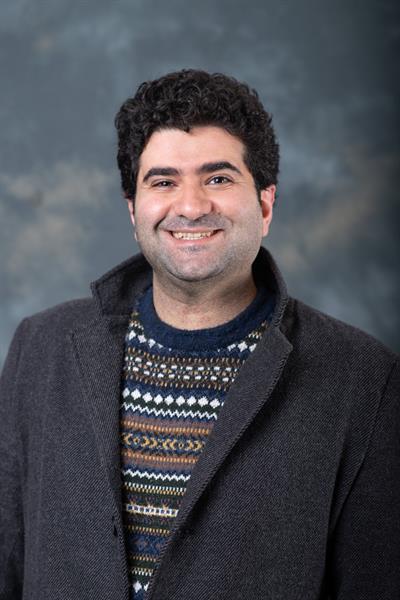
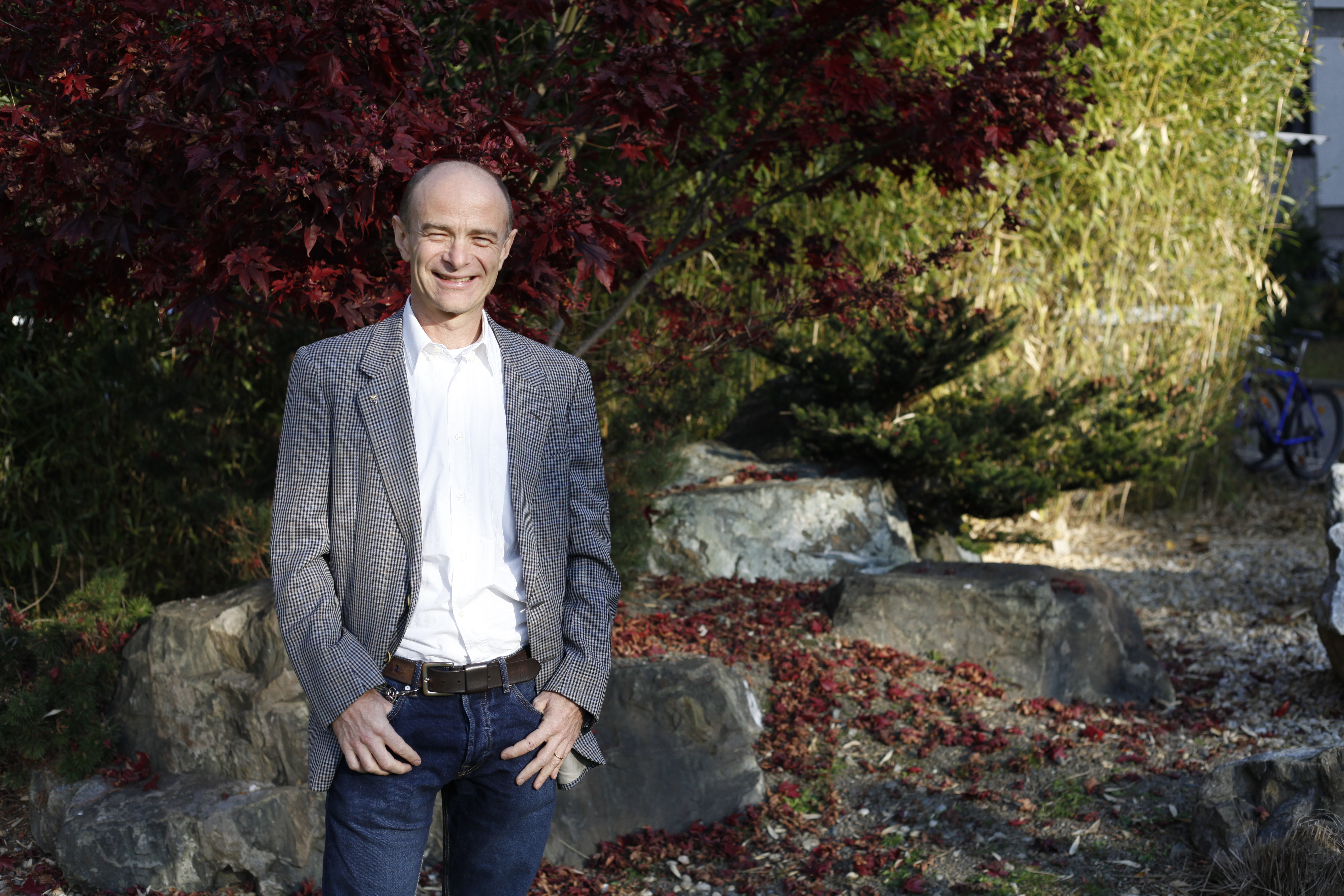
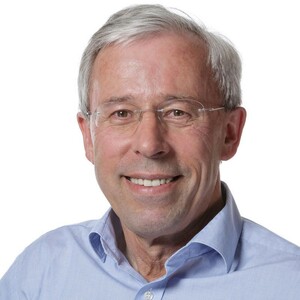
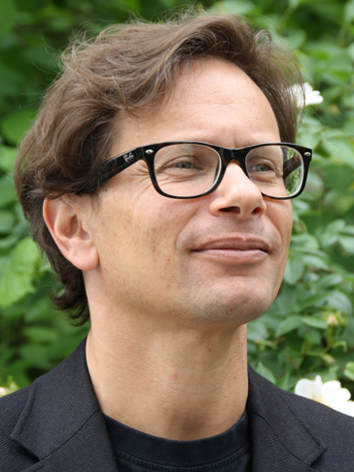
Professor Vedran Dunjko is a faculty member at the Leiden Institute of Advanced Computer Science (LIACS), Leiden University, with affiliations to the Leiden Institute of Physics (LION). He leads the Applied Quantum Algorithms group and co-founded the Quantum@LIACS initiative, focusing on the intersection of quantum computing, machine learning, and artificial intelligence. His research interests include quantum machine learning, quantum-enhanced reinforcement learning, quantum heuristics, and the application of AI to quantum computing challenges. Dunjko's work bridges theoretical foundations with experimental implementations on near-term quantum devices, exploring both quantum advantages in learning and the use of classical AI for quantum system design. The recent publications show a strong trend toward proving quantum advantages in learning tasks, optimization, and topological data analysis, with publications in Nature , Nature Communications , and NeurIPS . Key themes include quantum policy gradients, quantum TDA, and reinforcement learning for quantum circuit optimization. ERC Consolidator Grant (2024) PNAS Cozzarelli Prize (2018) Editor’s Suggestion in Physical Review Letters (2014, 2018) Featured in Physics (American Physical Society) (2014, 2018) Dunjko advises several PhD candidates and postdocs, including Rahul Bandyopadhyay, Sofiene Jerbi, and Lea Trenkwalder. He has received competitive grants, most notably the ERC Consolidator Grant in 2024. His group fosters international collaborations with institutions across Europe and industry partners. The Applied Quantum Algorithms group and the Quantum@LIACS team combine theoretical investigations with practical implementations on quantum hardware, focusing on scalable quantum algorithms and AI-driven quantum discovery.
Saeed Mehraban is an Assistant Professor of Computer Science at Tufts University's School of Engineering and an Assistant Professor in the Department of Physics & Astronomy within the School of Arts and Sciences. He joined Tufts University in June 2022 as an Assistant Professor after serving as a Visiting Assistant Professor from June 2021 to May 2022. Prior to his position at Tufts, he was an IQIM Postdoctoral Scholar at the California Institute of Technology and a research fellow at the Simons Institute for the Theory of Computing during spring 2020. Doctor of Philosophy in Electrical Engineering and Computer Science from MIT (2019) Master of Science from MIT (2015) B.Sc. in Physics from Sharif University of Technology, Iran (2013) B.Sc. in Electrical Engineering from Sharif University of Technology, Iran (2013) Saeed Mehraban's research focuses on quantum computation and information, exploring the profound connections between computer science and physics. His work particularly addresses quantum computational complexity and continuous variable systems. A significant portion of his recent research concerns delineating the boundary between classical and quantum computing in noisy intermediate-scale quantum devices. His research bridges theoretical computer science with quantum physics, examining fundamental questions about what quantum computers can and cannot efficiently solve, with particular emphasis on mathematical foundations and computational complexity aspects of quantum information processing. Mehraban's publication record demonstrates a strong focus on quantum computing theory, with particular emphasis on quantum complexity, quantum algorithms, and the mathematical foundations of quantum information. His recent work (2021-2023) has explored topics like unitary t-designs, holomorphic representations of quantum computations, and quantum-inspired identities. Earlier publications (2015-2020) examined computational complexity in quantum theories, approximation algorithms for matrix problems, and connections between classical algorithms and quantum many-body systems. His research consistently sits at the intersection of theoretical computer science and quantum physics, addressing fundamental questions about computational advantages of quantum systems. Gold Medalist, National Physics Olympiad (2007) Bronze Medalist, National Astronomy Olympiad (2005) Identified as Exceptional Talent by the Iranian Educational System (2004) Mehraban teaches dissertation research courses at Tufts University, indicating his involvement in mentoring graduate students. His teaching activities include specialized courses in quantum information science, quantum computer science, and quantum complexity theory. His professional activities show invitations to speak at prestigious institutions including Microsoft Research Station Q, Mila Institute in Quebec, and the Simons Institute, suggesting recognition of his research contributions. His postdoctoral work at Caltech's Institute for Quantum Information and Matter (IQIM) demonstrates his connection to leading quantum research groups. While specific lab affiliations at Tufts aren't explicitly detailed in the provided information, Mehraban's teaching of specialized quantum courses and his research profile suggest he likely contributes to quantum computing research initiatives at Tufts University. His background at Caltech's IQIM and involvement with the Simons Institute's Quantum Wave in Computing Program indicate strong connections to the broader quantum information science community.
Garnet K. Chan is the Bren Professor of Chemistry and Director of the Rudolph A. Marcus Center for Theoretical Chemistry at the California Institute of Technology. He received his B.S. from the University of Cambridge in 1996 and his M.A. and Ph.D. from the University of Cambridge in 2000. Dr. Chan's research lies at the interface of theoretical chemistry, condensed matter physics, and quantum information theory, focusing on quantum many-particle phenomena and the numerical methods to simulate them. His group has developed numerous methodologies including density matrix renormalization and tensor network algorithms, canonical transformation-based down-foldings, local quantum chemistry methods, quantum embeddings, and new quantum Monte Carlo algorithms. His work addresses problems that appear naively exponentially hard but where understanding of physics, particularly entanglement structure, allows for calculations of polynomial cost. Analysis of his recent publications reveals a strong focus on quantum simulation techniques, particularly tensor network methods applied to strongly correlated systems. His research spans fundamental theoretical developments to practical applications in quantum computing, molecular simulation, and materials science, with increasing integration of machine learning techniques and GPU acceleration in computational chemistry frameworks. Dr. Chan leads an active research group at Caltech dedicated to simulating chemical and physical systems at the level of many-particle quantum mechanics. His group has welcomed numerous researchers including Kasra Hejazi, Zuxin Jin, Zhihao Cui, Ke Liao, Henrik Larsson, and Wenyuan Liu. He teaches courses in Physical Chemistry (Ch 21 abc) and Advanced Quantum Chemistry (Ch 225), contributing significantly to theoretical chemistry education at Caltech.
Enrico Arrigoni is a Professor at the Institute of Theoretical Physics - Computational Physics at Graz University of Technology (TU Graz). His research focuses on correlated quantum systems, many-body physics, and nonequilibrium dynamics, with applications to Mott insulators, quantum transport, and photovoltaic systems. He teaches courses such as 'Green's functions in Many-Particle Physics' and 'Atom Physics - Quantum Mechanics'. Recent work explores phonon effects in Mott systems, neural network approaches to quantum states, and impact ionization processes in photodriven materials. His methods include auxiliary master equation techniques and variational cluster approaches. Publications span topics like nonequilibrium steady states, quantum impurity models, and disordered systems. While no specific awards are listed, his contributions to theoretical physics and computational methods are evident through his prolific research output. Advising and grants details are not explicitly mentioned, though his involvement in graduate theses and research projects is implied via available master's and bachelor's thesis topics.
Peter Zoller is a Professor of theoretical physics at the University of Innsbruck and Scientific Director at IQOQI Innsbruck (Austrian Academy of Sciences). His research focuses on quantum optics, many-body quantum physics, and quantum information science, with a strong emphasis on quantum simulation of gauge theories and atomic systems. He has trained 34 PhD students and hosted 57 postdoctoral researchers, fostering collaborations between theory and experiment. His group, the Zoller Group, explores quantum phenomena such as lattice gauge theories, entanglement dynamics, and topological order using advanced quantum simulation techniques. Key research interests include atomic physics, quantum gases, and applications of quantum technologies to high-energy physics problems. Recent work addresses string breaking in quantum simulators, entanglement Hamiltonians, and scalable architectures for fermionic quantum processors. Collaborations span institutions like Harvard, MIT, and the University of Innsbruck’s experimental teams. His contributions bridge foundational physics with cutting-edge quantum technologies, aiming to solve problems inaccessible to classical methods.
Prof. Fakher Assaad is a Professor of Theoretical Physics I at Julius-Maximilians-Universität Würzburg. His research focuses on quantum many-body systems, with expertise in numerical methods like quantum Monte Carlo simulations. He investigates metal-insulator transitions, heavy fermion compounds, and correlated electron systems. His work spans topics including Hubbard models, graphene physics, and topological quantum phases. Assaad leads the Theoretical Physics I team and collaborates with postdocs and students such as Dr. Marcin Raczkowski and Jonas Schwab. Research interests include quantum phase transitions, strongly correlated systems, and emergent phenomena in condensed matter. His studies often address challenges like sign problems in fermionic simulations and the interplay between magnetism and topology. Recent publications highlight advancements in quantum criticality, lattice models, and topological defects. His work bridges theoretical frameworks with computational methods to explore novel materials and quantum phenomena. Advising includes supervision of PhD and master’s students in theoretical physics. His group is part of the Wilhelm Wien Institute and contributes to the FOR1807 research network. The team is based at the M1 Computer Science/Physics building in Würzburg.
Erik Koch is an apl. Prof. Dr. (Associate Professor) and head of the Research Group Computational Materials Science at the Institute for Advanced Simulation (IAS) , Jülich Supercomputing Centre (JSC) , within Forschungszentrum Jülich , Germany. His research is part of the Helmholtz Program-oriented Funding (PoF IV) under 'Engineering Digital Futures', focusing on enabling computational- and data-intensive science and engineering. He is actively engaged in both research and teaching, leading a group dedicated to understanding quantum materials with strong electronic correlations. His research interests center on the theoretical and computational challenges of strongly correlated electron systems . He investigates phenomena such as orbital ordering , employing advanced numerical techniques including Lanczos diagonalization and analytic continuation . His group develops and applies methods to tackle the many-body problem, particularly using Dynamical Mean-Field Theory (DMFT) to bridge the gap between model systems and real materials, aiming to understand and design novel quantum materials with emergent functionalities. Prof. Koch is deeply involved in academic education. He teaches core and elective courses for the MSc in Simulation Sciences (MSc SiSc), including Applied Quantum Mechanics , Correlated Electrons , Density Functional Theory & Practice , and Solid State Theory . He is the primary organizer of the renowned annual Autumn School on Correlated Electrons , which has been a key international forum for over a decade, covering topics from Kondo physics to quantum topology and entanglement. This demonstrates his significant role in training the next generation of computational physicists. He has no listed scientific awards in the provided text. Prof. Koch leads the Computational Materials Science research group, which collaborates with the Strongly Correlated Systems group at PGI-2/IAS-3. His work is fundamentally tied to the high-performance computing resources at the Jülich Supercomputing Centre, utilizing massively parallel simulations. While specific grants are not mentioned, his research is funded through the Helmholtz Association's Program-oriented Funding. The group's research area is focused on using analytical methods and large-scale simulations to understand and design quantum materials with strong electronic correlations.
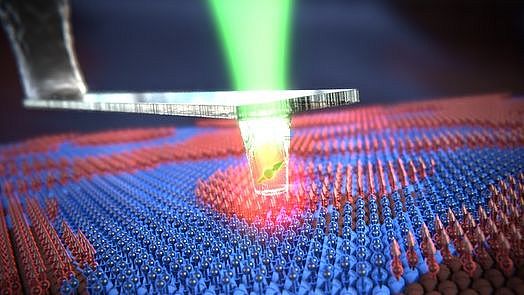
Prof. Patrick Maletinsky is a Full Professor and Head of the Department of Physics at the University of Basel. He leads the Maletinsky Research Group focused on quantum sensing and nanoscale magnetometry using nitrogen-vacancy (NV) centers in diamond. His academic journey includes a PhD from ETH Zurich (2010 Schläfli Prize recipient) and postdoctoral research at Harvard University. Current research emphasizes quantum technologies for imaging exotic materials and mesoscopic systems, with applications in condensed matter physics and quantum computing. Key projects include the QuantumLeap initiative and leadership in NCCR SPIN for silicon-based quantum computing. Education: PhD in Physics, ETH Zurich (2008) Studies at École Normale Supérieure Paris and JILA, Boulder Research interests span quantum sensing, nanoscale magnetometry, and NV center-based tools for probing magnetic materials. His group pioneered cryogenic nanoscale magnetometers and demonstrated imaging of cuprate superconductors. Awards include the Georg-H.-Endress Professorship (2012) and promotion to Associate Professor (2017) before becoming Full Professor and Department Head. Scientific achievements include coupling NV spins to mechanical oscillators, strain-based sensing, and nanophotonics in diamond nanostructures. His work bridges quantum technologies with condensed matter challenges, targeting exotic states like topological materials and strongly correlated systems.
Sandy Irani is a Full Professor at the University of California, Irvine (UCI) in the Department of Computer Science within the Donald Bren School of Information and Computer Sciences. She received her Ph.D. from UC Berkeley in 1991 and has been at UCI since 1992. Her research focuses on algorithm design, computational complexity theory, and quantum computing, with notable contributions to online algorithms and quantum complexity theory. She currently serves as Associate Director of the Simons Institute for the Theory of Computing at UC Berkeley, a role she has held since 2022. This position allows her to collaborate with researchers across theoretical computer science and related disciplines. Irani’s teaching excellence is recognized through the UCI Distinguished Faculty Award for Teaching (2021), and she has contributed to education through her zyBook on Discrete Mathematics, used by over 94,000 students globally. Her work bridges foundational computer science with practical applications, including power management strategies and distributed computing algorithms. Notably, she has collaborated with industry leaders like Mike Luby on optimizing distributed systems. Her research in quantum computing explores computational problems inspired by condensed matter physics, aiming to understand quantum advantage over classical systems. She has also authored influential papers on topics like cache hierarchy design, scheduling algorithms, and the theoretical limits of electronic structure calculations. Awards: ACM Fellow (2022), UCI Distinguished Faculty Award for Teaching (2021). Key Roles: Associate Director, Simons Institute; Vice Chair, Computing Division at UCI. Recent Projects: Quantum algorithms for condensed matter systems, maximal independent set algorithms in distributed networks.
Zohreh Davoudi is an Associate Professor in the Department of Physics at the University of Maryland, College Park. She holds additional roles as a Fellow of the Joint Center for Quantum Information and Computer Science (QuICS) and Associate Director for Education at the NSF Institute for Robust Quantum Simulation. Her research focuses on simulating strongly interacting systems using lattice quantum chromodynamics (LQCD), quantum simulation, and quantum computing. She earned her B.Sc. and M.Sc. from Sharif University of Technology in Iran, followed by a Ph.D. in Theoretical Physics from the University of Washington (2014), and served as a postdoctoral researcher at MIT's Center for Theoretical Physics before joining UMD in 2017. Her research interests include developing computational frameworks to study nuclear and particle physics phenomena, such as neutrino interactions, dark matter scattering, and neutron star dynamics. She has pioneered efforts to leverage quantum computing to address the 'sign problem' in fermionic systems and simulate real-time dynamics of early universe matter. Notable awards include the 2025 Presidential Early Career Award, 2024 Simons Emmy Noether Fellowship, and 2019 Alfred P. Sloan Fellowship. Her educational contributions include leading training programs in quantum information science and fostering collaborations across institutes like RIKEN (2017–2021) and the NSF Quantum Simulation Institute. She supervises a dynamic research group focused on lattice gauge theory, quantum algorithms, and interdisciplinary applications such as neutrinoless double-beta decay calculations.
James Chelikowsky is Professor and W. A. "Tex" Moncrief, Jr. Chair in Computational Materials at The University of Texas at Austin's Oden Institute for Computational Engineering and Sciences (ICES). His research pioneers quantum mechanical simulations for materials design and discovery across multiple domains. His educational background includes: B.S. in Physics from Kansas State University (1970) Ph.D. in Physics from University of California at Berkeley (1975) Chelikowsky's research spans computational materials science with focus on quantum models for functionalized nanostructures, simulations of liquids and crystal growth, "green magnetism" in dilute magnetic semiconductors, oxide defects, materials informatics, and high-performance electronic structure algorithms. His work bridges theoretical physics with practical materials engineering to solve complex problems in energy and electronics. Analysis of his 2012-2022 publications reveals evolving focus from fundamental quantum simulations toward machine learning integration for magnetic materials discovery, while maintaining strong contributions to two-dimensional materials and interfacial phenomena. Key trends include increased computational complexity and interdisciplinary collaboration with experimental groups. His distinguished honors include: Feynman Prize for Theory (2022) FMD John Bardeen Award (2021) Aneesur Rahman Prize (2013) Multiple society fellowships (MRS, AAAS, APS) Guggenheim Fellowship (1996) As leader of an active research group, Chelikowsky mentors graduate students in computational methods development. While specific grant details aren't provided, his sustained publication record and named chair position indicate substantial ongoing research funding. His group maintains strong industry and national laboratory collaborations evident in co-authorship patterns. The Computational Materials Group operates through ICES with research facilities supporting high-performance computing for materials simulations. Current projects focus on machine learning-guided materials discovery and quantum mechanical modeling of novel electronic materials.
Lena Funcke is an Assistant Professor of Theoretical Physics at Bonn University. Her research focuses on quantum computing, lattice field theory, and machine learning applications in physics. She explores topics such as topological phases, gauge theories, and quantum simulations. Her work bridges high-energy physics and computational methods, with a particular emphasis on overcoming noise challenges in quantum algorithms and leveraging machine learning for optimization tasks. Funcke’s research projects include C01 and C03, focusing on Hamiltonian lattice formulations and quantum computing methods for gauge theories. She investigates hybrid approaches combining Monte Carlo simulations with quantum computing to study quantum electrodynamics and topological systems. Her contributions highlight the interplay between theoretical physics and cutting-edge computational tools. Her publications span quantum algorithms for particle physics experiments, error mitigation strategies, and the application of normalizing flows to complex systems like the Hubbard model. She actively contributes to advancing the theoretical foundations of quantum computing and its practical implementation in solving fundamental physics problems.
Witold "Witek" Nazarewicz is a John A. Hannah Distinguished Professor in the Department of Physics & Astronomy at Michigan State University and serves as the Chief Scientist at the Facility for Rare Isotope Beams (FRIB). He is also a Corporate Fellow Emeritus at Oak Ridge National Laboratory (ORNL) and maintains a professorship at Warsaw University, Poland. Nazarewicz previously held positions as James McConnell Distinguished Professor at the University of Tennessee and served as Scientific Director of ORNL's Holifield Radioactive Ion Beam Facility from 1999-2012. His academic career spans multiple international institutions including Lund University, University of Cologne, Kyoto University, University of Liverpool, and Peking University. Nazarewicz's research focuses on theoretical nuclear physics with particular emphasis on exotic nuclei at the limits of nuclear existence. His work spans quantum many-body problems, physics of open quantum systems, superheavy elements, and nuclear fission. He has pioneered approaches to unify structure and reaction aspects of nuclei based on open quantum system many-body formalism, including the Gamow Shell Model. His research connects nuclear physics with high-performance computing, developing comprehensive descriptions of all nuclei through theoretical and experimental investigations of rare atomic nuclei. An analysis of Nazarewicz's recent publications reveals a strong focus on cutting-edge nuclear structure research, particularly concerning exotic nuclei near the driplines, charge radii measurements, superheavy elements, and the development of advanced computational methods. His work increasingly incorporates machine learning and Bayesian analysis techniques to address nuclear physics challenges. The publications demonstrate his leadership in connecting fundamental nuclear physics with applications in nuclear astrophysics, while also addressing foundational questions about the limits of nuclear existence and the nature of nuclear forces. Fellow of the American Physical Society Fellow of the U.K. Institute of Physics Fellow of the American Association for the Advancement of Science 2008 Carnegie Centenary Professor Honorary Doctorates from University of the West of Scotland (2009) and University of York (2019) 2012 Tom W. Bonner Prize in Nuclear Physics 2012 ORNL Distinguished Scientist 2013 UT-Battelle Corporate Fellow 2017 G.N. Flerov Prize 2025 Marian Smoluchowski Medal Nazarewicz has authored approximately 500 peer-reviewed publications with over 37,000 citations and an h-index of 103 (Web of Science). He has delivered over 220 invited talks at major international conferences and organized approximately 70 scientific meetings. His research has been supported by numerous grants from the Department of Energy, National Science Foundation, and international funding agencies. Nazarewicz plays a leadership role in major nuclear physics initiatives including the UNEDF, NUCLEI, and BAND collaborations, and has contributed to several National Academies reports on nuclear physics. As FRIB Chief Scientist, Nazarewicz leads theoretical efforts at one of the world's premier facilities for rare isotope research. His research group at MSU collaborates extensively with experimentalists worldwide, bridging theoretical predictions with cutting-edge measurements. He directs the FRIB Theory Alliance, fostering international collaboration in nuclear theory, and has established strong connections between nuclear physics and other disciplines including quantum information science and machine learning.
Alex Kamenev is a Professor in the School of Physics and Astronomy at the University of Minnesota and serves as Director of the William I. Fine Theoretical Physics Institute. His academic career spans multiple decades with continuous research output since 1991, demonstrating sustained contributions to theoretical physics. His research focuses on theoretical condensed matter physics, with particular emphasis on disordered systems and glasses, field-theoretical treatment of many-body systems, mesoscopic systems, and out-of-equilibrium phenomena. His fingerprint analysis reveals strong expertise in Instanton Physics (100%), Fermion Physics (90%), Conductance (69%), Quantum Dot Physics (64%), and Superconductor physics (62%). Analysis of his recent publications shows a clear trend toward quantum computing applications, non-equilibrium quantum dynamics, and advanced field-theoretical approaches to many-body problems. His work bridges fundamental theoretical physics with practical applications in quantum information science, particularly in understanding quantum dissipation, localization phenomena, and quantum annealing processes. As Principal Investigator, Kamenev has led numerous significant research projects, primarily funded by the National Science Foundation. His current active projects include the REU Site: Physics and Astronomy at the University of Minnesota (2024-2027) and NSF-BSF: Many Body Physics of Quantum Computation (2024-2027), demonstrating his leadership in training the next generation of physicists and advancing quantum computing research. He actively mentors graduate students, as indicated by his statement that he is "Accepting new graduate research students." His research group contributes to the Condensed Matter Theory research area within the School of Physics and Astronomy, focusing on theoretical approaches to quantum systems.
Xifan Wu is a Professor of Physics at Temple University, specializing in computational methods and materials science. His research focuses on first-principles computational approaches, particularly exploring the locality of Wannier orbitals to address physical problems in solids and liquids. Key interests include superlattice design and applications of order-N exact exchange functionals like PBE0 and GW quasi-particle approximations. He has authored numerous high-impact publications in journals such as Physical Review Letters and Physical Review B , covering topics like ferroelectric superlattices, X-ray absorption spectroscopy, and the dielectric properties of electrolyte solutions. His work bridges quantum mechanical models with machine learning potentials, advancing large-scale simulations of complex materials. Education/Background: Not explicitly detailed in the provided text. Grants/Awards: No specific awards listed, but his research is supported by Temple University’s Center for the Computational Design of Functional Layered Materials (CCDM). Labs/Teams: Collaborates with teams focused on computational design and materials modeling, possibly through Temple’s physics department and affiliated research centers. His recent work explores molecular-scale insights into electrical double layers at oxide-electrolyte interfaces and the impact of ions on X-ray spectra, demonstrating expertise in linking theoretical models with experimental phenomena.