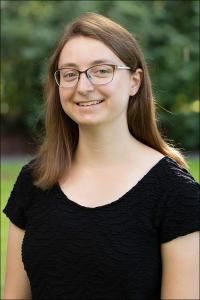
Kyla Pohl is a Visiting Assistant Professor of Mathematics at Colby College and an ABD PhD candidate at the University of Oregon, where she is advised by Ben Young. Her academic background includes a Bachelor of Arts degree in Mathematics with a concentration in Japan Studies from St. Olaf College and a Master's degree in Mathematics from the University of Oregon. Her research focuses on algebraic and enumerative combinatorics, with primary emphasis on Jack symmetric functions, hook length formulas, and probabilistic methods. She employs experimental approaches using SageMath and maintains an active GitHub repository showcasing implementations of combinatorial algorithms. Pohl's publications demonstrate expertise in both combinatorics and algebra, with recent work exploring probabilistic aspects of symmetric functions. Her research trajectory shows increasing focus on combinatorial algorithms and computational approaches to partition theory. She contributes to academic service through seminar organization and maintains educational resources including Jupyter notebooks demonstrating Markov Chain Monte Carlo methods. Her teaching experience includes courses in mathematics and mentorship through the Directed Reading Program.
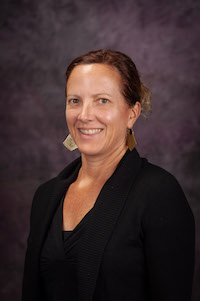
Cydney Alexis is Associate Professor in the Department of English at Kansas State University, holding graduate faculty status. Her research examines writing through interdisciplinary frameworks bridging material culture, media studies, and composition theory. Research Interests: Explores writing as material practice across domains including consumer culture theory, digital rhetoric, writing habits/identity, and media representations. Current projects investigate writing tools (e.g., Moleskine notebooks), spatial writing environments, and cinematic portrayals of writers. Publication Focus: Her scholarship demonstrates consistent focus on material dimensions of writing across historical and contemporary contexts. Recent works analyze writing artifacts, place-based composition, and cultural narratives about writing processes. Research methodologies combine textual analysis, cultural criticism, and practice-based inquiry. Teaching: Specializes in writing studies, rhetoric, and material culture approaches to composition. Course development emphasizes connections between writing practices, tools, and identity formation.
Christopher Aubin is Professor of Physics and Director of the 3-2 Engineering Program and FCRH Undergraduate Research at Fordham University's Department of Physics and Engineering Physics. His research focuses on statistical thermodynamics through information theory approaches and lattice QCD applications in particle physics. He authored the textbook Statistical Thermodynamics: An Information Theory Approach and maintains supplemental Jupyter Notebook resources for pedagogical innovation. Research interests span quantum chromodynamics, muon anomalous magnetic moment calculations, hadronic vacuum polarization, and finite-volume effects in theoretical physics. His computational work emphasizes precision measurements in particle physics using advanced lattice simulations. Publication trends show consistent focus on theoretical particle physics (92% of recent works), with notable contributions to muon physics and quantum chromodynamics. Methodological themes include staggered fermion techniques, chiral perturbation theory, and uncertainty quantification in lattice QCD.
Anastasia Kitsantas is a Professor of Educational Psychology at George Mason University's College of Education and Human Development. Her research focuses on self-regulation, metacognition, and motivation in educational contexts. Research interests include self-regulated learning across disciplines, metacognitive strategies, motivation in STEM education, and technology-enhanced learning environments. Publications demonstrate strong emphasis on self-regulation frameworks with applications in STEM education, metacognitive development, and technology integration, particularly examining how cognitive and motivational factors interact in learning processes.
Richard L. Tieszen is a Professor of Philosophy at San José State University, where he has been teaching since 1989, achieving the rank of Professor in 1998. His academic career spans over three decades with significant contributions to the fields of philosophy of mathematics, phenomenology, and logic. Education: Ph.D. in Philosophy, Columbia University, 1986 M.A. in Philosophy, Graduate Faculty, New School for Social Research, 1978 B.A. with Honors in Philosophy, Colorado State University, 1975 Professor Tieszen's research focuses on the intersection of phenomenology, logic, and the philosophy of mathematics, with particular emphasis on the works of Kurt Gödel, Edmund Husserl, and other key figures in the foundations of mathematics. His scholarship bridges the analytic and continental philosophical traditions, exploring how phenomenological approaches can illuminate fundamental questions in mathematical logic and epistemology. Tieszen has made significant contributions to understanding Gödel's philosophical turn to Husserl's transcendental phenomenology, arguing that this perspective offers valuable insights into the nature of mathematical intuition and objectivity beyond the limitations of formalism and logicism. His work examines the connections between mathematical intuition, consciousness, and the ontology of mathematical objects, challenging purely formal or computational accounts of mathematical reasoning. Tieszen's research also extends to the philosophy of time, exploring the relationship between phenomenological accounts of time consciousness and physical theories of time. Professor Tieszen's publications reveal a consistent focus on bridging continental and analytic philosophical traditions through rigorous examination of mathematical and logical concepts. His work on Gödel's philosophical development, particularly the mathematician's turn to Husserl's phenomenology, has been influential in reshaping scholarly understanding of Gödel's philosophical position beyond the caricature of simple Platonism. Tieszen's scholarship demonstrates how phenomenological methods can contribute to contemporary debates in the philosophy of mathematics, particularly regarding mathematical intuition, evidence, and the nature of mathematical objects. Scientific Awards: University President's Scholar, 2007-08 (highest award at San José State University) National Endowment for the Humanities (NEH) Fellowship, 2006-07 Outstanding Research Award, College of Humanities and Arts, San José State University, 2001-2002 Dutch National Science Foundation (NWO) Fellowship, 1994-95 Faculty Development Assigned Time Award, San José State University, 1990-91 Meritorious Performance and Professional Promise Award, San José State University, 1989-90 National Endowment for the Humanities (NEH) Summer Seminar Fellowship, 1988 Professor Tieszen has served as Associate Chair of the Philosophy Department at San José State University (1992-1999, 2005-2009) and has held numerous visiting positions at prestigious institutions including Stanford University, Universiteit Utrecht, and various research centers in Paris. He has been an active member of the philosophical community, serving on the editorial board of Philosophia Mathematica since 1991 and participating in major research projects such as the transcription and publication of Gödel's unpublished philosophical notebooks ("Max-Phil"). His work has been recognized with the CELJ certificate for "Best Special Issue of 2006" for his guest-edited issue of Philosophia Mathematica on "Gödel on Mathematics and Logic." Throughout his career, Professor Tieszen has developed an extensive research program connecting phenomenological approaches with foundational questions in mathematics and logic, establishing himself as a leading scholar in bridging the analytic and continental philosophical traditions through rigorous engagement with mathematical and logical concepts.
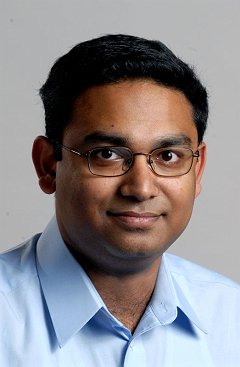
Koushik Sen is a Professor in the Department of Electrical Engineering and Computer Sciences at the University of California, Berkeley. His research focuses on developing software tools and methodologies to enhance programmer productivity and software quality, with expertise in Software Engineering, Programming Languages, and Formal Methods. Education: B.Tech from Indian Institute of Technology, Kanpur M.S. and Ph.D. in Computer Science from University of Illinois at Urbana-Champaign Research Focus: Professor Sen pioneers automated testing techniques including concolic testing and DART (Directed Automated Random Testing). His work bridges formal methods with practical software development, emphasizing bug detection, program synthesis, and AI-driven software analysis tools. Recent innovations include machine learning approaches for code recommendation and fuzzing. Publication Trends: His recent publications (2019-2023) demonstrate strong emphasis on fuzzing techniques, program synthesis, and AI/ML applications in software engineering. Notable domains include smart contract security, automated testing, and developer tooling, with frequent collaborations in top-tier conferences. Awards and Honors: NSF CAREER Award (2008) Sloan Foundation Fellowship (2011) IFIP TC2 Manfred Paul Award (2010) Okawa Foundation Research Grant (2015) Multiple ACM SIGSOFT Distinguished Paper Awards UIUC Distinguished Alumni Educator Award (2014) Leadership: Active program committee member for premier conferences (PLDI, ICSE, ISSTA) and keynote speaker. His research is supported by NSF, Okawa Foundation, and Sloan Foundation.
L. Thomas van Binsbergen is a Professor in the Department of Computer Science & Computer Engineering at the University of Wisconsin-La Crosse, affiliated with the College of Science & Health. His work focuses on language design, formal methods, and policy-based systems. His research explores Executable formal specifications of programming languages Modular meta-language frameworks (e.g., iCoLa+, eFLINT) Data-dependent grammars for network protocols Purpose-based access control derived from GDPR Functional parsing algorithms (GLL, Happy-GLL) Policy enforcement in distributed systems Recent publications (2020-2025) demonstrate trends in language parametric design, security policy formalization, and exploratory programming environments. Notable collaborations include Damian Frölich, Tim Müller, and Tom M. van Engers. Van Binsbergen earned his PhD from Royal Holloway, University of London (2019) and contributes to conferences like GPCE, SLE, and workshops on programming language theory and data security.
Ramón Luis Rizo Aldeguer is a University Professor in the Department of Computer Science and Artificial Intelligence at the Higher Polytechnic School of the University of Alicante. He has held this position since 1996 and continues to be actively involved in teaching and research as recently as 2025. He previously served in various leadership roles including Director of the Department of Computer Science and Artificial Intelligence (1997-2004) and Deputy Director of the Institutional Projects Area at the University of Alicante (2012-2020). His educational background includes a PhD in Computer Science from the Polytechnic University of Valencia (1992) and a degree in Mathematics from the University of Valencia (1977). He has been a member of the Spanish Association for Artificial Intelligence since 1990 and has held leadership positions within the organization. Rizo Aldeguer's research focuses on artificial intelligence with particular emphasis on swarm robotics, UAV deployment, and deep reinforcement learning. His work bridges theoretical foundations with practical applications in robotics and autonomous systems. He has made significant contributions to educational methodologies, particularly in integrating computational tools into engineering education. His publication record shows a consistent trajectory in swarm intelligence and robotics, with recent publications (2018-2023) demonstrating increasing sophistication in applying deep reinforcement learning to complex multi-agent systems. His research spans both theoretical advancements and practical implementations in robotics and autonomous systems. Fifteen five-year research periods (trienios) Six teaching merit periods Five six-year research periods (sexenios) President of Organizing Committee of VI Conference of Spanish Association for Artificial Intelligence (1995) President of Scientific Committee of CAEPIA (1999) Rizo Aldeguer has supervised 14 doctoral theses, with many receiving the highest honors (SOBRESALIENTE CUM-LAUDE). He has participated as a researcher in over 30 competitive public research projects, serving as principal investigator in 12 of them. His educational projects include innovative teaching methods and the development of computational tools for engineering education. He has been instrumental in the design and implementation of computer science programs at both the University of Alicante and the Polytechnic University of Valencia. He is a founding member of the University Institute for Computer Research and directed the Industrial Computing and Artificial Intelligence research group from 1992 to 2004. His current research continues to focus on swarm robotics and intelligent systems, with active participation in the Valencian Graduate School and Research Network of Artificial Intelligence since 2021.
Steve Oney is an Associate Professor at the University of Michigan School of Information and Computer Science and Engineering (by courtesy). His research focuses on enabling and encouraging more people to write and customize computer programs by creating new programming tools and exploring usability issues in programming environments. With a strong background in Human-Computer Interaction, he bridges the gap between theoretical research and practical applications in programming education, accessibility, and developer tool design. Dr. Oney completed his Ph.D in Human-Computer Interaction at Carnegie Mellon University's Human-Computer Interaction Institute under Professor Brad Myers and Dr. Joel Brandt. He also earned an M.Eng in Computer Science and SB degrees in Computer Science and Mathematics from MIT. His research spans multiple interconnected areas with a unifying theme of making programming more accessible and understandable. Key focus areas include programming education tools that help instructors understand student code at scale, web automation systems that simplify repetitive tasks, accessibility research addressing challenges faced by visually impaired programmers, and innovative VR programming environments. His work consistently emphasizes the human aspects of programming, exploring how tools can better support diverse programming needs and contexts. Dr. Oney's research output shows a strong trajectory toward increasingly sophisticated tools that integrate AI capabilities while maintaining a focus on human-centered design principles. Recent publications demonstrate growing emphasis on inclusive design, educational applications, and the integration of generative AI in programming environments. L@S 2024 Best Paper Award for CFlow CHI 2023 Honorable Mention for VizProg UIST 2024 Best Short Paper (EdCode) VL/HCC 2019 Best Short Paper Recognition for Contribution to Diversity and Inclusion (CSCW 2021) UMSI Excellence in Instruction Award (2021) University of Michigan President's Postdoctoral Fellowship (2015) As a mentor, Oney advises multiple Ph.D. students and postdoctoral researchers, with several successful graduates including Dr. Lei Zhang (June 2024). His research has secured over $1 million in funding from the National Science Foundation, Google, and Adobe, supporting projects that address critical challenges in programming education, accessibility, and developer tool design. He leads the Programming Tools Lab at the University of Michigan, where his team develops innovative tools that help programmers work more effectively. Current projects focus on AI-enhanced programming education, web automation, accessibility for diverse user groups, and next-generation programming environments for virtual and augmented reality.
Fabian Monrose is a Professor at the Georgia Institute of Technology, holding the Julian T. Hightower Chair in Cybersecurity. His career spans leadership roles at the University of North Carolina at Chapel Hill (UNC), Johns Hopkins University, and Bell Labs. He earned his Ph.D. in Computer Science from New York University's Courant Institute in 1999. Dr. Monrose specializes in cybersecurity, with research focusing on malware analysis, network security, and hardware threats. His work has earned Best Paper Awards at IEEE and USENIX conferences, along with the AT&T Best Applied Security Paper Award . He has published over 100 papers and led collaborative efforts at institutions like RENCI. Dr. Monrose's recent publications include studies on TLS certificate risks, hardware trojans, and AI-aided malware evasion. Best Paper Award at IEEE Symposium on Security & Privacy Best Paper Award at USENIX Security Symposium Outstanding Research in Privacy Enhancing Technologies Award AT&T Best Applied Security Paper Award Best Student Paper Award (2013) His research trends emphasize practical security solutions , including defensive registration strategies, automated bug analysis, and IoT threat mitigation. Dr. Monrose has also contributed to cybersecurity education through gamified platforms and secure autograding systems.
Heiner Giefers is a Professor for Cloud Computing at the Department of Computer Science and Natural Sciences at Southwestphalia University of Applied Sciences since 2018. Prior to this position, he worked as a Research Staff Member at IBM Research - Zürich (2013-2018), focusing on hardware acceleration in cloud environments, implementation of big data algorithms on FPGAs, and development of hardware platforms for approximate and in-memory computing. Dr. Giefers received his doctorate (Dr. rer. nat.) from Universität Paderborn in 2012 with a dissertation titled "Design and Programming of Reconfigurable Mesh based Many-Cores." His academic journey at Universität Paderborn includes serving as an Academic Council Member (Akademischer Rat a.Z.) from 2008-2013 and as a Scientific Staff Member from 2006-2012, where he taught digital technology and computer architecture. Professor Giefers' research focuses on energy-efficient computing, particularly through hardware acceleration using FPGAs for cloud and AI workloads. His work spans cloud computing infrastructure, hardware-software co-design, approximate computing, in-memory computing, and energy-efficient implementations of machine learning algorithms. He has made significant contributions to the field of reconfigurable hardware for high-performance computing applications. His recent publications show a strong trend toward applying hardware acceleration techniques to artificial intelligence and machine learning workloads, with a particular focus on energy efficiency. His work bridges the gap between theoretical computer science and practical hardware implementation, often resulting in patented technologies that address real-world computing challenges in cloud environments. Best Paper Award for "Stochastic Matrix-Function Estimators: Scalable Big-Data Kernels with High Performance" (2016) Best Paper Award Nomination for "Energy-Efficient Stochastic Matrix Function Estimator for Graph Analytics on FPGA" (2016) Best Paper Award Nomination for "Analyzing the energy-efficiency of dense linear algebra kernels by power-profiling a hybrid CPU/FPGA system" (2014) Best Paper Award Nomination for "A Triple Hybrid Interconnect for Many-Cores: Reconfigurable Mesh, NoC and Barrier" (2010) Professor Giefers actively supervises numerous Bachelor's and Master's students, with over 50 completed theses covering topics from machine learning and cloud computing to IoT systems and hardware acceleration. He leads the "Energy-efficient AI" project (eki), which aims to increase the energy efficiency of AI systems through approximation techniques for FPGA implementation. Additionally, he collaborates with Prof. Dr. Christian Plessl on the "Digital teaching materials with Jupyter Notebooks" project, creating interactive learning materials that integrate teaching content, program code, and results into a single document. His work extends to practical applications through multiple patents related to FPGA implementations, neural networks, and memory systems, demonstrating his commitment to translating research into real-world solutions.
Christian Winkler is Professor for AI-based UX optimization and general business administration at Nuremberg Institute of Technology since 2022. With over 25 years of experience spanning entrepreneurship, enterprise architecture, and academia, he brings substantial industry expertise to his academic role. His career includes founding multiple technology companies including an internet service provider (WWL Internet AG) that went public in 1999, Querplex GmbH through management buyout in 2003, and datanizing GmbH as an NLP SaaS provider in 2017. Professor Winkler's research focuses on practical applications of artificial intelligence in business contexts, with particular expertise in natural language processing, user experience optimization, and data-driven marketing strategies. His work bridges theoretical AI research with real-world business applications, emphasizing accessibility of complex technologies. He has published extensively on language models (including BERT and LLaMA implementations), text analysis techniques, and social media data analysis for business insights. Recent publications reveal a strong trend toward optimizing large language models for practical deployment, with significant focus on analyzing user-generated content from social platforms like Instagram and WallStreetBets. His work demonstrates how NLP can extract valuable business intelligence from unstructured data sources while making advanced AI techniques accessible to non-technical business professionals. Winkler teaches E-Commerce, International Marketing Tools - Quantitative Methods, Applied User Experience, and Communication Management, reflecting his interdisciplinary approach that combines technical AI knowledge with business administration expertise. He is an active contributor to the data science community through conference presentations at events like m3 Konferenz, MLsummit, and data2day, as well as educational content for Heise Academy on Python and NLP topics.
Gintaras Reklaitis is the Burton and Kathryn Gedge Distinguished Professor of Chemical Engineering at Purdue University's Davidson School of Chemical Engineering. He joined Purdue in 1970 and holds a B.S. from Illinois Institute of Technology (1965) and M.S./Ph.D. from Stanford University (1969). His research focuses on applying computing and systems technology to optimize processing systems, particularly in pharmaceutical manufacturing and integrated energy systems. Key areas include batch process design, enterprise-wide planning, and robust scheduling under uncertainty. Professor Reklaitis has been recognized with prestigious awards, including National Academy of Engineering membership (2007) and the Professional Achievement Award from Illinois Institute of Technology (2006). He has co-advised multiple graduate students, including Megha Das, Zachary Hillman, Shrivatsa Korde, and Dalton Yu. His work appears in journals like Computers & Chemical Engineering and Journal of Pharmaceutical Sciences . Research highlights include developing frameworks for real-time quality assurance in pharmaceutical manufacturing, integrating data management systems, and advancing continuous manufacturing technologies. His contributions also span editorial roles, including Editor-in-chief of Computers & Chemical Engineering (1986–2008). Current projects emphasize digital design tools, techno-economic analysis, and sensor-driven process monitoring.
Francis Jones is an Honorary Lecturer (retired) at the University of British Columbia's Department of Earth, Ocean and Atmospheric Sciences (Faculty of Science). He volunteers in roles supporting geoscience education and outreach, focusing on curriculum development, educational technology, and public engagement. His work includes coordinating the OCESE and QuEST projects to enhance quantitative geoscience education, developing open-source educational resources, and improving online and in-person teaching practices. Research interests center on geoscience education innovation, including curriculum redesign, assessment strategies, and bridging geophysics research with educational practice. He collaborates with institutions like the Pacific Museum of Earth (PME) to create accessible learning resources and has advised on geoscience programs at the University of Central Asia. Recent activities include evaluating teaching initiatives through multi-source data (student/instructor/observer inputs), designing interactive online labs, and promoting science literacy among non-science students. Jones emphasizes transfer of geophysical research techniques into education and industry, with a focus on fostering computational and quantitative skills in undergraduate programs. Key collaborations involve the PME, UBC's EOAS department, and international partnerships like the University of Central Asia. His work integrates pedagogical research with practical educational development, aiming to modernize STEM education through technology and community-driven approaches.
Dr. Zhiming Zhao is an Associate Professor and Chair of the Multiscale Networked Systems (MNS) research group at the Informatics Institute (IvI), University of Amsterdam (UvA). He serves as the technical manager of the Virtual Lab and Innovation Center (VLIC) of LifeWatch ERIC, a European research infrastructure for ecology and biodiversity science. Zhao holds an IEEE Senior Member designation and is the Managing Editor of the Journal of Cloud Computing . He earned his Ph.D. in Computer Science from UvA in 2004. His research focuses on quality-critical distributed computing, data-intensive workflows, virtual research environments, and digital twins. He leads projects such as LTER-LIFE (Dutch research infrastructure for digital twins) and coordinates UvA contributions to EU initiatives like ENVRI-HUB Next , EVERSE , and BlueCloud-2026 . Zhao’s work spans technical development in EU projects (e.g., ENVRI-FAIR , ARTICONF , CLARIFY ) and leadership roles in international workshops and conferences. His team develops frameworks like NaaVRE (Jupyter-based collaborative environments) and CloudsStorm (dynamic infrastructure planning). Current research emphasizes trustworthy AI in cloud systems, federated learning, and edge-cloud resource optimization. Key achievements include over 150 peer-reviewed publications, supervision of numerous PhD students, and contributions to open science initiatives. His lab actively explores interdisciplinary applications in environmental science, medical imaging, and blockchain-based decentralized systems.