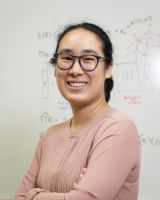
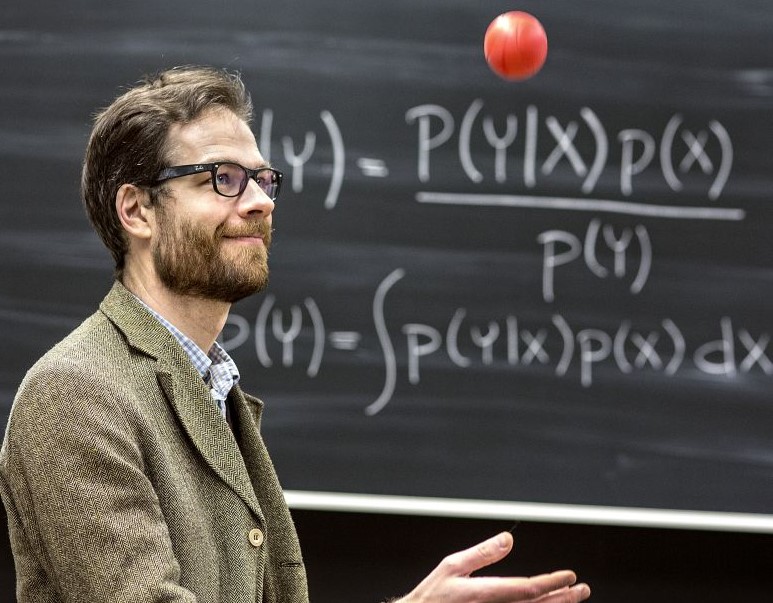
Maurice Smith serves as the Gordon McKay Professor of Bioengineering at Harvard University's School of Engineering and Applied Sciences (SEAS), where he leads the Neuromotor Control Lab. His primary appointment resides within the Department of Bioengineering, focusing on the computational and neural mechanisms underlying human movement control. Smith's research centers on sensorimotor learning , motor adaptation , and neuromotor control systems . He investigates how the brain forms and retains motor memories, particularly examining cerebellar contributions to long-term sensorimotor memory and the dissociation between implicit and explicit learning pathways. His work frequently employs computational modeling to dissect neural tuning properties and motor variability regulation. Analysis of his recent publications reveals a strong emphasis on temporal dynamics in motor learning , cerebellar function in memory consolidation , and Bayesian frameworks for understanding sensorimotor adaptation . His research demonstrates consistent focus on how error processing, uncertainty, and neural plasticity shape motor memory formation across multiple timescales. Smith maintains active collaborations with researchers including Wilsaan M. Joiner, Yohsuke R. Miyamoto, and Nathan Sandholtz, as evidenced by frequent co-authorship patterns. His laboratory investigates fundamental questions in motor control with implications for neurorehabilitation and adaptive robotics.
Jonathan Barrett is a Professor of Quantum Information Science at the University of Oxford, affiliated with Wolfson College. He holds roles as Director of Graduate Studies and Governing Body Fellow. His research focuses on quantum foundations, quantum information science, and interdisciplinary work spanning computer science and physics. He explores quantum systems' applications in computation, cryptography, and addressing conceptual problems in quantum theory through information science tools. Recent publications include foundational work on quantum states, thermodynamics in quantum theory, and causal models. His contributions to quantum cryptography include device-independent protocols and security analysis. Notable collaborations involve experimental tests of quantum state ontology and theoretical explorations of generalized probabilistic theories. Barrett advises numerous graduate students and has mentored researchers in quantum information and foundational studies. His work bridges theoretical insights with practical implications in quantum technologies. He is a co-author of the influential book *Many Worlds? Everett, Quantum Theory, and Reality* (2010), reflecting his engagement with philosophical aspects of quantum mechanics.
Robin A. Murphy is a Professor of Experimental Psychology at the University of Oxford and a Fellow and Tutor for Admissions at Corpus Christi College. He holds a PhD from McGill University (Canada) and has contributed over 50 scientific publications on associative learning mechanisms, their role in mental disorders like depression and psychopathy, and translational neuroscientific applications. His research bridges animal and human learning, with a focus on computational psychopathology and neurochemical modulation (e.g., serotonin). Education: Undergraduate degree, Queen's University MA and PhD in Psychology, McGill University Research Interests: Dr. Murphy investigates how associative learning processes underpin mental disorders, particularly through neurochemical systems like serotonin. His work explores causal reasoning biases in depression, psychopathy's learning deficits, and translational models linking animal studies to human cognition. Key themes include agency perception, contingency judgment, and the neural substrates of prejudice. Recent projects involve peptide research in aging and computational modeling of multi-agent systems in depression. Grants and Funding: Supported by MRC, BBSRC, Wellcome Trust, and Japan Society for the Promotion of Science. He has advised UK Research Councils and NSERC (Canada). Labs and Teams: Leads a lab focusing on associative learning mechanisms, collaborating with institutions globally on computational psychopathology and translational neuroscience.
KHOO Siau Cheng is an Associate Professor in the Department of Computer Science at the National University of Singapore (NUS) School of Computing. He also serves as Co-Director of the NUS Business Analytics Centre, established in 2013 in collaboration with the Economic Development Board of Singapore and IBM. His academic journey began with a Ph.D. in Computer Science from Yale University in 1992. Professor Khoo's research focuses on improving software developer productivity through advanced programming language theories and software engineering techniques. His work spans multiple areas including static program analysis, dynamic program optimization, code analytics, and specification mining. He has applied his expertise to develop domain-specific languages for financial data analysis and has pioneered techniques for discovering dynamic program behaviors via data-mining approaches. Research Interests: Programming Languages and Software Engineering Code Analytics and Program Analysis Specification Mining and Bug Signature Discovery Static and Dynamic Program Analysis Program Transformation and Optimization Domain-Specific Languages Professor Khoo's publications demonstrate a consistent focus on improving software quality and developer productivity. His recent work emphasizes scalable approaches to refactoring detection, bug signature mining, and specification inference, showing an evolution from theoretical foundations to practical applications in software maintenance and quality assurance. As an educator and mentor, Professor Khoo has supervised numerous graduate students to completion of their M.Sc. and Ph.D. degrees. His research projects have provided valuable training opportunities for students while addressing important challenges in software development. He has also contributed significantly to academic administration, having served as Vice Dean (Undergraduate Studies) in the School of Computing from 2005 to 2011 and currently as Co-Director of the Master of Science (Business Analytics) Programme.
Ali Ghodsi is a Professor at the University of Waterloo and Director of the Data Science Lab, with affiliations at the Vector Institute. His research spans machine learning, deep learning, and artificial intelligence, with applications in natural language processing, bioinformatics, and computer vision. His group develops theoretical frameworks and algorithms for analyzing large-scale datasets, focusing on neural network architectures, knowledge distillation, and model efficiency. Current projects include deep learning for identity control, computational antibody design, and generative AI/large language models. Ghodsi has authored influential tutorials on diffusion models, graph neural networks, and large language models. Notable research contributions include computational methods for de novo peptide sequencing from mass spectrometry data, green simulation-assisted reinforcement learning, and efficient natural language processing models. His lab maintains collaborations with industry partners including Google, Amazon, and Roche.
Samuel W.K. Wong is an Associate Professor in the Department of Statistics and Actuarial Science at the University of Waterloo. He holds a Ph.D. in Statistics from Harvard University (2013) under Prof. Samuel Kou. His research focuses on statistical methodology for complex data science challenges in protein structure modeling, dynamic systems inference, and reliability engineering of wood-based products. He has held academic positions at the University of Florida (2013–2018) and has been at Waterloo since 2018. His research interests include Bayesian computation, statistical inference for dynamic systems, and spatial-temporal data analysis. Notable contributions include the development of manifold-constrained Gaussian processes (MAGI package) and sequential Monte Carlo methods for protein folding studies. He has advised over 15 graduate students and researchers, many of whom are now in academic or industry roles worldwide. Wong has received teaching distinctions at Harvard and holds awards including the Nash Medal (2008) for academic excellence. His work bridges computational statistics with applications in bioinformatics, structural engineering, and environmental science. He has published extensively in top-tier journals like Journal of Computational and Graphical Statistics and Biometrics , and collaborates with wood scientists to improve real-time lumber quality assessment using laser imaging data. His teaching portfolio includes courses on probability theory, statistical inference, and spatial data analysis at both undergraduate and graduate levels. Beyond academia, he maintains an active passion for classical piano performance, having performed recitals combining music with his statistical research interests.
Dr. Karthika Mohan is an Assistant Professor of Computer Science in the College of Engineering at Oregon State University, affiliated with the School of Electrical Engineering and Computer Science. Her research bridges artificial intelligence and causal inference, focusing on graphical models, missing data, and non-IID data challenges. Her work has been recognized with the Google Outstanding Graduate Research Award. She serves as an associate editor for the Journal of Causal Inference and has secured NSF funding for research on incomplete data. Dr. Mohan mentors students in causal inference methods and maintains collaborations with institutions like UC Berkeley and UCLA. Her laboratory develops innovative approaches for causal reasoning in AI systems.
Prof. Vlatko Vedral is a Professor of Quantum Information Science in the Department of Physics at the University of Oxford, affiliated with the Clarendon Laboratory. He leads research in the Frontiers of Quantum Physics group. His work focuses on quantum entanglement, quantum gravity, quantum foundations, and quantum thermodynamics, with applications to biological systems and quantum technologies. Notable contributions include theoretical frameworks for quantum gravity experiments and quantum causal inference protocols. Research interests span quantum information science, quantum gravity, atomic and laser physics, and the philosophical interpretation of quantum mechanics. Recent work explores emergent geometry from quantum correlations, quantum refrigeration with indefinite causal order, and experimental probes of quantum effects in macroscopic systems. Publications highlight interdisciplinary approaches, such as testing quantum gravity via entanglement and analyzing non-classicality in photosynthetic systems. His research often bridges theoretical physics with experimental feasibility, leveraging quantum simulators and NMR systems.
Jeffrey Heinz is a Professor at Stony Brook University, with a joint appointment in the Department of Linguistics and the Institute for Advanced Computational Science. He holds a Ph.D. from UCLA (2007) and previously served on the faculty at the University of Delaware from 2007–2017. His research bridges theoretical linguistics, computational learning theory, and formal language models, focusing on phonology, linguistic typology, and grammatical inference. He has contributed to influential works on computational phonology and edited volumes on topics like phonological stress and learning theory. Key academic achievements include the 2017 Linguistic Society of America Early Career Award for contributions to computational inference in language. His work emphasizes the intersection of formal models and empirical linguistics, with applications to reduplication, phonological processes, and machine learning benchmarks like MLRegTest. Heinz has co-authored a book on grammatical inference and guest-edited special issues in Machine Learning and Phonology . His research also extends to interdisciplinary applications, such as modeling human-robot interaction and pediatric motor rehabilitation through grammatical inference techniques.
Kirk Roberts, PhD, is an Associate Professor in the Department of Health Data Science and Artificial Intelligence at the McWilliams School of Biomedical Informatics, UTHealth Houston. He specializes in Natural Language Processing (NLP), with a focus on clinical information extraction, spatial information extraction, and medical information retrieval. His work bridges computer science, medicine, linguistics, and machine learning to improve accessibility and usability of biomedical data. Education: PhD (2013) and MS (2009) in Computer Science from the University of Texas at Dallas; BS (2005) in Computer Science from Georgia Institute of Technology. Research emphasizes NLP applications for healthcare, including question-answering systems, EHR analysis, and spatial relation extraction. He leads the TREC Clinical Decision Support track and has been recognized with a National Library of Medicine Career Development Award. His contributions span over 20 peer-reviewed publications in journals like JAMIA and conferences such as ACL and AMIA. Key areas include: advancing clinical decision support via NLP, optimizing biomedical literature retrieval, and improving health data dissemination through natural language systems.
Dr. Alvin J. K. Chua is an Assistant Professor at the National University of Singapore (NUS) under the NUS Presidential Young Professorship. He holds a joint appointment in the Department of Mathematics and a courtesy appointment in the Department of Statistics and Data Science. His research focuses on gravitational-wave astronomy , particularly extreme mass ratio inspirals (EMRIs) as key sources for the LISA mission. He develops computational and statistical methods for modeling GW sources and analyzing detector data, with recent work on machine learning and Bayesian inference techniques. His selected publications highlight advancements in modeling beyond-vacuum-GR effects in EMRIs non-local parameter degeneracies rapid relativistic waveform generation neural networks for GW inference statistical sampling on manifolds These works span gravitational-wave astrophysics , computational relativity , and applied statistics . Scientific recognition includes the NUS Presidential Young Professorship. He collaborates with the LISA Consortium and the North American Nanohertz Observatory for Gravitational Waves (NANOGrav).
Li Cai is a Professor and Director at the National Center for Research on Evaluation, Standards, and Student Testing (CRESST) within the Graduate School of Education and Information Studies at the University of California, Los Angeles (UCLA). His work focuses on quantitative methods in education, particularly psychometrics and statistical modeling. Ph.D. in Quantitative Psychology from the University of North Carolina – Chapel Hill Research and teaching interests center on psychometrics, latent variable models, item response theory, nonlinear mixed models, and statistical computation. His methodological work addresses advanced techniques for educational assessment and model evaluation. His representative publications include studies on covariance structure models, item response theory, bifactor analysis, and goodness-of-fit testing. These works often emphasize computational algorithms and practical applications in educational measurement. Li Cai is affiliated with CRESST at UCLA, a leading center dedicated to rigorous research, assessment design, and evaluation methodology across diverse educational contexts.
Christina Lee Yu is an Assistant Professor at Cornell University in the School of Operations Research and Information Engineering (ORIE). She holds a PhD and MS in Electrical Engineering and Computer Science from MIT (2017, 2013) and a BS in Computer Science from Caltech (2011). Her research focuses on algorithm design, high-dimensional statistics, causal inference in networks, and reinforcement learning. She is also an Amazon Scholar and has received prestigious awards, including the NSF CAREER Award and Intel Rising Stars Award. Her work is supported by grants from the NSF and Air Force Office of Scientific Research. Education: PhD in EECS, MIT (2017) MS in EECS, MIT (2013) BS in Computer Science, Caltech (2011) Research Interests: Algorithm design and analysis Inference over networks and causal inference Sequential decision making under uncertainty Online learning and reinforcement learning High-dimensional statistics Awards and Honors: NSF CAREER Award (2024) ACM SIGMETRICS Rising Stars Award (2024) Intel® Rising Stars Award (2021) JPMorgan Faculty Research Award (2021) Simons Institute Research Fellow (2020) INFORMS Dantzig Dissertation Award Honorable Mention (2018) Grants and Funding: National Science Foundation (NSF) CAREER Grant Air Force Office of Scientific Research Grant Advising: PhD Students: Sean Sinclair, Tyler Sam, Xumei Xi Collaborators: Mayleen Cortez, Matthew Eichhorn Labs and Collaborations: Member of ORIE, Statistics, CAM, and CS graduate fields at Cornell Amazon Visiting Academic in Fulfillment Optimization (2025)
Joseph P. Romano is a distinguished Professor of Statistics and Economics at Stanford University, where he has been on the faculty since 1986. He holds joint appointments in both the Department of Statistics and the Department of Economics, reflecting his interdisciplinary research that bridges statistical theory with economic applications. Romano has established himself as a leading scholar in mathematical statistics with significant contributions to econometrics, climate science, and multiple testing methodologies. Ph.D. in Statistics, University of California, Berkeley (1986) M.S. in Statistics, University of California, Berkeley (1983) A.B. in Statistics, Princeton University (1982), Summa Cum Laude Romano's research focuses on the theoretical foundations and practical applications of statistical methods, particularly in nonparametric statistics, bootstrap and resampling techniques, and multiple testing procedures. His work addresses the challenges of analyzing massive datasets with complex structures, such as those found in biotechnology, clinical trials, and econometrics. He has developed universal statistical tools applicable across diverse fields including climate science, genetics, finance, and education. His recent work emphasizes methods for multiple testing and multivariate inference driven by the availability of massive datasets, where he tackles issues like unknown dependence structures, heterogeneity, and high dimensionality. Analysis of Romano's recent publications reveals a consistent focus on developing robust statistical methodologies for complex data structures. His work spans theoretical advances in U-statistics with growing dimensions, practical applications in seroprevalence studies, and innovative approaches to ranking inference across various domains. The interdisciplinary nature of his research is evident in publications spanning economics journals, statistics journals, and even behavioral science preprints, demonstrating the broad applicability of his methodological contributions. 2021 LGBTQ+ Scientist of the Year, Out to Innovate Fellow, International Association of Applied Econometrics (2020) Fellow, Institute of Mathematical Statistics Presidential Young Investigator Award, National Science Foundation The Canadian Journal of Statistics Award Romano has mentored dozens of doctoral students throughout his career at Stanford, serving as dissertation advisor, co-advisor, and committee member for numerous PhD candidates in Statistics. His research has been consistently supported by National Science Foundation grants, including recent funding for computer-intensive inference with applications to social sciences (2020-2023) and randomization inference for contemporary statistical problems (2013-2016). He has served in various administrative roles at Stanford including Associate Chairman and Chair of Committee on Faculty Affairs. Beyond his academic pursuits, Romano is actively involved in the 500 Queer Scientists visibility campaign and maintains a balanced life with passions in music (having performed at Carnegie Hall), competitive tennis (ranked nationally in his age group), cooking, and architecture.
Carl Henrik Ek is a Professor of Statistical Learning at the Department of Computer Science and Technology (Computer Laboratory) at the University of Cambridge. He is also a fellow and Director of Studies at Pembroke College, and holds visiting positions at Karolinska Institute in Stockholm and the Royal Institute of Technology. He serves as co-Director for the UKRI AI Centre for Doctoral Training in Decision Making for Complex Systems, a collaboration between Cambridge and Manchester universities, and is involved with the Accelerate Program in the Computer Laboratory. Dr. Ek's educational background includes a MEng degree in Vehicle Engineering from the Royal Institute of Technology in Stockholm, followed by a PhD from Oxford Brookes University. During his PhD, he spent time at the University of Manchester and the University of Sheffield. His PhD supervisors were Professor Neil Lawrence and Professor Phil Torr, and his postdoctoral research was conducted at UC Berkeley with Professor Trevor Darrell and Professor Raquel Urtasun. Professor Ek's research focuses on statistical learning, particularly on developing data-efficient and interpretable machine learning methods. His work spans modeling and inference in machine learning, with special emphasis on Bayesian non-parametric methods and Gaussian processes. He explores how to specify assumptions that allow learning from small amounts of data, bridging theoretical foundations with practical applications in various domains. His recent publications demonstrate a strong trend toward applying machine learning to healthcare, drug discovery, and engineering design. There's significant work on Gaussian processes, reinforcement learning, and generative models, with applications ranging from medical diagnostics to structural engineering. His research shows an increasing interdisciplinary focus, connecting machine learning with fields like cardiology, pharmacology, and computational geometry. Professor Ek has received numerous teaching awards throughout his career: Pilkington Price for Teaching Excellence (2024) Teacher of the year in Computer Science at University of Bristol (2016) Docent in Machine Learning at Royal Institute of Technology (2016) Teacher of the year at Royal Institute of Technology, Sweden (2015) Teacher of the year from Student chapter in Industrial Economics at Royal Institute of Technology (2015) Teacher of the year in Computer Science at Royal Institute of Technology (2012) Professor Ek teaches Advanced Data Science, Advanced topics in machine learning, and Machine Learning and the Physical World. He has supervised PhD students throughout his career but is not currently accepting new PhD students for 2025/26 or 2026/27. His research is supported by various grants, including his role as co-Director of the UKRI AI Centre for Doctoral Training. He is an active member of the ml@cl research group at Cambridge and has previously been involved with research groups at University of Bristol and Royal Institute of Technology. His work connects with several interdisciplinary initiatives, particularly in healthcare AI and engineering applications of machine learning.