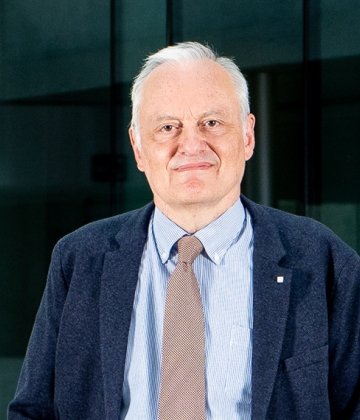
Francesco Corielli is an Associate Professor of Mathematics for Finance, Economics, and Insurance at Bocconi University, where he has held academic positions since 1989. He graduated in Economics from Bocconi University in 1983. His research focuses on model misspecification in statistics and finance, robustness analysis, partial differential equations in finance, and the application of canonical correlation to financial price analysis. He has contributed to seminal works on parametrix approximation methods, risk management, and hedging strategies in energy markets. Corielli has taught courses including Financial Econometrics, Machine Learning in Finance, and Quantitative Methods for Trading, emphasizing rigorous foundational knowledge and practical applications. His teaching philosophy prioritizes clarity and precision to avoid conceptual misunderstandings. He has published extensively in journals such as the Siam Journal on Financial Mathematics and Journal of Banking & Finance , and his work spans empirical finance, project finance, and theoretical econometrics. Notable research areas include analyzing model error propagation, developing approximation techniques for PDE solutions in finance, and exploring the interplay between textual analysis of online messages and financial market dynamics. His contributions to the understanding of beta regression in finance and ESG rating methodologies further highlight his interdisciplinary approach.
Giuseppe Savaré is Professor of Mathematical Analysis at Bocconi University's Department of Decision Sciences, with previous positions at the University of Pavia and as Hans Fisher Fellow at TU Munich's Institute for Advanced Study. His research develops mathematical frameworks for evolution equations, optimal transport, and geometric analysis in metric spaces. Major contributions include gradient flow theory, entropy-transport problems, and curvature-dimension conditions. Recent work explores Wasserstein spaces, dissipative systems, and their applications to probability and game theory. Publications consistently advance theoretical foundations of transport metrics and their geometric properties, while maintaining strong connections to problems in physics and probability.
Martin Lackner is an Associate Professor in the Databases and Artificial Intelligence department at the Faculty of Informatics, Vienna University of Technology. His research focuses on computational social choice, voting theory, and algorithmic decision making, with particular expertise in multi-winner elections, approval-based voting systems, and participatory budgeting. He maintains an active research program with continuous publications in top AI and theoretical computer science venues. Lackner's research interests center on the theoretical foundations and practical implementations of fair decision-making systems. His work bridges theoretical computer science with practical applications in democratic processes, examining how computational methods can enhance fairness, representation, and efficiency in collective decision making. He has made significant contributions to understanding the computational complexity of voting rules, developing new algorithms for preference aggregation, and establishing axiomatic properties for multiwinner election methods. His recent publications demonstrate a consistent focus on fairness in long-term decision processes, with particular attention to perpetual voting systems, participatory budgeting mechanisms, and approval-based multiwinner rules. The research shows strong theoretical grounding combined with practical implementation considerations, as evidenced by his development of the abcvoting Python package for implementing approval-based voting rules. Lackner has received continuous funding for his research through multiple projects: SuDeMa (2019–2025): Algorithms for Sustainable Group Decision Making (Austrian Science Fund) FAIR (2013–2018): Fixed-Parameter Tractability in Artificial Intelligence and Reasoning (Austrian Science Fund) HINT (2012–2017): Heterogenous Information Integration (Austrian Science Fund) SEE (2012–2016): SPARQL Evaluation and Extensions (Vienna Science and Technology Fund) As an academic advisor, Lackner has supervised doctoral and master's students including J. Maly (2020) on ranking sets of objects and B. Krenn (2019) on algorithms for implicit delegation to predict preferences. His work appears in premier venues including AAAI, IJCAI, AAMAS, and the Journal of Artificial Intelligence Research, demonstrating both theoretical depth and practical relevance to democratic processes and collective decision making.
Hilmi Berk Çelikoğlu is a full Professor specializing in Traffic Flow Theories and Transportation Network Modeling at Istanbul Technical University (ITU) Department of Civil Engineering. He has served as the head of the ITU ITS Research Lab since 2014 and previously held a Visiting Professor position at PennState Department of Computer Science & Maths between 2014-2015. His educational background includes B.Sc. (2000), M.Sc. (2002), and Ph.D. (2006) degrees, all from Istanbul Technical University in Transportation Engineering. Professor Çelikoğlu's research spans multiple critical areas in modern transportation systems. His primary focus includes Traffic Flow Theories and Transportation Network Modeling, with significant contributions to on-demand mobility systems and sustainable urban transportation solutions. He has pioneered work in dynamic network management, traffic flow control and simulation, and Intelligent Transportation Systems (ITS). His recent research has increasingly focused on the integration of electric vehicles into transportation networks, cooperative adaptive cruise control systems, and environmentally conscious transportation planning. His work bridges theoretical modeling with practical applications, particularly in the context of Istanbul's complex urban transportation challenges. His recent publications demonstrate a strong trend toward addressing contemporary transportation challenges, particularly the integration of emerging technologies like connected and autonomous vehicles into existing infrastructure. A significant portion of his work focuses on optimizing traffic flow in mixed environments containing both traditional human-driven vehicles and newer cooperative adaptive cruise control systems. His research also shows increasing emphasis on sustainability, with multiple studies examining emissions reduction, electric vehicle routing, and environmentally conscious transportation network design. Professor Çelikoğlu has received notable recognition for his work, including: Project Performance Award from TUBITAK (2018) Throughout his career, Professor Çelikoğlu has secured substantial research funding from prestigious organizations including TUBITAK, EU COST, and EU Horizon programs. His current research portfolio includes multiple active projects focusing on demand-based mobility systems, integrated mobility services, cooperative vehicle dynamics, and environmentally sensitive transportation network optimization. He has mentored numerous students and researchers through his leadership of the ITU ITS Research Lab, fostering the next generation of transportation engineers and researchers. Professor Çelikoğlu leads the ITU ITS Research Lab, which serves as a hub for cutting-edge transportation research. The lab focuses on applying advanced computational methods to solve complex transportation challenges, with particular expertise in traffic simulation, network modeling, and intelligent transportation systems. Under his leadership, the lab has become a center for innovation in transportation engineering, collaborating with both national and international partners to address pressing urban mobility issues.
Dr. Mustazee Rahman is an Associate Professor in the Department of Mathematical Sciences at Durham University. His research focuses on Combinatorics, Probability, and Statistical Mechanics, with contributions to stochastic processes, random matrix theory, and graph theory. He has published extensively on topics such as particle systems, growth models, and permutation patterns. His work bridges theoretical mathematics and applications in statistical physics. Key research interests include scaling limits in interacting particle systems, spectral properties of graphs, and algorithmic limitations in combinatorial optimization. Recent studies explore universality classes in KPZ models and local statistics in random sorting networks. His research also addresses percolation phenomena and meta-Fibonacci sequence dynamics. Publications span high-impact journals such as the Annals of Probability, Communications on Pure and Applied Mathematics, and Combinatorica. He has contributed to understanding phase transitions in random graphs and the geometry of permutation limits. His work demonstrates interdisciplinary connections between combinatorics, probability, and mathematical physics.
Professor Sir Brian Smith was a distinguished academic and administrator. He held positions at the University of Oxford, including Professor in the Department of Chemistry, and later became Vice Chancellor of Cardiff University. His research focused on intermolecular forces and their biomedical applications, leading to advancements in anaesthesia and diving safety. He authored influential textbooks such as Chemical Thermodynamics and later works in retirement. Education: Graduated from Liverpool University, completed his doctorate there, and undertook postdoctoral research at the University of California, Berkeley. He was a Research Fellow at the Physical Chemistry Laboratory (Oxford) before becoming a Lecturer and Fellow of St Catherine's College. Research Interests: Intermolecular forces and their role in biological systems Mechanisms of general anaesthesia and inert-gas narcosis Decompression sickness solutions for deep-sea diving Awards: Knight Bachelor, recognized for contributions to science and academia. His work with the US Navy and Jacques Cousteau highlighted practical applications of his research. Administration: Served as Master of St Catherine's College, Chairman of the General Board (Oxford), and Vice Chancellor of Cardiff University. Post-retirement, he contributed to fundraising for Oxford and held a Welsh supernumerary fellowship at Jesus College. Labs/Teams: Associated with the Physical Chemistry Laboratory (Oxford) and Cardiff University's academic leadership teams. His research collaborations extended globally, influencing both academic and industrial sectors.
Frederick Gent is an Assistant Professor at the Nordic Institute for Theoretical Physics (Nordita) and a Research Fellow at the Department of Computer Science, affiliated with the Korpi-Lagg Maarit and Vehtari Aki professorships. He holds a PhD in Natural Sciences from Newcastle University (2012) and has been a Visiting Researcher there since 2018. His research focuses on magnetohydrodynamics, dynamo theory, and interstellar medium dynamics, with applications to solar magnetic activity and supernova-driven turbulence. Gent has been awarded the 2018 Grand Challenge Award for his work on galactic dynamo interactions. He supervises postgraduate students, including A. Capobianco and P. Tengnér, and collaborates internationally, notably through the Pencil Code project. His work bridges computational astrophysics and theoretical physics, addressing challenges in high-performance computing and numerical simulation. Education: Doctoral degree in Natural Sciences (Newcastle University, 2012). Research interests include magnetic field dynamics in galaxies, supernova-driven turbulence, and the interplay between magnetic fields and interstellar medium structures. His computational methods leverage advanced numerical models to simulate astrophysical phenomena, such as magnetic buoyancy instabilities and dynamo transitions. Recent studies examine the destruction of supernova dust in magnetized environments and the transition from small- to large-scale dynamos in multiphase media. Scientific awards include the 2018 Grand Challenge Award for interdisciplinary dynamo research. He actively participates in conferences and workshops, notably organizing the Pencil Code User Meeting (2024) and presenting invited talks on galactic dynamo models. Gent’s advising roles include co-supervising doctoral students alongside Prof. Shukurov and mentoring visiting researchers at Nordita and Newcastle University. Labs/Teams: Pencil Code Collaboration (software developer), Korpi-Lagg Maarit Research Group (visiting fellow), and Nordic Institute for Theoretical Physics (primary affiliation).
Anatoly Svidzinsky is a Research Professor at Texas A&M University, specializing in advanced theoretical and applied physics. His research focuses on quantum optics, gravitational theories, and quantum thermodynamics, with notable contributions to black hole physics, vector gravity models, and quantum heat engine design. His work bridges fundamental physics with practical applications in photonics and condensed matter systems. Key research areas include: Quantum phenomena in black holes and de Sitter space Vector gravity models challenging general relativity Quantum coherence effects in energy systems Entanglement in relativistic systems (Unruh, Hawking radiation) Condensed matter dynamics and Bose-Einstein condensation Recent work explores novel applications of quantum theory in biology, photonic energy systems, and antenna engineering. His interdisciplinary approach integrates classical and quantum frameworks, as seen in his reinterpretation of Bohr's molecular model and vector gravity's implications for dark energy solutions. Publications highlight innovations in transient lasing without inversion, parametric resonance applications, and experimental designs for gravitational wave detection. His research often emphasizes coherence-driven enhancements in energy transfer and signal detection, with potential impacts on quantum computing and renewable energy technologies.
Dr. Valentina Baccetti is a Lecturer in the School of Science at RMIT University, Australia. Her research focuses on quantum physics, mathematical physics, and astronomical sciences. She specializes in areas such as analogue gravity models, black hole evaporation, and relativistic quantum phenomena. Baccetti has supervised research projects including computational thermodynamics of neuromorphic systems and studies on analogue gravity models' observational perspectives. Her work bridges theoretical physics with experimental applications, particularly in quantum entanglement and gravitational collapse dynamics. Research Interests: Her studies explore quantum gravity effects, gravitational thermodynamics, and the interplay between relativity and quantum mechanics. She investigates phenomena like event horizon avoidance in collapsing systems and energy conditions in spacetime geometries. Her recent work also involves memristive networks and reservoir computing in neuromorphic systems. Collaborations: Active in international collaborations, including with physicists at institutions like the University of Sydney and others. Supervision: Open to mentoring PhD/Masters students in computational thermodynamics and analogue gravity models. Publications: Over 20 peer-reviewed articles in journals such as Physical Review D , Classical and Quantum Gravity , and Journal of High Energy Physics . Her work frequently addresses foundational questions in quantum gravity and relativistic physics.
Kishan Panaganti Badrinath is a Postdoctoral Scholar Research Associate in the Computing and Mathematical Sciences department at the California Institute of Technology (Caltech), affiliated with the Division of Engineering and Applied Science. Hosted by Prof. Adam Wierman and Prof. Eric Mazumdar, his work focuses on theoretical foundations of reinforcement learning algorithms and bridging simulation-to-real-world performance gaps. Education: PhD in Electronics and Communication Engineering & Mathematical Optimization (2023) from Texas A&M University Masters in Communication and Networks (2018) from Indian Institute of Science (IISc) Bachelors in Electronics and Communication Engineering (2017) from PES University Research Interests: Kishan’s work spans reinforcement learning theory , addressing robustness in multi-agent systems , imitation learning , and human feedback integration . His expertise includes high-dimensional probability , optimization , and stochastic theory , with applications to autonomous solutions and environmental uncertainties . Recent Articles (2025): His recent publications focus on robust sequential decision-making , including KL-regularization privacy , multi-agent tractability via behavioral economics , and distributionally robust LLM alignment . These contributions reflect his emphasis on theoretical rigor and practical adaptability. Scientific Awards: PIMCO Postdoctoral Fellow in Data Science ML and Systems Rising Stars 2025 awardee (selected from 150+ applicants) Current Status: Kishan is actively seeking full-time faculty or core industrial research positions starting in 2025, with recent speaking engagements at IIT Bombay, Microsoft Research, and the Theory CS Winter School at IISc.
Jeremy Nguyen is a Senior Lecturer in Economics at Swinburne University of Technology's School of Business, Law and Entrepreneurship. He researches economic impacts of AI/machine learning with focus on bias, discrimination mitigation, and creative industries. Education: Ph.D. in Computable General Equilibrium Modeling from Australian National University Current projects examine AI's effects on business processes, writing practices, and education through randomized controlled trials. Work has been featured in New York Times, The Guardian, and Forbes. Professional background includes Reserve Bank of Australia and Brookings Institution fellowship. Awards: National teaching awards for educational innovation Publications recognized through early career research prizes Recent publications analyze anchoring bias in LLMs, NFT market discrimination, and economic impacts of diversity in creative industries. His interdisciplinary approach integrates economic modeling with behavioral experiments and machine learning techniques.
Dr. Jane Lehr is a Professor in the Department of Electrical and Computer Engineering at the University of New Mexico (UNM), where she has served since 2013. She previously chaired the department from 2013 to 2015. A Fellow of the IEEE since 2008, she is actively involved in the Applied Electromagnetics Group, focusing on pulsed power systems, high-voltage phenomena, and electrical insulation. Her research explores topics like exploding wire phenomena, corona discharges, and dielectric breakdown mechanisms. Education: Ph.D. in Electrical Engineering, New York University, 1996 B.E. in Electrical Engineering, Stevens Institute of Technology, 1985 Research Interests: Dr. Lehr’s work spans theoretical and applied aspects of electrical engineering, including pulsed power systems, high-voltage insulation, plasma dynamics, and advanced semiconductor switches. Her recent projects address challenges in aircraft MVDC power systems, laser-triggered gas switches, and high-power Marx generators. Publications Trends: Her recent articles highlight advancements in Marx generator optimization, photoconductive semiconductor switches, and partial discharge analysis in high-voltage systems. She also explores novel applications of nanotechnology in photonic sensors and low-pressure effects on aircraft power cables. Awards: 2015 IEEE Nuclear and Plasma Sciences Society’s Richard F. Shea Distinguished Member Award IEEE Fellow (2008–present) Advise & Grants: Dr. Lehr has led projects funded by organizations like Sandia National Laboratories and the Air Force Research Laboratory. Her work emphasizes practical applications of pulsed power in aerospace and energy systems. Labs & Teams: She collaborates within the Applied Electromagnetics Group at UNM, focusing on experimental and computational studies of high-voltage phenomena and advanced power electronics.
Tanvi Verma is a Research Scientist at the Institute of High Performance Computing (IHPC), A*STAR in Singapore. She holds a PhD in Information Systems from Singapore Management University (SMU), where she was awarded the Presidential Doctoral Fellowship for outstanding research. Prior to her PhD, she earned a B.Tech. in Computer Science and Engineering from the National Institute of Technology Warangal, India. Her professional experience includes software development roles at NetApp India and Dell India R&D before transitioning to academia in 2015. Her research focuses on lifelong continual learning, reinforcement learning, game theory, and auto ML . Applications of her work include optimizing revenue maximization through deep RL methods, decision support systems for healthcare (e.g., visual perimetry, retinal pathology detection), and sustainable indoor farming via generative deep learning. She also explores multi-agent systems for large-scale coordination and privacy-preserving techniques in medical image classification. Key contributions span scalable MARL algorithms, entropy-based learning in anonymous environments, and light recipe design for vertical farming. Her articles reflect a blend of theoretical advancements and practical applications across AI, healthcare, and agriculture. Awards: Presidential Doctoral Fellowship (SMU). Labs/Teams: Affiliated with IHPC’s AI and Data Science research group.
Zissis Poulos is an Assistant Professor at the School of Information Technology within the Faculty of Liberal Arts & Professional Studies at York University. He holds a PhD and MASc in Electrical and Computer Engineering from the University of Toronto, obtained in 2018 and 2014 respectively. Previously, he served as a postdoctoral fellow at the Joseph L. Rotman School of Management, University of Toronto. His research focuses on machine learning applications in financial risk management, derivatives hedging, volatility modeling, natural language processing for financial analysis, and decentralized finance technologies. He co-founded Tartan AI, a startup developing energy-efficient deep learning solutions. **Education:** - PhD in Electrical and Computer Engineering, University of Toronto (2018) - MASc in Electrical and Computer Engineering, University of Toronto (2014) **Research Interests:** Zissis' research spans machine learning for derivatives hedging and risk management, natural language processing (NLP) applied to financial soft information analysis, generative models for financial data synthesis, and blockchain-based decentralized finance systems. His work emphasizes volatility surface modeling, reinforcement learning for financial decision-making, and distributed ledger technologies. **Recent Research Trends:** His publications highlight advancements in reinforcement learning for hedging strategies, volatility modeling via variational autoencoders, and text-based analysis of monetary policy uncertainty. He also explores synthetic data applications in regulatory frameworks and decentralized blockchain oracles for trustless systems. **Professional Activities:** Zissis co-founded Tartan AI, which focuses on optimizing deep learning compute and compression for energy efficiency. His work bridges academic research with industry applications in fintech and blockchain solutions.
Serguei Maliar is an Associate Professor of Economics at Santa Clara University's Leavey School of Business. He joined in 2013 and is affiliated with the Department of Economics, serving as an associate editor of the Journal of Economic Dynamics and Control . His research focuses on computational economics, macroeconomic theory, numerical methods, and policy analysis. He advises the Canadian Central Bank on optimal monetary policy models and holds a NSF grant (2016-2019). Education: B.S. in Physics and Applied Mathematics (Moscow Institute of Physics and Technology), M.A. in Economics (Central European University), Ph.D. in Applied Mathematics (Zaporozhye State University), and Ph.D. in Economics (University of Pompeu Fabra). Research Interests: His work bridges macroeconomic theory with computational techniques, emphasizing applications like deep learning for policy modeling, capital-skill dynamics, and nonlinear economic systems. Recent projects include analyzing cross-border economic spillovers and evaluating software tools (e.g., Python vs. Julia) for economic computing. Publications: Over 30 peer-reviewed articles in top journals such as Econometrica and Quantitative Economics , focusing on numerical methods, policy modeling, and economic inequality. His work often combines theoretical rigor with practical computational frameworks. Grants & Awards: NSF grant (2016-2019), contributions to the Handbook of Computational Economics , and collaborations with institutions like the Bank of Canada and Stanford University's Hoover Institution. Labs/Teams: Engaged with interdisciplinary teams in computational economics and policy analysis.