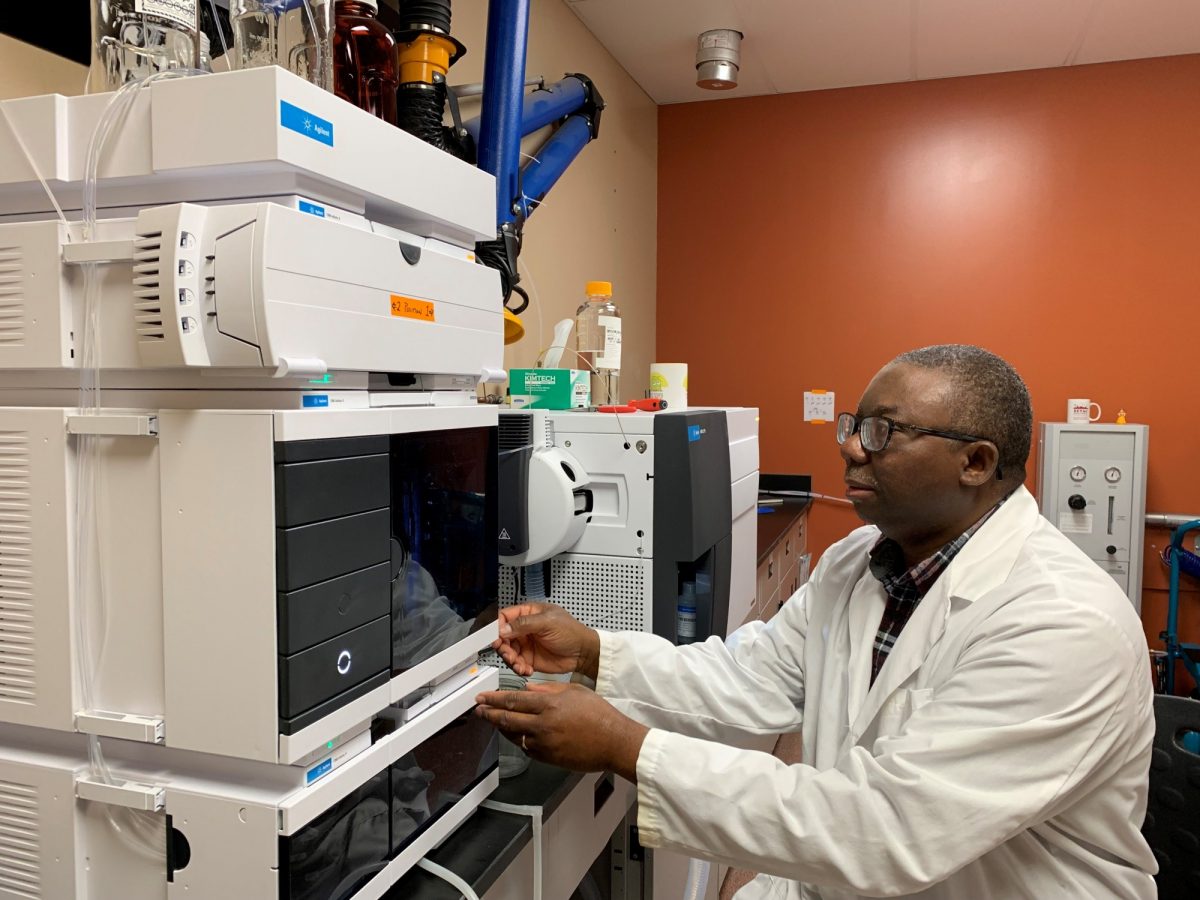
Dr. Rotimi Aluko is a Professor and Tier 1 Canada Research Chair in Bioactive Peptides at the University of Manitoba's Department of Food and Human Nutritional Sciences. He leads the Richardson Centre for Functional Foods and Nutraceuticals, focusing on converting food proteins into bioactive peptides with health benefits. His research spans enzymatic hydrolysis, in vitro/in vivo testing, and statistical modeling to identify peptides targeting metabolic disorders like hypertension, diabetes, and obesity. Education: PhD (Food Science, University of Guelph), MSc and BSc (Biochemistry, Nigeria). He joined the University of Manitoba in 2001 after roles at Agriculture & Agri-Food Canada. Awards include CRC Tier 1 and Fellowships from CIFST, IFT, and AOCS. Research interests include protein structure-function relationships, functional foods, and nutraceuticals. His work emphasizes natural products' health benefits, reducing healthcare costs, and enhancing Canadian crop value. He supervises graduate students and postdocs, fostering equity/diversity/inclusion. Labs/Teams: Richardson Centre for Functional Foods and Nutraceuticals. Collaborations focus on peptide discovery, food technology, and sustainable agriculture.
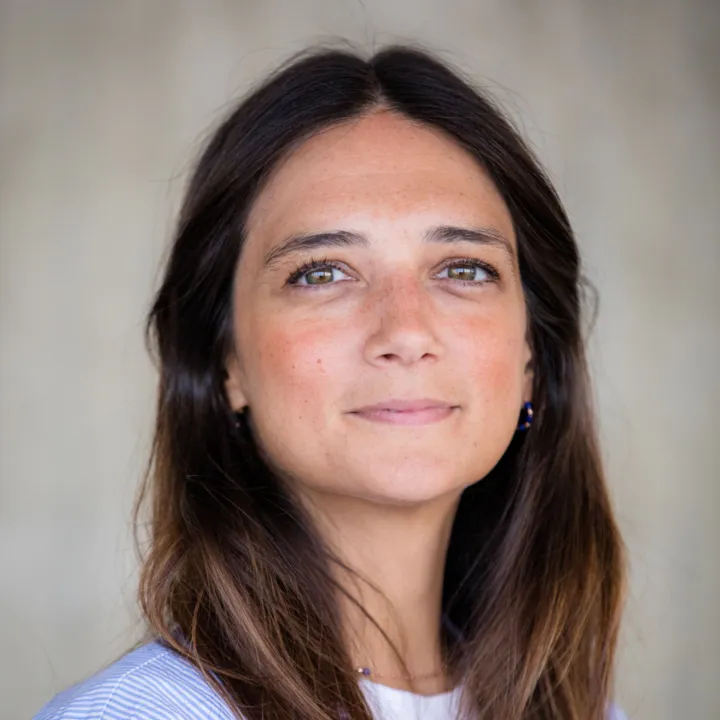
Claudia Cea is an Assistant Professor in the Department of Electrical & Computer Engineering at Yale University's School of Engineering and Applied Science. Her research focuses on developing soft, multifunctional bioelectronic devices designed to interface with the nervous system for long-term neural interrogation and modulation. She leads The Cea Group, which integrates principles from bioelectronics, materials science, and neuroscience to engineer conformable, high-resolution neural interfaces. Ph.D., Columbia University M.Sc., San Diego State University B.Sc., University of Pisa Her research interests lie at the intersection of bioelectronics , neural engineering , and soft materials design , with a focus on creating minimally invasive tools for understanding brain–body communication. By combining electrical, optical, and chemical modalities, her lab develops technologies capable of both recording and modulating neural activity in central and peripheral circuits. These innovations aim to uncover fundamental neural mechanisms and translate them into therapies for neurological, psychiatric, and systemic disorders. The recent publications demonstrate a strong trajectory in implantable bioelectronics , particularly in organic electrochemical transistors , ionic communication systems , and multimodal neural interfaces . Her work consistently appears in top-tier journals such as Nature Materials , Science Advances , and PNAS , reflecting significant impact in neuroengineering and bioelectronic medicine. The research emphasizes device autonomy, biocompatibility, and real-time neural signal processing. Her scientific achievements have been recognized with prestigious honors: MIT Technology Review 35 Innovators under 35 SEAS Ph.D. Research Symposium Winner, Columbia University CSNE Hackathon Winner, University of Washington Shiley Scholarship in Bioengineering Claudia Cea has secured competitive funding and recognition that support her lab’s innovative work. While specific grant details are not listed, awards such as the Shiley Scholarship and hackathon wins indicate strong support from institutions like the Center for Sensorimotor Neural Engineering (CSNE). Her role as principal investigator of The Cea Group suggests active mentorship of graduate students and postdoctoral researchers in interdisciplinary research. The lab fosters collaboration across engineering, neuroscience, and clinical domains to accelerate translation. The Cea Group is dedicated to advancing soft, multifunctional electronics for biomedical applications. The team focuses on designing conformable, implantable devices that seamlessly integrate with biological tissues. Their work spans materials synthesis, device fabrication, in vivo testing, and clinical translation, aiming to bridge gaps between engineering innovation and medical need. The lab environment promotes creativity, rigor, and translational thinking in next-generation neural technologies.
Prof. Dr. Rezan Demir-Cakan is a leading academic in Chemical Engineering at Gebze Technical University’s Faculty of Engineering, with a focus on rechargeable battery technologies and electrochemical systems. Holding a PhD (2006-2009) from the Max Planck Institute and postdoctoral experience at CNRS (2009-2012), she bridges fundamental research with industrial applications through projects like Türkiye-France bilateral collaborations and TÜBİTAK grants. Her work spans Li-S, Na-ion, and aqueous electrolyte batteries, emphasizing scalable solutions and sustainable materials. Education: PhD: Max Planck Institute Colloids and Interfaces (2006-2009) MSc: Yildiz Technical University (2002-2005) BSc: Yildiz Technical University (1997-2002) Research Interests: Her group investigates advanced electrode materials, hydrothermal carbonization for battery components, and aqueous electrolyte systems. Specialized areas include polysulfide/polysulfate cathodes, inverse vulcanization polymer synthesis, and sustainable carbon precursor utilization from agricultural waste. Projects often address capacity fading mechanisms and industrial-scale battery design. Recent Publications: Her 15 most recent articles (2019-2020) focus on sodium-ion anodes, Li-S interlayer engineering, and aqueous electrolyte stability. Keywords span Energy Storage, Electrochemistry, and Polymer Chemistry, with subfields like Tin Sulfide Synthesis, Polysulfide Management, and Biomass-Derived Electrodes. Scientific Contributions: ODTU Research Incentive Award (2019) TÜBİTAK METATEG Advisory Board (2018-2019) Sorbonne University Invited Professor (2019) TUBA-GEBIP Distinguished Scientist (2018) Horizon 2020 Evaluator (2014-present) Advising & Projects: She has mentored 10+ PhD and Master’s students in sodium/Li-S battery research and led or advised 12+ grants including TÜBİTAK 1001 projects and France-Turkey bilateral collaborations. Her lab integrates materials synthesis, electrochemical testing, and industrial scalability analysis.
Prof. Dr. Ali Coruh is a distinguished faculty member at Sakarya University 's Faculty of Science, Department of Physics , where he has served as Head of the General Physics Department since 2022. With a career spanning over three decades, his expertise lies in Condensed Matter Physics , Nanotechnology , and Materials Science , focusing on perovskite oxides , adsorbent materials , and supercapacitor applications . PhD in Physics, Middle East Technical University (2003) MSc in Physics, Sakarya University (1996) BSc in Physics, Karadeniz Technical University (1989) His research interests include computational modeling of molecular structures, environmental pollutant removal using nanomaterials, and electrochemical properties of advanced materials. Recent studies focus on pharmaceutical pollutant recovery via organoclay composites, Pd-doped perovskites for biosensing, and perovskite oxides for energy storage. His work bridges theoretical and experimental approaches in solid-state physics and environmental remediation . The article trends show consistent contributions to Journal of the Taiwan Institute of Chemical Engineers , Chemical Engineering Journal , and Journal of Energy Storage , with a focus on adsorption mechanisms , electrocatalysis , and nanocomposite synthesis . Collaborations span international institutions, including studies on supercapacitor electrode materials and microwave absorbing textiles . As an academic leader, he has supervised 14 doctoral and master's theses , including works on molecular dynamics , perovskite oxides , and nanoparticle-based sensors . He has also served on editorial boards for journals like Materials Chemistry and Physics (2010-2013) and contributed to TUBITAK Olympiad training .
Rupert Wimmer is a Professor at the Institute of Wood Technology and Renewable Resources of the University of Natural Resources and Life Sciences, Vienna. He serves as an Editorial Board Member for journals like Frontiers in Chemistry and Wood and Fiber Science , and has been a Review Editor for ISRN Forestry (2009–2018). His work bridges wood science , renewable materials , and dendrochronology , with a focus on 3D-printed bio-composites , triboelectric wood processing , and climate reconstruction . His research spans Biocomposites: Innovations in lignin-based materials , wood-plastic composites , and fully recyclable wall systems . Wood Technology: Studies on surface activation , mechanical properties , and dust reduction during machining. Dendrochronology: Climate history analysis via tree rings and wood chemistry . The most recent articles explore circular economy in construction, electrostatic wood treatment , and drought proxies , reflecting his interdisciplinary approach. Awards include Rudolf Sallinger S&B Innovation Award nominations (2018, 2019) German Study Prize for Wood Materials Research (2010) Fellow of the International Academy of Wood Science (2005) He has supervised over 74 theses, including Roman Myna (2025) on innovative dust reduction and Raphaela Hellmayr (2024) on wood-based circular bioeconomy . Grants from EU , FFG , and Fonds zur Förderung der wissenschaftlichen Forschung fund his work. Collaborations span institutions in Australia, Germany, and the Czech Republic.
Dr. Spencer Jeffs is an Associate Professor in Aerospace Engineering at Swansea University's School of Aerospace, Civil, Electrical and Mechanical Engineering. Based in the Institute of Structural Materials, his research focuses on advanced high-temperature materials including ceramic matrix composites (CMCs), titanium alloys, and nickel superalloys, with applications in gas turbines and nuclear reactors. He is a Chartered Engineer (CEng) and Fellow of the Higher Education Academy (FHEA), teaching across foundation, aerospace, mechanical, and materials engineering modules. Current roles: Admissions Tutor (2017-present), Honorary Editor for the Engineering Integrity Society (2020-present) Research aligns with SDGs 7 (Affordable Clean Energy) and 9 (Industry Innovation) His work employs experimental and computational techniques like mechanical testing, electron microscopy, and X-ray CT, often in collaboration with industrial partners. Recent publications emphasize small punch testing for additive manufacturing, process optimization, and structural integrity of advanced materials. Supervision includes PhD projects on CMCs, corrosion-fatigue interactions, and hybrid composite driveshafts.
Aumber Abbas is a researcher at Newcastle University specializing in advanced materials for sustainable energy and environmental applications. His work spans nanotechnology, catalysis, and biomass conversion, with significant contributions to carbon-based nanomaterials and electrochemical systems development. His research focuses on synthesizing graphene quantum dots from biomass waste for environmental sensing and remediation applications, developing catalytic processes for CO 2 utilization and cyclic carbonate production, and engineering electrochemical systems including vanadium redox flow batteries. Recent work emphasizes waste-derived functional materials for optical security, anti-counterfeiting, and wastewater treatment through nanoporous catalyst design and plasma-based tar removal technologies. Analysis of recent publications (2024-2025) reveals a dominant trend in sustainable nanomaterial engineering, particularly biomass-waste-derived carbon structures with tailored optical and catalytic properties. His work integrates experimental validation with simulation approaches to address energy storage, environmental remediation, and security applications, demonstrating strong interdisciplinary collaboration within Newcastle's engineering research community.
Birgit Öhlinger is a Research Associate and Co-Excavation Director of the Monte Iato Project at the Leopold Franzens University of Innsbruck . Her work focuses on the archaeology of the ancient Mediterranean, particularly social transformation processes in cultural contact zones and identity formation through material culture, with a regional emphasis on Sicily. Education: Doctoral studies in Classical and Provincial Roman Archaeology (2010–2014), University of Innsbruck Master’s in Ancient History and Classical Studies (2005–2009), University of Innsbruck Master’s in Classical and Provincial Roman Archaeology (2002–2008), University of Innsbruck Research Interests: Öhlinger specializes in the archaeology of cultural contact zones, ritual and religious practices, and ceramic studies in the Archaic Mediterranean. Her methodological expertise includes digital excavation documentation, experimental archaeology, and material culture analysis, particularly focusing on Monte Iato in Western Sicily. Recent Publications: Her work examines technological choices in local ceramic production, neutron activation analysis applications in Mediterranean archaeology, and ritual consumption practices. She has contributed to debates on cultural hybridity, social identity, and the role of sanctuaries in elite formation. Awards: Anniversary Prize of Böhlau Verlag Vienna (2015) Prize of the Principality of Liechtenstein (2015) Merit Scholarship (2003–2007), University of Innsbruck Doctoral Scholarship (2013–2014), University of Innsbruck Professional Activities: Öhlinger leads projects like "Monte Iato Pots - Experimental Study on Organic Residue Analysis" and "Crime Scene Monte Iato around 500 BC: Microbiological Forensics" . She organizes international conferences and contributes to public outreach through media appearances and exhibitions.
Timo Laaksonen is a Professor of Pharmaceutical Nanotechnology at the Faculty of Pharmacy, University of Helsinki , Finland. His research spans biomaterials, photo-activated systems, and controlled drug release mechanisms, with a focus on nanocellulose applications and photon upconversion technologies. Doctor of Science (Technology), Helsinki University of Technology (2007) Master of Science (Technology), Helsinki University of Technology (2002) Docent, University of Helsinki (2010) Research interests include: Utilizing nanofibrillar cellulose for sustained drug delivery Developing light-responsive hydrogels via triplet energy transfer Advancing photon upconversion for low-power drug release Modeling drug release kinetics from nanomaterials His recent publications highlight trends in DNA origami nanocarriers , liposomal photorelease , and 3D-printable hydrogels , blending nanophotonics and biomaterials engineering . Awards include the Young Researcher's Award 2012 and Gust. Komppa Prize 2008 for his doctoral thesis. He supervises doctoral research and leads projects like Bioblocks (Foundation for Pharmaceutical Sciences) and TARDIS (Academy of Finland).
Jenn-Ming Yang is a Distinguished Professor in the Department of Materials Science and Engineering at the University of California, Los Angeles (UCLA), holding the Collins Aerospace Term Chair for Excellence. His work focuses on advanced composite materials for aerospace and transportation applications, with significant contributions to high-temperature material systems. Professor Yang's research centers on fundamental problems in processing, microstructure development, and mechanical behavior of high-temperature composites. His investigations target critical applications in aerospace structural systems and ground transportation, with emphasis on material durability, failure mechanisms, and performance under extreme conditions. This work bridges materials science, mechanical engineering, and aerospace engineering through experimental and analytical approaches. His recent publications (2007-2008) reveal a concentrated focus on composite material systems, including titanium-based laminates, carbon nanotube reinforcements, ultra-incompressible transition metal diborides, and ceramic composites. Key research themes involve mechanical property characterization, failure analysis, and microstructure-property relationships, with direct applications to aircraft structures, propulsion systems, and energy storage technologies. Professor Yang's scientific achievements have been recognized through numerous prestigious awards: Scholars Award from National Engineering Research Center for Composite Manufacturing Science & Engineering (1987) Faculty Career Development Award (1989) Presidential Young Investigator Award from the National Science Foundation (1990-1995) Alcoa Foundation Award (1992) Ford Foundation Award (1993) Best Paper Award from the Japan Society of Mechanical Engineers (2007) His research program addresses critical challenges in advanced material systems for next-generation aerospace and transportation applications, with ongoing investigations into novel composite architectures and high-temperature material solutions.
Odile Merdrignac-Conanec is an Associate Professor in the Department of Chemistry at University of Rennes 1's Faculty of Science, affiliated with the Institut des Sciences Chimiques de Rennes (UMR 6226 CNRS). Her career spans over three decades at the university, progressing from Assistant Professor (1991-2000) to current Associate Professor status with qualification for university professorship (CNU 31-33). PhD in Chemistry, University of Rennes 1 (1989) Accreditation to Supervise Research (HDR), Chemistry; Chemical Physics, University of Rennes 1 (2000) Post-Doctoral Fellow, Harwell Lab, AEA Technology (UK) (1990-1991) Her research focuses on advanced materials synthesis and characterization, specializing in ceramics engineering for optical, sensing, and biomedical applications. Key areas include infrared-transparent ceramics (ZnS, La 2 O 2 S), gas sensors using semiconductor oxides, photocatalytic (oxy)nitrides, and biomaterials like bioactive glasses. Her work integrates soft chemistry methods with advanced sintering techniques (HP, HIP, SPS) and in-situ characterization (TPD/MS, DRIFTS). Analysis of her 15 most recent publications reveals strong emphasis on rare-earth doped phosphors for lighting applications, porous biomaterials for tissue engineering, and energy conversion materials including thermoelectrics and CO 2 reduction catalysts. Her optical materials research consistently targets infrared transparency and luminescence efficiency. 2018 Semester for Innovation of Rennes 1 Foundation 2017 Year for business creation of Rennes 1 Foundation 2015 CNRS delegation (50%) 2013 Board Member, French Ceramic Society (GFC) 1990 Chemistry PhD Thesis Prize (Pr P. Gineste Award) She has directed eight PhD theses since 2003 with notable success including the Rennes 1 Foundation Thesis Prize (2017) and French Ceramic Society Thesis Prize (2020). Her research is supported by CNRS collaborations and Rennes 1 Foundation innovation grants. She actively participates in thesis committees at institutions including University of Tübingen, ENSM Saint-Etienne, and IRCER Limoges. Her laboratory work centers on the Institut des Sciences Chimiques de Rennes, utilizing specialized equipment for ceramic synthesis, optical characterization, and biomaterial testing. Current projects include infrared-transparent sulfide ceramics and doped oxysulfides for optical refrigeration.
Andrew Stewart serves as Professor in the Department of Atmospheric and Oceanic Sciences at the University of California, Los Angeles (UCLA), directing the Dynamical Oceanography Group. His research centers on high-latitude ocean circulation physics with specialized focus on Antarctic margin dynamics and climate system interactions. Research interests span dynamical oceanography, Antarctic ice-ocean-atmosphere coupling, and submesoscale processes in polar regions. The group employs advanced simulation methodologies to investigate ocean circulation behavior and its responses to environmental forcing, particularly emphasizing Southern Ocean dynamics and ice sheet interactions. Recent publication trends reveal concentrated investigation into Southern Ocean energy cascades, Antarctic meltwater feedbacks, and global ocean eddy dynamics. Work integrates satellite observations, numerical modeling, and experimental approaches to address climate-relevant oceanographic phenomena. Scientific Awards: No awards documented in provided materials Advising and Grants: Professor Stewart supervises eight graduate researchers including Garrett Finucane, Kaylie Cohanim, and Cheng-Yang (Sunny) Yeh as evidenced by the 2025 group roster. External funding sources remain unspecified in available documentation though research scope implies National Science Foundation and climate-focused grant support. Labs and Teams: The UCLA Dynamical Oceanography Group maintains experimental facilities including rotating tank systems for dynamical studies. Current team composition reflects interdisciplinary collaboration across ocean modeling, satellite data analysis, and polar field research domains.
Dr. Jesse Hodgetts is a Senior Lecturer in Global Indigenous Studies at The Wollotuka Institute, University of Newcastle, specializing in Indigenous Education and Research. A Wangaaypuwan Ngiyampaa and Wiradjuri man from Central and Western NSW, he brings ancestral knowledge and contemporary academic expertise to his work. His research bridges traditional cultural practices with modern educational frameworks, focusing on Indigenous Knowledge Systems, Songlines, Language revitalization, and Kinship. Education: Aboriginal Studies, University of Newcastle Master of Teaching, University of Newcastle PhD: 'Guthi Girrmara (Old Songs Waking Up): Reawakening Archived Wangaaypuwan and Wiradjuri songs to inform our Culture, Language and Identity' Hodgetts' research centers on First Nations Cultural revitalization through Songlines, Language, and Kinship systems. He explores how traditional songs serve as vessels for cultural knowledge, connecting Country, identity, and intergenerational transmission. His work emphasizes decolonizing research methodologies and centering Indigenous voices in academic discourse. As both a cultural practitioner and academic, he develops frameworks for Indigenous-led song documentation and language revitalization that respect cultural protocols while adapting to contemporary contexts. His scholarly output reveals a consistent focus on Indigenous musicology, language documentation, and cultural revitalization. The publications demonstrate methodological innovation in representing Indigenous knowledge systems through culturally appropriate frameworks rather than Western academic conventions. A recurring theme is the development of Mayi (Aboriginal) terminology for discussing songs within their cultural context, challenging Western musicological approaches. His work bridges archival research with community-based application, particularly in language reclamation efforts. Scientific Awards: 3rd Place 3MT Competition, University of Newcastle (2021) Musicology Society Indigenous Postgraduate Prize, Musicology Australia (2019) Hodgetts actively supervises five PhD candidates and has completed one supervision, focusing on topics including Aboriginal music in digital platforms, language revitalization, land management, and cultural education. His teaching portfolio includes courses such as 'Aboriginal Ways of Knowing, Being and Doing' and 'Aboriginal Cultural Immersion,' which emphasize experiential learning through storytelling, art, weaving, dance, and language. As a trained secondary teacher with experience in Aboriginal communities and juvenile justice settings, he brings practical educational insights to his academic work. His creative practice as a singer of traditional Ngiyampaa and Wiradjuri songs informs his scholarly approach, creating a unique integration of cultural practice and academic research.
Filippo Ubertini is Professor of Civil and Environmental Engineering at the University of Perugia, Italy, where he coordinates the International Doctoral Programme in Civil & Environmental Engineering and represents the University inside the FABRE national bridge-research consortium. He leads the Structural Health Monitoring Laboratory ( SHM-Lab ) and is the primary contact for assignments linked to smart-infrastructure research. Education: While explicit degrees are not listed in the supplied text, his role as programme coordinator and full professor implies completion of a PhD and habilitation in Civil Engineering. Research focus: Ubertini’s work sits at the intersection of smart materials and data-driven infrastructure management . He develops self-sensing cementitious composites doped with carbon micro-fibers or graphene nano-platelets that can measure strain, cracking and moisture in real time, turning whole bridges and buildings into distributed sensors. Complementary research threads include low-cost acquisition electronics, UAV & InSAR remote sensing, Bayesian & adversarial machine-learning algorithms for damage detection, digital twins and life-cycle cost analysis of bridge networks. Publication trends (2024-2025): Roughly 30 peer-reviewed items per year concentrate on (i) AI-enhanced operational modal analysis and transfer-learning damage classification across bridge populations, (ii) experimental characterisation of 3D-printed and cast self-sensing concrete, (iii) full-scale validation on curved box-girder, masonry and railway bridges, and (iv) integration of satellite radar data with numerical collapse simulations to predict residual service life of landslide-affected viaducts. Scientific awards & recognition: No specific prizes or fellowships are mentioned in the provided text. Doctoral supervision & grants: The text does not enumerate individual students or funded projects; however, his coordination of an international PhD programme and numerous experimental campaigns imply sizeable supervisory and funding responsibilities. Laboratory & team: Ubertini heads the SHM-Lab at UniPg, maintaining facilities for material mixing, 3D concrete printing, electrical impedance tomography, UAV photogrammetry, and large-scale structural testing, while collaborating with the European FABRE consortium and multiple EU projects.
Heather Liddell is an Assistant Professor at Purdue University with joint appointments in Mechanical Engineering and Environmental & Ecological Engineering. She leads the Liddell Research Group, focusing on sustainable manufacturing, environmental life cycle assessment, and mechanics of multilayered systems. Her work bridges engineering and policy, addressing industrial decarbonization and sustainable supply chains. She holds a PhD in Materials Science from the University of Rochester, postdoctoral training at the U.S. Naval Research Laboratory, and prior DOE contract experience. Education: PhD (2013, Materials Science, University of Rochester), MS (2010, Mechanical Engineering, University of Rochester), BS (2008, Mechanical Engineering, University of Rochester). Research Interests : Industrial decarbonization strategies and circular economy frameworks Fracture mechanics in multilayer systems (e.g., coatings, composites) Environmental LCA of emerging technologies Lightweighting strategies for transportation sectors Awards include the 2024 EnergyTech Prize, ASEE Postdoctoral Fellowship (2017), and multiple Above and Beyond Awards. Her group includes 9 researchers studying topics like EEIO modeling, adhesion in lithium-ion batteries, and dairy forage drying LCA. Lab activities emphasize interdisciplinary collaboration, with projects funded by DOE and industry partnerships. Recent work addresses carbon performance reporting in Industry 4.0 and rebound effects in decarbonization initiatives.