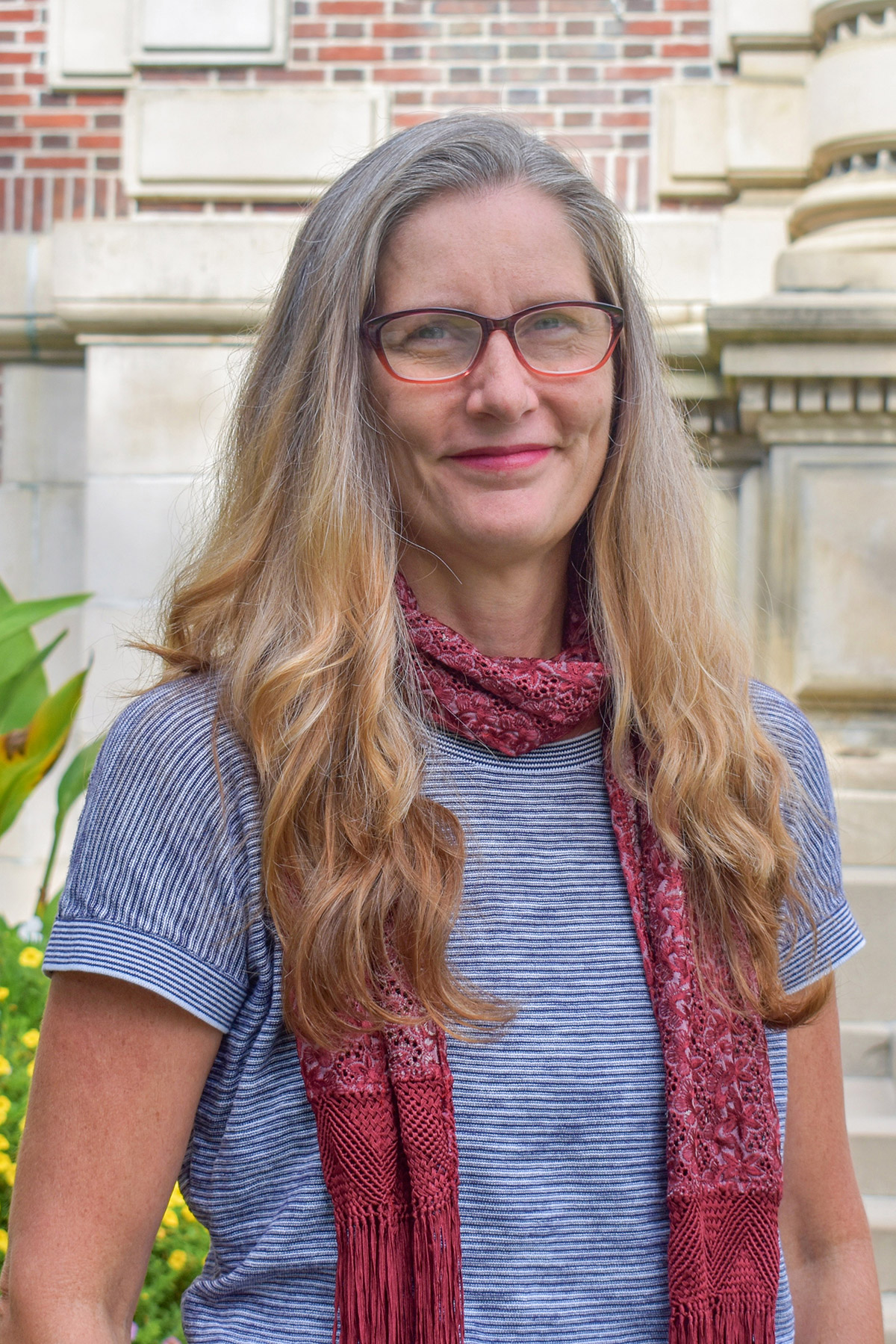
Natalie Priebe Frank is a Professor of Mathematics and Statistics at Vassar College. She has been affiliated with the university since 2000 and specializes in hierarchical tiling systems, quasicrystals, and dynamical systems. Her work bridges mathematical theory with applications in materials science and art. Education: BS from Tulane University of Louisiana; PhD from the University of North Carolina at Chapel Hill. Research interests include the study of aperiodic tilings, their spectral properties, and connections to quasicrystal structures. She explores how tiling patterns model natural phenomena and has contributed to breakthroughs like the discovery of the aperiodic monotile. Her recent work discusses the implications of hierarchical tilings in understanding non-repetitive patterns and their diffraction properties. Notably, she co-authored the 2023 discovery of the 'einstein' tile, an aperiodic monotile, and has published extensively on substitution tiling dynamics and fractal geometry. Publications span foundational texts like The Tiling Book and peer-reviewed articles on spectral theory and geometric patterns. She actively engages in science communication, featured in Quanta Magazine for her insights on aperiodic tilings' real-world relevance.
J. Ian Munro is a University Professor and Canada Research Chair in Algorithm Design at the Cheriton School of Computer Science, University of Waterloo. He has been a faculty member at Waterloo since completing his PhD at the University of Toronto in 1971 and was appointed University Professor in 2006, one of the highest honors the university bestows on its faculty. Dr. Munro's research focuses on the design, analysis, and implementation of efficient algorithms and data structures, with particular emphasis on space-efficient solutions. His work spans several key areas including succinct data structures, tree algorithms, text search methods, priority queues, and memory management for data structures. His research has had significant impact on how we understand the theoretical limits of data representation while maintaining efficient query performance. The trajectory of his recent publications (2020-2024) reveals a continued focus on pushing the boundaries of space efficiency in data structures, particularly for graphs and trees. His work increasingly addresses dynamic scenarios where data structures must be updated efficiently while maintaining query performance. The research shows strong connections between information theory, combinatorics, and practical algorithm design, with applications spanning database systems, computational geometry, and text processing. Fellow of the Association for Computing Machinery (FACM) Elected Fellow of the Royal Society of Canada (FRSC) in 2003 Canada Research Chair in Algorithm Design Dr. Munro has supervised over 24 PhD students throughout his career and has been actively involved in teaching advanced courses on data structures and algorithms. His research has been consistently funded through competitive grants, including his Canada Research Chair position. He maintains active collaborations with researchers worldwide, as evidenced by his extensive co-authorship network across numerous publications. As a member of both the Algorithms and Complexity Group and the Data Systems Group at Waterloo, Dr. Munro contributes to interdisciplinary research that bridges theoretical computer science with practical systems challenges. His work continues to influence both theoretical understanding and practical implementations of efficient data management solutions.
Lev Reyzin is a Professor of Mathematics, Statistics, and Computer Science at the University of Illinois Chicago (UIC) and Director of the IDEAL Institute. He specializes in the theory of machine learning, data science, and artificial intelligence, with affiliations to theoretical computer science and mathematical foundations. Prior roles include a Simons Postdoctoral Fellowship at Georgia Tech and an NSF Computing Innovation Fellowship at Yahoo! Research. He earned his Ph.D. from Yale University (NSF doctoral fellowship) and a bachelor’s degree from Princeton University. Research interests focus on algorithmic learning theory, computational complexity, and applications of machine learning to real-world problems. Notable work includes contributions to statistical learning algorithms, adversarial bandits, and graph theory. His research has been funded by NSF grants (e.g., ECCS-2217023, CCF-2307106), DOD programs, and others since 2015. He has received awards at leading conferences (ICML, COLT, AISTATS). Reyzin holds editorial roles, including Editor-in-Chief of Mathematics of Data, Learning, and Intelligence and Chair positions in major conferences like FOCS 2024 and ALT 2017. His leadership in academic organizations highlights his influence in shaping theoretical computer science and machine learning research.
Eva Miranda Galceran is a Full Professor at the Facultat de Matemàtiques i Estadística (FME) of the Universitat Politècnica de Catalunya (UPC) , where she leads the GEOMVAP research group and directs the Laboratory of Geometry and Dynamical Systems . She holds affiliations as a Chercheur Affilié at the Observatoire de Paris , an ICMAT Honorary Vinculado , and a member of the BGSMath network. Research: Her work bridges Symplectic and Poisson Geometry with Hamiltonian Dynamics , Fluid Dynamics , and Computer Science . Key themes include geometric quantization , integrable systems , singular manifolds , and universality in Euler flows , including the construction of Turing complete fluid systems . She has advanced the singular Weinstein conjecture and explored b-symplectic and E-symplectic manifolds with applications to celestial mechanics. Awards: ICREA Academia Prizes (2016, 2021) François Deruyts Prize 2022 Friedrich Wilhelm Bessel-Forschungspreis 2022 Gauss Professor 2025 Advising: She mentors 2 Ph.D. students ( Pablo Nicolás , Søren Dyhr ) and has supervised 9 Ph.D. graduates, including Anastasia Matveeva (2022, InPHINIT La Caixa), Joaquim Brugués (2024, FI-AGAUR), and Mir Garcia (2024). Her team spans Mathematical Physics , Geometric Quantization , and Computational Complexity . Grants: Principal Investigator for projects AQUACELL (AEI-DFG, €350,000), INTERGAP (PID2023-146936NB-I00, €293,750), COMPLEXFLUIDS (BBVA, €150,000), and the ICREA Academia 2021 (€120,000). She co-leads the Maria de Maeztu CEX2020-001084-M program (€2M) at the Centre de Recerca Matemàtica (CRM) .
Jordi Guàrdia Rúbies is a Professor in the Department of Mathematics at the Universitat Politècnica de Catalunya (UPC), affiliated with the Faculty of Mathematics and Statistics (FME). He is a member of the UPC's STNB research group (Seminari de Teoria de Nombres de Barcelona), specializing in Number Theory and Algebraic Geometry. His work bridges theoretical research with educational innovation, particularly in Open Educational Resources (OER) for STEM fields. Affiliations: UPC, STNB Group, FME. Research Interests: Computational Algebra, Valuation Theory, Modular Forms, Mathematics Education. Recent research focuses on OER development, with contributions to collaborative platforms like Gate2Math. He has published extensively in journals like Journal of Algebra and Foundations of Computational Mathematics , addressing topics such as polynomial factorization over Henselian fields and valuation theory applications. Key awards include the Distinció Vicens Vives and UPC Quality Teaching Prize. He leads projects on OER quality assessment and has collaborated on EU-funded initiatives like the Erasmus+ Gate2Math program. His teaching contributions include innovative projects like Aprenentatge de l’Estadística basat en casos pràctics transversals , emphasizing practical case studies in statistics education.
Joseph D Rabinoff is an Associate Professor of Mathematics at Duke University's Trinity College of Arts & Sciences. His research focuses on non-Archimedean analytic geometry, tropical geometry, and their applications to algebraic and arithmetic geometry. He holds a Ph.D. in Mathematics from Stanford University (2009). Key research areas include non-Archimedean theta functions, Diophantine geometry, and the interplay between tropical and algebraic structures. He has led NSF-funded projects on non-Archimedean analytic geometry and number theory. His work bridges abstract algebraic geometry with computational and combinatorial methods. Rabinoff has presented at international conferences, including the Regensburg Days on non-Archimedean geometry and the Oberwolfach Tropical Geometry workshop. He serves as a referee for major journals such as the Journal of Algebra and Comptes Rendues Mathematiques.
Professor Daniel Singleton is a distinguished academic in the Department of Chemistry at Texas A&M University, holding the Davidson Chair in Science. He specializes in reaction mechanisms, kinetic isotope effects, and dynamic effects in organic and organometallic chemistry. His research employs NMR-based methodologies to study reaction pathways and combines experimental and computational approaches. Singleton has contributed significantly to understanding reaction dynamics, including hydroboration selectivity, cycloadditions, and transition-state geometry measurements. Education: B.S. in Chemistry (Case Western Reserve University, 1980); Ph.D. in Chemistry (University of Minnesota, 1986). Postdoctoral training at the University of Wisconsin-Madison and General Electric. Research Interests: Focuses on reaction mechanisms, kinetic isotope effects, and dynamic effects. Key areas include the study of organic reaction dynamics using NMR, computational predictions of isotope effects, and resolving mechanistic controversies. His lab investigates energy redistribution in reactions and the role of transition-state geometry in selectivity. Awards: Arthur C. Cope Scholar Award (2008), Davidson Professor of Science (2005), and multiple teaching awards from Texas A&M. Recognized for contributions to organic chemistry and education. Grants & Advising: Advises graduate students like Jonathan Bailey and Andrew Jeffreys. Active in mentoring, including the Wells Fargo Faculty Mentor Award (2017). Research supported by grants from NIH, NSF, and industry collaborations (e.g., Process Origins Company). Labs & Teams: Singleton Research Group, focused on mechanistic organic chemistry. Collaborations with experts like Prof. K.N. Houk (UCLA) and Dr. Jack Waas. Active in journal editorial roles, including The Journal of Organic Chemistry (2005–2011).
Professor Craig Wheeler is a distinguished academic in the School of Engineering at the University of Newcastle, specializing in Mechanical Engineering with a focus on bulk solids handling and belt conveyor technology. As Associate Director of the Centre for Bulk Solids and Particulate Technologies and Deputy Chairman for the Australian Society for Bulk Solid Handling, he has established the university as a global leader in fundamental and applied research within this field. Wheeler's research interests primarily center on reducing the energy intensity and environmental impact of ore and mineral transportation globally. His work develops novel theoretical approaches to model and optimize belt conveyor and bulk handling systems, with significant contributions in energy-efficient transportation, dust emission control, and innovative conveying technologies like the Rail Conveyor system. His research bridges fundamental computational techniques with practical industrial applications, addressing real-world challenges in bulk material handling. His extensive publication record demonstrates trends toward increasingly sophisticated modeling techniques, combining continuum mechanics, discrete element methods, and computational fluid dynamics to solve complex problems in bulk material flow and energy consumption. Recent work shows particular emphasis on large-diameter idler rollers for energy savings, rail-running conveyor systems, and advanced dust control methodologies. 2023 Engineers Australia - Australian Society for Bulk Solids Handling 2017 Significant Contributions to Engineers Australia's Warman Design and Build Competition (Weir Minerals) 2017 Australian Council of Engineering Deans National Award for Engineering Education Excellence 2016 Innovative Technology Award (Australian Bulk Handling) 2010 Rising Star Award (Newcastle Innovation, The University of Newcastle) 2009 Pro-Vice Chancellor's Award for Research Excellence 2006 Best Research and Development Project (Australian Bulk Handling Review) 2000 A.W. Roberts Award (Australian Society for Bulk Solids Handling) Professor Wheeler has successfully led numerous Linkage Projects with major companies including Rio Tinto, Veyance Technologies, and Laing O'Rourke, securing significant cash and in-kind contributions for research projects. His industrial consulting experience, built on a 10-year engineering career with BHP, provides valuable insights that bridge fundamental research with practical applications. He actively supervises research students and contributes to professional development courses both within Australia and internationally. As a key member of the Centre for Bulk Solids and Particulate Technologies in association with TUNRA Bulk Solids, Wheeler leads research teams focused on developing eco-friendly conveying solutions. His work has resulted in new licensed technologies, internationally recognized testing methods, design guidelines, and Australian Standards that have transformed industry practices worldwide.
Xiaoqiang Wang is a Professor in the Department of Scientific Computing at Florida State University (FSU). His research focuses on numerical analysis, applied partial differential equations, mathematical biology, image processing, and scientific computing. He holds a Ph.D. from Pennsylvania State University (2005). His work emphasizes phase-field modeling for elastic bending energy, biological microstructures, and computational methods for complex systems. Notable contributions include advancements in centroidal Voronoi tessellation algorithms for image segmentation and high-performance computing techniques for scientific visualization. Recent publications highlight innovations in topology-preserving phase-field models, neural network-based energy minimization, and stochastic resource competition models. His research bridges theoretical mathematics with practical applications in biophysics, materials science, and biomedical engineering. Wang collaborates actively with interdisciplinary teams, contributing to FSU's computational science initiatives. His lab focuses on developing novel numerical methods and simulations for biological and physical systems, reflecting a commitment to both foundational and applied research.
Mustafa Hajij is an Assistant Professor in the Data Science program at the University of San Francisco. He holds a PhD in Mathematics from Louisiana State University, an MS in Computer Science, and completed postdoctoral training at University of South Florida and Ohio State University. Previously, he served as Assistant Professor at Santa Clara University and as an AI Research Scientist at KLA Corporation. His research develops foundational frameworks for topological deep learning, including cell complex neural networks and geometric learning architectures that operate beyond graph domains. He leads the NSF-funded project 'A Unifying Deep Learning Framework Using Cell Complex Neural Networks' (DMS-2134231, $547,626). Recent publications establish new paradigms for topological representation learning, including combinatorial complexes and simplicial networks, with applications in computational biology, 3D vision, and drug discovery. He organized the ICML Topological Deep Learning Challenges and develops open-source tools like TopoX for topological learning.
Efthymios N. Karatzas serves as an Assistant Professor in the Department of Mathematics at Aristotle University of Thessaloniki, Faculty of Sciences, within the Computer Science and Numerical Analysis Section. He maintains an active research profile in computational mathematics with strong institutional affiliations including collaborations with SISSA mathLab and FORTH Institute of Applied and Computational Mathematics. His academic credentials include: PhD in Mathematics, National Technical University of Athens (2015) Master's in Applied Mathematical Sciences – Computational Mathematics, NTUA (2009) Master's in Applied Mathematics, University of Patras (2001) Bachelor's in Mathematics (Computational Mathematics), University of Patras (1999) Dr. Karatzas' research program centers on advanced numerical techniques for partial differential equations , with pioneering work in reduced order modeling , embedded boundary methods , and optimal control systems . His expertise spans computational fluid dynamics, uncertainty quantification, and biomechanical applications, characterized by methodological innovation in handling geometrically complex domains through cut finite element approaches and shifted boundary formulations. Analysis of his 15 most recent publications reveals a cohesive research trajectory focused on developing efficient numerical frameworks for parametrized PDE systems. His work consistently bridges theoretical rigor with practical implementation, particularly in advancing reduced basis methods for fluid-structure interaction and biological modeling, demonstrating significant contributions to computational mathematics through high-impact journal publications. No major scientific awards are documented in the available sources. Dr. Karatzas demonstrates research leadership through project management roles including Scientific Manager for the ELIDEK project at NTUA (2019-2021) and Project Manager for the European Social Fund HEaD initiative at SISSA (2017-2019). His grant administration experience encompasses coordinating interdisciplinary teams and securing external funding for computational mathematics research. He maintains active collaborations with the SISSA mathLab in Trieste (particularly with Prof. Gianluigi Rozza's group) and the FORTH Institute in Crete, participating in international workshops including the Reduced Order Methods in CFD Summer School (2019) and SIAM UQ conferences. His research network spans computational mathematics groups across Europe with emphasis on advancing numerical methodologies for real-world engineering and biological applications.
Prof. Sebastian Hensel is a Professor of Pure Mathematics at Ludwig Maximilian University of Munich (LMU), serving as Dean of Studies at the Mathematical Institute. His research focuses on low-dimensional topology, geometric group theory, and their interplay with mapping class groups, handlebody groups, and diffeomorphism groups of surfaces. He holds a PhD from the University of Bonn (2011) and has held positions at the University of Chicago as a Dickson Instructor and in Bonn before joining LMU. Research interests include algebraic and geometric properties of mapping class groups, handlebody groups, and their actions on geometric spaces. Recent work explores applications of geometric group theory to surface diffeomorphism groups. Preprints and publications span topics like thick laminations, curve graphs, and handlebody group rigidity. Teaching responsibilities include courses on geometric group theory, Riemannian geometry, and topology. He co-organizes advanced seminars such as the Geometry and Dynamics of Homeomorphisms and Representation Theory block seminars. His work also extends to pedagogical projects, including a textbook on representation theory for students and translations of foundational papers like Hilbert's ninth-degree equation. Current sabbatical (Winter 2024/25) involves collaboration on seminars while maintaining research output. The Geometry and Topology Working Group at LMU is central to his academic activities.
Suresh Venkatasubramanian is a Professor at Brown University, previously at the University of Utah's School of Computing. His research focuses on algorithmic fairness, automated decision systems, computational geometry, and the societal impacts of AI. He co-founded the FAT* conference and sits on the ACLU of Utah board. He holds a B.Tech from IIT Kanpur and a Ph.D. from Stanford University. Education : B.Tech (Computer Science, IIT Kanpur), Ph.D. (Stanford University). Key Roles : Member of Computing Community Consortium Council, Research Advisory Council for NYC's FTA Tool, and First Judicial District of Pennsylvania. Research interests emphasize fairness, accountability, and transparency in algorithms. Notable contributions include work on predictive policing biases, Shapley-value critiques, and information access gaps. Awards include an NSF CAREER Award and an ICDE Test-of-Time Award. Grants : Mozilla Foundation, NSF BIGDATA, DARPA A4V. Teaching : Advanced Algorithms, Ethics of Data Science, and courses on algorithmic fairness. Service roles include organizing conferences like FAT* and ALENEX, and advising on algorithmic governance in criminal justice systems.
Federico Ardila-Mantilla is a Professor of Mathematics at San Francisco State University and an Adjunct Professor at Universidad de los Andes, Colombia. His research focuses on combinatorics and its connections to geometry, algebra, and topology, with notable contributions to matroid theory, polytopes, and tropical geometry. He is also deeply involved in promoting equitable and inclusive mathematics education through initiatives like the SFSU-Colombia Combinatorics Initiative . His work bridges pure mathematics and applications, particularly in robotics and discrete geometry. He has held visiting positions including at the Institute for Advanced Study (Princeton, 2024-25). His research spans over 60 publications, emphasizing interdisciplinary approaches to combinatorial problems. Ardila advocates for accessibility in mathematics through axioms such as 'Mathematical potential is equally present in all groups' (cited widely in educational contexts). Key areas of research include algebraic structures on polytopes, Lagrangian geometry of matroids, and geometric enumeration. He collaborates internationally and mentors students across institutions. His outreach efforts aim to make mathematics accessible to underrepresented communities.
Hsiao-Dong Chiang is a Professor in the School of Electrical and Computer Engineering at Cornell University. He holds a Ph.D. in Electrical Engineering from the University of California, Berkeley, and has made significant contributions to nonlinear system theory and power system stability. His research spans theoretical development and practical applications in electric power systems, nonlinear optimization, and machine learning. B.S., Electrical Engineering, National Taiwan University, 1979 M.S., Electrical Engineering, National Taiwan University, 1981 Ph.D., Electrical Engineering, University of California, Berkeley, 1986 Chiang's research interests focus on nonlinear system theory , power system stability and control , nonlinear optimization , and their applications to modern power grids with high penetration of inverter-based resources. He is renowned for developing the BCU method and TRUST-TECH methodology , which have enabled fast direct stability assessment and global optimization in complex systems. His work bridges fundamental theory with industrial deployment through his companies, Bigwood Systems, Inc. and Global Optimal Technology, Inc. His recent publications (2024–2025) reflect a strong trend toward integrating machine learning and deep neural networks with power system analysis , particularly in state estimation, optimal power flow, and voltage control. There is a clear emphasis on handling uncertainty, non-convexity, and multi-scale dynamics in active distribution networks and integrated energy systems . His work increasingly focuses on resilience , real-time control , and user-centered methodologies for modern grid operations. Chiang has received numerous scientific honors, including: IEEE Fellow (1997) United States Presidential Young Investigator Award (1989) Multiple DOE Grid Optimization Challenge Awards (2020–2023) Best Paper Awards from IEEE Transactions and Conferences Outstanding Education Award, Cornell University (1990) He has successfully managed over 100 research projects and holds 28 U.S. and international patents. As the founder of Bigwood Systems, Inc., he has commercialized advanced software for utility companies across the U.S. and Japan. His team has published over 480 refereed papers and received more than 17,500 citations. He advises a large research group and leads innovations in computational methods for energy systems. His lab is actively involved in developing next-generation tools for grid security, optimization, and machine learning integration.